
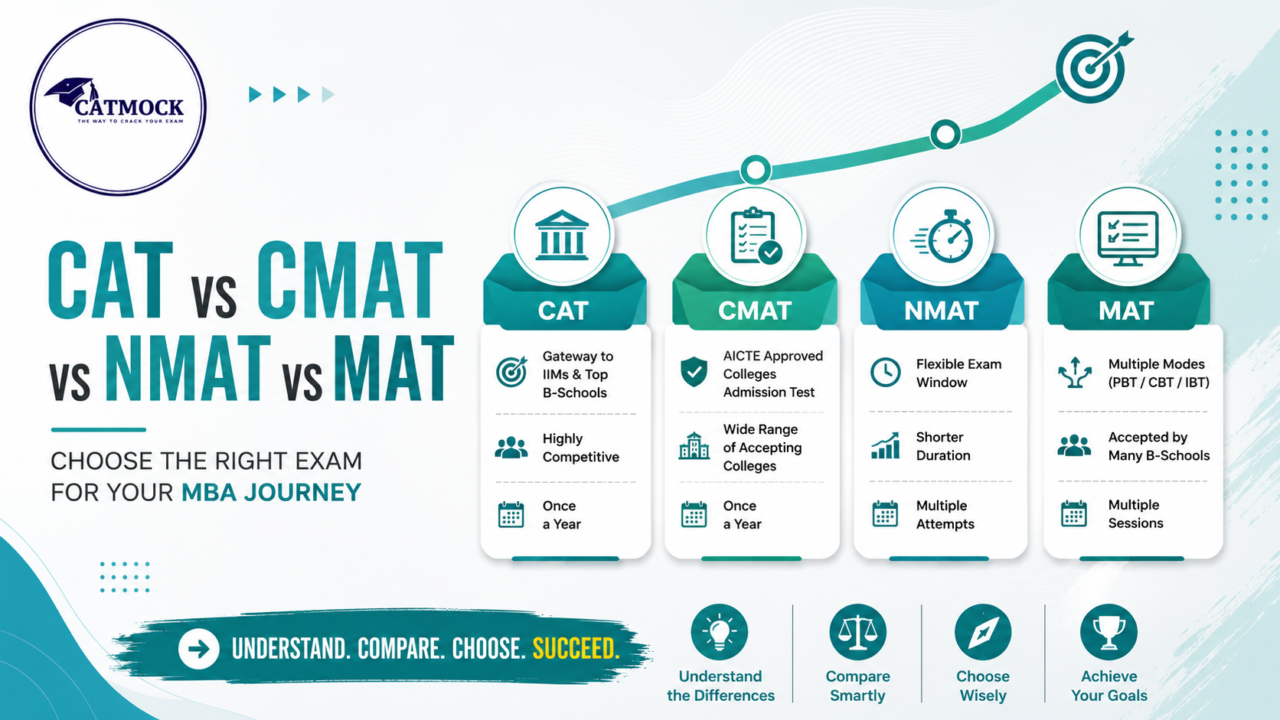
The Complete, Elaborated MBA Entrance Exam Comparison Guide for 2027 Aspirants
Table of Contents
- Introduction
- Understanding MBA Entrance Exams in India
- What is CAT?
- What is CMAT?
- What is NMAT?
- What is MAT?
- CAT vs CMAT vs NMAT vs MAT: Complete Comparison
- Exam Pattern Comparison
- Difficulty Level Analysis
- Colleges Accepting Each Exam
- Which Exam Should You Choose?
- Common Mistakes MBA Aspirants Make
- Summary Table
- FAQs
- Conclusion
Introduction
Choosing the right MBA entrance exam ranks among the first and most important decisions in an MBA aspirant’s journey. This decision shapes not just which exam you study for, but how you allocate your preparation months, which colleges become realistically accessible to you, and ultimately which career doors open after your MBA. Multiple national-level exams exist, so students often find themselves confused between CAT, CMAT, NMAT, and MAT, unsure whether to specialise in one or spread their effort across several.
Each exam serves a different purpose, targets different business schools, and follows a unique pattern and difficulty level. Treating all four as interchangeable, or assuming that strong performance in one automatically guarantees the same in another, ranks among the most common planning mistakes aspirants make.
CAT opens the doors to the prestigious Indian Institutes of Management (IIMs) and top B-schools. Exams like NMAT, CMAT, and MAT, meanwhile, provide access to excellent private universities and management institutes across India — institutions that, for many students, offer just as strong a return on investment given their own career goals, budget, and location preferences.
This guide compares CAT vs CMAT vs NMAT vs MAT in full, helping you decide which exam aligns with your career goals, preparation level, and target colleges. It covers what each exam actually tests, how they differ in pattern and difficulty, which colleges accept each one, and how to build a single preparation strategy that can serve more than one exam at a time.
Understanding MBA Entrance Exams in India
MBA entrance exams in India fall broadly into four categories. Understanding which bucket an exam falls into tells you a great deal about its difficulty, its prestige, and the kind of colleges it typically unlocks, well before you look at its detailed syllabus.
The Four Exam Categories
| Category | Examples |
| Tier-1 National Exams | CAT, XAT |
| Private University Exams | NMAT, SNAP |
| Government Entrance Exams | CMAT |
| Moderate Difficulty Exams | MAT, ATMA |
Tier-1 National Exams such as CAT and XAT stand as the most competitive, feeding directly into the IIMs and other top-ranked institutes. They best suit aspirants willing to commit several months of intensive, application-focused preparation.
Specific university groups, such as NMIMS and Symbiosis, run Private University Exams such as NMAT and SNAP, or commission them on their behalf. These exams tend to reward consistent, speed-oriented practice rather than exceptionally difficult problem-solving.
A central testing authority, the National Testing Agency (NTA), conducts Government Entrance Exams such as CMAT. A very wide network of AICTE-approved institutions accepts these scores, making CMAT a useful safety net alongside a Tier-1 attempt.
Moderate Difficulty Exams such as MAT and ATMA run multiple times a year. Most aspirants view them as the most accessible entry point into an MBA, particularly for students applying to Tier-2 and Tier-3 institutes.
Five Dimensions to Evaluate
Each exam differs in the following ways, so evaluate every exam against all five of these dimensions rather than judging it on reputation alone:
- Difficulty level — how conceptually and psychologically demanding the questions are, which determines how much preparation time you realistically need.
- Competition — how many candidates you compete against for a limited number of seats, which affects how high a percentile you actually need to aim for.
- Number of participating colleges — how wide a net the exam casts, which shapes how many admission options a single good score can realistically open up.
- Exam pattern — the sections tested, question count, and timing structure, which determines what kind of practice, speed-based versus depth-based, will help you most.
- Score acceptance period — how long a valid score remains usable for admissions, which matters if you apply across multiple admission cycles or consider a gap year.
What is CAT?
The Indian Institutes of Management (IIMs) conduct the Common Admission Test (CAT) every year, and it stands as India’s most prestigious MBA entrance examination. Aspirants informally compare most other Indian MBA exams against it, and clearing it at a high percentile remains the single most direct route into the country’s top-ranked business schools.
Key Highlights
| Particulars | Details |
| Conducting Body | IIM |
| Exam Frequency | Once a year |
| Duration | 120 Minutes |
| Mode | Computer-Based Test |
| Difficulty Level | High |
| Accepted By | IIMs and Top B-Schools |
Because CAT takes place only once a year, the stakes rise considerably. Unlike NMAT or MAT, you get no second attempt within the same admission cycle if your performance on test day falls short, which is exactly why a structured, months-long preparation plan matters so much for this particular exam.
Its High difficulty rating reflects not just harder questions but a tighter, more unforgiving time limit relative to the volume and complexity of the questions. This is why CAT preparation places such heavy emphasis on speed and selective question attempts rather than just conceptual knowledge.
Top Colleges Accepting CAT
- IIM Ahmedabad — many rank it as India’s top management institute and among the most selective CAT-accepting programmes in the country.
- IIM Bangalore — built a strong reputation for general management and consulting placements among CAT-based admissions.
- IIM Calcutta — one of the oldest IIMs, carrying a particularly strong reputation in finance-focused MBA placements.
- FMS Delhi — a CAT-accepting institute that offers an unusually strong fee-to-salary ratio given its low tuition costs.
- SPJIMR Mumbai — a top private institute that also accepts CAT scores and draws applicants for its strong industry connect.
- MDI Gurgaon — a well-regarded CAT-accepting institute with strong sales and marketing placement pipelines.
- IIT Delhi DMS — the management programme of IIT Delhi, attracting CAT candidates who want a technology-oriented MBA.
What is CMAT?
The National Testing Agency conducts the Common Management Admission Test (CMAT), a national-level entrance exam for admission into AICTE-approved MBA and PGDM institutions. Because a central government body administers it, a very large number of institutes accept it uniformly, making it one of the most broadly useful single exams an aspirant can take.
Key Highlights
| Particulars | Details |
| Conducting Body | NTA |
| Exam Frequency | Once a year |
| Duration | 180 Minutes |
| Difficulty Level | Moderate |
| Accepted By | 1000+ Institutions |
CMAT’s 180-minute duration runs notably longer than CAT, NMAT, or MAT, so it tests sustained focus and stamina across a longer sitting in addition to raw problem-solving speed. This factor deserves specific practice, rather than an assumption that your CAT pacing habits will transfer directly.
Over 1,000 institutions accept CMAT scores, which makes it one of the highest-reach exams on this list. This reach is precisely why it functions well as a broad safety net alongside a more selective Tier-1 attempt like CAT.
Top Colleges Accepting CMAT
- JBIMS Mumbai — one of the most sought-after CMAT-accepting institutes, carrying a strong Mumbai corporate placement network.
- K J Somaiya Institute — a well-regarded Mumbai-based institute that accepts both CMAT and NMAT scores.
- Great Lakes Chennai — a reputed institute that runs a strong PGPM programme and analytics specialisation.
- BIMTECH — a Noida-based institute with a long-standing reputation in retail and international business.
- Welingkar Mumbai — a well-known institute that offers strong specialisations in marketing and e-business, and accepts CMAT scores.
What is NMAT?
GMAC — the same body behind the GMAT — administers NMAT, a management entrance exam primarily used for admission to NMIMS and several reputed private B-schools. This lineage gives NMAT a globally standardised testing structure and scoring methodology.
NMAT’s biggest advantage lies in the opportunity to take the exam multiple times. This structure removes much of the single-attempt pressure that defines an exam like CAT and lets candidates treat an early attempt as a genuine practice run rather than their only shot.
Key Highlights
| Particulars | Details |
| Conducting Body | GMAC |
| Attempts Allowed | 3 |
| Duration | 120 Minutes |
| Difficulty Level | Moderate |
| Accepted By | 50+ B-Schools |
Three allowed attempts arguably give NMAT its single defining strategic advantage. Candidates can take an early attempt largely as a calibration exercise, then use the score and experience to sharpen pacing and section strategy for subsequent attempts, in a way no other exam on this list permits.
Its Moderate difficulty rating somewhat deceives: individual questions rarely reach CAT’s conceptual difficulty, but the section-wise time limits stay tight enough that speed, not depth, becomes the binding constraint. This is why NMAT preparation looks meaningfully different from CAT preparation even though the topics overlap heavily.
Top Colleges Accepting NMAT
- NMIMS Mumbai — NMIMS originally created NMAT for this flagship institute, which remains its most prominent destination.
- TAPMI Manipal — a well-ranked institute that accepts NMAT scores alongside other major MBA entrance exams.
- K J Somaiya — accepts NMAT in addition to CMAT, giving candidates flexibility in which score they use for this particular institute.
- XIM University — a Bhubaneswar-based institute with a strong sustainability and rural-management specialisation, accepting NMAT scores.
- SDA Bocconi Asia Center — an international collaboration offering a distinct global-management-oriented MBA route through NMAT.
What is MAT?
The Management Aptitude Test (MAT) ranks among India’s oldest MBA entrance examinations, and hundreds of management institutions accept it. Its long track record and wide acceptance make it a dependable, low-risk option for aspirants who want maximum flexibility in when and how often they test.
Also Read: SNAP vs MAT 2026: Pattern, Fees, Dates & Which to Take
Key Highlights
| Particulars | Details |
| Conducting Body | AIMA |
| Exam Frequency | Four times a year |
| Duration | 120 Minutes |
| Difficulty Level | Easy to Moderate |
| Accepted By | 600+ Institutions |
Running four times a year makes MAT the most flexible exam on this list by a clear margin. Candidates who miss one sitting, or want to improve on a previous score, simply have to wait a few months rather than an entire year, which significantly lowers the pressure attached to any single test date.
Its Easy to Moderate difficulty rating, combined with its 600+ accepting institutions, makes MAT a particularly good fit for first-time MBA aspirants or those applying primarily to Tier-2 and Tier-3 colleges rather than the most selective national institutes.
Top Colleges Accepting MAT
- Christ University — a well-regarded Bangalore-based university that accepts MAT scores for its management programmes.
- JIMS Rohini — a Delhi-based institute popular among MAT candidates targeting the NCR region.
- Jaipuria Institute — a multi-city institute group with several campuses accepting MAT scores.
- ITM Navi Mumbai — a Mumbai-region institute offering PGDM programmes through MAT admissions.
- IPE Hyderabad — a Hyderabad-based institute that accepts MAT scores for its management courses.
CAT vs CMAT vs NMAT vs MAT: Complete Comparison
Placing all four exams side by side makes the trade-offs immediately visible: CAT concentrates prestige and difficulty in a single annual attempt, while MAT and NMAT trade some of that prestige for flexibility and repeat attempts.
| Parameter | CAT | CMAT | NMAT | MAT |
| Conducting Body | IIM | NTA | GMAC | AIMA |
| Exam Frequency | Once | Once | Multiple Attempts | Four Times |
| Difficulty Level | High | Moderate | Moderate | Easy-Moderate |
| Duration | 120 Min | 180 Min | 120 Min | 120 Min |
| Number of Questions | 66-68 | 100 | 108 | 120 |
| Negative Marking | Yes | Yes | No | Yes |
| Competition Level | Very High | Moderate | Moderate | Moderate |
| Top Colleges | IIMs | JBIMS | NMIMS | Tier-2 Colleges |
NMAT alone carries no negative marking among these four exams, and this creates a meaningful strategic difference: an educated guess on NMAT costs you nothing, whereas the same guess on CAT, CMAT, or MAT carries a real accuracy penalty. So, don’t copy attempt strategy directly from one exam to another.
The question count also rises steadily, from CAT (66–68) to MAT (120), within the same roughly 120-minute window. This pattern tells you something important: MAT questions are, on average, designed for faster answers, reinforcing its overall easier difficulty profile.
Exam Pattern Comparison
All four exams broadly test language, reasoning, and quantitative ability. Even so, the exact section names and the presence of extra sections like General Awareness reveal how differently each exam approaches its own structure.
| Section | CAT | CMAT | NMAT | MAT |
| Language Skills | VARC | Language Comprehension | Language Skills | Language Comprehension |
| Logical Reasoning | DILR | Logical Reasoning | LR | Intelligence & Critical Reasoning |
| Quantitative Aptitude | QA | Quantitative Techniques | Quantitative Skills | Mathematical Skills |
| General Awareness | No | Yes | No | Yes |
| Innovation & Entrepreneurship | No | Optional | No | No |
CAT and NMAT share a structural similarity: neither tests General Awareness, so both keep their focus tightly on language, reasoning, and quantitative skill. This overlap is one reason candidates preparing for CAT can pivot to NMAT with comparatively little extra content to learn.
CMAT and MAT both include a General Awareness component. Candidates preparing exclusively for CAT or NMAT often overlook this entirely, yet it represents a genuine content gap that requires its own dedicated preparation rather than incidental pickup.
CMAT’s optional Innovation & Entrepreneurship section stands unique to this exam. It can offer a useful scoring opportunity for candidates with a genuine interest or background in the area, though it remains optional.
Difficulty Level Analysis
Based on syllabus complexity, competition level, and question quality, you can rank the four exams from most to least demanding as follows:
- CAT — Highest difficulty and competition, driven by a combination of genuinely harder questions, a single high-stakes attempt per year, and the largest applicant pool competing for the fewest seats.
- NMAT — Moderate difficulty but speed intensive, since the real challenge lies less in question complexity and more in completing a high question count within tight sectional time limits.
- CMAT — Moderate difficulty with an additional GK section; the core sections stay manageable, but overall performance depends on a broader, less predictable knowledge base than the other exams require.
- MAT — Comparatively easier and suitable for beginners, making it a sensible starting point for aspirants new to MBA entrance exam preparation altogether.
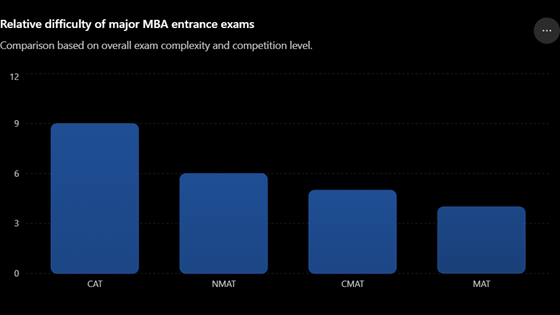
The chart above visually reinforces this ranking: CAT sits well above the other three exams on both difficulty and competition, while MAT consistently sits at the more accessible end. Keep this reference point in mind when deciding how to sequence your preparation across exams.
Colleges Accepting Each Exam
Beyond the flagship institutes named earlier, it helps to see each exam’s best-known colleges grouped together, since this often becomes the deciding factor for aspirants weighing exams primarily by career outcome rather than exam difficulty alone.
| Exam | Best Colleges |
| CAT | IIMs, FMS, MDI, SPJIMR |
| CMAT | JBIMS, KJ Somaiya, Welingkar |
| NMAT | NMIMS, TAPMI, XIM |
| MAT | Christ University, Jaipuria, JIMS |
Notice that some institutes, such as K J Somaiya, accept more than one exam’s scores. Research each target college’s accepted exam list individually before you commit your preparation time to only one exam.
Which Exam Should You Choose?
Choose
CAT If:
- You aim for IIMs or Tier-1 B-schools — CAT remains the only mandatory route into IIM admissions and most other Tier-1 institutes.
- A 6–8 month preparation window suits you — CAT’s difficulty and single-attempt format reward sustained, structured preparation rather than last-minute cramming.
- Analytical problem solving appeals to you — CAT questions typically reward flexible, first-principles reasoning over rote formula application.
CMAT If:
- You target good Tier-2 B-schools — CMAT’s 1,000+ accepting institutions give you a wide set of solid options without CAT-level competition.
- You want an easier alternative to CAT — CMAT’s moderate difficulty and more forgiving overall competition level suit this goal.
NMAT If:
- You are targeting NMIMS Mumbai — NMAT is the exam through which NMIMS primarily admits its MBA candidates.
- You prefer multiple attempts — NMAT’s three-attempt structure lets you treat your first sitting as practice and improve on subsequent attempts.
MAT If:
- You want maximum flexibility — MAT runs four times a year, offering more retry opportunities than any other exam on this list.
- You are applying to Tier-2 and Tier-3 institutions — MAT’s easier difficulty and broad acceptance make it a strong fit for this target segment.
Common Mistakes MBA Aspirants Make
- Preparing only for one exam — narrows your admission options unnecessarily, especially since 80–85% of the preparation effort would carry over to additional exams with only modest extra work.
- Ignoring General Awareness for CMAT and MAT — leaves a scoring opportunity untapped, since candidates can often improve this section faster than the quantitative or verbal sections.
- Underestimating NMAT’s speed requirements — leads candidates to assume that CAT-level preparation automatically transfers, when NMAT actually rewards different pacing habits.
- Focusing only on percentile and ignoring college fit — can result in accepting a seat at a college that doesn’t match your specialisation interests, location preference, or budget, despite a strong score.
- Applying late for NMAT slots — risks losing access to preferred test dates and centres, since NMAT’s multiple-attempt system depends on early registration to space out your attempts.
Summary Table: Key Takeaways
| Aspect | Best Exam |
| Prestige | CAT |
| Multiple Attempts | NMAT |
| Easier Difficulty | MAT |
| Best ROI | CAT |
| Largest College Acceptance | CMAT |
| Best Private University Option | NMAT |
CAT tops both Prestige and Best ROI because its IIM and Tier-1 outcomes typically translate into the strongest long-term salary and career trajectory relative to the time invested in preparation.
NMAT’s strength lies specifically in Multiple Attempts and Best Private University Option, reflecting its three-attempt structure and its strong association with NMIMS and similar institutes.
MAT’s Easier Difficulty ranking makes it the natural recommendation for beginners or for aspirants whose target colleges don’t require a Tier-1 level score.
CMAT’s Largest College Acceptance reflects its NTA-administered, centrally recognised status across more than a thousand AICTE-approved institutions.
FAQs
1. Which exam is easier among CAT, CMAT, NMAT, and MAT?
Most aspirants consider MAT the easiest and CAT the toughest. This gap exists mainly because of CAT’s tighter time pressure, higher competition, and more demanding question design. MAT, by contrast, aims to stay accessible to a much broader base of aspirants across four sittings a year.
2. Is NMAT easier than CAT?
Yes, NMAT proves easier in terms of difficulty but demands excellent speed management. Its questions individually carry less complexity than CAT’s, but the higher question count within a similar time limit means slow, careful solving won’t work as an approach.
3. Can I prepare for all four exams together?
Yes. Around 80–85% of the syllabus overlaps, which is why the six-month combined preparation strategy outlined earlier in this guide front-loads CAT preparation and then layers in exam-specific adjustments for NMAT, CMAT, and MAT.
4. Which exam is best for IIM admission?
CAT stays mandatory for admission to IIMs. The IIM system accepts no other exam on this list, which is why aspirants with an IIM target should treat CAT preparation as their non-negotiable starting point.
5. Which exam offers multiple attempts?
NMAT allows candidates to attempt the exam up to three times, a structural advantage that meaningfully reduces the single-attempt pressure present in CAT and CMAT.
6. Is CMAT accepted by good colleges?
Yes, colleges such as JBIMS, Welingkar, and K J Somaiya accept CMAT scores, which makes it a genuinely strong option rather than a fallback exam, particularly for aspirants targeting Mumbai-based institutes.
7. Should beginners start with MAT or CAT?
Students targeting top B-schools should start directly with CAT preparation, since its fundamentals transfer well to the other exams. Students whose primary goal is a Tier-2 or Tier-3 college, however, may find it more efficient to begin with MAT-level preparation instead.
Conclusion
CAT, CMAT, NMAT, and MAT each serve different purposes in India’s MBA admission ecosystem. CAT remains the gold standard for aspirants targeting IIMs and elite institutions, while NMAT provides an excellent route to premier private universities. CMAT and MAT offer wider accessibility and opportunities for students aiming for quality management education with comparatively lower competition.
Instead of asking which exam is the best, aspirants should ask which exam aligns best with their career goals, preparation level, and target business schools. This guide’s comparisons, pattern breakdowns, and decision criteria exist to help answer exactly that question.
For most students, the ideal strategy stays simple: prepare for CAT first and leverage that preparation to appear for NMAT, CMAT, and MAT as well, maximizing admission opportunities across India’s top B-schools.
You May Also Like : CAT MOCK, CAT MOCK PYQ
Follow Us On : Facebook, Instagram, Youtube