
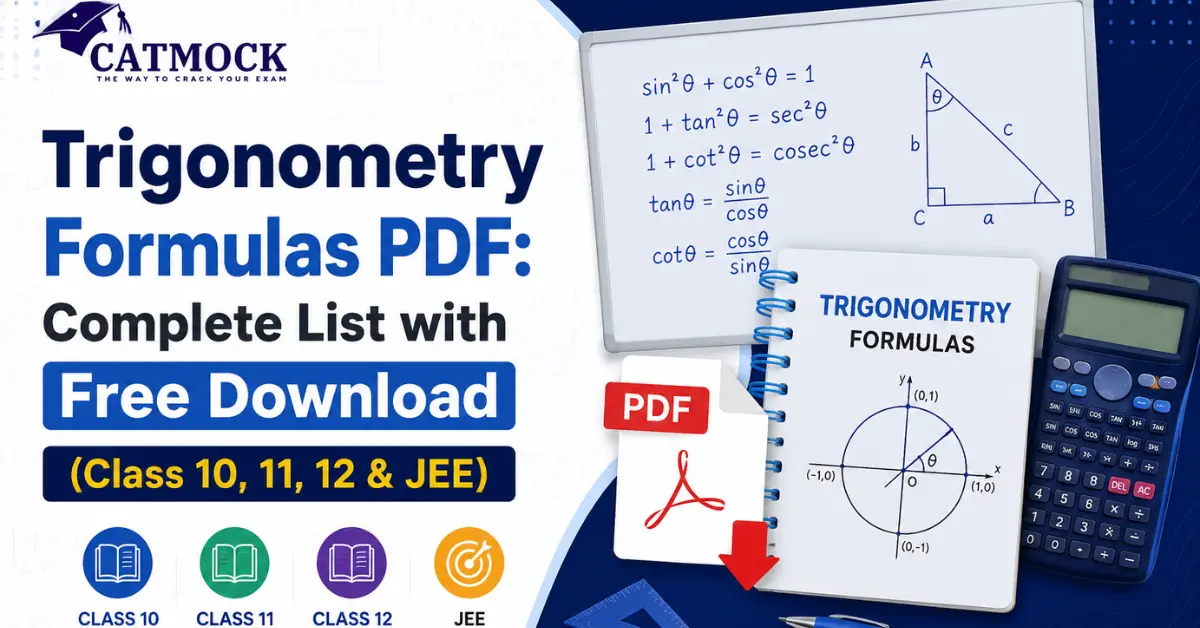
Trigonometry is one of those chapters that decides how comfortable you feel with the rest of your math syllabus — and later, with physics, engineering, and competitive exams. If you’ve ever searched for a trigonometry formulas PDF just before an exam, you already know the panic of scrolling through ten tabs trying to find one clean, correct list. This guide fixes that problem permanently.
Below, you’ll find every important trigonometric ratio, identity, and formula — organized by class level and exam relevance — along with a downloadable formula sheet you can save, print, and revise from anytime, even without internet access.
What Is Trigonometry? A Quick Refresher
Trigonometry comes from two Greek words — trigonon (triangle) and metron (measure). At its core, it studies the relationship between the angles and sides of a triangle, especially a right-angled triangle. These relationships are expressed through six functions: sine, cosine, tangent, cosecant, secant, and cotangent.
Once you understand these six ratios, almost every other formula in this guide is simply a variation or extension built on top of them. That’s why students preparing for CBSE boards, JEE Main, JEE Advanced, NEET, or SSC exams all rely on the same foundational set of identities — just applied differently depending on the difficulty level.
Why Keep a Trigonometry Formulas PDF Handy?
A well-organized, downloadable formula sheet saves you from three common problems:
- Formula confusion — mixing up sum and difference identities under exam pressure
- Time loss — flipping through an entire textbook to find one identity
- Inconsistent notes — formulas scattered across class notes, guidebooks, and online sources
Having a single, verified reference sheet means faster revision and fewer silly mistakes — especially in objective-based exams like JEE and SSC CGL, where speed matters as much as accuracy.
Basic Trigonometric Ratios (Foundation of Every Formula)
Every formula you’ll ever use in trigonometry traces back to these six basic ratios, defined using the sides of a right-angled triangle: Opposite (perpendicular), Adjacent (base), and Hypotenuse.
| Ratio | Formula | Reciprocal Of |
|---|---|---|
| sin θ | Opposite / Hypotenuse | cosec θ |
| cos θ | Adjacent / Hypotenuse | sec θ |
| tan θ | Opposite / Adjacent | cot θ |
| cot θ | Adjacent / Opposite | tan θ |
| sec θ | Hypotenuse / Adjacent | cos θ |
| cosec θ | Hypotenuse / Opposite | sin θ |
Source: National Council of Educational Research and Training (NCERT) — ncert.nic.in
This table alone answers most Class 10 board exam questions. Students moving into Class 11 and 12 build on these same six ratios to derive identities, compound angle formulas, and inverse functions.
Trigonometry Table: Standard Angle Values (0°, 30°, 45°, 60°, 90°)
This is one of the most searched sections in any trigonometric reference sheet, since these exact values appear repeatedly in board exams and competitive tests.
| Angle → | 0° | 30° | 45° | 60° | 90° |
|---|---|---|---|---|---|
| sin θ | 0 | 1/2 | 1/√2 | √3/2 | 1 |
| cos θ | 1 | √3/2 | 1/√2 | 1/2 | 0 |
| tan θ | 0 | 1/√3 | 1 | √3 | Not Defined |
| cot θ | Not Defined | √3 | 1 | 1/√3 | 0 |
| sec θ | 1 | 2/√3 | √2 | 2 | Not Defined |
| cosec θ | Not Defined | 2 | √2 | 2/√3 | 1 |
Source: CBSE Academic Curriculum, NCERT Mathematics Textbook — cbseacademic.nic.in
Memory tip: Notice that sin values increase from 0 to 1 as the angle rises from 0° to 90°, while cos values do the exact opposite. Once this pattern clicks, you rarely need to memorize the table by rote.
Extended Trigonometry Table: Values for 15°, 18°, 36°, and 75°
Beyond the five standard angles, JEE and Olympiad-level questions often use a few additional “special” angles derived using half-angle and sum-difference formulas. Keeping these handy saves derivation time during exams.
| Angle | sin θ | cos θ | tan θ |
|---|---|---|---|
| 15° | (√6 − √2)/4 | (√6 + √2)/4 | 2 − √3 |
| 18° | (√5 − 1)/4 | √(10 + 2√5)/4 | — |
| 36° | √(10 − 2√5)/4 | (√5 + 1)/4 | — |
| 75° | (√6 + √2)/4 | (√6 − √2)/4 | 2 + √3 |
Source: NCERT Exemplar Problems, Class 11 Mathematics — ncert.nic.in
Sign of Trigonometric Functions in Each Quadrant (ASTC Rule)
Knowing which functions are positive or negative in a given quadrant is essential for solving equations and simplifying expressions correctly. This is remembered using the “ASTC” rule — All, Sine, Tangent, Cosine.
| Quadrant | Angle Range | Positive Functions | Negative Functions |
|---|---|---|---|
| I | 0° – 90° | All (sin, cos, tan, and reciprocals) | None |
| II | 90° – 180° | sin, cosec | cos, tan, sec, cot |
| III | 180° – 270° | tan, cot | sin, cos, sec, cosec |
| IV | 270° – 360° | cos, sec | sin, tan, cot, cosec |
Source: NCERT Class 11 Mathematics, Chapter — Trigonometric Functions
A quick way to remember ASTC: “Add Sugar To Coffee” — each letter marks which functions stay positive in that quadrant, moving anticlockwise from quadrant I.
Allied Angle (Co-Function) Formulas
Allied angles are angles that are integer multiples of 90° added to or subtracted from a given angle θ. These formulas let you convert an unfamiliar angle into a known reference angle, and they appear constantly in simplification and proof-based questions.
| Angle Form | sin | cos | tan |
|---|---|---|---|
| (90° − θ) | cos θ | sin θ | cot θ |
| (90° + θ) | cos θ | −sin θ | −cot θ |
| (180° − θ) | sin θ | −cos θ | −tan θ |
| (180° + θ) | −sin θ | −cos θ | tan θ |
| (270° − θ) | −cos θ | −sin θ | cot θ |
| (270° + θ) | −cos θ | sin θ | −cot θ |
| (360° − θ) | −sin θ | cos θ | −tan θ |
| (360° + θ) | sin θ | cos θ | tan θ |
Source: NCERT Class 11 Mathematics Textbook, Chapter 3
Quick rule: For 90° and 270°, the function name changes (sin ↔ cos, tan ↔ cot). For 180° and 360°, the function name stays the same — only the sign changes based on the quadrant (use the ASTC table above to check the sign).
Negative Angle (Even-Odd) Formulas
These identities tell you what happens when the angle itself is negative — a small detail that trips up a lot of students in simplification problems.
| Function | Identity | Type |
|---|---|---|
| sin(−θ) | −sin θ | Odd |
| cos(−θ) | cos θ | Even |
| tan(−θ) | −tan θ | Odd |
| cot(−θ) | −cot θ | Odd |
| sec(−θ) | sec θ | Even |
| cosec(−θ) | −cosec θ | Odd |
Source: NCERT Class 11 Mathematics, Chapter — Trigonometric Functions
Periodicity of Trigonometric Functions
Every trigonometric function repeats its values after a fixed interval, called its period. This concept is what makes trigonometric equations have infinite solutions and is frequently tested in Class 11 and JEE.
| Function | Period |
|---|---|
| sin θ, cos θ, sec θ, cosec θ | 2π (360°) |
| tan θ, cot θ | π (180°) |
Source: NCERT Class 11 Mathematics Textbook
Complete Trigonometry Formulas PDF: Quick-Reference Chart
At this point, you’ve covered ratios, standard angles, extended angles, quadrant signs, allied angles, negative-angle rules, and periodicity — which together make up the first half of any complete trigonometry formulas PDF. Before moving into identities and compound-angle formulas, it helps to pause and see how these categories fit together, so you’re not just memorizing isolated tables.
| Formula Category | Number of Key Formulas | Typically Tested In |
|---|---|---|
| Basic Ratios & Reciprocals | 6 | Class 10, 11 |
| Standard & Extended Angle Values | 9 angles | Class 10, 11, JEE |
| Quadrant Signs (ASTC) | 4 quadrants | Class 11 |
| Allied Angle Formulas | 8 | Class 11, JEE |
| Negative Angle Formulas | 6 | Class 11 |
| Periodicity Rules | 2 | Class 11, JEE |
Source: Compiled from NCERT Class 10 & 11 Mathematics Textbooks — ncert.nic.in
Why a Trigonometry Formulas PDF Chart Works Better Than Scattered Notes
Seeing every category in one chart, rather than as separate scattered notes, makes it far easier to spot which formulas you’ve actually memorized and which ones still need practice. Most students who revise from a single, well-organized sheet report fewer mix-ups between similar-looking rules — such as confusing allied angle sign changes with quadrant sign changes — simply because both appear side by side instead of in different notebooks or textbook chapters.
The remaining categories — identities, compound-angle formulas, product-to-sum conversions, and inverse functions — build directly on the six categories above, which is why getting this first half solid before moving forward makes the rest of the chapter noticeably easier.
Trigonometric Identities: Pythagorean & Reciprocal Relations
These identities form the backbone of Class 11 trigonometry and are used constantly to simplify expressions and prove equations.
| Identity Type | Formula |
|---|---|
| Pythagorean Identity 1 | sin²θ + cos²θ = 1 |
| Pythagorean Identity 2 | 1 + tan²θ = sec²θ |
| Pythagorean Identity 3 | 1 + cot²θ = cosec²θ |
| Reciprocal Identity | sin θ = 1 / cosec θ |
| Reciprocal Identity | cos θ = 1 / sec θ |
| Quotient Identity | tan θ = sin θ / cos θ |
| Quotient Identity | cot θ = cos θ / sin θ |
Source: NCERT Class 11 Mathematics, Chapter — Trigonometric Functions
These identities are derived directly from the Pythagoras theorem applied to a right-angled triangle, which is why they hold true for every value of θ within the function’s domain.
Sum, Difference, Double & Half-Angle Formulas
This section is where most students lean heavily on a saved reference sheet, since these formulas are lengthy and easy to misremember under time pressure.
Sum and Difference Formulas
- sin(A + B) = sin A cos B + cos A sin B
- sin(A − B) = sin A cos B − cos A sin B
- cos(A + B) = cos A cos B − sin A sin B
- cos(A − B) = cos A cos B + sin A sin B
- tan(A + B) = (tan A + tan B) / (1 − tan A tan B)
- tan(A − B) = (tan A − tan B) / (1 + tan A tan B)
Double Angle Formulas
- sin 2θ = 2 sin θ cos θ
- cos 2θ = cos²θ − sin²θ = 1 − 2sin²θ = 2cos²θ − 1
- tan 2θ = 2 tan θ / (1 − tan²θ)
Triple Angle Formulas
- sin 3θ = 3 sin θ − 4 sin³θ
- cos 3θ = 4 cos³θ − 3 cos θ
- tan 3θ = (3 tan θ − tan³θ) / (1 − 3 tan²θ)
Half-Angle Formulas
- sin(θ/2) = ±√[(1 − cos θ)/2]
- cos(θ/2) = ±√[(1 + cos θ)/2]
- tan(θ/2) = ±√[(1 − cos θ)/(1 + cos θ)]
These compound-angle formulas are heavily tested in JEE Main and JEE Advanced, where questions often require combining two or three identities in a single problem — another reason a consolidated formula sheet is worth keeping on your device.
Product-to-Sum and Sum-to-Product Formulas
Once you’re comfortable with the sum, difference, and double-angle formulas, the next logical step is product-to-sum and sum-to-product identities. These appear less frequently in Class 10 and 11 syllabi but show up often in JEE Advanced and higher-level engineering mathematics, where converting a product of trigonometric terms into a sum (or vice versa) simplifies integration and equation-solving.
| Conversion Type | Formula |
|---|---|
| Product to Sum | 2 sin A cos B = sin(A+B) + sin(A−B) |
| Product to Sum | 2 cos A cos B = cos(A−B) + cos(A+B) |
| Product to Sum | 2 sin A sin B = cos(A−B) − cos(A+B) |
| Sum to Product | sin A + sin B = 2 sin[(A+B)/2] cos[(A−B)/2] |
| Sum to Product | cos A + cos B = 2 cos[(A+B)/2] cos[(A−B)/2] |
Source: NCERT Class 11 Mathematics, Chapter — Trigonometric Functions
These conversions are particularly useful in calculus-based problems, where integrating a product of sine and cosine terms directly is difficult, but integrating their sum form is straightforward. Engineering aspirants preparing for JEE Advanced should treat this table as a priority section, since it frequently appears in integration and equation-solving questions.
Also read: 5 Pillars of Democracy in India
Trigonometric Equations and General Solutions
Beyond identities, trigonometry also involves solving equations where an unknown angle satisfies a given trigonometric condition. These are called trigonometric equations, and unlike algebraic equations, they usually have infinite solutions due to the periodic nature of trigonometric functions.
| Equation Type | General Solution |
|---|---|
| sin θ = sin α | θ = nπ + (−1)ⁿα, n ∈ Z |
| cos θ = cos α | θ = 2nπ ± α, n ∈ Z |
| tan θ = tan α | θ = nπ + α, n ∈ Z |
Here, “n” represents any integer, which accounts for the fact that sine, cosine, and tangent repeat their values at regular intervals (periodicity). This concept is introduced in Class 11 and becomes especially important for JEE-level problem-solving, where a single trigonometric equation can have multiple valid answers within a given range.
Inverse Trigonometric Formulas
Inverse trigonometric functions reverse the usual ratio-to-angle relationship — instead of finding a ratio from an angle, you find the angle from a given ratio. These are introduced in Class 12 and are a scoring topic if practiced well.
| Function | Domain | Range |
|---|---|---|
| sin⁻¹x | [−1, 1] | [−π/2, π/2] |
| cos⁻¹x | [−1, 1] | [0, π] |
| tan⁻¹x | (−∞, ∞) | (−π/2, π/2) |
Source: NCERT Class 12 Mathematics, Chapter — Inverse Trigonometric Functions
Common inverse identities include:
- sin⁻¹x + cos⁻¹x = π/2
- tan⁻¹x + cot⁻¹x = π/2
- sin⁻¹(−x) = −sin⁻¹x
How to Use This Formula Sheet for Revision
Getting the formulas is only half the job — using them efficiently matters more. Here’s a simple approach that toppers use:
- Print the trigonometry formulas PDF and stick it somewhere visible — your study desk or the inside cover of your notebook.
- Group formulas by type (ratios, identities, compound angles) instead of memorizing them as one giant list.
- Solve 5–10 problems daily applying at least one formula from each category.
- Revisit the standard angle table weekly until it becomes automatic recall.
- Use the PDF the night before exams as a rapid-fire revision tool rather than reading full chapters again.
Real-World Applications of Trigonometry Formulas
Trigonometry isn’t just an exam topic — it has practical relevance that makes the formulas easier to remember once you see them in context:
- Architecture and construction — calculating heights, roof angles, and structural load distribution
- Navigation and astronomy — determining distances between celestial bodies and ship positioning at sea
- Engineering — signal processing, wave mechanics, and electrical circuit analysis rely on sine and cosine functions
- Geography — triangulation methods used in mapping distances between landmarks
- Computer graphics — rotation, animation, and 3D modeling all use trigonometric transformations
Understanding these applications makes the formula list feel less like abstract memorization and more like a practical toolkit.
Class-Wise Relevance: What to Focus On
| Class Level | Key Focus Areas |
|---|---|
| Class 10 | Basic ratios, Pythagorean identity, heights & distances |
| Class 11 | Trigonometric functions, identities, compound angle formulas, graphs |
| Class 12 | Inverse trigonometric functions, equations, application in calculus |
| JEE/NEET/SSC | Multiple angle formulas, transformation formulas, equations with general solutions |
Source: CBSE Curriculum Framework — cbse.gov.in
This breakdown helps you know exactly which section of the formula guide to prioritize based on your current class or target exam, rather than trying to memorize everything at once.
Formula Sheet vs Full Textbook: Which Should You Revise From?
Many students wonder whether it’s better to revise from a compact formula sheet or go back to the full textbook chapter every time. Both have a place in your study routine, but they serve different purposes.
| Factor | Formula Sheet (PDF) | Full Textbook Chapter |
|---|---|---|
| Best for | Quick revision, last-minute recall | First-time learning, understanding derivations |
| Time required | 5–10 minutes | 45–60 minutes |
| Ideal usage stage | Week before exams, daily practice warm-up | Initial concept building |
| Portability | High — works offline, fits on one page | Low — requires carrying the full book |
| Depth of explanation | Minimal, formula-focused | Detailed, includes proofs and solved examples |
The most effective students don’t choose one over the other — they learn concepts from the textbook first, then switch to a condensed reference sheet for ongoing revision. Relying only on a formula list without ever understanding the derivation tends to create shaky recall under exam pressure, while relying only on the textbook wastes valuable revision time closer to exams.
Common Mistakes Students Make With Trigonometry Formulas
- Confusing sin(A+B) with sin A + sin B — these are not the same
- Forgetting the ± sign in half-angle formulas depending on the quadrant
- Mixing up domain and range for inverse trigonometric functions
- Applying degree-based values in radian-based questions without converting
- Skipping the derivation logic and memorizing formulas as isolated symbols, which makes recall harder under pressure
Avoiding these errors comes down to practicing derivations occasionally, not just formulas — even five minutes of writing out how sin(A+B) is derived cements the formula far better than repetition alone.
Summary: Key Takeaways From This Trigonometry Formulas PDF
- The six basic trigonometric ratios (sin, cos, tan, cot, sec, cosec) are the foundation for every other formula.
- The standard angle table (0°, 30°, 45°, 60°, 90°) is essential and frequently tested across all classes.
- Pythagorean and reciprocal identities simplify complex trigonometric expressions.
- Sum, difference, double, and half-angle formulas are critical for JEE and advanced problem-solving.
- Inverse trigonometric functions matter most for Class 12 and calculus-based applications.
- Keeping a single, verified formula sheet for revision saves significant exam preparation time.
Frequently Asked Questions (FAQs)
Q1. Where can I get a free trigonometry formulas PDF for Class 10, 11, and 12?
You can compile one using verified NCERT textbook content, or save the formula tables from this guide directly as a PDF using your browser’s print-to-PDF option for offline revision.
Q2. What are the six basic trigonometric ratios?
The six basic ratios are sine, cosine, tangent, cotangent, secant, and cosecant, all derived from the sides of a right-angled triangle.
Q3. Is the trigonometry formulas PDF useful for JEE and NEET preparation?
Yes. JEE and NEET frequently test compound angle formulas, double and half-angle identities, and inverse trigonometric functions, all of which are included in a comprehensive formula PDF.
Q4. How many trigonometric identities are there in total?
There are three core Pythagorean identities, along with reciprocal, quotient, sum-difference, double-angle, half-angle, and product-to-sum identities — together forming a fairly extensive but learnable list.
Q5. What is the easiest way to memorize the trigonometry table?
Understanding the increasing and decreasing pattern of sin and cos values between 0° and 90°, rather than memorizing numbers directly, makes recall significantly easier.
Q6. Do Class 10 and Class 12 use the same trigonometry formulas?
No. Class 10 focuses on basic ratios and heights-and-distances problems, while Class 12 introduces inverse trigonometric functions and their application in calculus.
Conclusion
Trigonometry rewards consistency more than raw memorization. Once the six basic ratios and the standard angle table are second nature, every other formula in this trigonometry formulas PDF becomes an extension of concepts you already understand rather than a separate list to cram. Keep this guide as your primary reference sheet, revisit it weekly, and pair it with regular problem-solving — that combination is what actually turns formula knowledge into exam-ready recall, whether you’re preparing for board exams, JEE, NEET, or SSC-level competitive tests.
You May Also Like : CAT MOCK, CAT MOCK PYQ
Follow Us On : Facebook, Instagram