Marketing today moves fast. Platforms change, ad formats change, and the tools you used last year might already feel outdated. If you’re a student, a working professional, or someone planning an MBA, picking up a structured online marketing course is one of the quickest ways to stay relevant.
The good news? You don’t need to spend a fortune to start. Several globally recognized platforms offer free or low-cost marketing courses that cover everything from the basics of digital marketing to running your first Google Ads campaign.
In this guide, we’ve rounded up 10 online marketing courses worth your time in 2026, along with what each one teaches and who it’s best suited for.
Quick Comparison Table
| S.NO. | Course Name | Platform | Best For |
|---|---|---|---|
| 1 | Foundations of Digital Marketing & E-commerce | Coursera | Beginners wanting a broad digital marketing overview |
| 2 | Introduction to Social Media Marketing | Coursera | Students focused on social platforms and content strategy |
| 3 | Fundamentals of Sales and Marketing | Coursera | Those who want to understand sales-marketing overlap |
| 4 | Marketing Foundations | Great Learning | Absolute beginners needing core concepts |
| 5 | Marketing: Strategic Framework | Great Learning | Learners who want a strategic, framework-driven approach |
| 6 | 4Ps of Marketing Mix | Great Learning | Anyone brushing up on classic marketing theory (useful for CAT/MBA prep) |
| 7 | Diploma in Digital Marketing | Alison | Learners wanting an in-depth, diploma-level certification |
| 8 | Digital Marketing Course (Overview) | Alison | A shorter, overview-style introduction |
| 9 | Complete Online Marketing & Advertising Course | Alison | Those who want to cover marketing and advertising together |
| 10 | Google Ads for Beginners | Coursera | Anyone who wants hands-on, tool-specific ad skills |
1. Foundations of Digital Marketing & E-commerce
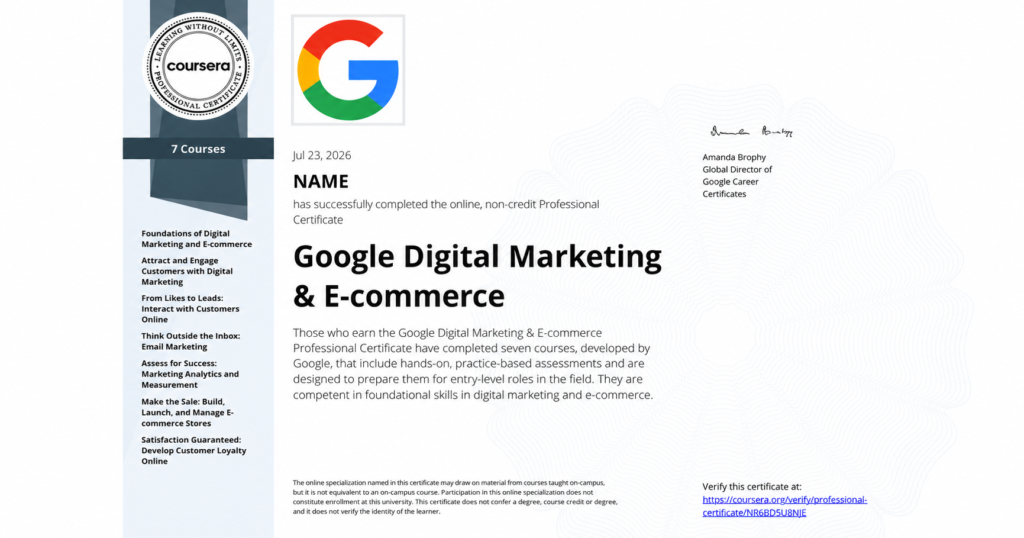
This course lays out the building blocks of digital marketing, from SEO and email marketing to e-commerce fundamentals. It’s designed for people with no prior marketing background and works well if you want one course that touches every major digital channel before you specialize. You’ll come away with a working vocabulary for terms like “conversion rate,” “customer journey,” and “organic reach”—the kind of language that shows up constantly once you start working in or around a marketing team.
What makes this course a strong starting point is its breadth. Rather than going deep on one channel, it gives you a map of the entire digital marketing landscape, so you know where SEO fits relative to paid ads and where email marketing fits relative to social. That context makes it much easier to decide which channel to specialize in later, once you’ve picked a direction that interests you.
Link: Foundations of Digital Marketing & E-commerce
2. Introduction to Social Media Marketing
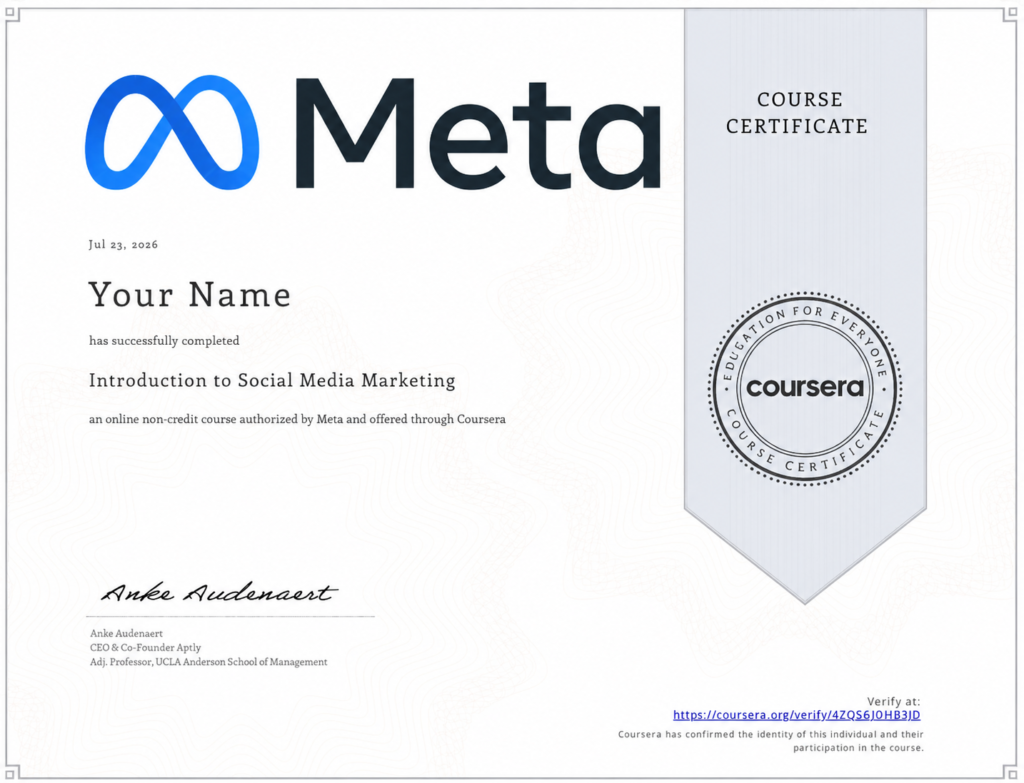
Social platforms are often the first channel brands use to reach audiences, and this course walks through how to plan, create, and measure social content. It’s a good pick if you’re interested in content creation, community management, or brand strategy roles. The course also touches on how different platforms serve different purposes — a brand’s Instagram strategy rarely looks the same as its LinkedIn strategy, and understanding why is a big part of doing this work well.
Beyond the basics of posting and scheduling, you’ll get a sense of how marketers actually measure whether social content is working: engagement rate, reach, and audience growth are covered in a way that’s practical rather than purely theoretical. If your interest leans toward content, community, or influencer marketing, this course gives you a reasonable head start.
Link: Introduction to Social Media Marketing
3. Fundamentals of Sales and Marketing, with Goldman Sachs 10,000 Women
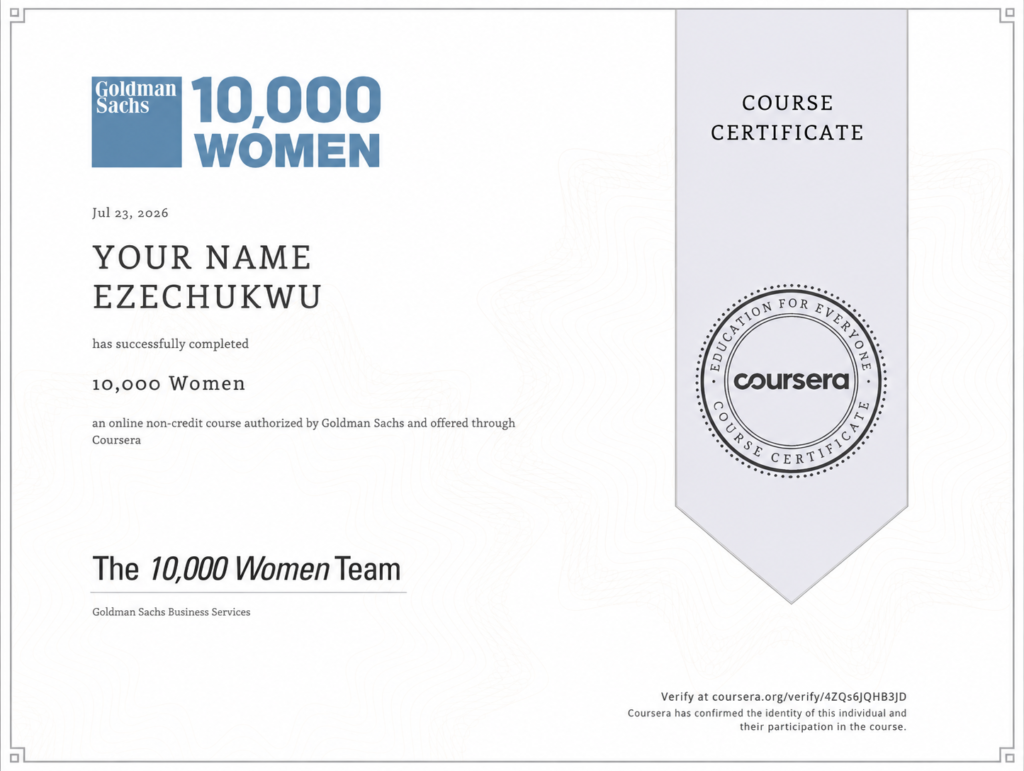
Marketing rarely works in isolation from sales, and this course explains how the two functions connect—from lead generation to closing a deal. It’s especially useful if you’re aiming for a general management or consulting role where you’ll need to speak both languages. Many aspirants preparing for CAT or other MBA entrance exams tend to focus heavily on marketing theory while overlooking how sales teams actually operationalize it, and this course helps close that gap.
You’ll also get a sense of the full funnel—how a prospect moves from awareness to interest to an actual purchase decision and where marketing’s job ends and sales’ job begins. That’s a useful mental model to carry into internships, case competitions, or interview rounds where interviewers often test whether you understand how business functions work together rather than in silos.
Link: Fundamentals of Sales and Marketing
4. Marketing Foundations
A beginner-friendly course that breaks down core marketing concepts like market segmentation, targeting, and positioning. If you want a no-frills introduction before diving into more specialized topics, this is a solid starting point. It avoids jargon-heavy explanations and instead builds up each concept with simple, relatable examples, which makes it easy to follow even if you’ve never studied marketing formally.
Because it’s shorter and more focused than some of the other options on this list, it’s a good choice if you want to quickly refresh core terminology—segmentation, targeting, positioning, and the basic marketing mix—before moving on to a more advanced or strategy-focused course.
Link: Marketing Foundations
5. Marketing: Strategic Framework
This one goes a step further by teaching how companies build marketing strategy around business goals. It’s a good fit for anyone preparing for case-study rounds in MBA interviews, since it trains you to think in structured frameworks. Instead of treating marketing as a list of tactics, it positions marketing decisions as outcomes of a broader business strategy, which is closer to how real companies actually operate.
You’ll learn how to connect a company’s overall objectives—growth, market share, and brand positioning—to specific marketing choices. This kind of structured, top-down thinking is exactly what interview panels and group discussion evaluators tend to reward, since it shows you can reason through a business problem rather than just recalling definitions.
Link: Marketing: Strategic Framework
6. 4Ps of Marketing Mix

Product, Price, Place, and Promotion—the 4Ps are a marketing fundamental that shows up repeatedly in MBA coursework and case interviews. This short, focused course is worth doing even if you only have an hour to spare, since it’s a concept CAT and MBA aspirants are expected to know cold. Despite being one of the oldest frameworks in marketing, it still comes up constantly in group discussions, personal interviews, and even in case-study-based questions during MBA admissions.
The course breaks each of the four elements down individually with examples, so you’re not just memorizing the framework but actually understanding how a company might adjust pricing, distribution, or promotional strategy in response to a specific market situation. Given how frequently this concept is tested, it’s one of the higher-value, lower-time-investment courses on this list.
Link: 4Ps of Marketing Mix
7. Diploma in Digital Marketing
For learners who want more depth than a single short course, this diploma-style program on Alison covers digital marketing topics in greater detail, including SEO, content marketing, and analytics. It’s a longer commitment but gives you a more complete certification to add to your resume. Because it’s structured as a diploma rather than a single module, it’s better suited to someone who’s already decided digital marketing is a direction worth pursuing, rather than someone still exploring options.
The added depth also means you’ll spend more time on analytics and measurement—understanding how campaigns are tracked and optimized—which is often the part of digital marketing that separates a working professional from someone with only surface-level knowledge.
Link: Diploma in Digital Marketing
8. Digital Marketing Course (Overview)
A shorter, overview-style course that’s useful if you want a quick refresher on digital marketing basics without committing to a full diploma. It works well as a companion course alongside more specialized options on this list. Since it moves faster and covers less ground than the diploma program above, it’s a reasonable choice if you already have some familiarity with marketing and just want to fill in gaps rather than start from zero.
It’s also a practical option if you’re short on time — say, during a busy exam preparation period — and want something you can complete in a single sitting without losing momentum on your primary study schedule.
Link: Digital Marketing Course
9. Complete Online Marketing & Advertising Course
This course pairs marketing fundamentals with advertising-specific content, covering how paid campaigns are planned and executed across channels. It’s a practical choice if your goal is to eventually manage ad budgets or work in a performance marketing role. Unlike some of the more theory-heavy courses on this list, this one leans toward the applied side — how ad campaigns are structured, targeted, and evaluated for return on spend.
If you’re weighing a career in performance marketing or media planning specifically, this course gives you a broader view of advertising as a discipline before you specialize further into a single platform like Google Ads or Meta Ads.
Link: Complete Online Marketing & Advertising Course
10. Google Ads for Beginners
A hands-on, project-based course where you actually set up a Google Ads campaign rather than just learning theory. Given how central Google Ads is to digital marketing roles, this is one of the more directly job-relevant courses on the list. Because it’s structured around a real project instead of passive video lectures, you finish with something concrete — an actual campaign you built — rather than just notes on how campaigns work in theory.
This kind of applied, tool-specific experience is often exactly what recruiters look for when hiring for entry-level or internship marketing roles, since it shows you can do the work rather than just describe it. If you only have time for one hands-on course from this list, this is a strong candidate.
Link: Google Ads for Beginners
Conclusion
You don’t need a marketing degree to start building marketing skills — these 10 courses give you a practical, low-cost way to get started, whether you’re exploring a career switch, strengthening your MBA application, or simply curious about how digital marketing works. Pick one or two based on your goals, and treat the rest as a roadmap for later.
You May Also Like: CAT MOCK, CAT MOCK PYQ
Follow Us On: Facebook, Instagram