
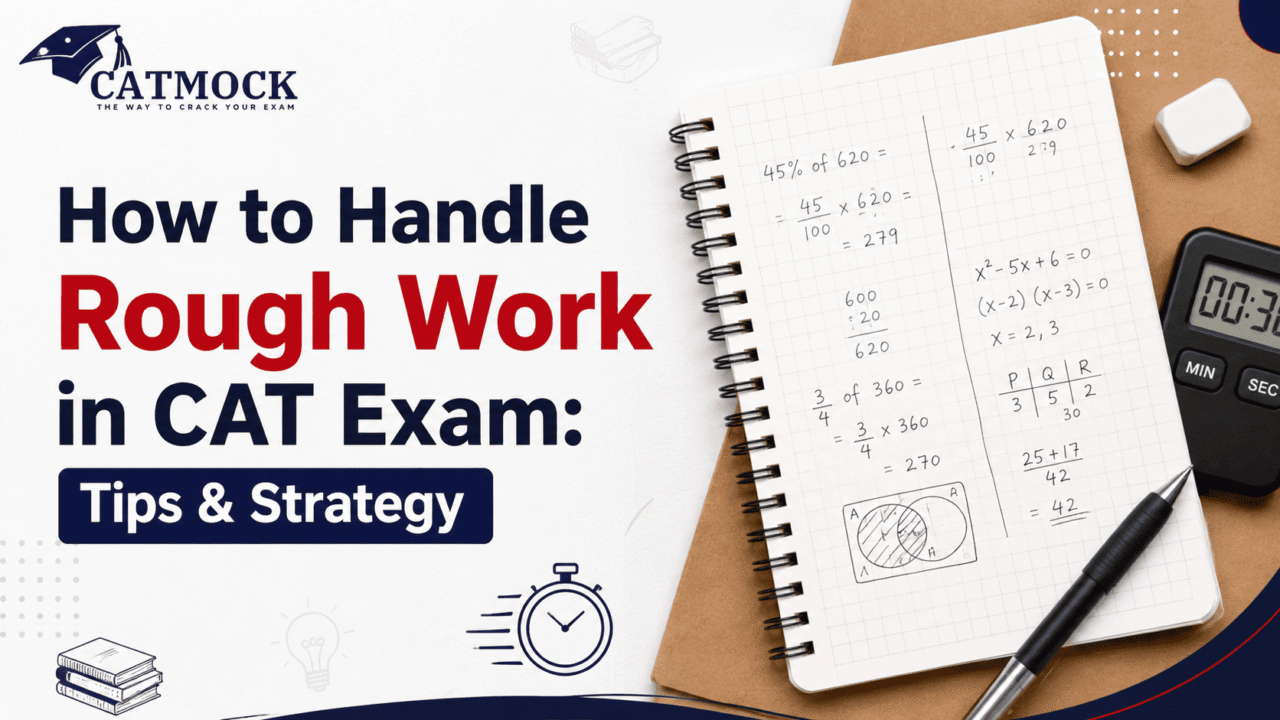
Two hours. Three sections. One thin booklet for every calculation, table, and para-jumble sequence you write. That’s the reality of rough work in the CAT exam, and it catches more candidates off guard than almost any other logistical detail on test day.
Most aspirants prepare on full-size notebooks, then get handed a booklet a fraction of that size on exam day. The candidates who handle this well aren’t the ones who write less — they’re the ones who’ve practised organising their scratch work beforehand. This guide covers the format, section-wise strategy, and the mistakes that quietly cost marks every year.
What Is Rough Work in a CAT Exam?
Rough work refers to the scratch calculations, tables, diagrams, and notes you make on the booklet provided at the test center. It isn’t submitted for evaluation — only your final answers matter — but it directly shapes how quickly and accurately you reach them.
The exam-day rough sheet has fixed rules: no personal paper, nothing to take home, limited space. Treating rough work as a skill you actively manage, not something you figure out on the spot, separates organised attempts from rushed ones.
Why Rough Work Deserves a Real Strategy
It’s tempting to treat your scratchpad as an afterthought — something you scribble on between reading a question and typing the answer. That mindset leads to lost time and avoidable errors.
Doing calculations entirely in your head under time pressure raises your error rate, especially in Quant and DILR. Writing steps down gives your reasoning a visible trail you can double-check in seconds instead of re-deriving from scratch. CAT rewards speed and accuracy together — a messy sheet slows you down exactly when you’re verifying an answer with two minutes left. This structure compounds across 60-plus questions and costs nothing extra to build.
What You Actually Get: The CAT Rough Sheet Format
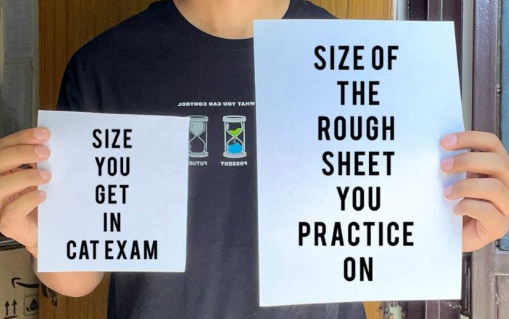
Unlike your prep-phase notebook, the exam-day worksheet has fixed, non-negotiable specs. Knowing them in advance — and practising on something similar — removes one entire category of exam-day surprise.
| Detail | Specification |
|---|---|
| Format provided | Bound booklet issued at the test center |
| Personal stationery | Not allowed — pen and worksheet are issued on-site |
| Refill policy | Additional sheets available on request from the invigilator |
| End of exam | The booklet and pen must be returned before leaving the center |
| On-screen tools | Digital calculator available for basic arithmetic |
Because you can’t bring your own paper or pen, the smartest preparation move is to rehearse on a similarly sized notepad during your mocks, rather than your usual full-size notebook. This is exactly why CAT rough sheet practice is worth building into your revision plan, not leaving until exam week.
Section-Wise Rough Work Requirements
CAT’s three sections don’t demand the same amount of scratch space. Allocating your booklet accordingly avoids running short exactly where you need it most.
| Section | Rough-Work Need | What to Jot Down |
|---|---|---|
| VARC | Low | Passage keywords, para-jumble sequence numbers |
| DILR | High | Data tables, grids, quick diagrams for set-based questions |
| QA | Highest | Step-by-step calculations, equations, quick figures |
A Repeatable System for Organising Rough Work
Follow the same sequence every attempt so it becomes automatic:
- Divide your page before you start. Split each sheet into blocks rather than writing wherever there’s blank space.
- Number every question, in the top-left corner of its block, so you can jump back without hunting for it.
- Write in short form. Symbols and partial steps are enough to reconstruct your logic later.
- Keep one notation system for addition, multiplication, and fractions, and stick with it.
- Leave breathing room. A wasted inch of space is cheaper than a confused re-read.
- Draw a line after each question so one calculation doesn’t bleed into the next.
Rough-Work Strategy by Section
Quant consumes the most space, so work in stages: write the given values in a labelled block, solve the first step and box the intermediate result, then use that boxed value for the next step instead of recalculating mentally. Estimate first — round intermediate numbers, go precise only at the end.
DILR rewards visual structure over linear writing. For a set with multiple constraints, draw a simple grid — entities as rows, attributes as columns — before applying any condition, and mark ruled-out combinations with a cross rather than erasing. Keep one grid per question; redrawing from memory mid-question wastes time.
VARC needs the least space, but light structure still helps: number sentences for para-jumbles before committing to a sequence, and note only the keywords you’ll need to verify an inference. Over-writing is the more common mistake here.
The on-screen calculator doesn’t reduce the need for rough work — it’s useful for verifying a single number, not for holding a multi-step problem or a DILR data set. Rough work is where the reasoning lives; the calculator is just a final check.
Common CAT Rough-Work Mistakes and How to Fix Them
| Mistake | Why It Hurts | Better Approach |
|---|---|---|
| Unorganised scrawling | Wastes time re-locating a calculation | Number questions and section your page before writing |
| Over-detailing every step | Eats into your limited two hours | Write only what’s needed to reconstruct your logic |
| Skipping rough work on “easy” questions | Silly errors creep in under pressure | Write even simple calculations to avoid basic slips |
| Ignoring page limits | Running out of space mid-section causes panic | Practise section-wise space budgeting during mocks |
| Inconsistent notation | Confuses you when reviewing your own work | Fix one shorthand system and use it throughout |
| Reusing a grid across questions | Old data mixes with new data | Start a fresh grid for every DILR set |
Why Practising in an Exam-Like Booklet Helps
Most preparation plans focus on concepts and question-solving, treating the rough sheet as an afterthought. But the space you practise on shapes habits that carry into the exam: familiarity with limited space, consistent organisation, better calculation tracking, and more realistic pacing.
This isn’t a claim that a particular format improves scores — rehearsing under realistic conditions simply removes a source of exam-day friction. For aspirants who want to build this habit deliberately, a dedicated CAT rough work practice booklet, sized and ruled closer to the actual exam sheet, is a logical next step after learning these strategies. You can find one on the CATMock Store for a consistent, exam-like format to rehearse on.
How to Practise Rough Work Before CAT
- Use a similarly sized pad during mocks, not your full-size notebook.
- Review your rough work, not just your score — messy sections signal what to adjust.
- Practise with CAT PYQs. Solve a set from one section on a rough sheet sized like the actual booklet, then check whether your working stays legible enough to verify later. Official CAT previous year papers build pattern recognition for both the questions and your habits.
- Rotate sectional and full-length mocks. Sectional tests build one section’s style in isolation; full CAT mock tests confirm your system holds up across all three back-to-back.
- Time yourself section-wise; check current-year timings on the official CAT portal, iimcat.ac.in, before your final stretch of prep.
Before, During, and After a Mock
| Stage | What to Do |
|---|---|
| Before | Set up a similarly sized rough sheet; decide your notation and grid style in advance |
| During | Number every question, section your page, and box intermediate results as you go |
| After | Review your rough work alongside your score; identify one specific habit to fix next time |
Summary: How to Handle Rough Work in CAT Exam
- Treat rough work as a skill you manage, not an afterthought.
- Number every question and keep one consistent notation system.
- Give Quant the most space, DILR the next most, VARC the least.
- Use grids for DILR casework and boxed results for Quant.
- Use the calculator only for quick checks, not multi-step reasoning.
- Practise on a similarly sized sheet during mocks and PYQ drills.
- Review your rough work after every mock, not just your score.
Frequently Asked Questions
Q1. Is rough work allowed during the CAT exam?
Yes, but only on the booklet provided by the invigilator — personal paper or notepads aren’t permitted.
Q2. Can I bring my own rough sheets or notepad to the CAT exam?
No. All rough work must be done on the official booklet issued at the center.
Q3. How should I use the limited rough space in CAT effectively?
Divide your page into blocks, number each question, and keep one consistent notation system.
Q4. How do I organise calculations so I can verify them quickly?
Box intermediate results and keep each question in its own section, so verifying means glancing at a boxed value, not redoing the calculation.
Q5. How can I practise rough work at home before the CAT exam?
Use a similarly sized notepad instead of a full notebook, and review your rough work — not just your answers — after every session.
Q6. Should rough-work practice be part of mock test preparation?
Yes. Practising it only in isolation won’t prepare you for exam-day fatigue and section-switching; doing it during mocks builds a system that holds under time pressure.
Q7. How do I avoid wasting space on the rough sheet?
Leave a small, deliberate gap between questions instead of cramming, and avoid over-detailing steps you don’t need.
Q8. Which CAT section needs the most rough work?
Quantitative Ability, followed by DILR. VARC needs the least.
Q9. Can a CAT practice booklet help with rough-work practice?
A booklet sized closer to the actual exam sheet can help you rehearse space management under realistic conditions, though the underlying habits matter more than the booklet itself.
Rough work handles your working — the on-screen calculator handles your final numbers. See our complete guide on using it strategically.
Conclusion
Rough work in the CAT exam isn’t a minor logistical detail — it’s a skill that directly affects your speed, accuracy, and composure across all three sections. The candidates who handle it well are usually the ones who’ve rehearsed the exact constraints beforehand, not just the exam content.
Build the habit early: practise on a similarly sized sheet, number your questions, keep your notation consistent, and review your rough work after every mock the same way you review your score. If you’d like a more exam-like format to rehearse this on, the CATMock Store’s CAT rough work practice booklet is one option worth exploring as you build this habit — but the routine itself, practised consistently, is what makes the difference on exam day.
You May Also Like : CAT MOCK, CAT MOCK PYQ
Follow Us On : Facebook, Instagram, Youtube