
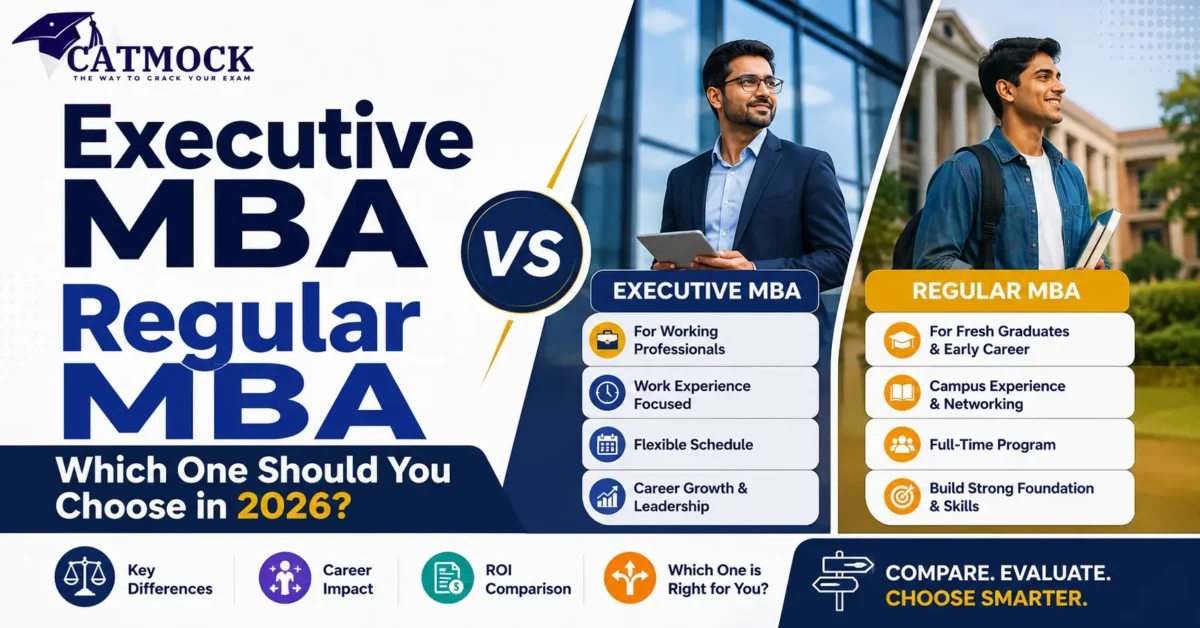
If you have ever stared at an MBA brochure and wondered whether you should apply for a regular MBA or wait a few years and go for an Executive MBA instead, you are not alone. Every year, thousands of graduates and working professionals in India face this exact fork in the road. The two degrees sound similar, share the letters “MBA,” and even promise the same outcome — better leadership skills and a stronger paycheck. But underneath the surface, an Executive MBA vs Regular MBA decision comes down to very different eligibility rules, admission tests, fee structures, and career timelines.
This guide breaks down the Executive MBA vs Regular MBA debate in plain language, with comparison tables, real salary ranges, and a clear framework to help you decide which path fits your career stage. Whether you are a fresh graduate preparing for CAT or a mid-career manager weighing an EMBA, you will find a straight answer here — not just theory. By the end, the Executive MBA vs Regular MBA choice should feel far less confusing and much more like a decision you can act on.
Executive MBA vs Regular MBA: Quick Comparison Table
Before going into the details, here is a snapshot of how a Regular (full-time) MBA and an Executive MBA differ across the factors that matter most to applicants.
| Parameter | Regular MBA | Executive MBA (EMBA) |
|---|---|---|
| Ideal for | Fresh graduates, early-career professionals (0–3 yrs experience) | Mid to senior-level professionals (5+ yrs experience) |
| Average starting age | Around 22–27 years | Around 32–39 years |
| Duration | 2 years (full-time) | 1 to 2 years (often modular/weekend) |
| Mode of study | Full-time, on-campus | Part-time, weekend, blended, or online-cum-campus |
| Entrance exam | CAT, XAT, SNAP, NMAT, CMAT | GMAT, GRE, or institute-specific EMBA test; some waive tests |
| Work experience needed | Not mandatory (freshers eligible) | Usually 3–5 years minimum, often more |
| Employment during course | Typically leave the job to study full-time | Continue working while studying |
| Average fees (India) | ₹10–25 lakh at top B-schools | ₹15–40 lakh at top IIMs/ISB |
| Curriculum focus | Fundamentals-first, broad-based learning | Applied, strategy-heavy, leadership-focused |
| Typical recruiters | Consulting, FMCG, BFSI, IT, e-commerce | Senior/leadership roles across own or new industry |
Source: Compiled from AICTE-recognised institute disclosures, official IIM/B-school admission brochures, and industry placement reports, 2026.
What Is a Regular MBA?
A Regular MBA — also called a full-time MBA — is a two-year, campus-based postgraduate management degree. It is designed for people who are either fresh out of college or have limited work experience and want a strong, structured foundation in business fundamentals before starting or restarting their career.
Most Regular MBA programs in India are entered through national-level entrance exams such as CAT, XAT, SNAP, NMAT, or CMAT, followed by group discussions, written ability tests, and personal interviews. The first year usually covers core subjects like finance, marketing, operations, human resources, and business analytics, while the second year allows students to specialise and complete internships or live projects.
Because a Regular MBA does not require prior work experience, it remains the most common entry point into management education in India — and it’s exactly why CAT preparation gets so competitive every year. If you’re targeting this route, structured practice through CAT mock tests and topic-wise daily practice can make a measurable difference to your percentile.
What Is an Executive MBA (EMBA)?
An Executive MBA is a management degree built specifically for working professionals who already have a track record of managerial or leadership experience — typically 3 to 5+ years, though many top EMBA cohorts average 8-10 years. Instead of asking candidates to pause their careers, EMBA programs are scheduled around full-time jobs: classes run on weekends, in modular blocks, or in a hybrid online-plus-campus-immersion format.
The Executive MBA curriculum assumes participants already understand basic business operations, so it moves faster into strategy, negotiation, change management, and senior decision-making. Cohorts tend to be smaller, more experienced, and often employer-sponsored, which is why EMBA classrooms are known for peer-to-peer learning that’s as valuable as the coursework itself.
Admission to most EMBA programs is based on GMAT, GRE, or an institute-specific test (like IIM Kozhikode’s EMAT), and a number of highly selective programs — including certain ISB, IIM Ranchi, and IIM Nagpur tracks — waive the standardised test altogether in favour of a profile-based selection process.
Executive MBA vs Regular MBA: Key Differences Explained
1. Eligibility and Work Experience
This is the single biggest differentiator in the Executive MBA vs Regular MBA comparison. A Regular MBA has no minimum work-experience requirement — a candidate can apply straight after graduation. An Executive MBA, on the other hand, almost always requires a minimum of 3 years of full-time work experience, and competitive programs at top IIMs and ISB routinely see candidates with 8 years or more.
2. Admission Process and Entrance Exams
Regular MBA admissions in India run through CAT (for IIMs and CAT-accepting colleges), along with XAT, SNAP, NMAT, and CMAT for other institutes. Executive MBA admissions typically rely on GMAT or GRE scores, though several institutes now accept CAT scores or run their own executive assessment tests. If you’re unsure which exam applies to your target program, checking each institute’s exam details page before you start preparing can save months of misdirected effort.
3. Duration and Format
A Regular MBA is a continuous two-year, full-time, on-campus program. An Executive MBA is more flexible — most run for 1 to 2 years, delivered through weekend classes, modular contact sessions, or blended online-and-campus formats, allowing candidates to keep earning a salary while studying.
4. Curriculum and Teaching Style
Regular MBA programs build knowledge from the ground up: fundamentals in year one, specialisation in year two, with heavy emphasis on case studies, group projects, and internships. Executive MBA programs assume working knowledge of business basics and instead focus on applied strategy, leadership, negotiation, and real-time problem solving drawn directly from participants’ current jobs.
5. Fees and Return on Investment (ROI)
| Parameter | Regular MBA (India) | Executive MBA (India) |
|---|---|---|
| Fee range (top institutes) | ₹10–25 lakh | ₹15–40 lakh |
| Fee range (mid-tier institutes) | ₹2–10 lakh | ₹8–20 lakh |
| Average salary post-course | ₹8–20 lakh per annum | ₹10–30 lakh per annum (varies widely by seniority) |
| Top-end salary potential | Up to ₹30–40 lakh per annum (top B-schools) | Up to ₹80–90 lakh per annum at leading IIMs |
| Opportunity cost | Loss of ~2 years’ salary while studying full-time | Minimal — candidates continue earning during the course |
| Typical ROI timeline | 3–5 years | 2–4 years (often faster, since salary continues during study) |
Source: Industry placement disclosures and institute-published salary reports, 2025–2026.
Because Executive MBA students don’t step away from their jobs, the “cost” of the degree isn’t just tuition — it’s tuition minus the salary they would have otherwise lost. This is a major reason many working professionals find an EMBA’s ROI timeline shorter, even though the fees are often higher. Weighed purely on ROI, the Executive MBA vs Regular MBA gap narrows considerably once lost income is factored into the Regular MBA’s true cost.
6. Career Outcomes and Recruiter Preference
Regular MBA graduates are typically hired into structured management-trainee or associate-level roles across consulting, FMCG, BFSI, IT, and e-commerce companies, since recruiters value the broad, generalist grounding these programs provide. Executive MBA graduates, by contrast, are usually being evaluated for promotion into or lateral entry at senior leadership, general management, or business-head roles — either within their current organisation or a new one, since the degree signals proven managerial capability rather than raw potential.
Executive MBA vs Regular MBA: Top Institutes and Fee Ranges in India
| Institute | Program Offered | Approx. Fees | Work Experience Required |
|---|---|---|---|
| IIM Ahmedabad | Regular MBA (PGP) / Executive MBA (PGPX) | PGP: ~₹25 lakh / PGPX: ~₹35–40 lakh | PGP: None / PGPX: 5+ years |
| IIM Bangalore | Regular MBA / EPGP | Regular: ~₹24 lakh / EPGP: ~₹30 lakh | Regular: None / EPGP: 5+ years |
| IIM Calcutta | Regular MBA / PGPEX | Regular: ~₹27 lakh / PGPEX: ~₹28–30 lakh | Regular: None / PGPEX: 5+ years |
| IIM Lucknow | Regular MBA / IPMX (Executive) | Regular: ~₹19 lakh / IPMX: ~₹20 lakh | Regular: None / IPMX: 5+ years |
| ISB Hyderabad | PGP (early-career) / Executive tracks | PGP: ~₹35 lakh / Executive: ~₹30–40 lakh | PGP: 0–2 years typical / Executive: 8–10 years typical |
Source: Official institute admission brochures and disclosures, 2025–2026 admission cycles. Fees are indicative and subject to change — always verify current figures on the respective institute’s official website before applying.
All AICTE-recognised MBA and PGDM programs in India must meet the technical and management education standards laid down by the All India Council for Technical Education (AICTE), the statutory body under the Ministry of Education. It’s worth checking a program’s AICTE or UGC approval status before enrolling in either a Regular MBA or an Executive MBA, especially for private or online-heavy formats.
Executive MBA vs Regular MBA: Which One Should You Choose?
There’s no universal right answer in the Executive MBA vs Regular MBA debate — the better choice depends entirely on where you are in your career.
Choose a Regular MBA if:
- You are a final-year student or recent graduate with limited full-time work experience.
- You want a broad, foundational understanding of every core business function before specialising.
- You’re open to relocating for campus placements and can afford to pause earning for two years.
- You’re preparing for CAT, XAT, or SNAP and want to build a strong generalist profile early.
Choose an Executive MBA if:
- You already have 3+ years of managerial or team-leading experience.
- You want to keep earning your current salary while upskilling.
- Your goal is a senior leadership role, a business-head position, or a career pivot backed by an established track record.
- Your employer is willing to sponsor part or all of the program, which many companies do for high-performing managers.
A useful rule of thumb: a Regular MBA builds your foundation; an Executive MBA sharpens what you’ve already built through experience. If you’re not sure which stage you’re at, it often helps to map out where you want to be in five years and work backwards from there.
How to Prepare for Your MBA or Executive MBA Admission
Regardless of which path you choose, admission into a top Indian B-school starts with clearing a competitive entrance exam. For Regular MBA aspirants targeting CAT, XAT, or SNAP, consistent mock practice is non-negotiable — most 99-percentile scorers attribute their result to disciplined, sectional mock-test practice rather than last-minute cramming.
If you’re on the CAT preparation path, a few resources can genuinely move the needle:
- Attempt full-length, exam-pattern CAT mock tests to build stamina and accuracy under real exam conditions.
- Practice with actual previous year question papers (PYQs) to understand recurring patterns across CAT, XAT, and SNAP.
- Join live sessions and expert lectures for concept clarity in DILR, VARC, and QA.
- Read the CAT Mock blog for exam updates, strategy guides, and college-selection advice.
- Build a daily habit with topic-wise daily practice sets rather than relying only on weekend study.
For Executive MBA aspirants, GMAT preparation, building a strong resume that highlights leadership impact (not just tenure), and securing a compelling letter of employer support usually matter more than raw test scores alone.
Frequently Asked Questions
1. Which is better, an executive MBA or a distance MBA?
It depends on your career goals. An Executive MBA is a better choice if you have work experience and want to move into leadership roles while continuing your job. A Distance MBA offers more flexibility and is often more affordable, making it suitable for professionals who need to study at their own pace.
2. Can I do an Executive MBA without work experience?
No. Executive MBA programs are specifically designed for experienced professionals, and most institutes require a minimum of 3 years of full-time work experience, with many competitive programs expecting 5 years or more.
3. Which has a higher salary: Executive MBA or Regular MBA?
On an absolute basis, Executive MBA graduates often report higher post-program salaries because they already hold senior positions and years of experience before enrolling. However, Regular MBA graduates typically see a sharper percentage jump in salary relative to their pre-MBA pay, since they’re starting from an earlier career stage.
4. Is an Executive MBA harder than an MBA?
Neither programme is inherently harder—they are challenging in different ways. An EMBA is designed for working professionals, so the biggest challenge is balancing classes, assignments, and a full-time job. A regular MBA is more academically intensive and usually requires full-time study. The better choice depends on your career stage and how you prefer to learn.
5. Is an Executive MBA worth the higher fees?
For most working professionals, yes — because EMBA students continue earning their regular salary throughout the program, the effective ROI timeline is often shorter than a Regular MBA’s, despite the higher tuition fees.
6. How many years of experience do I need for an Executive MBA?
Most Executive MBA programmes require at least 3–5 years of full-time work experience, although the exact requirement varies by institute. Top business schools often prefer candidates with 5 or more years of professional experience, especially those who have taken on leadership or managerial responsibilities.
Conclusion
The Executive MBA vs Regular MBA decision isn’t about which degree is more prestigious — it’s about matching the program to where you actually are in your career. In almost every Executive MBA vs Regular MBA comparison, the deciding factor comes back to one question: are you building your foundation, or accelerating from one you’ve already built? A Regular MBA gives fresh graduates and early-career professionals the broad foundation and campus experience needed to launch a management career, backed by rigorous entrance exams like CAT. An Executive MBA, on the other hand, is built for experienced managers who want to formalise and accelerate leadership growth without stepping away from their job.
If you’re still early in your career and aiming for a Regular MBA through CAT, XAT, or SNAP, the smartest next step is consistent, exam-pattern practice. Start with a free CAT mock test on CatMock, track your percentile improvement over time, and build the fundamentals today that will make your eventual MBA — regular or executive — count.
Related Reading on CATMock
- MAH CET 2027: Eligibility, Exam Pattern, Syllabus & Preparation Guide
- SNAP Score vs Percentile 2026
- FPM / PhD through CAT 2026
- Kirori Mal College 2026 Cutoff
- XLRI Selection Process 2026
You May Also Like : CAT MOCK, CAT MOCK PYQ
Follow Us On : Facebook, Instagram