
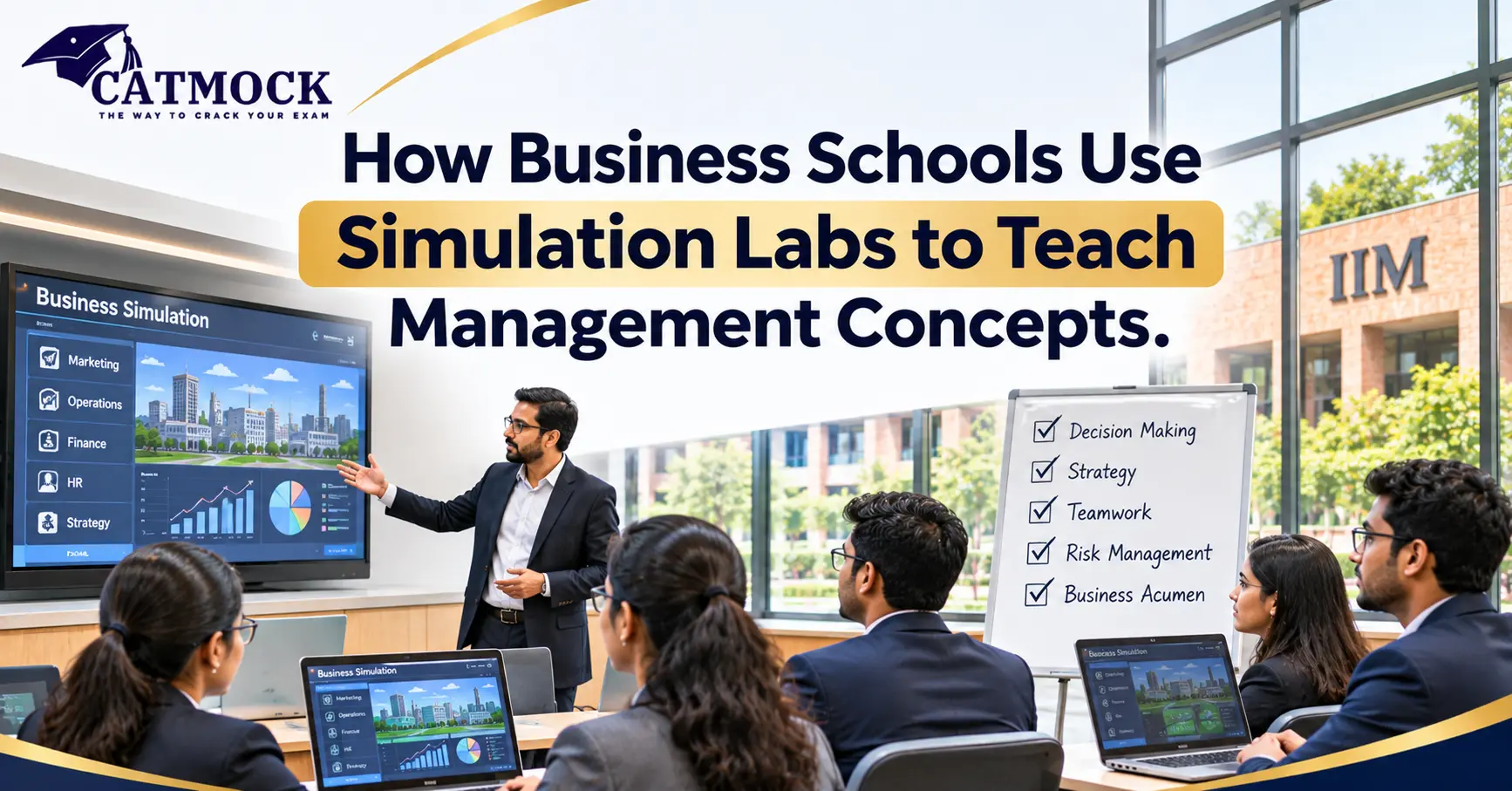
Reading about a supply chain shortage is one thing. Running a company when your orders spike, your supplier delays and your cash runs low is another. That gap between knowing and doing is exactly why business schools have invested in simulation labs.
In a simulation lab, students make real decisions in a safe, realistic environment, see the consequences unfold and then reflect on what happened. This guide explains how business schools use simulation labs to teach management concepts, what types exist, how a typical session works, where simulations shine, and where they fall short.
Quick answer: A business simulation lab is a learning space, physical, digital or both, where students run virtual or role-played organisations, markets or processes. Schools use them to teach strategy, marketing, finance, operations, leadership and negotiation through practice, followed by structured debriefing.
What Is a Simulation Lab in a Business School?
A simulation lab is a dedicated setting for experiential learning. Students take on roles such as CEO, marketing head, operations manager or trader. They make decisions in a model of a business or market, and the model responds with results such as sales, profit, inventory levels, share price or customer satisfaction.
Management training simulations are commonly described as computer programs or board games that help people learn to manage and understand business. They are also called business games, management games or business war games.
Simulation Lab vs. Classroom vs. Case Study
| Aspect | Lecture | Case Study | Simulation Lab |
|---|---|---|---|
| Student role | Listener | Analyst | Decision-maker |
| Feedback | Delayed (exam) | Discussion | Immediate, in rounds |
| Risk of failure | None | None | Safe, low-stakes |
| Repeatability | Not applicable | Fixed story | Can replay with changes |
The case method is not replaced. Simulations extend it by letting students act on what they have analysed.
Why Business Schools Use Simulations
Learning by Doing
Management is a practical skill. People learn to decide under uncertainty by deciding under uncertainty. A simulation compresses years of business cycles into hours, so students can see long-term effects of short-term choices.
The Experiential Learning Cycle
Many simulation frameworks draw on Kolb’s experiential learning cycle: concrete experience, reflective observation, abstract conceptualisation and active experimentation. A simulation provides the experience, the debrief encourages reflection and connects it to theory, and the next round lets students test new strategies.
Safe Failure
In a real firm, a poor pricing decision can cost jobs. In a simulation, it costs a few points and a valuable lesson. This freedom to fail productively is one of the most cited advantages.
Support from Policy and Accreditation Trends
National policy such as NEP 2020 encourages experiential, skills-oriented learning, and accreditation bodies stress measurable learning outcomes. Simulations help schools document how students apply knowledge.
Types of Simulation Labs and Formats
Not all simulations look alike. Schools mix formats depending on the course and budget.
Table 1: Common types of business simulation formats
| Format | How It Works | Typical Concepts Taught |
|---|---|---|
| Computerised market simulations | Teams run competing firms; decisions on price, product, production and marketing feed a market model | Strategy, marketing, competitive dynamics, finance |
| Functional simulations | Focus on one area, such as inventory, pricing or budgeting | Operations, supply chain, accounting |
| Board and table-top games | Physical games with roles and scoring | Supply chain flow, negotiation, project management |
| Role-play simulations | Students play stakeholders in a scripted scenario | Negotiation, leadership, conflict resolution, HR |
| Trading and finance labs | Live or simulated market data used to build portfolios | Investment, risk management, derivatives |
| Process and operations labs | Students run a service or production process | Lean, quality, service operations |
| Venture or startup simulations | Students build and run a virtual start-up | Entrepreneurship, cash flow, growth strategy |
| Immersive and VR/AR simulations | Digital environments with 3D or interactive elements | Leadership presence, crisis response, customer service |
| AI-driven scenario simulations | Adaptive scenarios that respond to student choices | Decision-making, analytics, ethics |
Physical vs. Digital Labs
Some schools maintain physical labs, such as trading rooms or mock service spaces, where teams work in person. Others rely on browser-based simulations that students can access anywhere. Many use a blend, with physical teamwork supported by software.
Mapping Management Concepts to Simulations
The real skill in using simulations is matching the concept to the right design.
Table 2: Management concepts and the simulations that teach them
| Management Concept | Simulation Approach | What Students Practise |
|---|---|---|
| Corporate strategy | Multi-round competitive market simulation | Positioning, resource allocation, responding to rivals |
| Marketing | Pricing and promotion simulation | Segmentation, price elasticity, brand investment |
| Finance and accounting | Firm-level financial simulation | Budgeting, working capital, capital structure, cash flow |
| Operations and supply chain | Supply chain game (such as the classic beer distribution game) | Inventory, forecasting, the bullwhip effect, coordination |
| Project management | Table-top project simulation | Scheduling, risk, resources, trade-offs |
| Human resources and leadership | Role-play and team simulation | Motivation, communication, conflict, delegation |
| Negotiation | Structured role-play | Preparation, concessions, value creation |
| Investment and risk | Trading lab with market data | Portfolio construction, risk limits, discipline |
| Entrepreneurship | Startup simulation | Business models, funding, scaling |
| Ethics and governance | Scenario-based simulations | Dilemmas, stakeholder impact, accountability |
| Analytics and decision-making | Data-driven simulations | Interpreting dashboards, testing hypotheses |
A Closer Look at a Few Examples
The supply chain game. Teams manage different links of a supply chain with limited information. Small changes in end-customer demand produce large swings upstream, demonstrating the bullwhip effect far more vividly than a textbook diagram.
The market simulation. Teams compete in a shared market over several simulated years. Choosing a price, a product mix and a marketing budget, they quickly learn that every decision interacts with competitors’ moves and their own financial limits.
The trading lab. Students build portfolios with market data, track risk and performance, and discover how emotion and discipline affect decisions. This pairs finance theory with practical judgement.
The negotiation role-play. Each side receives confidential instructions. Students discover how preparation, listening and creative trade-offs create value that a simple haggle would miss.
How a Simulation Session Works: Step by Step
A good simulation is more than software. It is a structured teaching process.
Table 3: Typical lifecycle of a simulation-based course module
| Phase | What Happens | Faculty Role |
|---|---|---|
| 1. Learning objectives | The faculty defines what concepts the simulation should teach | Selects or designs simulation, aligns with course |
| 2. Pre-briefing | Students read background material and learn the rules | Explains context, roles, scoring |
| 3. Team formation | Students form teams and assign roles | Balances skills and diversity |
| 4. Practice round | A trial round to learn the interface and mechanics | Troubleshoots, answers questions |
| 5. Decision rounds | Teams decide, the system calculates results, teams adapt | Observes, nudges, avoids giving answers |
| 6. Mid-point reflection | Short pause to compare strategies | Prompts analysis |
| 7. Final rounds | Teams refine strategy and compete or collaborate | Monitors fairness and participation |
| 8. Debriefing | Teams and faculty analyse results, link to theory | Leads discussion, connects outcomes to concepts |
| 9. Assessment | Performance, reflection and teamwork are evaluated | Grades with clear criteria |
Why the Debrief Matters Most
The debrief is where learning is consolidated. Without it, students may remember the game but not the lesson. A strong debrief asks:
- What decisions did you make and why?
- What information did you ignore or misread?
- How did your results compare with theory?
- What would you change next time?
- How might this play out in a real organisation?
Facilitator Skill
Faculty need training to run simulations well. They must keep rounds on time, handle technical glitches, manage team dynamics and steer the debrief. Schools that invest in facilitator training generally see better outcomes.
Benefits of Simulation Labs
Table 4: Benefits and limitations of simulation-based teaching
| Benefits | Limitations |
|---|---|
| Active engagement and motivation | Setup costs for software, labs and training |
| Safe space to fail and learn | Simulations simplify reality and may mislead |
| Immediate feedback through results | Students may chase the score instead of learning |
| Practice of integrated, cross-functional decisions | Teamwork conflicts can overshadow the concept |
| Development of soft skills: teamwork, communication, leadership | Assessment can be subjective if criteria are unclear |
| Repeatable and scalable for large cohorts | Technology failures can disrupt sessions |
| Measurable data on student behaviour and decisions | Quality depends heavily on facilitators |
| Better retention through experience | Not suited to every concept or learner |
Skills Students Develop
- Decision-making under uncertainty. Choosing with incomplete information.
- Systems thinking. Seeing how functions interact.
- Collaboration. Working in diverse teams under time pressure.
- Communication. Defending choices to peers and faculty.
- Analytical ability. Reading dashboards and data to adjust strategy.
- Resilience. Recovering from poor results and iterating.
Limitations and How Schools Manage Them
A simulation is a model, and every model simplifies reality. Good schools are open about this.
- Oversimplification. Real markets include irrational behaviour, regulation, culture and chance. Faculty should explain what the model leaves out.
- Gaming the system. Students may exploit quirks in the software. Debriefs should ask whether a strategy would work in the real world, not just the simulated one.
- Unequal participation. Some team members dominate. Clear roles, peer evaluation and rotation help.
- Cost and access. Licensing and lab setup can be expensive. Many schools start with low-tech or table-top games.
- Over-reliance. Simulations should complement cases, lectures, projects and internships, not replace them.
How Schools Assess Learning in Simulations
Assessment should reward understanding, not just winning. Common approaches include:
- Performance metrics. Profit, market share or return on investment, weighted modestly.
- Reflection papers. Students explain decisions, errors and lessons.
- Presentations. Teams present strategy and results to faculty or guest evaluators.
- Peer evaluation. Team members rate contributions.
- Participation and process. Preparation, engagement and collaboration.
- Concept application. Linking choices to theories and frameworks taught in class.
Industry guests, such as those engaged through a visiting faculty programme at an IIM, can add authenticity by reviewing team decisions and sharing real-world parallels.
Simulation Labs and the Wider Push for Industry Links
Simulation labs sit alongside live projects, internships and practitioner teaching. Schools often invite industry leaders to set simulation scenarios, judge team presentations or provide feedback. The result is a learning path where classroom, lab and workplace connect. Accreditation and ranking frameworks, including the NIRF portal and international bodies such as AACSB, emphasise learning outcomes and practical exposure, which simulations help demonstrate.
What to Look For When Evaluating a Business School’s Simulation Offering
If experiential learning matters to you, ask these questions before applying:
- In which courses are simulations used? Is it one elective or a core part of the curriculum?
- What formats are available? Digital, table-top, trading labs, role-plays or a mix?
- How are faculty trained? Do instructors have experience facilitating?
- How is learning assessed? Are debriefs and reflection part of grading?
- What facilities exist? Are labs staffed and accessible, or occasionally used?
- How are results used? Does the school collect feedback and improve its simulations?
- Is there industry involvement? Are practitioners part of design or evaluation?
Verify claims through the school’s official pages and public disclosures.
Tips for Students Using Simulation Labs
- Read the instructions fully. Many mistakes come from misunderstanding rules.
- Agree on a strategy early. Teams that plan before round one perform better.
- Assign clear roles. Each member should own a function.
- Track data. Keep a log of decisions and results to inform your debrief.
- Don’t chase the score alone. The aim is learning, not just ranking first.
- Reflect honestly. Note what worked, what failed and why.
- Connect to theory. Link every major decision to a framework or concept.
The Future of Simulation-Based Learning
Several trends are shaping the next generation of simulation labs:
- AI-driven scenarios that adapt to each student’s decisions and provide personalised feedback.
- Immersive technologies such as VR for leadership, crisis and customer-facing scenarios.
- Data analytics that give faculty detailed insight into how students think and decide.
- Hybrid delivery allowing remote and in-person participation.
- Industry-linked scenarios built from real company data and challenges.
These tools promise richer experiences, but the core principle remains the same: practice, reflect, improve.
Summary
- A simulation lab lets students practise management decisions in a realistic, low-risk environment.
- Formats range from computer-based market simulations to table-top games, role-plays and trading labs.
- Different management concepts match different simulations, such as supply chain games for operations or trading labs for finance.
- A session follows a cycle of briefing, practice, decision rounds and, crucially, debriefing.
- Benefits include engagement, feedback, soft skills and retention.
- Limitations include simplification, cost, gaming and dependence on facilitator quality.
- Fair assessment rewards reasoning and reflection, not just winning.
- Aspirants should ask how simulations are used, taught and assessed, and verify answers through official sources.
Frequently Asked Questions
What is a business simulation lab?
It is a learning environment, physical or digital, where students run virtual or role-played organisations or markets, make decisions and receive feedback on the results, followed by reflection and discussion.
How do simulation labs teach management concepts?
They put students in decision-making roles where choices on pricing, production, staffing or investment produce visible results. Debriefs connect those results to theories in strategy, marketing, finance, operations and leadership.
Are simulations better than case studies?
Neither is universally better. Cases build analysis and discussion skills, while simulations add practice, feedback and teamwork. Most schools combine both.
What subjects are taught through simulations?
Strategy, marketing, finance, operations, supply chain, project management, human resources, negotiation, entrepreneurship, investing and ethics are common examples.
Do simulations replace real-world experience?
No. They prepare students for real-world practice but simplify reality. Internships, live projects and work experience remain essential.
How are students graded in simulation-based courses?
Typically through a mix of performance metrics, reflection papers, presentations, peer evaluation and application of concepts. Good courses weight reasoning and learning above the final score.
How can I find out if a business school uses simulations well?
Review the curriculum, ask about formats, faculty training and assessment, and check the school’s official pages and public disclosures. Current students and alumni can describe how the labs work in practice.
Conclusion
Simulation labs have changed how business schools teach management. Instead of only reading about strategy, finance or operations, students now run companies, trade markets, negotiate deals and manage supply chains in environments that respond to their choices. Combined with careful debriefing, the experience turns abstract concepts into lived understanding.
They are not a magic solution. Simulations simplify reality, they cost time and money, and they depend on skilled facilitators. But used well, alongside cases, projects and industry exposure, they build the judgement and teamwork that employers value.
If you are comparing business schools, look beyond the brochure photo of a lab. Ask how simulations are designed, how often they are used, how learning is assessed and how faculty guide the debrief. The answers will tell you whether the lab is a showpiece or a genuine engine of learning.
You May Also Like : CAT MOCK, CAT MOCK PYQ
Follow Us On : Facebook, Instagram, Youtube