


Most IPMAT Indore aspirants split their prep time equally across all three sections—and that’s usually the first strategic mistake. Verbal Ability alone accounts for half the paper’s normalized weight, which means the highest-scoring section in IPMAT Indore isn’t the one that feels hardest; it’s the one carrying the most marks. This guide breaks down the exact sectional split, explains why Verbal Ability outweighs both Quant sections, and lays out a timing and preparation plan built around that weightage.
With roughly 30,000 candidates registering for IPMAT Indore every year and only a fraction of that pool clearing every sectional cutoff, small differences in where you invest your preparation hours can end up mattering far more than raw effort alone. Understanding exactly how each section contributes to your final percentile — before you build a study plan, not after — is what separates candidates who plateau from those who convert their score into a shortlist.
Why the Highest Scoring Section Matters in IPMAT Indore
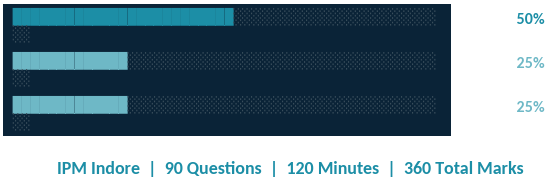
IPMAT Indore doesn’t weigh every section equally when converting raw scores into the final percentile. Verbal Ability alone determines 50% of a candidate’s normalized score, while the two Quant sections share the remaining half between them. A candidate who masters Verbal Ability can move the percentile needle more than one who focuses only on Quant, simply because of how the weighting works.
Knowing which section carries the highest scoring weight changes how a candidate should allocate study hours in the months before the exam and how many minutes to spend on each section on exam day itself. Treating all three sections as equally important—when the exam itself doesn’t—is one of the most common planning mistakes among first-time IPMAT Indor.
SECTIONAL WEIGHTAGE AT A GLANCE
IPMAT Indore Exam Pattern: Full Breakdown
The IPMAT Indore exam runs for 120 minutes and carries 90 questions across three sections, each with its own fixed 40-minute sectional timer. Candidates must attempt sections in a pre-set order and cannot return to a completed section once its timer ends.
| Section | Questions | Marks | Time Limit |
| Verbal Ability (MCQ) | 45 | 180 | 40 minutes |
| Quantitative Ability (MCQ) | 30 | 120 | 40 minutes |
| Quantitative Ability (Short Answer) | 15 | 60 | 40 minutes |
| Total | 90 questions | 360 marks | 120 minutes |
Table 1: IPMAT Indore exam pattern by section
Every correct answer earns 4 marks. MCQ sections deduct 1 mark for a wrong answer, while the Short Answer section carries no negative marking at all, making it a distinctive scoring opportunity within the paper.
Verbal Ability: The Highest Scoring Section
Verbal Ability holds the highest question count at 45 and the highest mark share at 180 out of 360, making it the single most valuable section for a candidate’s final percentile. The section blends Reading Comprehension, vocabulary, grammar, and para-jumbles, testing both speed and retention under time pressure.
Reading Comprehension passages typically anchor a large share of Verbal Ability marks, and candidates who build strong retention and reading speed can attempt this portion faster than the rest of the section. Since accuracy tends to run higher in Verbal Ability than in fast-paced Quant MCQs, many toppers report their highest raw score coming from this exact section—which is exactly why it’s worth building a dedicated daily reading habit well before exam season.
Quantitative Ability (MCQ): Second-Highest Weightage
The Quant MCQ section carries 30 questions worth 120 marks and applies the same negative marking as Verbal Ability. This section tests arithmetic, algebra, geometry, and modern math at a pace that rewards strong mental calculation over slow, written-out methods.
Because Quant MCQ carries a real penalty for wrong answers, candidates should attempt only the questions they can solve with reasonable confidence within the 40-minute window, rather than guessing to inflate their attempt count. Selective, high-confidence attempts consistently outperform blanket attempts in this section.
Quantitative Ability (Short Answer): The Safe Scoring Zone
The Short Answer section carries just 15 questions but offers a unique advantage: zero negative marking. Every attempted answer, right or wrong, costs nothing beyond the time spent, which makes this section the safest place in the entire paper to attempt every single question.
Candidates who master calculation speed can lean on this section as a reliable score booster, since it removes the accuracy pressure that affects both MCQ sections. Pair this with the sectional timing strategy below to avoid running out of time before attempting every short answer question.
What Verbal Ability Actually Tests: Building the Right Skills
Scoring well in Verbal Ability isn’t just about vocabulary—it’s a mix of several distinct skills working together. Retention, the ability to hold on to the details and arguments inside a Reading Comprehension passage, tends to matter more than raw vocabulary size, since most RC questions test what you remember and understand rather than obscure word meanings. Reading speed matters almost as much, since the section is time-bound and slow readers simply can’t get through every passage within the 40-minute window.
Beyond retention and speed, candidates also need to gauge the tone and intent of a passage—whether the author is arguing, describing, or criticizing—since several question types hinge on this rather than literal comprehension. Vocabulary and grammar round out the section, covering para-jumbles, sentence correction, and word-usage questions that tend to be more scoreable with consistent, spaced practice than with last-minute cramming.
Common Mistakes IPMAT Indore Aspirants Make with Sectional Prep
- Over-indexing on Quant difficulty: Because Quant MCQ feels harder, many candidates over-allocate study hours to it, even though it carries less weight than Verbal Ability in the final normalized score.
- Ignoring the Short Answer section until late: Since it carries no negative marking, candidates sometimes assume it needs less preparation, then struggle with speed on exam day because they never practiced it under a real 40-minute timer.
- Treating all three sections as equally time-flexible: Since each section has its own hard 40-minute cutoff, time saved in one section can never be transferred to another—a mistake candidates only realize once they’re inside the actual exam.
- Skipping sectional mocks in favor of full-length ones: Full mocks are useful, but sectional-only practice is what actually builds the specific stamina and pacing each 40-minute block demands.
Recognizing these patterns early—ideally a few months before the exam rather than during the final revision phase—makes it far easier to correct course before it affects your score.
Sectional Timing Strategy: How to Split 120 Minutes
Since each section carries its own fixed 40-minute timer, candidates cannot borrow time from one section for another. The real strategic decision lies in how many minutes within each 40-minute block go toward reading, solving, and reviewing.
| Section | Recommended Focus | Time Allocation Tip |
| Verbal Ability | Attempt RC passages first, then vocabulary-based questions | Spend 4-5 minutes per RC passage |
| Quant (MCQ) | Solve high-confidence questions first and skip lengthy ones | Cap 90 seconds per question on the first pass |
| Quant (Short Answer) | Attempt every question, since there is no penalty | Leave 5 minutes at the end for quick guesses |
Table 2: Recommended sectional timing strategy for IPMAT Indore
Section-Wise Difficulty vs Scoring Potential
A section’s difficulty level does not always match its scoring potential. Verbal Ability often feels more approachable than Quant MCQ for a wide range of candidates, yet it carries the highest mark share, which makes it doubly valuable to prepare well.
| Section | Typical Difficulty | Scoring Potential |
| Verbal Ability | Moderate | Highest (180 marks) |
| Quantitative Ability (MCQ) | High | Moderate-High (120 marks) |
| Quantitative Ability (Short Answer) | Moderate-High | Safe and steady (60 marks, no negative marking) |
Table 3: Difficulty vs scoring potential across IPMAT Indore sections
This mismatch between perceived difficulty and actual scoring weight is exactly why candidates who “feel” strong in Quant sometimes end up under-preparing for the section that ultimately decides their percentile.
How Section Scores Convert to Your Final Percentile
IPMAT Indore doesn’t use raw marks directly for the final merit list. Instead, each section’s score gets normalized against the highest and lowest scores in that section among all candidates, then scaled to its section-specific weight—50% for Verbal Ability and 25% each for the two Quant sections. This normalization is exactly why a strong Verbal Ability performance carries more percentile impact than an equally strong Quant MCQ performance.
This also means your raw score alone doesn’t tell the full story. Two candidates with the same total raw marks can land on different percentiles depending on which sections those marks came from, since Verbal Ability marks are weighted more heavily in the final scaling.
Sectional Cutoffs: Why Balance Still Matters
Even though Verbal Ability carries the highest weight, clearing every section’s minimum cutoff remains mandatory for shortlisting. Recent cycles have consistently shown Verbal Ability holding the highest sectional cutoff among the three sections, reinforcing just how central it is to the overall selection process—but a candidate who ignores Quant entirely to chase Verbal Ability marks still risks missing the sectional threshold there. The safest approach is to prioritize Verbal Ability preparation time while still comfortably clearing both Quant cutoffs.
A Quick Note on IPMAT Indore vs IPMAT Rohtak Weightage
Since IPMAT Indore and IPMAT Rohtak are often prepared for together, it’s worth noting that their sectional weightage isn’t identical, even though both exams lean heavily on Verbal Ability. Rohtak’s paper structure allocates marks slightly differently between Verbal and Quant compared to Indore, which means a study plan optimized purely around Indore’s 50-25-25 split may need small adjustments if you’re also targeting Rohtak. The core principle stays the same across both exams, though—check the exact sectional weightage for whichever paper you’re sitting, rather than assuming one exam’s structure applies to the other.
Preparation Tips to Maximise Your Highest Scoring Section
- Read editorials and long-form articles daily to build the reading speed Reading Comprehension demands.
- Build a rotating vocabulary list and revise it weekly rather than cramming words close to the exam.
- Practice full Verbal Ability sectional tests under the exact 40-minute limit to build section-specific stamina.
- Attempt every Quant Short Answer question in mocks, since the zero-penalty structure rewards a full attempt.
- Track section-wise accuracy separately in every mock, and rebalance study hours toward whichever section shows the smallest improvement.
Summary
| Key Point | Detail |
| Highest scoring section | Verbal Ability (45 questions, 180 marks, 50% weight) |
| Total questions | 90 across three sections |
| Total marks | 360 |
| Total duration | 120 minutes (40 minutes per section) |
| Negative marking | -1 for MCQs, none for Quant Short Answer |
| Safest scoring section | Quantitative Ability (Short Answer) |
| Score conversion method | Section-wise normalisation, then weighted scaling |
Table 4: IPMAT Indore’s highest-scoring section—quick summary
From IPMAT to CAT: Why This Prep Habit Pays Off Later
Whether IPMAT Indore is your final destination or a stepping stone toward CAT a few years down the line, the habit of studying a paper’s weightage before diving into random practice is one worth keeping. Aspirants who later prepare for CAT often find the same principle holds — some sections carry disproportionate weight in the final percentile, and identifying them early saves months of misdirected effort. The exams themselves differ in format and difficulty, but the underlying discipline of mapping marks-to-effort before building a study plan carries over directly.
Conclusion
Verbal Ability’s 50% weight makes it the section that decides most IPMAT Indore outcomes, but a balanced attempt across the full exam pattern still matters, since Quant MCQ and Quant Short Answer together make up the other half of the paper. Candidates who study this weightage early, practice sectional mocks under real-time limits, and lean on the Short Answer section’s zero-penalty structure give themselves the best possible shot at a strong overall percentile in IPMAT Indore. The exam rewards preparation that mirrors its own structure — not effort spread evenly across sections that were never designed to carry equal weight.
Frequently Asked Questions
Q1: Which is the highest scoring section in IPMAT Indore?
Verbal Ability is the highest-scoring section, with 45 questions worth 180 marks and a 50 percent weight in the final normalized score.
Q2: How many questions are there in IPMAT Indore?
IPMAT Indore carries 90 questions in total: 45 in Verbal Ability, 30 in Quant MCQ, and 15 in Quant Short Answer.
Q3: What is the sectional time limit in IPMAT Indore?
Each of the three sections carries a fixed 40-minute time limit, adding up to a total exam duration of 120 minutes.
Q4: Is there negative marking in IPMAT Indore?
Yes, MCQ sections deduct 1 mark for every wrong answer, while the Quant short answer section has no negative marking.
Q5: Which section should I prioritize for IPMAT Indore preparation?
Verbal Ability deserves the most preparation time, since it carries the highest question count and the highest weight in the final score.
Q6: Can I switch between sections during the IPMAT Indore exam?
No. Candidates must attempt sections in the pre-set order and cannot return to a section once its 40-minute timer ends.
You May Also Like: CAT MOCK, CAT MOCK PYQ
Follow Us On: Facebook, Instagram