
Picture two equally capable candidates sitting the same management entrance exam. One reads the screen comfortably and types without effort. The other has a condition that makes reading slower, writing harder or sitting for two hours painful. Same questions, same clock. Is that a fair test?
A test-taking accommodation exists to answer that question. It does not lower the standard or hand anyone an advantage. It changes how the test is delivered so the exam measures your aptitude and not your disability. If you are preparing for CAT, XAT, GMAT, GRE or any other management entrance exam, knowing your rights and the process can protect both your score and your peace of mind.
Quick answer: A test-taking accommodation is an approved change to exam conditions, such as compensatory time, a scribe or reader, breaks, assistive technology or an accessible centre, for a candidate with a disability or documented condition. In India, candidates with benchmark disability (40% or more) and, in many cases, candidates with a lower disability percentage who have a documented difficulty in writing can request it. For GMAT and GRE, you apply to the test body and must be approved before you schedule.
What Is a Test-Taking Accommodation?
A test-taking accommodation is a modification to the standard testing environment, format or timing that removes a barrier caused by a disability or documented condition, while keeping the exam’s purpose and difficulty intact.
Three ideas sit inside that definition:
- It is individual. The accommodation matches your functional need, not your diagnosis label.
- It is approved, not automatic. You apply, provide evidence and receive a decision.
- It protects fairness. The test still measures the same skills for everyone.
“Extra Time” vs “Compensatory Time”
You will see both phrases. Government guidelines in India use compensatory time, and the earlier wording of “extra time” or “additional time” was changed on purpose. The idea is that the time compensates for a barrier, such as the slower speed of dictating to a scribe, rather than giving a bonus.
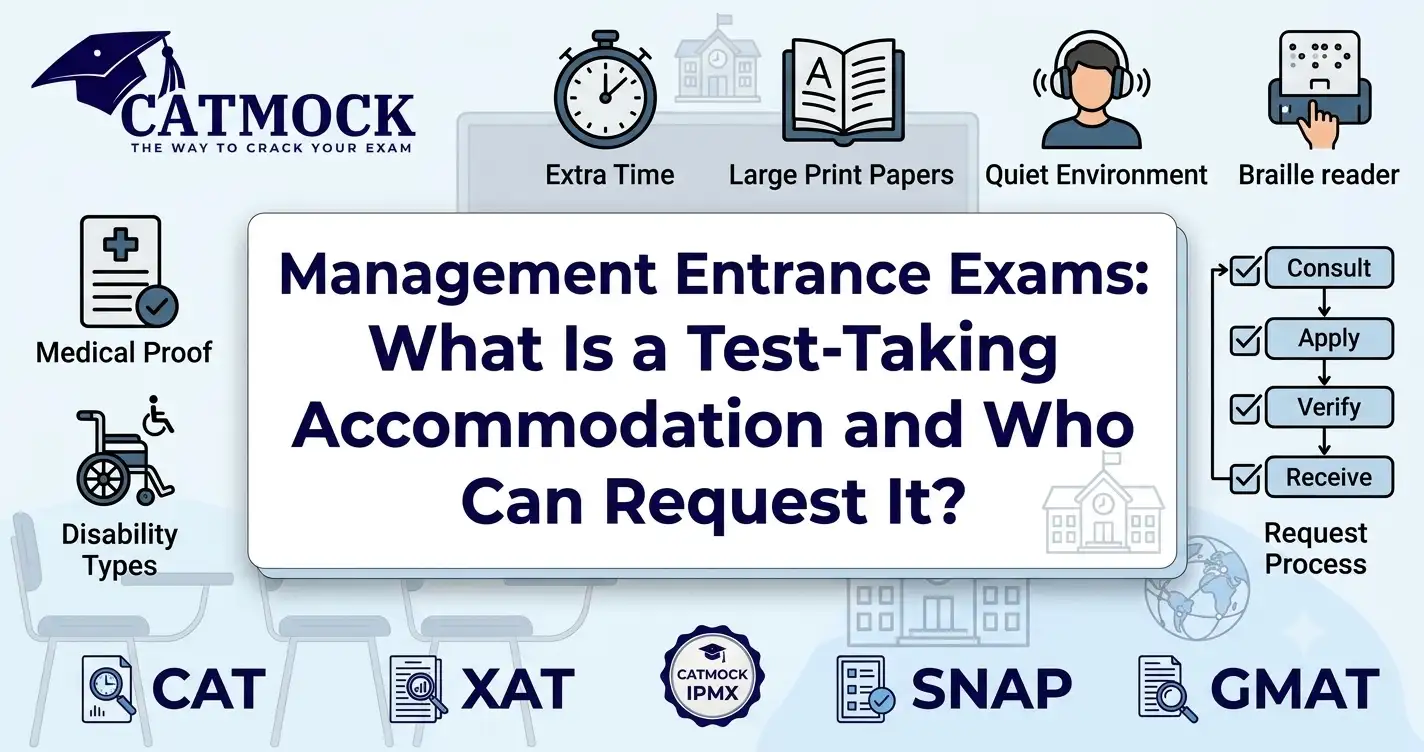
Common Accommodations at a Glance
| Accommodation | What it does | Typically used by |
|---|---|---|
| Compensatory time | Adds time to each hour of the exam | Candidates with writing, reading or processing limitations |
| Scribe or reader | A person writes or reads on your behalf under rules | Candidates with visual, locomotor or severe writing limitations |
| Extra or longer breaks | Allows rest or medical care during the test | Candidates with chronic or systemic conditions |
| Assistive technology | Screen magnification, screen readers or similar tools | Candidates with low vision or sensory disabilities |
| Accessible centre or seating | Barrier-free access and suitable seating | Candidates with mobility disabilities |
| Separate or quiet room | Reduces distraction or sensory load | Candidates with attention, anxiety or sensory conditions |
Who Can Request a Test-Taking Accommodation?
Eligibility depends on two things: the legal category you fall under and the rules of the specific exam.
Persons with Benchmark Disability (PwBD)
Under the Rights of Persons with Disabilities Act, 2016, a “benchmark disability” is a specified disability of 40% or more, certified by a competent authority. PwBD candidates form the core group for scribe and compensatory time facilities in Indian exams. Typically you need a valid disability certificate or UDID.
Persons with Disabilities Below 40% (PwD)
This is the group many applicants overlook. A person with a specified disability below 40% is still a person with disability under the Act, even though not a “benchmark” case.
Under a government memorandum issued in 2018 and revised in 2022, candidates in this group can receive a scribe and compensatory time if they have a documented limitation in writing. The medical certificate must state that you have difficulty writing and that a scribe is essential.
The 40% Misconception
A frequent mistake is treating the 40% figure as the key that unlocks a scribe. The benchmark mainly determines whether you count as a person with benchmark disability. Scribe eligibility depends on functional need and the exam’s rules. Equally, being below 40% does not automatically shut you out.
The Supreme Court has also weighed in. Reports of its rulings say that denying a scribe or extra time purely on the severity of a disability, meaning the benchmark threshold, conflicts with the Rights of Persons with Disabilities Act. Earlier decisions made the same point, namely that benchmark disability is not a precondition for accommodation. Exam bodies have since adjusted their notices, and the disability affairs department issued further clarification in 2025.
Conditions Commonly Covered by International Tests
For the GMAT and GRE, accommodations are typically considered across categories such as:
- Learning and cognitive disabilities
- Attention-related conditions (such as ADHD)
- Psychological disabilities
- Physical and systemic disabilities
- Sensory disabilities (vision and hearing)
Who Can Request: Quick Eligibility Table
| Your situation | Can you request? | What usually decides it |
|---|---|---|
| Disability certified at 40% or more | Yes, in Indian exams | Valid disability certificate or UDID, plus the exam’s rules |
| Disability below 40% with difficulty in writing | Yes, in many Indian exams | Medical certificate in the prescribed format confirming the writing limitation |
| Learning disability, ADHD or similar (GMAT/GRE) | Yes, through the test body | Documentation from a qualified professional and a functional rationale |
| Temporary injury or medical condition | Sometimes | Depends on the test body’s policy. Check before you register |
| No documented condition | No | Accommodations need evidence of need |
The Rules Behind Scribes and Compensatory Time in India
Most Indian exams follow guidelines issued by the Department of Empowerment of Persons with Disabilities. Key principles, as reflected across recent exam notices, include:
- Compensatory time of not less than 20 minutes per hour of the exam for candidates eligible for a scribe. Many exams grant it even to eligible candidates who choose not to use a scribe.
- For exams shorter than an hour, the extra time is calculated proportionately.
- Scribe arrangements vary by exam. Some let you bring your own scribe and require an undertaking from both of you, along with a photograph. Others provide a scribe. The scribe’s qualification is generally set at one step below the candidate’s.
- Misuse has serious consequences. If a scribe is found answering independently, candidature can be cancelled.
- Requests are often registration-bound. Many notices state that only candidates who registered for compensatory time can receive it, because the time is built into the exam system.
These principles show a pattern, but each exam publishes its own details, so always read the current brochure.
Test-Taking Accommodation by Exam: CAT, XAT, GMAT, GRE and More
CAT 2026
CAT is scheduled for 29 November 2026, and registration has closed. Public guides describe the standard CAT facilities as compensatory time at 20 minutes per hour and a scribe where needed, supported by a valid disability certificate of at least 40%. Because CAT is a 120-minute test, that rule works out to about 40 extra minutes, but confirm the exact entitlement and the scribe process in the official CAT 2026 brochure on the CAT portal.
If you did not request an accommodation during registration: contact the CAT helpdesk immediately and explain your situation. Do not assume it can be added on exam day.
XAT 2027
Registration for XAT 2027 closes on 6 December 2026, so there is still time to act. XLRI’s notification and registration page set out how PwD candidates should declare their requirements and upload documents. Read the PwD section of the XAT 2027 brochure on xatonline.in before submitting your application, since requests are typically tied to registration.
NMAT by GMAC, CMAT and Other Indian Exams
Each exam sets its own procedure. For NTA-run exams, check the information bulletin for PwD and scribe provisions. NTA’s guidance for other exams, such as JEE Main, shows the typical shape: a scribe on production of a relevant certificate, compensatory time of at least 20 minutes per hour and option selection during registration. For NMAT, read the current GMAC and participating-institute notices. Never assume that the rules of one exam apply to another.
GMAT
The GMAT process is run by the Graduate Management Admission Council (GMAC), and the key rule is the order of steps.
- Apply first, schedule later. You must submit the accommodation request and receive approval before you schedule your test. It is not possible to book accommodated testing in advance.
- Gather documentation by disability type. This usually includes a completed request form, supporting records from a qualified evaluator or healthcare provider and a statement explaining the impact on testing.
- Allow weeks. GMAC’s published materials describe review timelines of several weeks, and delays occur when documents are incomplete.
- Typical accommodations include 50% or 100% additional time, extra breaks and other approved adjustments.
GRE
The GRE is administered by ETS, which reviews accommodation requests independently of GMAC. Approval on one test does not transfer to the other. Some candidates with an established accommodation history may use a streamlined route for certain requests, but conditions apply, so read the ETS guidance on the GRE site before applying.
Exam Comparison Table
| Exam | Who reviews your request | When to request | Typical extra time |
|---|---|---|---|
| CAT 2026 | IIM exam authority | During registration (now closed) | Compensatory time as set in the brochure |
| XAT 2027 | XLRI | During registration (closes 6 Dec 2026) | Per the XAT brochure |
| Other NTA/Indian exams | The exam body | During registration | Commonly 20 minutes per hour |
| GMAT | GMAC | Before scheduling | 50% or 100% additional time where approved |
| GRE | ETS | Before registering or scheduling | As approved per request |
The details above are summaries. The official brochure for your exam is the final authority.
Documents You Will Typically Need
Document requirements differ, but most requests rely on a combination of the following.
| Document | Used for | Notes |
|---|---|---|
| Disability certificate or UDID | Establishing disability status in Indian exams | Must be issued by a competent authority and be valid |
| Medical certificate in the exam’s prescribed format | Confirming limitation in writing for candidates below 40% | Must state that a scribe or extra time is essential |
| Scribe details and undertaking | Using your own scribe | Both you and the scribe may need to sign, with photographs |
| Evaluator report or clinical documentation | GMAT and GRE requests | Should describe functional impact, not only a diagnosis |
| Accommodation request form | All international requests | Completed in full, submitted with all documents together |
| Prior approval letters | Supporting similar requests | May help in some cases, but each test body decides independently |
You can obtain a UDID through the government’s disability card system at swavlambancard.gov.in. Start early, because certification can take time.
How to Request a Test-Taking Accommodation: Step by Step
- Identify your category. Determine whether you are a benchmark case, a below-40% case with a writing limitation, or a candidate with a condition covered by an international test.
- Read the exam’s official brochure. Look for the PwD or accommodations section and note deadlines.
- Gather your documents. Collect your certificate, medical forms and any evaluator reports.
- Submit the request at the right time. For most Indian exams that is during registration. For GMAT and GRE it is before you schedule.
- Arrange your scribe, if allowed. Confirm eligibility rules and complete any undertakings.
- Keep confirmation and proof. Save acknowledgement emails and approval letters.
- Carry your documents on exam day. Bring originals or printouts as the notice requires.
When to Apply: A Timing Guide
| Exam type | Best time to act |
|---|---|
| Indian exams (CAT, XAT, NTA exams) | Before you submit the registration form, since options are often locked afterward |
| GMAT | As early as possible. Approval must precede scheduling, and review takes weeks |
| GRE | Before registering for your preferred date, leaving time for ETS review |
| Any exam, if you missed the window | Contact the exam helpdesk immediately and ask in writing |
Since CAT is on 29 November and XAT registration closes on 6 December, candidates applying this season should check their forms today.
Common Mistakes That Lead to Rejection or Delay
- Waiting until after registration. Many exams lock options once the form is submitted.
- Assuming 40% means automatic approval. The percentage establishes status, but eligibility for a scribe depends on the rules and your functional need.
- Submitting an outdated or wrongly formatted certificate. Use the exam’s prescribed format.
- Sending documents in pieces. For GMAT and GRE, incomplete packages slow the review.
- Using an ineligible scribe. A scribe who does not meet the qualification rule can lead to cancellation.
- Using the wrong website. Always apply through the exam body’s official portal
- Assuming approval carries across tests. GMAT approval does not transfer to GRE or to Indian exams.
Exam-Day Tips for Accommodated Candidates
- Reach the centre early and confirm your seating and timing arrangements.
- Bring all certificates, your admit card and any scribe documents.
- Rehearse with your scribe using timed mock tests so dictation feels natural.
- Practise using any approved assistive technology beforehand.
- Tell the invigilator calmly if an agreed provision is missing, and ask for the supervisor if needed.
Official Resources to Bookmark
- CAT official portal for the brochure and PwD provisions
- XAT official portal for registration and PwD guidance
- GMAT official site for GMAC accommodation information
- ETS GRE for GRE accommodation requests
- Department of Empowerment of Persons with Disabilities for national guidelines
- UDID portal to apply for a unique disability ID
- NTA CMAT for the information bulletin
Summary
- A test-taking accommodation is an approved change to exam conditions that removes a disability-related barrier without lowering the standard.
- In Indian exams, compensatory time is generally not less than 20 minutes per hour for eligible candidates, with or without a scribe.
- Candidates with benchmark disability (40% or more) can request accommodations, and many exams also extend them to candidates below 40% who have a documented difficulty in writing.
- The 40% figure establishes benchmark status. It does not by itself decide scribe eligibility.
- GMAT and GRE requests go to GMAC and ETS separately, and approval must come before you schedule.
- Most Indian exam requests are tied to registration, so read the PwD section of the brochure before submitting your form.
- CAT 2026 is on 29 November 2026, and XAT 2027 registration closes on 6 December 2026.
Frequently Asked Questions (FAQs)
What is a test-taking accommodation in management entrance exams?
It is an approved change to the exam conditions, such as compensatory time, a scribe, breaks or assistive technology, that helps a candidate with a disability or documented condition take the test fairly.
Who can request a test-taking accommodation?
Candidates with benchmark disability (40% or more), many candidates with lower disability who have a documented writing difficulty, and, for GMAT and GRE, candidates with documented learning, attention, psychological, physical or sensory conditions.
Is 40% disability mandatory to get a scribe?
No. The 40% benchmark defines benchmark disability, but guidelines also allow a scribe and compensatory time for candidates below 40% who have a certified limitation in writing.
How much compensatory time do candidates get?
Government guidelines provide not less than 20 minutes per hour of the exam for eligible candidates. Check each exam’s brochure for the exact entitlement.
Can I bring my own scribe?
It depends on the exam. Some allow your own scribe with an undertaking, while others provide one. Rules on the scribe’s qualification also apply.
Do I need to apply before registering for the exam?
For GMAT and GRE, you need approval before you schedule. For most Indian exams, you indicate your requirement during registration.
I missed the accommodation option during registration. What now?
Contact the exam’s helpdesk immediately, explain your situation and request guidance in writing. Do not assume it can be arranged on exam day.
How long does GMAT accommodation approval take?
GMAC describes a review period of several weeks, and incomplete documents cause delays, so apply early.
Does approval for the GMAT apply to the GRE?
No. GMAC and ETS review requests independently, so you must apply to each.
Where do I get a disability certificate or UDID?
Disability certificates come from a competent medical authority, and the UDID can be applied for through the government’s unique disability ID portal.
Conclusion
A test-taking accommodation is about fairness, not favours. If a documented condition affects how you read, write, process or sit through an exam, the system provides ways to level the field, from compensatory time and scribes to assistive technology and accessible centres.
The deciding factor is almost always timing and paperwork. Identify your category, read the official brochure, prepare your certificate and submit your request at the right moment. With CAT on 29 November 2026 and XAT registration open until 6 December 2026, now is the time to check your forms. Confirm every rule on the official exam website before you act.
You May Also Like : CAT MOCK, CAT MOCK PYQ
Follow Us On : Facebook, Instagram, Youtube