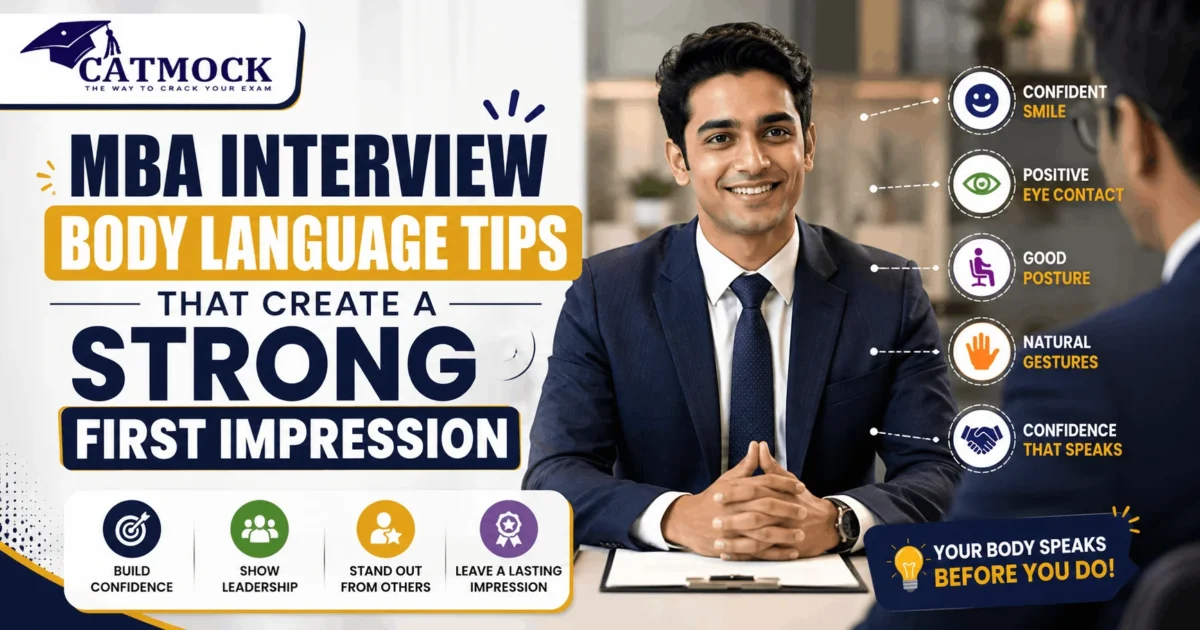
Getting shortlisted for an MBA interview is a huge milestone, but the work doesn’t stop there. Panellists often form an opinion within the first few seconds — before you’ve answered a single question. That snap judgment is driven largely by MBA interview body language: your posture, eye contact, handshake, and overall presence.
Strong nonverbal communication signals confidence, honesty, and composure. Nervous body language, on the other hand, can undercut even a brilliant verbal answer. The good part is that body language is learnable — small, deliberate adjustments to how you sit, look, and gesture can change how a panel perceives you within minutes.
This guide breaks down everything you need to know about mastering MBA interview body language: posture, eye contact, handshakes, virtual interview etiquette, common mistakes, and a quick-reference checklist you can use right before you walk in. If you’re also polishing your CAT preparation alongside your interview prep, our free CAT mock tests can help you walk into results season with confidence on both fronts.
Body language is one piece of the puzzle — see our MBA Interview Preparation guide for the complete WAT-GD-PI prep system.
1. MBA Interview Body Language: A Quick Snapshot
Before diving deep into each signal, here’s a quick snapshot of what confident MBA interview body language looks like in practice. Use this table as a fast pre-interview refresher.
Table 1: MBA Interview Body Language at a Glance
| Signal | What to Do |
|---|---|
| Posture | Sit upright, shoulders relaxed, lean slightly forward when engaged |
| Eye Contact | Maintain steady, natural contact; shift gently across the panel |
| Hand Gestures | Use open, moderate gestures to support your points |
| Handshake | Firm grip, brief duration, confident eye contact |
| Facial Expression | Relaxed, attentive, occasional natural smile |
| Voice and Pace | Steady tone, moderate pace, clear pauses |
Each of these signals works together, not in isolation. A firm handshake paired with a slouched posture sends a mixed message, and steady eye contact paired with fidgeting hands undercuts the confidence you’re trying to project. The goal is consistency across every nonverbal cue, from the moment you enter the room to the moment you leave it.
2. Why Body Language Matters in MBA Interviews
Admissions panels are evaluating far more than just your spoken answers. They’re reading your nonverbal communication as a proxy for how you’re likely to behave in a classroom, a boardroom, or a client-facing meeting during your MBA and beyond. This is precisely why interview body language carries so much weight in the overall evaluation — it’s a preview of your professional presence.
Confident body language during an MBA interview reassures the panel that you can handle pressure gracefully — a quality every top B-school values in its future managers and leaders. Closed-off or fidgety signals, by contrast, can raise doubts even when your actual content is strong and well-rehearsed.
Nonverbal cues also shape how persuasive your answers feel. A candidate who maintains steady eye contact and an open, upright posture while describing a leadership example comes across as more credible than one who slouches or avoids the panel’s gaze. Official career-guidance bodies echo this: employment services such as India’s National Career Service, the UK’s National Careers Service, and the U.S. Department of Labor all list confident body language and calm posture among the top predictors of interview success across virtually every hiring context.
Treating interview body language as a skill worth rehearsing — rather than an afterthought you’ll figure out on the spot — meaningfully improves your overall performance on interview day.
The same nonverbal signals matter in the Group Discussion round too — see GD for MBA Admission.
3. Posture and Sitting Position
Your posture communicates energy and confidence before you say a single word, so getting it right matters from the moment you enter the interview room.
How to Sit Confidently
Sit upright with your back lightly touching the chair, avoiding both a rigid, overly-formal posture and a slouched, overly-casual lean. Keep both feet flat on the floor, and rest your hands calmly on your lap or the table rather than crossing your arms defensively.
Leaning slightly forward when answering a question signals genuine engagement and interest in the conversation, while leaning back too far can read as detached or overly casual to the panel. A small forward lean at key moments — when making an important point, for instance — can subtly reinforce your confidence without appearing forced.
Avoiding Nervous Fidgeting
Common nervous habits — tapping a pen, jiggling a leg, repeatedly adjusting your clothing, or touching your face — distract the panel and quietly reveal underlying anxiety, even if your verbal answers sound composed. Practising in front of a mirror or recording yourself on video helps you notice these habits early, so you can consciously replace them with stillness well before the actual interview.
A calm, grounded posture throughout the interview reinforces every strong answer you give, and it becomes especially important during unexpected or difficult questions, when nervous fidgeting tends to spike.
Practising these signals is easiest inside a realistic simulation — see our MBA Mock Interview Guide.
4. Eye Contact and Facial Expressions
Eye contact ranks among the most powerful nonverbal signals in any interview setting, since it conveys honesty, attentiveness, and confidence simultaneously — often more effectively than words alone.
When facing a panel of multiple interviewers, shift your gaze naturally between them rather than fixating on just one person or staring blankly past the group. This shows that you’re engaging with the entire panel, not just the person who happens to be speaking.
Your facial expression should stay relaxed and attentive, with occasional, genuine smiles rather than a fixed, artificial grin held throughout the conversation. Nodding briefly while a panellist speaks shows active listening, and this small gesture builds rapport over the course of the conversation. Avoid frowning or narrowing your eyes when thinking through a tough question, since these expressions can unintentionally signal discomfort or confusion rather than careful thought.
Table 2: Positive vs Negative Body Language Signals
| Positive Signals | Negative Signals to Avoid |
|---|---|
| Steady, natural eye contact | Staring or constantly looking away |
| Open palm gestures while speaking | Crossed arms or clenched fists |
| Upright, relaxed posture | Slouching or excessive slumping |
| Firm, brief handshake | Weak grip or overly long handshake |
| Calm, measured pace of speech | Rapid, rushed, or monotone speech |
| Occasional natural smile | Fixed, forced grin or no expression at all |
5. Hand Gestures and the Handshake
Purposeful hand gestures can make your answers more engaging and easier to follow, provided they stay moderate and natural rather than exaggerated or repetitive. Open palm movements while explaining an idea reinforce confidence and clarity, while pointing fingers or sharp, jerky motions can feel aggressive or unpolished in a formal admissions setting.
The handshake at the start and end of the interview sets an immediate tone for the entire conversation. Offer a firm, brief handshake paired with direct eye contact and a warm greeting — a limp grip and an overly forceful one both leave the wrong impression, just in opposite directions. The UK government’s official JobHelp guide to confident body language echoes the same advice: a confident handshake, steady eye contact, and an upright posture remain foundational across virtually every interview format.
Practising this small interaction beforehand, ideally with a friend, mentor, or an experienced GDPI coach, helps remove any awkwardness on interview day and lets it feel natural rather than rehearsed.
6. Body Language During Virtual MBA Interviews
Video interviews change the mechanics of body language, but not its importance — if anything, the camera makes small nonverbal missteps more noticeable, not less.
Sit centred in the frame with your head and shoulders clearly visible, and position your camera at eye level rather than looking down into the lens, which can create an unflattering and disengaged angle. Looking directly at the camera — rather than at your own image on screen — best simulates natural eye contact for the panel, even though it feels slightly unnatural at first.
Good to know: Keep your hands visible within the frame when gesturing, and minimise background movement or clutter that could distract the panel. A stable internet connection and a quiet room remove technical distractions that could otherwise undercut an otherwise strong nonverbal presence on camera.
This guidance closely mirrors official advice from the UK’s National Careers Service on video interviews, which recommends sitting up straight, maintaining eye contact through the camera, and doing a practice run on video before the real interview — a habit worth adopting regardless of which B-school you’re interviewing with.
7. Common Body Language Mistakes to Avoid
Even well-prepared candidates slip into a few recurring nonverbal habits that quietly weaken their overall presentation. Watching for these patterns during mock interviews helps you correct them well before the real thing:
- Avoiding eye contact entirely, especially when answering a difficult or unexpected question.
- Crossing arms across the chest, which can read as defensive or closed-off to the panel.
- Excessive hand movement that distracts from the actual content of your answer.
- Checking a watch or phone, even briefly, which signals impatience or distraction.
- Speaking too quickly due to nerves, which can make your posture and gestures appear rushed and unsteady as well.
Most of these mistakes aren’t intentional — they’re stress responses that surface under pressure. That’s exactly why structured mock interview practice matters so much: it exposes these habits in a low-stakes setting, giving you time to correct them before they show up in front of an actual admissions panel.
8. Quick Reference Checklist
Keep this checklist handy in the days leading up to your interview, and run through it mentally right before you walk into the room.
Table 3: MBA Interview Body Language Checklist
| Category | Checklist Item |
|---|---|
| Entry | Confident walk, firm handshake, warm greeting |
| Seating | Upright posture, feet flat, hands calmly placed |
| Eye Contact | Shift naturally across the panel, avoid staring or avoiding gaze |
| Gestures | Open, moderate hand movement to support key points |
| Voice | Steady pace, clear pauses, calm tone |
| Exit | Thank the panel, maintain composed posture until you leave the room |
If you’d like structured, expert-led practice before your actual interview, CATMock’s GDPI mentorship sessions pair you with experienced faculty who can give direct feedback on exactly these nonverbal signals — the kind of feedback that’s hard to get from practicing alone in front of a mirror.
9. Frequently Asked Questions
Why does body language matter so much in MBA interviews?
Body language signals confidence, honesty, and composure — qualities that reassure panellists about how a candidate might perform under pressure in a management role. Since MBA interviews evaluate leadership potential as much as academic readiness, nonverbal cues carry unusually high weight in the overall assessment.
How should candidates maintain eye contact with a panel of interviewers?
Shift your gaze naturally between panellists rather than fixating on one person, and maintain steady, comfortable contact rather than staring. This shows engagement with the entire panel, not just whoever is currently speaking.
What is the ideal handshake for an MBA interview?
A firm, brief handshake paired with direct eye contact and a warm greeting creates the strongest first impression at the start of the interview. Avoid both a limp grip and an overly forceful one, since both leave the wrong impression.
Does body language matter in virtual MBA interviews too?
Yes. Candidates should sit centred in the frame, look at the camera rather than the screen, and keep gestures visible to maintain a strong nonverbal presence on video. Official guidance from government career services confirms this advice applies across virtually every interview format, in-person or virtual.
What are the most common body language mistakes MBA candidates make?
Avoiding eye contact, crossing arms, fidgeting, and speaking too quickly rank among the most common nonverbal mistakes that weaken an otherwise strong interview performance.
10. Conclusion
Strong MBA interview body language works alongside your verbal answers, not separately from them, to create a confident and credible overall impression. Upright posture, steady eye contact, purposeful gestures, and a firm handshake together signal the composure that every admissions panel is looking for in a future manager.
Practising these signals in front of a mirror, on video, or with a friend before your actual interview builds the muscle memory needed to stay natural under real pressure. When your body language and your spoken answers align, the panel experiences a candidate who feels genuinely prepared, self-assured, and ready for the program.
Pair this body-language prep with the right academic groundwork — explore CATMock’s live prep sessions and blog resources to round out your complete MBA admissions strategy, from the entrance exam all the way through to the final interview.
You May Also Like : CATMOCK / CATMOCK PYQ
Follow Us On : Facebook / Instagram