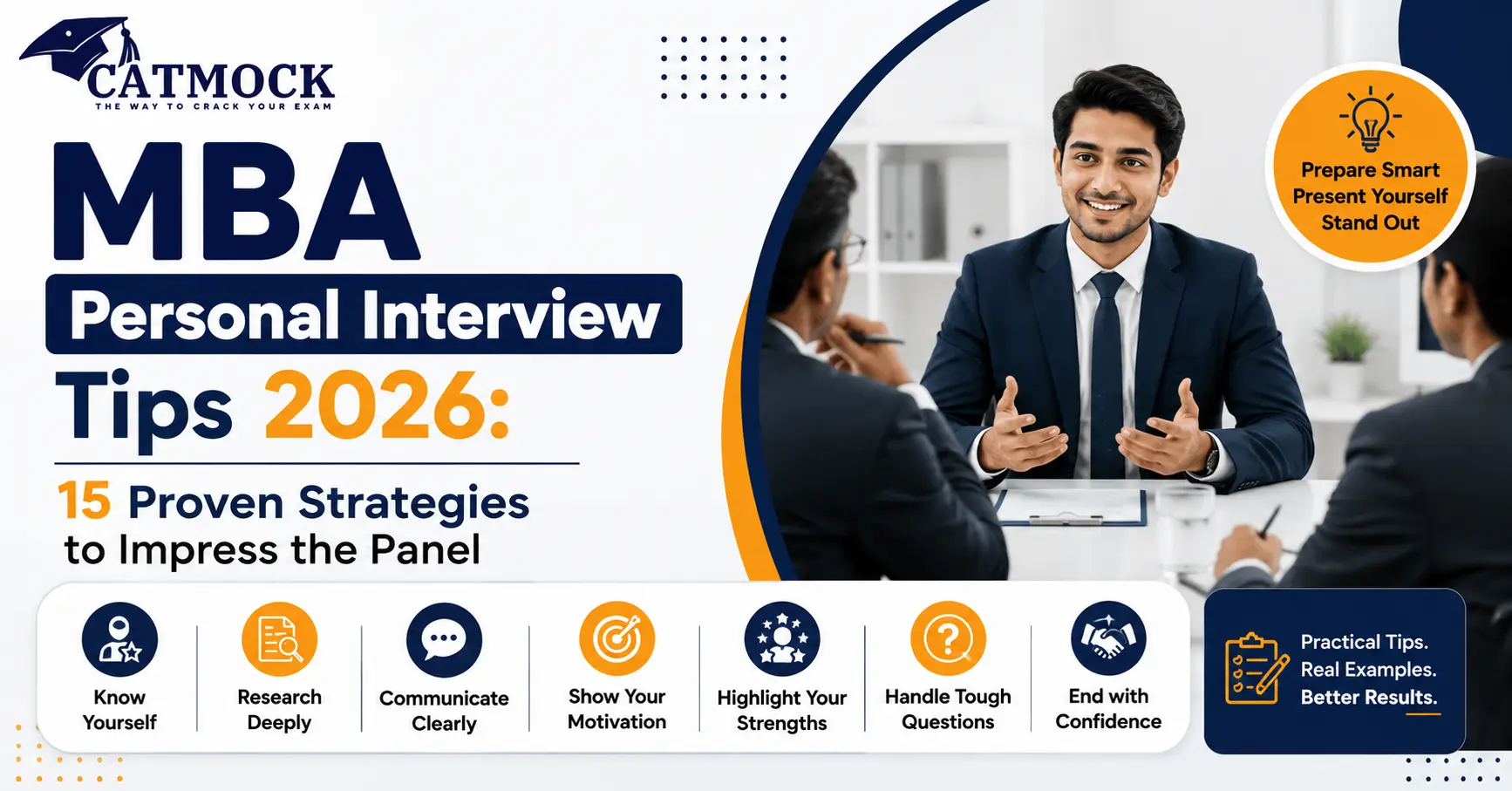
Somewhere between your CAT scorecard and your final admission offer sits a 15-minute conversation that can undo months of preparation — or seal your seat. The Personal Interview (PI) doesn’t test what you know as much as it tests how clearly you can present what you know, under pressure, to strangers who’ve heard a thousand similar stories before yours. That’s exactly why the right MBA Personal Interview tips matter more than another round of question-mugging.
This guide isn’t a generic list copied from last year’s blog. It’s built around what actually moves the needle in a B-school interview room: your body language, your resume command, your ability to handle a curveball, and the small habits that separate a “decent” candidate from a “selected” one. Whether you’re heading into an IIM, XLRI, SPJIMR, or any WAT-GD-PI process, these MBA Personal Interview tips apply directly to your prep.
For the complete WAT-GD-PI roadmap, start with our MBA Interview Preparation guide.
Why Personal Interview Tips Deserve Your Full Attention
It’s tempting to treat the PI as a formality once you’ve cleared the CAT cutoff. That’s a mistake nearly every unsuccessful candidate makes in hindsight. The Personal Interview, often combined with the Written Ability Test (WAT), typically decides 20–50% of your final composite score at top institutes — meaning a brilliant percentile can still be undone by fifteen unprepared minutes. Following structured MBA Personal Interview tips isn’t about scripting yourself into a robot; it’s about removing the avoidable mistakes so your genuine personality and preparation actually come through.
If you haven’t yet built a structured practice routine, pair this article with our detailed MBA Mock Interview Guide, which walks through how to simulate the real PI before you sit in front of an actual panel.
Before the Interview: Preparation Tips That Set the Foundation
1. Master Your Resume — Every Single Line
Panels almost always start from your resume or application form. If you’ve written “led a team of 12,” expect a follow-up on what that team did, what went wrong, and what you’d do differently. Nothing damages credibility faster than fumbling over your own claims.
2. Build a Clear “Why MBA, Why Now” Narrative
Vague answers like “to enhance my career” get flagged instantly. Connect your past decisions, your current gap, and your future goal into one coherent story a panelist could repeat back in one sentence.
3. Research the Institute Beyond the Website Homepage
Know the specialization tracks, recent rankings, and anything distinctive about the program’s pedagogy. A specific, well-researched answer to “Why this institute?” signals genuine intent over a mass-applied strategy.
4. Revise Your Core Academic Subjects
Especially if you’ve claimed a specialization or strong GPA in a subject, expect a basic conceptual question from it. This is one of the most common reasons confident candidates freeze mid-interview.
5. Build a Current Affairs Habit, Not a Cram Session
Reading one newspaper daily for a month beats memorizing fifty current-affairs facts the night before. Panels can tell the difference between genuine awareness and last-minute mugging within two follow-up questions.
If your process also includes a WAT or GD round, pair this with WAT Answer Structure and GD for MBA Admission.
During the Interview: Tips That Control the Room
6. Open Strong, But Don’t Over-Rehearse
Your opening answer to “Tell me about yourself” sets the tone. Prepare the structure (background → strength → goal) but keep the delivery natural, not word-for-word memorized.
7. Answer the Question Asked — Not the One You Prepared For
A common trap: twisting every question back to a rehearsed answer. Panelists notice this immediately, and it reads as evasive rather than clever.
8. Use the STAR Method for Behavioral Questions
For “Tell me about a time you…” questions, structure your answer as Situation, Task, Action, Result. It keeps your response tight and prevents rambling — one of the most common feedback points from real panelists.
9. It’s Okay to Say “I Don’t Know”
Bluffing through an unfamiliar fact-based question is far riskier than admitting the gap and explaining how you’d find the answer. Panels often ask curveball questions specifically to see how you handle not knowing something.
10. Watch Your Non-Verbal Signals as Closely as Your Answers
Confidence is read through posture and eye contact long before your first sentence lands. See the table below for the specific cues panelists commonly notice.
| Non-Verbal Signal | What It Communicates (Positive) | Common Mistake to Avoid |
|---|---|---|
| Eye contact | Confidence, honesty | Staring at one panelist only, or looking down while thinking |
| Posture | Alertness, self-assurance | Slouching or leaning too far back in the chair |
| Hand gestures | Engagement, natural communication | Fidgeting with pen, resume, or clothing |
| Tone of voice | Clarity, composure | Speaking too fast when nervous, or trailing off mid-sentence |
| Pace of speech | Thoughtfulness | Rushing answers to “get it over with” |
| Smile/expression | Warmth, approachability | A flat, tense expression throughout |
Source: Compiled from commonly reported panelist feedback across IIM and top B-school PI experiences, 2024–2026 admission cycles.
For a full breakdown of posture, eye contact, and gestures, see our MBA Interview Body Language Tips guide
MBA Personal Interview Dos and Don’ts
A quick-reference table you can review the morning of your interview:
| Do | Don’t |
|---|---|
| Arrive 20–30 minutes early (or log in early for online rounds) | Rush in at the last minute, appearing flustered |
| Dress in formal business attire, even for online interviews | Wear casual or overly bright clothing that distracts from your answers |
| Carry printed copies of your resume, admit card, and documents | Assume the panel has your full application memorized |
| Pause briefly before answering tough questions | Blurt out the first thing that comes to mind under pressure |
| Ask one thoughtful question if invited to at the end | Ask something answerable with a basic website search |
| Stay consistent with your written application and essays | Contradict facts you’ve already submitted in your application |
| Thank the panel and end on a positive, composed note | Over-apologize or dwell on a question you answered poorly |
Source: Compiled from standard B-school admissions interview practices reported across Indian and global MBA programs, 2025–2026.
Tips by Question Category
Different question categories reward different preparation styles. Here’s how to approach each one:
| Question Category | Preparation Tip | Example Focus Area |
|---|---|---|
| Introduction & Personality | Prepare a structured 60-90 second answer, not a memorized script | “Tell me about yourself,” strengths/weaknesses |
| Academics | Revisit core concepts from your specialization at a basic level | Definitions, real-world applications |
| Work Experience | Use STAR method; prepare 3-4 stories covering leadership, conflict, and failure | Team situations, decision-making |
| Why MBA / Why Us | Link your career gap directly to the program’s specific strengths | Program specialization, faculty, alumni outcomes |
| Current Affairs | Follow business and economic news weekly, form your own opinion | Policy changes, industry trends |
| Situational/Ethical | Think aloud calmly; panels evaluate reasoning process, not just the final answer | Hypothetical workplace dilemmas |
Source: Compiled from publicly reported IIM and B-school interview question patterns, 2024–2026 cycles.
Common Mistakes That Undo Good Preparation
- Over-scripting answers. A single follow-up question exposes memorized responses instantly — panels are trained to probe past rehearsed lines.
- Ignoring body language while focusing only on content. Strong answers delivered with poor posture or no eye contact land weaker than they should.
- Skipping institute-specific research. A generic “Why this institute” answer is one of the fastest ways to signal low genuine interest.
- Not revising your own resume. Panels frequently build entire question sequences around a single line you wrote months ago.
- Panicking on unfamiliar questions. Composure under an unexpected question often matters more to panelists than the content of the answer itself.
- Forgetting institute-wise shortlisting differences. Selection processes vary — for instance, the XLRI selection process runs its WAT-GD-PI stages differently from a typical IIM cycle, so generic prep isn’t always transferable.
See our complete list of 25 Common MBA Interview Mistakes.
Tips for Freshers vs. Working Professionals
Your PI strategy should shift slightly depending on your profile:
- Freshers should lean on academic projects, internships, extracurricular leadership, and a clear articulation of why an MBA — rather than more work experience — is the right next step now.
- Working professionals should prepare detailed, specific workplace scenarios (not vague summaries), be ready to justify why they’re leaving a stable role, and connect their MBA goal directly to a career transition or growth plan.
Both profiles are evaluated on the same core traits — clarity, composure, and consistency — so the difference is in content, not effort level.
Day-Before and Day-Of Interview Checklist
- Resume and application form reviewed line by line
- Formal interview attire ironed and ready
- All original documents and photocopies organized in one folder
- “Why MBA” and “Why this institute” answers reviewed once, not rehearsed obsessively
- One current affairs recap completed (last 2–3 weeks of major news)
- Directions/login details for the interview venue or platform confirmed
- Early night’s sleep prioritized over last-minute cramming
- One thoughtful question prepared for the panel, if given the chance
Summary
Cracking a business school interview isn’t about collecting the longest list of prepared answers — it’s about consistency, composure, and control over the small details competitors overlook. These MBA Personal Interview tips work because they focus on what panelists actually evaluate: how well you know your own story, how you handle the unexpected, and how you carry yourself in the room. Since the PI can influence up to half of your final admission score at top institutes, structured, deliberate preparation using tips like these — instead of last-minute question-mugging — is what consistently separates shortlisted candidates from selected ones.
Frequently Asked Questions
Q1. What are the most important MBA Personal Interview tips for beginners?
Start with your resume — know every line — and build a clear, honest “Why MBA” narrative. These two areas generate the most follow-up questions and the most common preparation gaps.
Q2. How should I dress for an MBA personal interview?
Formal business attire is expected, even for online interviews. Neutral colors, minimal accessories, and a well-groomed appearance help you look composed rather than distracting from your answers.
Q3. What if I don’t know the answer to a question during my MBA PI?
Admit it honestly and briefly explain how you’d find out. Bluffing is far riskier than a calm, confident “I’m not certain, but here’s how I’d approach it.”
Q4. How different are MBA Personal Interview tips for freshers versus working professionals?
Freshers should focus on academics, projects, and extracurriculars, while working professionals need specific, well-structured workplace examples. The core evaluation criteria — clarity and composure — stay the same for both.
Q5. How long is a typical MBA personal interview?
Most B-school PIs run between 10 and 20 minutes, though this can vary by institute and whether it’s combined with a WAT or GD round on the same day.
Q6. Can body language really affect my MBA interview outcome?
Yes. Panelists consistently report that posture, eye contact, and tone influence their overall impression of confidence and communication skills, independent of the actual content of your answers.
Conclusion
The panel isn’t looking for a perfect candidate — they’re looking for a clear, composed, and consistent one. Apply these MBA Personal Interview tips as a working checklist rather than a one-time read: revise your resume, rehearse your core narratives without memorizing them word-for-word, and pay as much attention to how you present as to what you say.
If you want to go a step further and simulate the real panel experience before interview day, combine this checklist with a structured MBA mock interview routine and explore CatMock’s free mock tests and GD-PI resources to walk into your PI fully prepared.
You May Also Like : CATMOCK / CATMOCK PYQ
Follow Us On : Facebook / Instagram