

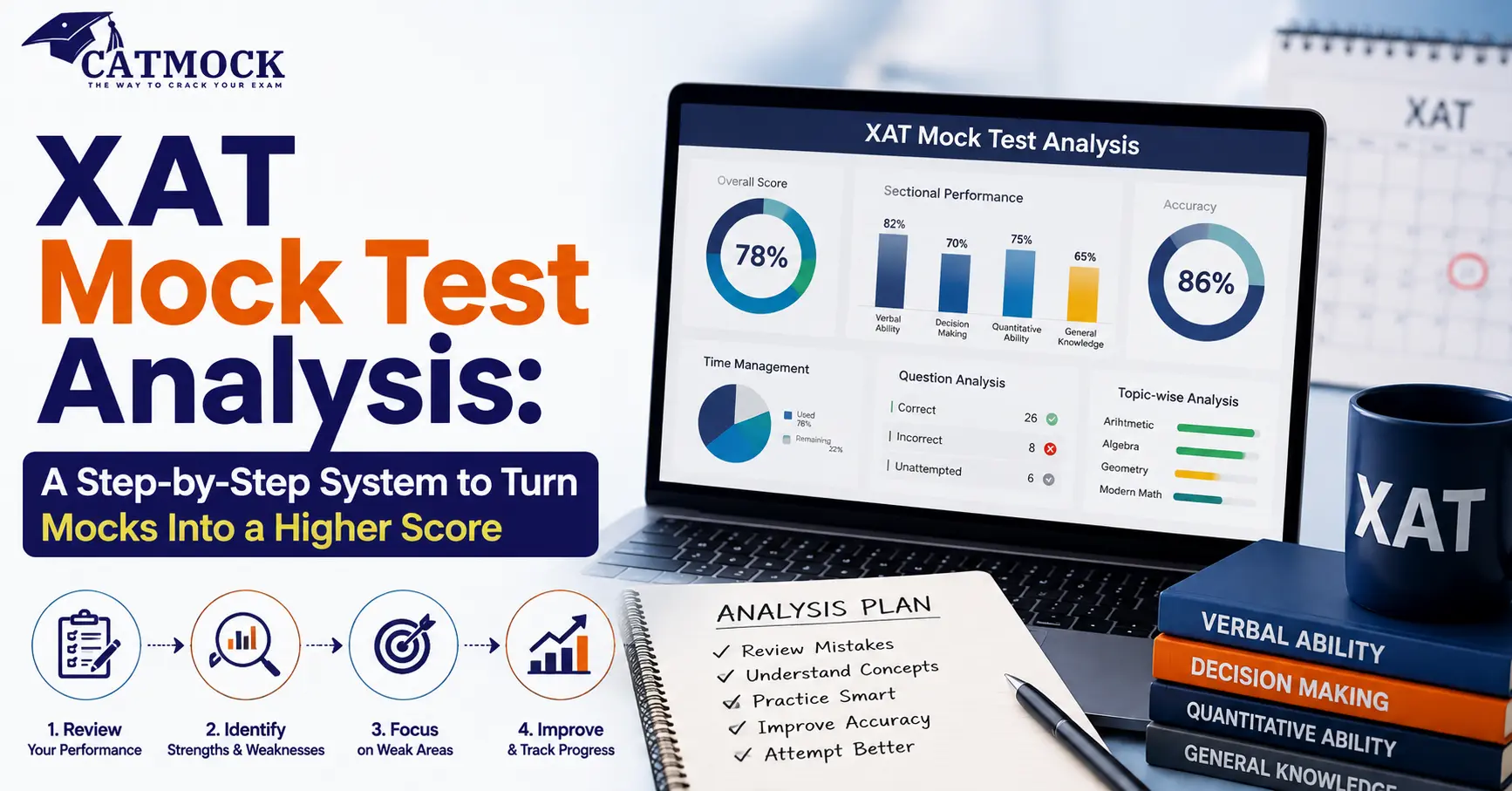
Most XAT aspirants take mock after mock and still watch their score plateau. If that’s you, the problem is rarely a lack of mocks — it’s usually what happens (or doesn’t happen) in the hour after you finish one. XAT mock test analysis is the process of examining your attempts, mistakes, time usage and question selection closely enough to know exactly why you scored what you scored — not just what you scored. This guide walks through a complete, repeatable analysis system you can use after every XAT mock, section by section, so each test actually moves your percentile instead of just adding to your mock count.
How Do You Analyze an XAT Mock Test?
To analyze an XAT mock properly, review four things for every question you attempted or skipped: whether it was correct, incorrect, or left unattempted; how much time it took relative to its difficulty; whether the mistake (if any) was conceptual, careless, or a selection error; and whether attempting or skipping it was the right call given XAT’s marking scheme. Do this section-wise — Verbal Ability & Logical Reasoning, Decision Making, Quantitative Ability & Data Interpretation, and General Knowledge — before moving to your next round of practice.
Why “More Mocks” Isn’t the Same as “Better Mocks”
Taking a mock test measures where you stand. Analyzing it is what actually changes where you stand. A student who takes 15 XAT mocks without reviewing them properly usually repeats the same mistakes 15 times — the same DM traps, the same QA calculation slips, the same over-investment in one tough passage. A student who takes 8 mocks but analyzes each one thoroughly typically improves faster, because every test surfaces a specific, fixable problem instead of a vague feeling of “I need to practice more.”
The goal of this article is to make that second approach practical and repeatable: Take Mock → Analyze Mock → Identify the Real Problem → Fix It → Practice → Take the Next Mock → Compare. Each step feeds the next one. Skipping the analysis step is what breaks the loop for most aspirants.
Step 1: Start With the Overall Score, But Don’t Stop There
Your total score and percentile tell you where you stand, not why. Before going section-wise, note down three numbers for the full test: total attempts, overall accuracy (correct ÷ attempted), and how close you got to your target attempt count for XAT’s marking scheme. This becomes your baseline for comparison against the next mock.
Step 2: Categorize Every Question You Attempted or Skipped
This is the step most students skip, and it’s the one that actually explains your score. After a mock, go through every question — correct, incorrect, and unattempted — and sort it into one of these buckets:
- Correct and easy — you solved it quickly and accurately. Good; move on.
- Correct but time-consuming — right answer, but it ate into time you needed elsewhere. Worth learning a faster method.
- Incorrect due to a concept gap — you didn’t actually know how to solve it. This needs revision, not just more practice.
- Incorrect due to a careless or calculation mistake — you knew the method but slipped somewhere. This needs a process fix (double-checking, slower reading), not concept revision.
- Guessed and got lucky, or guessed and got it wrong — either way, this tells you nothing reliable about your preparation on that topic and should be flagged separately from “correct” answers.
- Left unattempted despite being solvable — you had the skill but ran out of time or lost confidence. This is a time-management or confidence issue, not a knowledge gap.
- Correctly skipped — a genuinely hard or unfamiliar question you were right to leave. Not every skip is a mistake, especially under XAT’s unattempted-question penalty.
Once you’ve done this for a full mock, patterns show up fast. A student who assumes “I’m weak at DILR-style DI sets” might discover, after this categorization, that the real issue is time-consuming-but-correct answers eating 60% of their QADI time — a time-management problem, not a knowledge one. That distinction changes what you should actually practice next.
Step 3: Analyze Time Spent, Not Just Marks Earned
Two questions can carry the same +1 mark and mean completely different things about your prep. A question solved in 40 seconds and one solved in 4 minutes both look identical on the scorecard, but the second one is silently costing you attempts elsewhere. After every mock, identify:
- Questions where you spent noticeably longer than the section average, correct or not
- Whether those “time-trap” questions clustered around specific topics (long DM caselets, dense DI tables, unfamiliar VALR passages)
- Whether you revisited questions repeatedly instead of committing to a decision and moving on
Because XAT no longer has a strict sectional time limit within Part 1, time discipline has to come from you — this analysis is how you build it deliberately rather than by accident.
Step 4: Section-Wise XAT Mock Analysis
Each XAT section rewards a slightly different kind of review. Here’s what to specifically look for in each.
Decision Making (DM)
DM is the section that separates XAT from every other MBA entrance exam, and it’s also the one students analyze the least effectively, because there’s rarely a single “textbook” method to point to. When reviewing DM:
- Check whether wrong answers came from misreading the caselet’s constraints, or from applying your own personal judgment instead of the logic implied by the passage. XAT DM questions usually have one internally consistent “best” answer based on the information given — not the most ethical-sounding option in isolation.
- Note if you’re consistently drawn to the most cautious or most aggressive option. A recurring bias like this is worth being aware of before the actual exam.
- Re-read caselets you got wrong without looking at the answer first, and see if a second, slower read changes your choice. If it does, the issue was reading speed under pressure, not reasoning ability.
Verbal Ability & Logical Reasoning (VALR)
- Separate reading comprehension performance from grammar/verbal-reasoning performance — they test different skills and often have different accuracy levels for the same student.
- For RC, check whether wrong answers came from misreading the passage or from being pulled in by a plausible-but-wrong option. These require different fixes: the first needs slower, more careful reading; the second needs practice spotting distractor patterns.
- For logical reasoning and verbal-ability questions (para-jumbles, critical reasoning), track accuracy by sub-type rather than as one lump score, since strength in one sub-type doesn’t always transfer to another.
Quantitative Ability & Data Interpretation (QADI)
- Split your errors by cause: formula/concept gap, calculation slip, or misreading the data set/table. These three need three different fixes.
- For DI sets specifically, check whether you spent too long understanding the data layout itself before answering any question in the set — this is a common, fixable time sink.
- Revisit topics where wrong answers cluster (a specific arithmetic sub-topic, a geometry concept, a particular DI chart type) rather than treating QADI as one undifferentiated section.
General Knowledge (GK)
GK doesn’t count toward your overall XAT percentile, but XLRI uses it separately during shortlisting and interviews, so it’s still worth a quick review rather than being ignored entirely. After a mock, note which GK questions you got wrong — static or current-affairs — and use that to guide a short, low-effort daily reading habit rather than dedicated heavy preparation.
Step 5: Turn the Analysis Into Next Week’s Study Plan
Analysis only pays off if it changes what you do next. A practical, repeatable loop looks like this:
- List your top 2–3 recurring problems from this mock’s analysis — not everything, just the patterns that showed up more than once.
- Revise the specific concept or skill behind each problem (a QA topic, a DM reasoning pattern, a reading habit) rather than generically “studying more.”
- Practice targeted questions on exactly that problem, ideally pulled from real exam-style material such as XAT previous year papers, since these reflect the actual difficulty and phrasing XLRI uses rather than a generic approximation of it.
- Take a sectional or focused test on that area before your next full-length mock, to check the fix has actually taken before you retest it at full scale.
- Take the next full mock and compare directly against this one — same categorization, same section-wise breakdown — to see whether the specific problem you targeted has genuinely improved.
This is the core of the entire system: identify a specific, named problem, fix that specific problem, and verify the fix in your next test — rather than hoping that generic extra practice eventually helps.
Tracking Your Mock Performance Over Time
A single mock’s analysis tells you about that test. A tracker across mocks tells you about your trajectory — and it’s the only way to know if your fixes are actually working. After each mock, record:
| Metric | What to track |
|---|---|
| Overall score & percentile | Raw score, sectional cut-off status |
| Section-wise accuracy | Correct ÷ attempted, per section |
| Attempt count vs. unattempted count | Especially against XAT’s 8-question free-skip limit |
| Time-trap questions | Number and topic of questions that took disproportionately long |
| Error type breakdown | Concept gap vs. careless mistake vs. guess |
| Recurring weak topics | Same topic appearing across 2+ mocks |
| Fix applied | What you did about last mock’s top issue |
| Did it improve? | Yes/No/Partially, checked against this mock |
You don’t need elaborate software for this — a simple spreadsheet updated after every test is enough. What matters is consistency: reviewing the same categories every time so genuine trends are visible instead of noise from one unusually hard or easy paper.
How Long Should XAT Mock Analysis Take?
A thorough analysis of a full-length XAT mock typically takes 60–90 minutes — roughly the same length as, or slightly longer than, the mock itself. This isn’t wasted time; it’s usually the highest-value hour in your entire prep cycle, since it directly tells you what to fix. Rushing this step to “save time” for the next mock is one of the most common reasons scores plateau despite heavy mock volume.
Does a Mock Score Predict Your Actual XAT Percentile?
Not precisely, and it shouldn’t be treated as a guarantee. Mock scores are useful as a relative, trend-based indicator — whether your accuracy, attempts and section balance are improving over time — rather than as a literal forecast of your XAT percentile. Different mock providers calibrate difficulty differently, and the actual XAT paper’s difficulty and cut-offs vary each year. Use mocks to track improvement and identify weaknesses, not to predict an exact final percentile.
A Practical Example
Consider a student scoring around 60th percentile across three consecutive mocks with no visible improvement. A surface-level look suggests “needs more practice.” A proper analysis using the categorization above might instead reveal that QADI accuracy is actually strong (80%+) on attempted questions, but only 60% of QADI questions are being attempted at all — because DM caselets are consistently eating 15–20 extra minutes that should have gone to QADI. The real fix isn’t more quant practice; it’s timed DM practice to bring caselet-reading speed down, freeing up time for a section where accuracy is already solid. This is exactly the kind of insight that a score alone never reveals, but a structured analysis surfaces in one sitting.
Common XAT Mock Test Mistakes to Watch For
- Reviewing only the questions you got wrong, and skipping a look at correct-but-slow questions, which quietly cost just as much.
- Treating every skip as equally acceptable, without checking whether it pushed you past XAT’s 8-question unattempted buffer.
- Comparing raw scores across mocks from different providers, which can have different difficulty calibration and aren’t directly comparable.
- Re-solving wrong questions immediately after seeing the solution, rather than a day or two later — which tests recognition rather than actual recall.
- Skipping GK review entirely because “it doesn’t count,” when a consistent weak GK score can still affect shortlisting outcomes later.
Alao read: Top MBA Colleges Accepting XAT
FAQs on XAT Mock Test Analysis
How often should I analyze my XAT mocks?
Every single mock should be analyzed before you take the next one. Skipping analysis to squeeze in more mocks usually means repeating the same mistakes across tests instead of correcting them.
What should I check first after an XAT mock?
Start with your overall score and section-wise breakdown. Then categorize each question as correct, incorrect, guessed, or unattempted.
Why is my XAT mock score not improving even after taking many mocks?
This usually means mocks are being taken without structured analysis, so the same conceptual gaps, time-traps or question-selection errors repeat across tests without being identified or corrected.
How can XAT mock analysis actually improve my score?
Turn “I need to improve” into specific problems. Identify weak topics, time traps, or selection errors. Then revise, practice, and verify them in your next mock.
Should I focus more on Decision Making or QADI while analyzing mocks?
Both matter, since XAT typically applies sectional cut-offs. Analyze both sections, but give extra attention to Decision Making. Many students underprepare for it, despite its importance in the overall score.
Does a good mock score guarantee a similar XAT percentile?
No. Mock scores are useful for tracking relative improvement and identifying weak areas, but they don’t guarantee a specific real-exam percentile, since actual XAT difficulty and mock-provider calibration can differ.
Conclusion
If you’re building your XAT prep timeline around this analysis system, it helps to pair it with a clear sense of the exam calendar and pattern — the XAT 2027 exam dates and registration timeline are worth bookmarking so your mock schedule lines up with how much time you actually have left. For section-specific groundwork before your next mock, a focused look at XAT 2027 preparation strategy covers how to prioritize Decision Making and QADI without neglecting either. And once you’ve identified a weak topic through analysis, working through XAT previous year questions with solutions is one of the most reliable ways to practice that exact gap using real exam-style material rather than generic questions.
You May Also Like : CAT MOCK, CAT MOCK PYQ
Follow Us On : Facebook, Instagram