

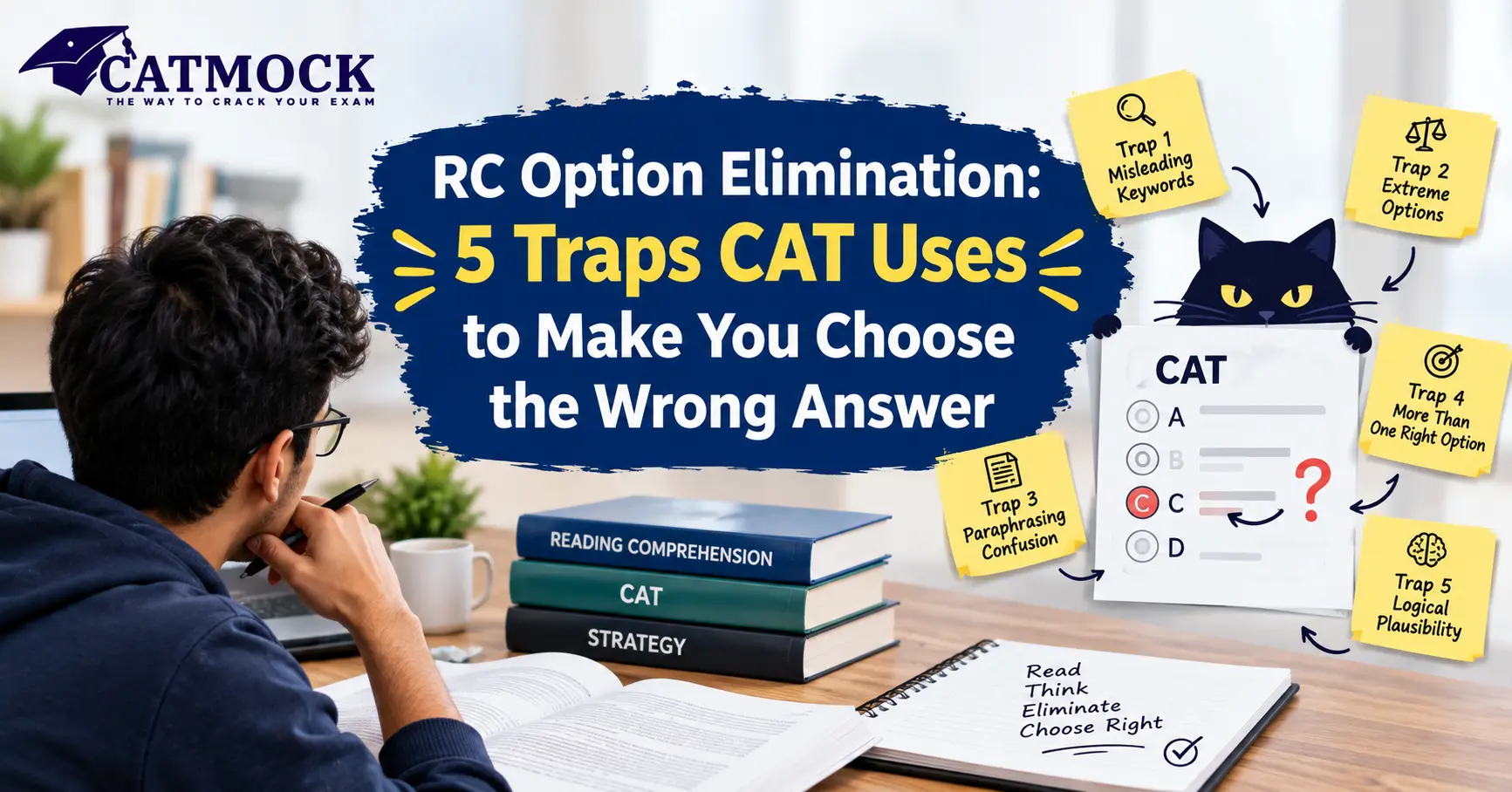
You read the passage carefully. You understood the argument, the tone, the author’s point of view. And yet, when you look at the five answer options, two of them look equally correct — and you pick the wrong one. If this sounds familiar, you haven’t failed at comprehension. You’ve fallen for a trap that CAT’s question-setters designed deliberately.
CAT RC questions rarely test whether you understood a passage in isolation. They test whether you can resist answer choices engineered to look correct while being subtly, deliberately wrong. This guide breaks down the 5 specific traps CAT consistently uses in its RC answer options, with real examples of how each one works, so you can recognize and eliminate them on sight instead of falling for them under time pressure.
Why CAT RC Traps Exist in the First Place
CAT’s Reading Comprehension section isn’t primarily testing your reading speed or vocabulary — it’s testing precision under pressure. If every wrong answer were obviously wrong, RC would simply become a memory test. Instead, question-setters construct distractors — the incorrect options — using specific, repeatable patterns designed to exploit common reading shortcuts: skimming too quickly, relying on keyword-matching instead of meaning, or assuming a plausible-sounding statement must be true.
Understanding these patterns doesn’t just help you avoid wrong answers — it fundamentally changes how you read options in the first place, shifting you from “which one sounds right” to “which one can I prove is wrong.”
The 5 Traps CAT Uses in RC Answer Options
Trap 1: The Extreme Words Trap
This is the most common and most avoidable trap in CAT RC. Options that use absolute, unqualified language — words like always, never, all, every, completely, entirely, impossible, only — are frequently incorrect, because most RC passages present nuanced, qualified arguments rather than sweeping, universal claims.
Why it works: These words feel confident and definitive, which can make an option seem authoritative even when the passage itself never makes such a strong claim.
How to spot it: Scan each option specifically for absolute qualifiers before evaluating its content. If a passage discusses a trend, tendency, or one perspective among several, an option claiming it applies “always” or “in every case” is almost certainly overreaching.
Trap 2: The Scope Trap
The scope trap introduces information, ideas, or conclusions that fall outside what the passage actually discusses — even if the statement sounds generally true or reasonable on its own.
Why it works: These options often sound intelligent and plausible, sometimes even more sophisticated than the passage’s actual argument, which makes them tempting for candidates trying to demonstrate deeper understanding.
How to spot it: Ask a simple question for every option: “Does the passage actually say or directly imply this?” If the answer requires outside knowledge or a logical leap the passage doesn’t support, it’s a scope trap — eliminate it regardless of how reasonable it sounds.
Trap 3: The Echo Trap
The echo trap is built from a line that appears almost word-for-word in the passage, but with one key term quietly swapped — changing the actual meaning while preserving the surface-level familiarity.
Why it works: When an option’s phrasing closely mirrors the passage, your brain recognizes it as “familiar” and assumes familiar means correct — even though the substituted word has changed what’s actually being claimed.
How to spot it: Before looking at the options, predict the answer in your own words based on the passage. This prediction step is your best defense against echo traps, since you’re comparing options against your own understanding rather than against surface-level wording similarity.
Trap 4: The Opposite Trap
Exactly what it sounds like — an option that states the reverse of what the passage actually argues or concludes, often placed among otherwise similar-sounding choices to increase the chance of a rushed, careless selection.
Why it works: Under time pressure, candidates sometimes recognize the topic of an option as relevant to the question, without carefully checking whether the direction of the claim (supportive vs. critical, increasing vs. decreasing) actually matches the passage.
How to spot it: For any option that feels immediately familiar or “obviously about the right topic,” specifically double-check the directional claim — is the passage saying this is good or bad, more or less, true or false — rather than just confirming the general subject matches.
Trap 5: The Scrambled Combination Trap
This trap combines two or more genuinely true statements from different parts of the passage into a single option that implies a connection or causation the author never actually made.
Why it works: Since every individual piece of the statement is technically accurate and traceable to the passage, candidates often approve the option without checking whether the combination itself is something the passage actually supports.
How to spot it: When an option contains multiple distinct claims, verify not just that each piece is true individually, but that the passage actually links them together the way the option suggests. A shared topic between two passage sections doesn’t mean the author drew the specific connection the option is claiming.
Quick Reference: The 5 CAT RC Traps at a Glance
| Trap Name | What It Does | Red Flag to Watch For |
|---|---|---|
| Extreme Words Trap | Uses absolute, unqualified language | Words like “always,” “never,” “all,” “completely” |
| Scope Trap | Introduces ideas outside the passage’s actual content | Sounds reasonable but isn’t directly supported by the text |
| Echo Trap | Mirrors passage wording with one key word changed | Feels “familiar” but changes the actual meaning |
| Opposite Trap | States the reverse of the passage’s actual claim | Right topic, wrong direction |
| Scrambled Combination Trap | Links true facts from different sections into a false connection | Each piece checks out, but the combination doesn’t |
A Practical Elimination Checklist for Every RC Question
Rather than evaluating options in isolation, run each one through this sequence before selecting your final answer:
- Predict first, then compare. Form your own answer in plain language before reading the options — this single habit neutralizes both the echo trap and the scope trap most effectively.
- Scan for extreme words immediately. Absolute qualifiers are the fastest, lowest-effort elimination you can make — do this pass before deeper analysis.
- Check the direction, not just the topic. For every option that seems relevant, confirm whether it matches the passage’s actual stance, not just its subject matter.
- Verify multi-part claims piece by piece. If an option makes more than one claim, check the passage support for each part individually, not just the general impression.
- Confirm the passage is the source, not your own assumptions. The correct answer must be traceable to what’s stated or clearly implied in the passage — not to outside knowledge, however accurate that knowledge might be.
Worked Example: Applying the Traps to a Sample RC Question
Imagine a passage arguing that a particular economic policy had “mixed results — clear short-term benefits, but uncertain long-term consequences that researchers are still studying.” Here’s how typical trap-laden options might be constructed around this idea:
| Option Style | Example Pattern | Trap Type |
|---|---|---|
| “The policy was an unqualified success with no drawbacks.” | Uses absolute language (“unqualified,” “no drawbacks”) | Extreme Words Trap |
| “The policy influenced the country’s foreign trade relationships significantly.” | Introduces a topic (foreign trade) never discussed in the passage | Scope Trap |
| “The policy had unclear short-term benefits but definite long-term consequences.” | Mirrors the passage’s wording but reverses which timeframe is “unclear” vs. “definite” | Echo Trap / Opposite Trap |
| “The policy failed to deliver any measurable results.” | States the opposite of “clear short-term benefits” | Opposite Trap |
| “Since the policy showed short-term benefits and is still being studied, researchers have concluded it should be permanently implemented.” | Combines two true passage facts into a conclusion the passage never actually draws | Scrambled Combination Trap |
Notice that every one of these options contains a kernel of passage-related content — that’s precisely what makes them traps rather than obviously wrong answers.
How This Connects to Your Broader RC Reading Strategy
Option elimination works best when it’s paired with strong initial reading comprehension, not used as a substitute for it. If you find yourself frequently unable to predict an answer before looking at the options, it’s often a sign that your first read-through needs more structural attention to the passage’s central argument and tone.
Why Trap Awareness Directly Protects Your Score
Since CAT applies negative marking for incorrect MCQ answers, falling for a well-constructed trap doesn’t just cost you the mark you would have earned — it actively costs you additional marks through the penalty. This makes trap recognition a direct accuracy lever, not just a comprehension nicety. Our detailed breakdown on how to avoid negative marking in CAT covers the broader decision-making framework for when to attempt a question versus skip it — trap awareness is one of the most effective tools for shifting genuinely uncertain guesses into confident, evidence-based eliminations instead.
Which Traps Show Up Most in Which Question Types
Not all five traps appear with equal frequency across every RC question type — knowing where each one tends to concentrate helps you apply extra scrutiny at the right moments.
| Question Type | Most Frequent Trap(s) | Why |
|---|---|---|
| Main Idea / Summary Questions | Scope Trap, Extreme Words Trap | Wrong options often overreach the passage’s actual claim or narrow it to one detail |
| Inference Questions | Scrambled Combination Trap | Inference questions specifically test whether you can distinguish supported connections from unsupported ones |
| Detail/Fact-based Questions | Echo Trap | These questions test precise recall, making word-substituted mirrors especially effective distractors |
| Author’s Tone/Attitude Questions | Opposite Trap | Tone questions often present a directionally reversed option alongside the correct one |
| Vocabulary-in-Context Questions | Scope Trap | Options may offer a technically valid dictionary meaning that doesn’t fit the passage’s specific context |
Building this awareness means you can pre-calibrate your scrutiny based on question type — for instance, applying extra care to directional wording specifically on tone questions, or double-checking multi-part logic specifically on inference questions, rather than applying the same generic caution uniformly across every question.
Building Trap Recognition Through Practice
Like reading speed, trap recognition improves with deliberate, reviewed practice rather than passive exposure.
- After every RC set, review your incorrect answers specifically for trap type. Categorizing your own mistakes against these five patterns reveals whether you consistently fall for one particular trap more than others.
- Practice writing your own trap options. Take a passage you’ve already solved and try constructing an extreme-words or scope-trap distractor yourself — actively building traps sharpens your ability to spot them far more than passively reading about them.
- Time-box your elimination process. Aim to run through the checklist above within 30–45 seconds per question once it becomes habitual, since the goal is building an automatic reflex, not a slow, deliberate manual process.
- Revisit questions you got right by luck, not method. If you selected the correct answer without being able to explain why the other four were wrong, treat that as a gap to close, not a win to celebrate.
Common Mistakes Aspirants Make While Eliminating RC Options
- Evaluating options in isolation instead of comparing them against a prediction. Without a predicted answer, every option can start to sound plausible, especially under time pressure.
- Treating “sounds smart” as a proxy for “is correct.” Scope-trap options are specifically designed to sound sophisticated; don’t confuse eloquence with textual support.
- Rushing past extreme words because the rest of the sentence sounds right. A single absolute qualifier can invalidate an otherwise well-constructed, passage-adjacent option.
- Not double-checking direction on familiar-sounding options. The opposite trap specifically exploits the assumption that topical relevance equals correctness.
- Failing to verify each part of multi-claim options separately. The scrambled combination trap survives exactly because candidates check the pieces but not the connection.
Summary
- CAT RC wrong answers aren’t random — they’re built using repeatable, deliberate trap patterns, and recognizing them is a trainable skill.
- The 5 core traps are: the Extreme Words Trap, the Scope Trap, the Echo Trap, the Opposite Trap, and the Scrambled Combination Trap.
- Predicting your answer before reading the options is the single most effective defense against most of these traps simultaneously.
- Since CAT applies negative marking, falling for a trap costs more than just a missed mark — making elimination skill a direct, high-leverage accuracy lever.
- Building trap recognition requires deliberate, reviewed practice — specifically categorizing your own mistakes by trap type, not just solving more questions.
Frequently Asked Questions
Q1. What are the most common traps in CAT RC answer options? The five most common traps are the Extreme Words Trap (absolute language), the Scope Trap (out-of-passage information), the Echo Trap (word-substituted passage mirroring), the Opposite Trap (reversed claims), and the Scrambled Combination Trap (false connections between true facts).
Q2. How can I avoid falling for the Echo Trap specifically? Predict your own answer in plain language before reading the answer choices, so you’re comparing options against your own understanding of the passage rather than against how closely their wording matches the original text.
Q3. Are extreme words like “always” and “never” always wrong in CAT RC? Not always, but they’re a strong red flag. Since most RC passages present nuanced, qualified arguments, options using absolute language are frequently, though not universally, incorrect — treat them as a signal to scrutinize carefully rather than an automatic elimination rule.
Q4. Why do scope-trap options often sound more intelligent than the correct answer? Scope-trap options are deliberately constructed to sound sophisticated and plausible, since this is precisely what makes candidates second-guess a simpler, more directly passage-supported correct answer.
Q5. How much time should I spend on option elimination per RC question? With consistent practice, the elimination checklist should take roughly 30–45 seconds per question once it becomes an automatic habit, rather than a slow, deliberate manual process.
Q6. Does understanding these traps help even if I already comprehend the passage well? Yes. Strong comprehension alone doesn’t guarantee accuracy, since traps are specifically designed to exploit small assumptions and rushed reading even among candidates who understood the passage correctly.
Conclusion
CAT RC doesn’t just test whether you understood a passage — it tests whether you can resist answer choices that are deliberately engineered to look correct. Once you can name and recognize the Extreme Words Trap, the Scope Trap, the Echo Trap, the Opposite Trap, and the Scrambled Combination Trap on sight, elimination stops being guesswork and becomes a systematic, evidence-based process. Pair this trap awareness with a strong initial reading strategy and consistent, reviewed practice, and RC shifts from your most unpredictable VARC section to one of your most reliably scorable ones.
You May Also Like : CAT MOCK, CAT MOCK PYQ
Follow Us On : Facebook, Instagram, Youtube