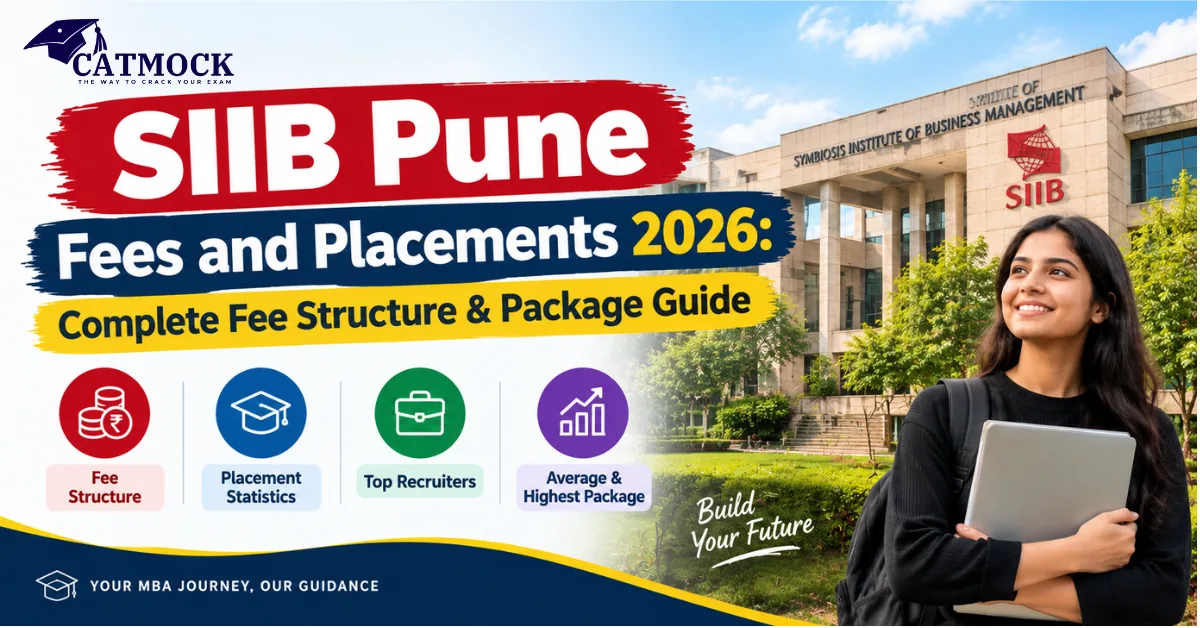
Before you shortlist Symbiosis Institute of International Business (SIIB) Pune on your SNAP preference list, two numbers matter more than almost anything else: what you’ll pay, and what you can realistically expect to earn once you graduate. SIIB fees and placements together decide whether this niche, internationally-focused B-school delivers a strong return on your two-year investment — and the honest answer depends on which of its three specializations you choose.
This guide lays out the complete SIIB Pune fee structure for 2026, including hostel and other charges, installment schedules, and scholarship options, followed by a detailed look at placement trends — average and highest packages, year-wise movement, top recruiters, and sector-wise hiring patterns. If you’re weighing whether the fee is worth it, the ROI breakdown toward the end will help you decide with real numbers, not guesswork.
SIIB Pune Fees and Placements 2026: Quick Overview
| Parameter | Details |
|---|---|
| Institute | Symbiosis Institute of International Business (SIIB), Pune |
| Established | 1992 |
| Parent University | Symbiosis International (Deemed University) |
| Programs Offered | MBA – International Business, MBA – Agri-Business Management, MBA – Sustainability Management |
| Total Tuition Fee Range (2 Years) | Approx. ₹13 – ₹20 Lakh, program-dependent |
| Average Package (Recent Batches) | Approx. ₹13 – ₹16 LPA |
| Highest Package (Domestic, Recent Batches) | Approx. ₹27 – ₹39 LPA |
| Placement Consistency | 100% placement reported in most recent cycles |
| Entrance Exam | SNAP |
| Accreditation | NAAC A++, AICTE approved |
Note: Fee and package figures vary across sources and change with each batch. Treat the ranges above as directional and always cross-verify with the institute’s official placement report before making a financial decision.
SIIB Pune Fee Structure 2026: Course-Wise Breakdown
SIIB Pune runs three distinct MBA specializations, and the total fee differs meaningfully depending on which one you enroll in. Here’s the approximate course-wise breakup for the full two-year program:
| Program | Approx. Total Tuition Fee (2 Years) | Approx. Annual Fee |
|---|---|---|
| MBA – International Business | ₹19 – ₹20 Lakh | ₹9.5 – ₹10 Lakh |
| MBA – Agri-Business Management | ₹13 – ₹14 Lakh | ₹6.5 – ₹7 Lakh |
| MBA – Sustainability Management | ₹14 – ₹15 Lakh | ₹7 – ₹7.5 Lakh |
International Business, being SIIB’s flagship and most in-demand program, carries the highest fee of the three — largely reflecting its stronger placement outcomes and larger recruiter base. Agri-Business Management remains the most affordable of the three, while Sustainability Management sits in between.
Also Read: SIIB Cutoff 2026: Expected Percentile, Marks & Trends
Additional Costs Beyond Tuition
The headline tuition figure is only part of the real cost of a two-year MBA at SIIB. Budget for these recurring components as well:
- Hostel Fees: Varies by room type (single/shared) and typically adds a meaningful annual cost on top of tuition; confirm current rates directly with the institute since room categories change year to year.
- Mess and Food Charges: Usually billed separately from hostel accommodation, often on a semester or annual basis.
- Caution Deposit and Security Deposit: A refundable component collected at admission, factored into the total payable amount in year one.
- Study Materials and Case Packs: Course-specific charges for case study subscriptions, software access, and reading material.
- Local Living Costs: Groceries, local transport, and personal expenses in Pune’s Hinjewadi area, which most students should budget for separately from institute-billed fees.
Fee Payment Schedule and Installment Options
SIIB Pune typically structures fee payment across multiple installments rather than requiring the full two-year amount upfront:
- The first installment is generally payable at the time of admission confirmation.
- Subsequent installments are usually spread across each semester or academic year, aligning with the program’s four-semester structure.
- Formal EMI through the institute is generally not offered, but the semester-wise installment structure itself eases the cash-flow burden for most families.
- Education loans from partner and nationalized banks are commonly used by students to cover tuition, with repayment typically starting after a moratorium period post-placement.
Scholarships and Financial Aid at SIIB Pune
SIIB periodically offers merit-based and need-based scholarship provisions, including relaxed fee structures for candidates from economically weaker backgrounds and first-generation learners, subject to income proof and academic performance criteria. Since scholarship policies and eligibility criteria are revised from year to year, always confirm the current scheme directly through the official admission office before assuming eligibility.
SIIB Pune Placements 2026: What the Numbers Actually Show
Placement outcomes are where SIIB’s specialized positioning genuinely pays off. The institute has consistently reported full or near-full placement across its three programs, with BFSI, consulting, logistics, and agri-business sectors forming the bulk of its recruiter base — reflecting its niche in international trade and sustainability-linked management.
SIIB Pune Placement Trends: Year-Wise Movement
| Year | Highest Package (Approx.) | Average Package (Approx.) | Placement Rate |
|---|---|---|---|
| 2021 | ₹24 LPA | ₹12 LPA | ~95–100% |
| 2022 | ₹25 LPA | ₹13 LPA | ~95–100% |
| 2023 | ₹28 LPA | ₹13.5 LPA | 100% |
| 2024 | ₹28 – 39 LPA | ₹13.5 – 14 LPA | 100% |
| 2025 | ₹27.6 LPA | ₹16 LPA | 100% |
The average package has shown a steady, gradual climb over five years rather than a dramatic jump — a pattern consistent with SIIB’s positioning as a stable, mid-to-upper-tier Symbiosis institute rather than one chasing headline numbers. Figures differ slightly across reporting sources depending on which cohort or program mix is included, so treat this table as a directional trend rather than an audited figure.
Program-Wise Placement and Top Recruiters
Placement outcomes differ noticeably between SIIB’s three specializations, largely because each draws from a different recruiter pool:
| Program | Typical Sector Focus | Indicative Top Recruiters |
|---|---|---|
| MBA – International Business | BFSI, Consulting, Logistics, Export-Import | KPMG, HCL, Accenture, DHL Logistics, American Express |
| MBA – Agri-Business Management | Agri-Business, FMCG, Rural Supply Chain | Adani Group, Forbes Marshall, Syngenta-linked agri firms |
| MBA – Sustainability Management | Energy, ESG Consulting, Environmental Management | Sustainability and ESG-focused consulting firms, energy majors |
BFSI alone accounts for a large share of SIIB’s overall recruitment intake, reflecting a strong finance and international trade tilt within the International Business specialization. Internship stipends across the batch have also trended upward, with many students securing pre-placement offers through their summer internship performance.
SIIB Pune ROI: Is the Fee Worth the Package?
Return on investment is really the question behind “SIIB fees and placements” as a search itself — is the money you put in likely to come back reasonably fast? Based on the average package and total fee figures above, SIIB Pune’s approximate ROI timeline works out as follows:
- International Business: With a total fee near ₹19–20 Lakh and an average package in the ₹13–16 LPA range, the fee-to-first-year-salary recovery period typically falls between 1.2 and 1.6 years.
- Agri-Business Management: A lower total fee (~₹13–14 Lakh) against a comparable or slightly lower average package generally produces a faster or comparable payback period, making it an efficient option for students specifically targeting the agri-business sector.
- Sustainability Management: Mid-range fee and a growing but still-developing recruiter base means ROI here is more dependent on the specific role and sector a candidate lands, rather than a stable batch-wide average.
ROI calculated purely off batch averages can be misleading at the individual level — your actual return depends heavily on which sector you land in, your prior work experience, and how competitively you interview, not just the institute’s aggregate numbers.
Also Read: Top MBA Colleges Accepting SNAP: Complete List, Cutoffs, Fees & Admission
How to Maximize Your Placement Outcome at SIIB Pune
- Choose your specialization deliberately, not just based on cutoff ease — International Business, Agri-Business, and Sustainability Management each lead to genuinely different recruiter conversations.
- Prioritize your summer internship performance. A strong internship frequently converts into a pre-placement offer, effectively locking in your final placement outcome months before the formal placement season.
- Build sector-specific skills early — Bloomberg terminal familiarity for finance-leaning roles, or supply-chain and trade-compliance knowledge for International Business and Agri-Business tracks.
- Network with the placement cell proactively rather than waiting passively for the placement season; institutes with smaller, specialized recruiter pools often reward students who engage early.
- Don’t ignore soft-sector roles in HR, operations, or general management if a core finance/consulting role doesn’t materialize — SIIB’s recruiter base spans multiple functions beyond its flagship trade focus.
SIIB Pune Fees and Placements 2026: Summary Table
| Factor | Key Takeaway |
|---|---|
| Cheapest Program | MBA – Agri-Business Management |
| Most Expensive Program | MBA – International Business |
| Highest Reported Package | ₹27 – 39 LPA (varies by year/source) |
| Average Package Trend | Rising gradually, ₹12 LPA (2021) to ₹16 LPA (2025) |
| Placement Rate | Consistently 95–100% across recent batches |
| Fastest ROI Program | Agri-Business Management (lower fee, competitive package) |
| Dominant Recruiting Sector | BFSI, Consulting, Logistics |
Frequently Asked Questions on SIIB Fees and Placements
Q1. What is the total fee for SIIB Pune MBA programs in 2026?
The total two-year tuition fee ranges from approximately ₹13–14 Lakh for MBA Agri-Business Management to around ₹19–20 Lakh for MBA International Business, with Sustainability Management priced in between. These figures exclude hostel, mess, and other living costs.
Q2. What is the average package at SIIB Pune?
Based on recent placement cycles, the average package at SIIB Pune has ranged between approximately ₹13 and ₹16 LPA, with a gradual upward trend over the last five years.
Q3. What is the highest package offered at SIIB Pune?
The highest domestic package has ranged between roughly ₹24 and ₹39 LPA across recent batches, depending on the specific year and reporting source, with select international offers occasionally reported higher.
Q4. Which SIIB Pune program has the best placement record?
MBA International Business generally has the strongest and most consistent placement record among SIIB’s three programs, owing to its larger and more established recruiter base in BFSI, consulting, and logistics.
Q5. Does SIIB Pune offer scholarships?
Yes, SIIB periodically offers merit-based and need-based scholarships, including relaxed fee structures for eligible first-generation learners and economically weaker candidates, subject to institute-specific criteria that change annually.
Q6. Is the SIIB Pune fee worth it compared to the placement package?
For most students, particularly in International Business and Agri-Business Management, the fee-to-package ratio delivers a reasonable ROI within roughly 1.2 to 1.6 years, though actual returns depend on the individual’s specific role and sector after graduation.
Q7. Can I pay SIIB Pune fees in installments?
Yes, SIIB Pune typically structures fee payment across semester-wise installments rather than requiring the full amount upfront, though a formal EMI facility through the institute itself is generally not available.
Key Takeaways
- SIIB Pune’s total MBA fee ranges from roughly ₹13 Lakh to ₹20 Lakh depending on the specialization chosen.
- MBA International Business is both the costliest and the most placement-strong of the three programs.
- Average packages have grown steadily from around ₹12 LPA (2021) to ₹16 LPA (2025).
- Placement rates have stayed consistently at or near 100% across recent batches.
- ROI is most favorable in Agri-Business Management and International Business, though individual outcomes vary by sector and role.
Also read: SCMHRD Selection Process 2026: Complete Step-by-Step Guide
Conclusion
SIIB fees and placements 2026 tell a fairly consistent story: this is a mid-to-upper-tier Symbiosis institute where the fee genuinely tracks with placement strength, particularly in its flagship International Business program. Agri-Business Management offers the most efficient ROI for students specifically drawn to that sector, while Sustainability Management remains a developing but promising third option. Whichever program you choose, factor in the full cost — tuition, hostel, and living expenses — against realistic placement expectations rather than headline highest-package figures, and always confirm current fee and scholarship details directly on the official SIIB website before finalizing your decision.
For official, verified figures on fees and admission, refer to the SIIB Pune official website and the SNAP Test official portal for exam-related updates.
You May Also Like : CAT MOCK, CAT MOCK PYQ
Follow Us On : Facebook, Instagram, Youtube