
Choosing between an MBA or MSc is one of the biggest ROI decisions you’ll make in your 20s. Both are postgraduate degrees, both can boost your salary — but they’re built for genuinely different career paths, and picking the wrong one can cost you two years and a lot of tuition.
This guide breaks down the real 2026 data — salaries, eligibility, costs, and outcomes — so you can decide with facts instead of guesswork.
Key Takeaways
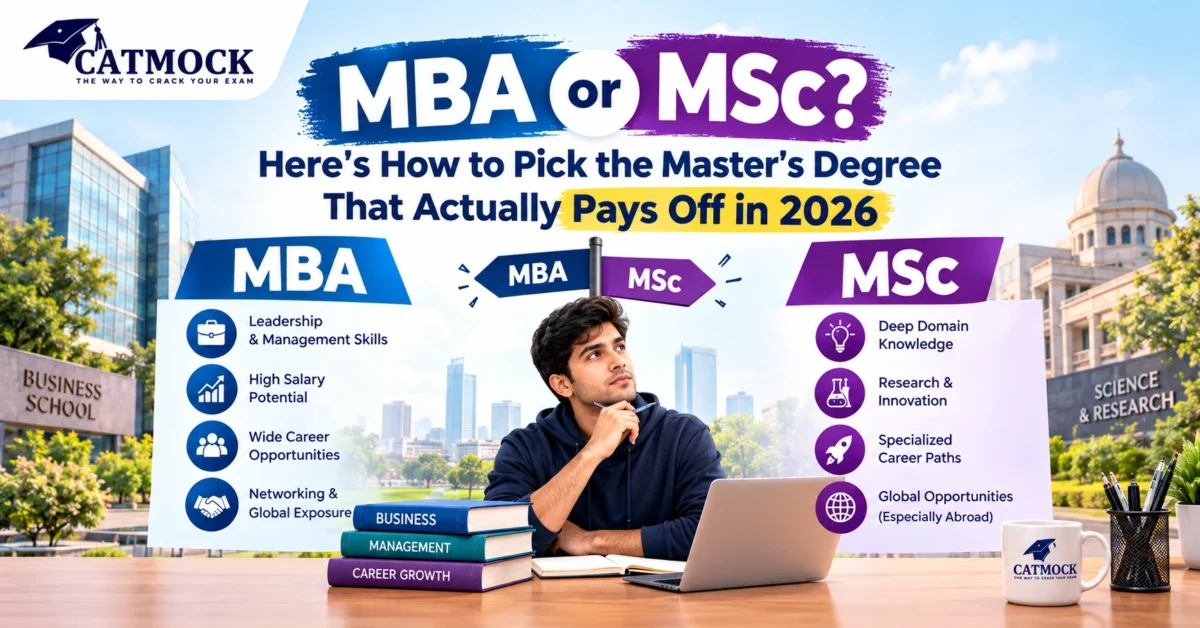
- MBA = leadership + breadth. Best if you have 2+ years of work experience and want management, consulting, or a career switch.
- MSc = depth + specialization. Best for early-career grads who want technical mastery in one field (finance, data, supply chain, etc.).
- In the US, the 2026 GMAC Corporate Recruiters Survey puts the median MBA starting salary at $120,000, versus $82,500 for non-MBA business master’s graduates.
- In India, IIM/ISB-tier MBA graduates average ₹25–35 LPA, while top MSc/MS graduates (especially in tech) land ₹20–30 LPA — the gap narrows fast once you factor in tuition and debt.
- Neither degree is “better” — the right one depends on your work experience, target industry, and budget, not internet opinions.
What Is an MBA? A Quick Definition
An MBA (Master of Business Administration) is a generalist management degree covering finance, marketing, operations, strategy, and leadership. Most reputed programs expect 2–5 years of prior work experience, which is why classroom discussions lean heavily on peer case studies rather than pure theory.
In India, admission usually runs through the CAT, XAT, or GMAT, followed by group discussions and personal interviews. Globally, GMAT or GRE scores plus a strong résumé are standard.
Who an MBA Is For
- Working professionals aiming for management or leadership roles
- Career switchers moving from a technical role into strategy, consulting, or general management
- Entrepreneurs who want structured business fundamentals and a strong peer network
Also Read: MBA vs Job After Graduation: Which Is Actually Better in 2026?
25 Common MBA Interview Mistakes and How to Avoid Them
What Is an MSc (Master of Science)? A Quick Definition
An MSc, or Master of Science, is a research- and curriculum-heavy postgraduate degree focused on one discipline — finance, data science, supply chain, marketing analytics, and so on. Unlike an MBA, most MSc programs accept students straight out of undergrad, with little or no work experience required.
According to QS Top Universities, MSc programs tend to emphasize technical or functional expertise, while MBA programs emphasize leadership development and strategic oversight — a distinction that shows up clearly in how each curriculum is designed.
Who an MSc Is For
- Recent graduates who want deep, specialist knowledge in one field
- Students targeting analyst, research, or technical roles rather than people-management
- Anyone who wants a shorter, lower-cost route into a specific industry
MBA vs MSc: Key Differences at a Glance
| Factor | MBA | MSc |
|---|---|---|
| Focus | Broad — leadership, strategy, cross-functional management | Narrow — deep expertise in one subject (finance, data, marketing, etc.) |
| Ideal work experience | 2–5 years typical | 0–2 years (often none) |
| Typical duration | 1–2 years | 1–2 years (many 1-year programs) |
| Entrance exam (India) | CAT / XAT / GMAT | GRE / GMAT / university-specific test |
| Class format | Case-study, peer-experience driven | Lecture, research, and technical-project driven |
| Career outcome | Management, consulting, general leadership | Analyst, specialist, technical or functional expert |
| Cost | Generally higher | Generally 30–50% lower |
MBA vs MSc: Salary and ROI Comparison (2026 Data)
Money is usually the deciding factor, so here’s what the latest employer surveys actually show — not internet folklore.
Global Salary Snapshot (US, GMAC 2026 Corporate Recruiters Survey)
| Degree Type | Estimated Median Starting Salary (2026) |
|---|---|
| MBA | $120,000 |
| Non-MBA Business Master’s (incl. MSc) | $82,500 |
| Bachelor’s degree hire | $72,000 |
| Experienced industry hire (no MBA) | $107,500 |
The 2026 GMAC Corporate Recruiters Survey shows the estimated median MBA salary slipping to $120,000 from $125,000, non-MBA business master’s pay dropping to $82,500 from $92,500, and bachelor’s hires easing to $72,000 from $75,000 — a reminder that even the “safe” MBA premium moves year to year, so always check the latest release before assuming last year’s number holds.
For context on where these business salaries sit against the broader job market, the U.S. Bureau of Labor Statistics reports business and financial occupations at a median annual wage of $80,920 in 2024, which is well below what most MBA and specialist-master’s graduates report post-degree.
India Salary Snapshot (2026)
| B-School / Program Tier | MBA Average Package | MSc / MS Average Package |
|---|---|---|
| Tier-1 (IIMs, ISB, XLRI) | ₹25–35 LPA | ₹20–30 LPA (top tech-focused MSc) |
| Tier-2 (MDI, NMIMS, SPJIMR) | ₹12–20 LPA | ₹10–18 LPA |
| Tier-3 / Regional | ₹5–10 LPA | ₹5–9 LPA |
Tier-1 recruiters for MBA graduates typically include BCG, McKinsey, and Goldman Sachs, while top MSc/MS graduates are more often picked up by Microsoft, Google, and Amazon for analytics and technical roles — same salary bracket, very different job description.
Proximity note: whether you weigh an MBA or MSc purely on starting pay, remember tuition offsets the comparison — an MBA can cost nearly double an MSc, so factor payback period, not just Year 1 salary, into your MBA vs MSc decision.
Which One Should You Choose? A 5-Point Decision Framework
1. Check Your Work Experience
If you have 2+ years of full-time work experience, an MBA’s peer-learning format will feel far more useful than sitting through an MSc’s case-free lecture halls. If you’re a fresh graduate, an MSc lets you build depth immediately rather than waiting years to qualify for a competitive MBA cohort.
2. Define the Role You Actually Want
Want to lead teams, manage P&L, or pivot into consulting? The MBA route is built for that. Want to be the go-to expert in data science, actuarial science, or supply chain analytics? An MSc gets you there faster and cheaper.
3. Run the Real ROI Math
Don’t just compare salaries — compare (salary − total cost) ÷ years. An MBA at ₹25 lakh fees generating ₹30 LPA can have a worse near-term payback than a fully-funded MSc generating ₹22 LPA with zero debt.
4. Consider the Industry You’re Targeting
- Consulting, investment banking, general management → MBA is still the default credential employers expect.
- Data science, engineering, actuarial work, research → MSc (or MS) is usually the more respected, more specific qualification.
5. Factor In Time and Opportunity Cost
An MBA usually pulls you out of the workforce for 1–2 years at a point when you already have income and career momentum. An MSc right after undergrad has almost no opportunity cost since you haven’t started earning a full salary yet.
Pros and Cons: MBA vs MSc
| MBA | MSc | |
|---|---|---|
| Pros | Strong alumni network, leadership skill-building, higher average salary ceiling, opens management-track roles | Lower cost, shorter path to technical expertise, no work-experience barrier, faster time-to-market for fresh grads |
| Cons | Higher tuition, requires prior work experience, opportunity cost of leaving a job | Narrower career pivot options, lower average starting salary than MBA, less leadership/network exposure |
MBA or MSc in India: What the Data Actually Shows
If you’re evaluating this from India, the entrance exam is usually where the decision gets made first. Most Indian MBA programs (IIMs, FMS, SPJIMR, and hundreds of others) require the CAT exam, while MSc admissions abroad typically hinge on GRE/GMAT plus your undergraduate transcript.
A large share of students actually decide “MBA or MSc” based on which exam they’re better positioned to crack — and CAT preparation timelines run 6–10 months, so this is not a last-minute call. If you’re leaning toward the MBA-in-India route, it’s worth checking your readiness for CAT early with a full-length CAT mock test rather than waiting until the final quarter of prep.
For deeper reading on exam strategy, sectional cut-offs, and B-school shortlisting once you’ve decided, the CATMOCK blog has ongoing, updated breakdowns worth bookmarking.
FAQs: MBA or MSc
1. Is an MBA better than an MSc?
Neither is universally “better.” An MBA is better for leadership and management careers with prior work experience; an MSc is better for deep technical specialization straight out of undergrad. The right choice depends on your goals, not a ranking.
2. Can I do an MSc after an MBA, or an MBA after an MSc?
Yes, both sequences exist. Many professionals do an MSc for technical depth early on, then an MBA later for leadership progression — though doing both back-to-back without work experience in between rarely adds proportional ROI.
3. Which is cheaper, MBA or MSc?
MSc programs are generally 30–50% cheaper than MBA programs, since MBAs charge a premium for network access, brand value, and case-study faculty time.
4. Do I need work experience for an MBA or MSc?
Most competitive MBA programs expect 2–5 years of work experience. MSc programs usually accept fresh graduates with little to no work experience.
5. Which pays more, MBA or MSc, in India?
At the top tier (IIMs/ISB vs. leading tech-focused MSc programs), packages are closer than people expect — ₹25–35 LPA for MBA versus ₹20–30 LPA for MSc — though MBA still leads on average across all tiers.
6. Is CAT required for both MBA and MSc?
CAT is specific to MBA/PGP admissions in India. MSc programs, especially abroad, typically require GRE or GMAT scores instead.
7. Can I switch careers with an MSc the way I can with an MBA?
An MBA is generally the stronger career-switching tool because of its broad curriculum and recruiter expectations around general management hires. An MSc supports a switch only if you’re moving into the specific technical field the degree covers.
Also check this: MBA in Digital Marketing (2026): Colleges, Fees, Syllabus & Career Scope
Final Verdict: Make the Decision, Don’t Just Read About It
If you remember one thing from comparing MBA or MSc, make it this: your work experience and target role should drive the decision, not the degree’s reputation. Run the real ROI math, check the current-year salary data for your target industry, and pick the path that gets you there fastest and cheapest.
If the MBA-in-India route looks like your fit, don’t wait until the last month to start prepping — take a free CAT mock test today and see exactly where you stand.
You May Also Like : CAT MOCK, CAT MOCK PYQ
Follow Us On : Facebook, Instagram, Youtube