

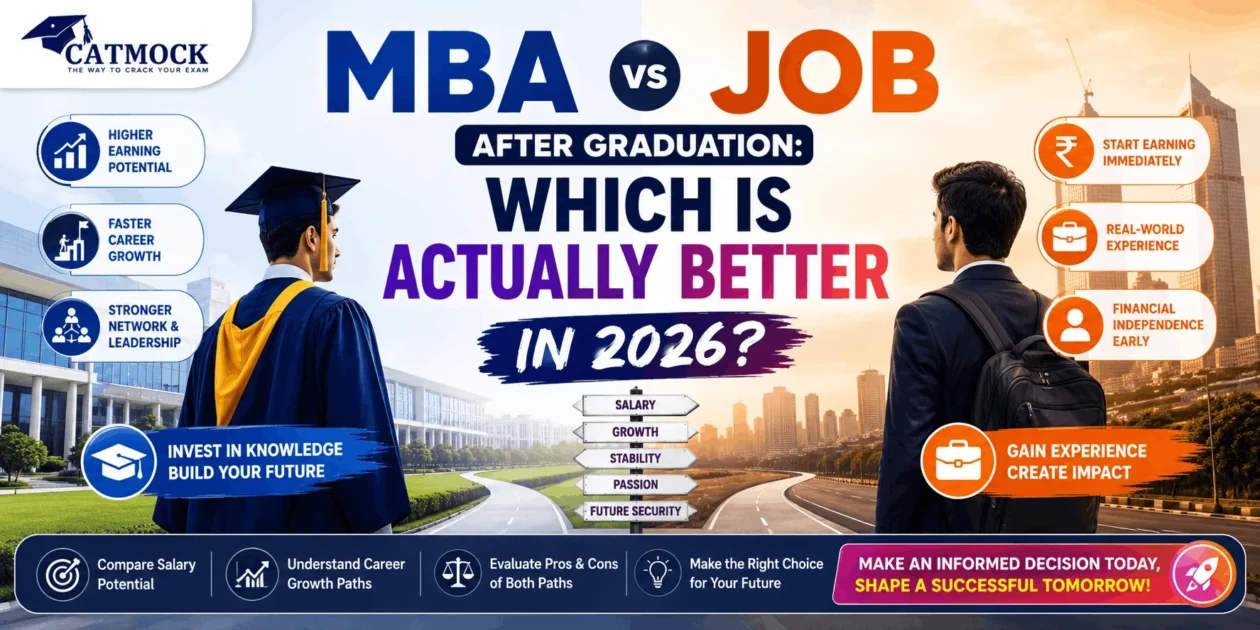
Introduction
Every final-year student eventually hits the same wall: the offer letter is sitting in one inbox, and the CAT/MBA application portal is open in another tab. Family members have opinions. Seniors have opinions. LinkedIn has even more opinions. And somewhere in the middle of all that noise, you’re expected to make a decision that could shape the next decade of your career.
The MBA vs job after graduation debate isn’t really about which option is “better” in some universal sense — it’s about which option is better for you, given your finances, your career goals, and your risk appetite. This guide breaks the decision down the way a mentor would: with real numbers, real trade-offs, and a framework you can actually use instead of just more opinions.
By the end of this article, you’ll know exactly which path fits your situation, whether that’s joining the workforce immediately, applying for an MBA straight out of college, or — as most top B-schools now recommend — working for two to three years and then applying with a stronger profile.
Understanding the Real Question: What Are You Actually Choosing Between?
Before comparing the two options, it helps to reframe the question. You’re not really choosing between “MBA” and “job” as permanent, mutually exclusive states. You’re choosing a sequence. Almost everyone who does an MBA eventually takes a job afterward, and a large share of people who take a job first eventually go back for an MBA once they’ve saved money and clarified their goals.
So the real question is: should you delay your entry into the workforce by one to two years to invest in a management degree, or should you start earning and gaining experience now and revisit the MBA decision later?
Framed this way, the decision becomes about timing, opportunity cost, and return on investment — not about which path is inherently superior.
The Case for Taking a Job Right After Graduation
Immediate Income and Financial Independence
The most obvious advantage of joining a job straight after graduation is that you start earning immediately. There’s no tuition fee, no loan EMI, and no two-year gap in your income. For students from middle-class backgrounds, this financial independence often matters more than any theoretical long-term salary bump.
Real-World Experience Builds Practical Skills
Classroom case studies are useful, but nothing replaces the muscle memory built from actually managing a project, handling a difficult client, or missing a deadline and learning from it. Recruiters at top companies increasingly value candidates who’ve demonstrated ownership and accountability in a real job, not just in a simulated classroom environment.
Avoiding Education Loan Debt
A two-year MBA from a premier institute can cost anywhere between ₹10 lakh and ₹30 lakh or more. Many students fund this through education loans, and unless the post-MBA salary jump is significant, loan repayment can eat into disposable income for years. Taking a job first lets you evaluate whether an MBA is truly necessary before taking on that debt.
Career Clarity Through Experience
A surprisingly large number of MBA applicants change their intended specialization (say, from finance to marketing, or operations to consulting) after working for a couple of years, simply because the job exposed them to what they actually enjoy. Applying to an MBA blind, straight out of college, sometimes means chasing a career path that looks good on paper but doesn’t fit your actual interests.
The Case for Pursuing an MBA Right After Graduation
Higher Long-Term Earning Potential
Graduates from top-tier B-schools consistently report significantly higher starting salaries compared to average fresher salaries in India. While outcomes vary widely by institute and specialization, an MBA from a well-ranked school can meaningfully compress the time it takes to reach a management-level salary compared to organic promotions in a regular job.
Career Switch and Domain Change Opportunities
If you graduated in engineering but want to move into consulting, product management, or finance, an MBA is often the fastest and most credible bridge. It’s far easier to pivot industries through a well-regarded MBA program than to convince a hiring manager to take a chance on you with zero relevant experience.
Networking and Brand Value of Top B-Schools
The peer network, alumni base, and placement pipeline of institutes like the IIMs, FMS, XLRI, and other top-ranked schools is genuinely hard to replicate through years of independent networking. This is one of the least discussed but most valuable parts of the MBA — the relationships and access that follow you for the rest of your career.
Structured Business Fundamentals
An MBA compresses years of fragmented on-the-job learning into a structured two-year curriculum covering finance, strategy, operations, marketing, and leadership. For students without prior business exposure, this structured foundation can be genuinely difficult to build purely through work experience. It’s worth checking that any program you shortlist is approved by the All India Council for Technical Education (AICTE), the official regulatory body overseeing management education standards in India.
Explore CAT exam details and eligibility for students planning to apply directly after graduation.
MBA vs Job: Side-by-Side Comparison
| Parameter | Job Right After Graduation | MBA Right After Graduation |
|---|---|---|
| Initial Income | Immediate salary from day one | No income for 1–2 years; tuition cost incurred |
| Skill Development | Practical, on-the-job, domain-specific | Structured, theoretical + case-based, broad-based |
| Career Switch Potential | Limited without additional qualification | High, especially for cross-industry moves |
| Networking | Organic, slower, workplace-limited | Strong peer and alumni network from day one |
| Financial Risk | Low (no loan) | Moderate to high (education loan common) |
| Time to Management Role | Longer, based on promotions | Shorter, if placed well |
| Ideal For | Clear career direction, financial constraints | Career switchers, leadership aspirants, unclear specialization |
Salary Comparison: MBA Graduates vs Working Professionals
The table below offers an approximate, illustrative comparison based on commonly reported placement and industry salary trends in India. Actual figures vary significantly by institute tier, specialization, industry, and city. For broader labour market and employment trends beyond placement brochures, the Ministry of Statistics and Programme Implementation (MoSPI) publishes official periodic labour force survey data.
| Career Stage | Fresher Job (No MBA) | MBA from Top Tier-1 School | MBA from Tier-2/3 School |
|---|---|---|---|
| Year 1 | ₹4–8 LPA | ₹18–35 LPA | ₹6–12 LPA |
| Year 3–4 | ₹8–14 LPA | ₹25–45 LPA | ₹10–18 LPA |
| Year 6–8 (Managerial) | ₹15–25 LPA | ₹35–70+ LPA | ₹18–30 LPA |
Key insight: An MBA from a top-ranked institute can significantly accelerate salary growth, but the same is not guaranteed from a lower-ranked institute — which is exactly why choosing where you do your MBA matters as much as whether you do one at all. Before shortlisting institutes, it’s worth cross-checking their standing on the National Institutional Ranking Framework (NIRF), the Ministry of Education’s official ranking system for B-schools and colleges in India. This is one reason serious aspirants invest heavily in structured preparation rather than treating the entrance exam casually — you can track your readiness through full-length CAT mock tests designed to mirror the actual exam pattern.
Who Should Choose a Job First?
You’re likely better off gaining work experience before considering an MBA if:
- You already have strong clarity on your career path and don’t need a “reset.”
- You come from a financially constrained background and can’t take on education loan risk right now.
- Your undergraduate degree already gives you a strong technical or domain foundation (engineering, CA, law) that a job will help you monetize immediately.
- You want to build a strong CAT/XAT profile with genuine work-ex points before applying to top B-schools, since most premier institutes reward candidates with 2–3 years of relevant experience.
If you’re evaluating job openings or trying to understand current hiring trends before making this decision, the National Career Service (NCS), run by the Ministry of Labour & Employment, is a genuinely useful official portal for job listings and career guidance.
Who Should Choose an MBA Immediately?
An MBA straight after graduation may make more sense if:
- You come from a family business background and need broad business fundamentals quickly.
- You’ve already secured admission into an exceptionally reputed program with strong placement outcomes for freshers.
- You have zero interest in your current degree’s core field and want a clean pivot.
- You can fund the MBA without taking on high-risk debt, reducing the financial downside of the two-year gap.
The Hybrid Path: Work Experience + MBA (What Top B-Schools Actually Recommend)
Here’s what most rankings and admission committees don’t say loudly enough: the most competitive MBA applicant profile today is not a fresher — it’s someone with 2 to 3 years of solid work experience.
Top Indian B-schools, particularly the IIMs, have increasingly weighted work experience in their admission criteria because candidates with real-world exposure contribute more to classroom discussions, case study analysis, and peer learning. Many premier global MBA programs (like those tracked by international ranking bodies) also show an average incoming class work experience of 4–5 years. Broader policy direction on management education standards in India is regularly published by the Ministry of Education, Government of India, and is a useful reference point when evaluating how admission criteria are evolving.
This is why the smartest strategy for a large share of graduates isn’t “MBA vs job” — it’s “job, then MBA, done deliberately.”
If this hybrid path fits your plan, the practical next step is to start CAT preparation early — even while working — using structured practice frameworks. Consistent daily practice sessions and access to previous year question papers can help you build the discipline needed to prepare for CAT alongside a demanding job.
Cost-Benefit Analysis: ROI of MBA vs Job
| Factor | Job-First Path | MBA-First Path | Hybrid (Job + MBA after 2–3 yrs) |
|---|---|---|---|
| Upfront Cost | None | ₹10–30+ lakh | ₹10–30+ lakh (funded partly by savings) |
| Opportunity Cost | Low | 1–2 years of no income | Minimal — MBA comes after building a base |
| Long-Term Salary Growth | Moderate, steady | High, if from a reputed institute | Highest, due to stronger admission profile & placements |
| Risk Level | Low | Moderate to high | Low to moderate |
| Admission Competitiveness | N/A | High for freshers at top schools | Favored by most top B-schools |
How CAT Preparation Fits Into This Decision
Regardless of which path you choose, the CAT exam remains the gateway to India’s top B-schools, and preparing for it well in advance keeps your options open. Many working professionals who eventually apply for an MBA say their biggest regret is not starting CAT preparation early enough alongside their job.
If you’re still undecided, a practical middle-ground strategy is this: take up the job offer, but simultaneously start structured, low-time-commitment CAT preparation. This way, you’re building income and experience while keeping your MBA option alive for when you’re genuinely ready. Reading through detailed exam breakdowns for CAT, XAT, SNAP, and NMAT can help you understand which exams align with your long-term goals before committing your evenings to preparation.
Common Mistakes Students Make While Deciding
- Choosing MBA just because peers are doing it. Peer pressure is one of the worst reasons to take on education loan debt.
- Ignoring institute ranking and placement data. An MBA from a low-ranked institute rarely delivers the ROI students expect.
- Underestimating the value of work experience in admissions. Many strong candidates weaken their profile by applying too early, without enough experience to stand out.
- Not preparing early enough for CAT. Waiting until your final job-related bandwidth frees up often means starting preparation too late.
- Treating the decision as permanent. You can always take a job now and pursue an MBA in a few years — very few career paths are truly “closed” by taking one route first.
Read more career planning insights on the CatMock blog to help refine your long-term strategy.
Key Takeaways
- MBA vs job is really a sequencing decision, not a permanent fork in the road.
- Taking a job first offers immediate income, real-world skills, and lower financial risk.
- Pursuing an MBA immediately offers faster career acceleration, especially for career switchers, but carries higher financial risk if the institute isn’t well-ranked.
- The hybrid path (2–3 years of work experience, then MBA) is what most top B-schools actively prefer and typically delivers the best long-term ROI.
- Regardless of your choice, starting CAT preparation early, even while working, keeps your options open and reduces last-minute pressure.
Frequently Asked Questions
1. Is it better to do an MBA right after graduation or work first?
For most students, working for 2–3 years before an MBA leads to stronger admission profiles, better placement outcomes, and more career clarity. However, if you already have strong clarity on your goals and access to a top-ranked program, doing an MBA immediately can also work well.
2. Does work experience really matter for MBA admissions?
Yes. Most premier B-schools, including the IIMs, give significant weightage to relevant work experience during the selection process, as it improves the quality of classroom discussions and peer learning.
3. Is an MBA worth it if the salary hike isn’t guaranteed?
An MBA’s value goes beyond immediate salary — it includes networking, structured business knowledge, and career-switch opportunities. That said, ROI depends heavily on the institute’s ranking and placement record, so research thoroughly before enrolling.
4. Can I prepare for CAT while working a full-time job?
Absolutely. Many successful candidates prepare for CAT while working, using focused evening study sessions, mock tests, and previous year papers to build consistency without quitting their job.
5. What is the average work experience of students in top MBA programs?
It varies by institute, but many leading Indian and global B-schools report an average incoming class work experience of 2 to 5 years, reflecting a strong preference for experienced candidates over fresh graduates.
Conclusion: Make the Decision That Fits Your Life, Not Just the Trend
There’s no universally “correct” answer to the MBA vs job after graduation question — only the answer that’s correct for your financial situation, career goals, and risk tolerance. If you have clarity and need income now, take the job. If you need a structured pivot and can manage the financial risk, an MBA might be the faster route. And if you’re unsure, the hybrid path — working for a couple of years while quietly preparing for CAT — is the choice that keeps the most doors open.
Whatever you decide, don’t let the decision sit in “someday” mode. Start building the habits — whether that’s excelling in your first job or preparing consistently for your MBA entrance exam — today.
You May Also Like : CATMOCK / CATMOCK PYQ
Follow Us On : Facebook / Instagram