
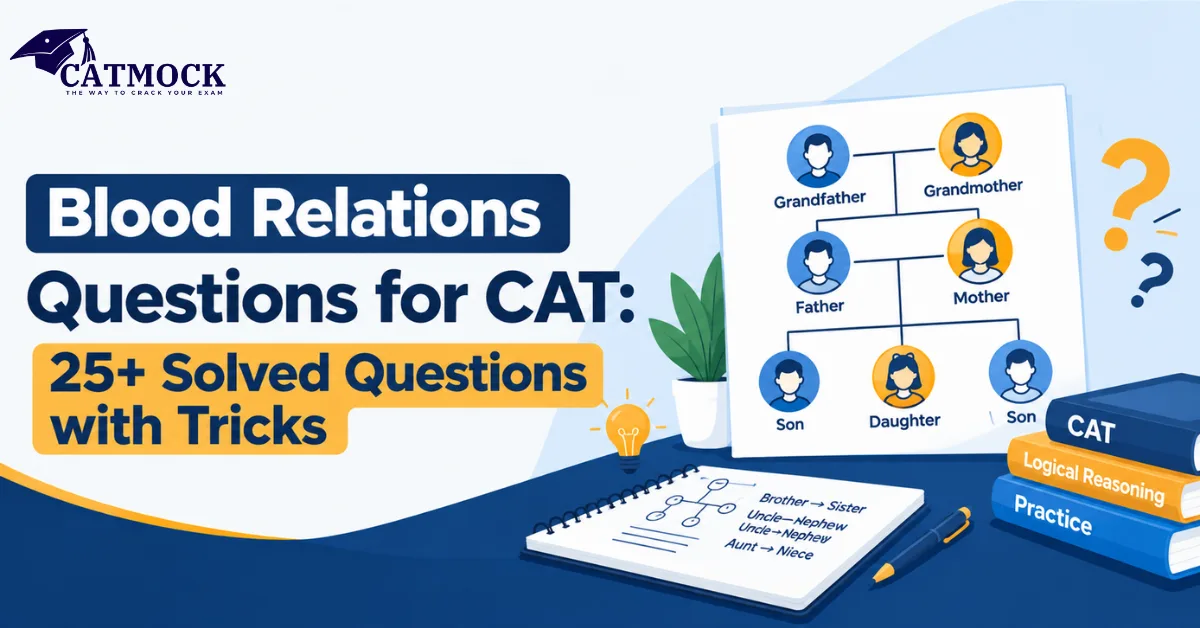
Blood relations questions for CAT look harmless, but one misread word like “only” or “mother’s” can turn a 30-second question into a 3-minute trap. In this guide you will get the concepts, a foolproof diagram method, a relationship cheat sheet, and 26 solved blood relations questions for CAT, each with a shortcut trick you can use on exam day.
What you’ll learn:
- Where blood relation questions appear in the CAT exam
- The symbol method for drawing family trees
- 26 practice questions, from easy to advanced, with solutions
- Common mistakes, FAQs and a quick revision summary
What Are Blood Relations Questions in CAT?
Blood relation questions test whether you can decode a chain of family connections and name the exact relationship between two people. A “blood relation” covers relations by birth (mother, brother, cousin) and by marriage (father-in-law, sister-in-law).
In the CAT exam, these questions belong to the Logical Reasoning (LR) side of the LRDI section. The official CAT exam website publishes the exam pattern, so always confirm the latest section structure there. Standalone blood relation questions are rare in recent papers. They usually show up embedded inside family-based puzzle sets, where you must first decode relationships and then arrange people in a picnic, seating or scheduling puzzle. That is why blood relation practice for CAT still matters: it makes those sets much faster.
Related reading: CAT Logical Reasoning preparation guide | Seating arrangement questions for CAT
Why Blood Relation Questions Matter for CAT 2026
- Low effort, high accuracy: once you know the method, accuracy is close to 100%.
- Foundation for LRDI sets: family puzzles need the same relationship decoding.
- Time saver: decoding a relation in 30 seconds leaves more time for tougher sets.
- Useful for other MBA exams: XAT, SNAP, NMAT and CMAT also test it.
Types of Blood Relation Questions Asked in CAT
1. Direct Statement Questions
A chain of statements such as “A is B’s father, B is C’s sister” leads to one relation.
2. Photograph or Pointing Questions
A person points to someone and describes them cryptically (“He is the son of my mother’s only brother”).
3. Coded Relation Questions
Symbols like +, –, × or @ stand for relations. You decode the symbols and evaluate an expression.
4. Family Puzzle or Set-Based Questions
Several people, couples and conditions are given, and you answer multiple questions from one set.
Family Tree Basics: The Symbol Method
Drawing beats imagining. Use this standard notation so every diagram looks the same.
| Symbol | Meaning |
|---|---|
| □ or (–) | Male |
| ○ or (+) | Female |
| = | Married couple |
| Horizontal line (—) | Siblings (same generation) |
| Vertical line (│) | Parent to child (next generation) |
| ? | Unknown gender or relation |
Trick: always read the statement from left to right and add one person at a time. Never try to solve in your head.
Relationship Cheat Sheet (Save This Table)
| Relation | Meaning |
|---|---|
| Paternal uncle (Chacha/Tau) | Father’s brother |
| Maternal uncle (Mama) | Mother’s brother |
| Paternal aunt (Bua) | Father’s sister |
| Maternal aunt (Mausi) | Mother’s sister |
| Nephew / Niece | Brother’s or sister’s son / daughter |
| Cousin | Child of uncle or aunt |
| Brother-in-law | Spouse’s brother, sister’s husband |
| Sister-in-law | Spouse’s sister, brother’s wife |
| Father-in-law / Mother-in-law | Spouse’s father / mother |
| Son-in-law / Daughter-in-law | Daughter’s husband / son’s wife |
| Grandfather / Grandmother | Parent’s father / mother |
5 Golden Tricks to Solve CAT Blood Relation Questions Faster
- Start from the person spoken about, then move outward.
- Decode “only” carefully. “My father’s only son” means me (if I’m male), or my brother if I’m female.
- “Mother’s/father’s” decides the side. Maternal and paternal relations are named differently.
- Gender is often hidden. Mark it as “?” until a statement reveals it.
- Reduce long chains in steps. Replace “my mother’s brother’s wife” with “aunt (mami)” and continue.
26 Blood Relations Questions for CAT with Solutions
Level 1: Basic Blood Relation Questions (Q1–Q8)
Q1. Pointing to a man, Ritu says, “He is the son of my mother’s only brother.” How is the man related to Ritu?
Solution: Mother’s brother = maternal uncle. His son = cousin.
Answer: Cousin.
Trick: “Son or daughter of an uncle/aunt” is always a cousin.
Q2. A is B’s sister. C is B’s mother. D is C’s father. How is A related to D?
Solution: A and B are C’s children. D is C’s father, so D is A’s maternal grandfather.
Answer: A is D’s granddaughter.
Q3. Pointing to a photograph, Shivam says, “She is the daughter of my grandfather’s only son.” How is she related to Shivam?
Solution: Grandfather’s only son = Shivam’s father. Father’s daughter = sister.
Answer: Sister.
Trick: “Grandfather’s only son” collapses to “father” (paternal side).
Q4. How is the father of my mother’s sister’s son related to me?
Solution: Mother’s sister = maternal aunt. Her son = cousin. The cousin’s father = the aunt’s husband.
Answer: Maternal uncle (Mausa).
Q5. P is the brother of Q. Q is the sister of R. R is the father of S. How is P related to S?
Solution: P, Q and R are siblings. R is male (father). P is R’s brother, so he is S’s paternal uncle.
Answer: Paternal uncle.
Q6. Pointing to a man, a woman says, “His mother is the only daughter of my father.” How is the woman related to the man?
Solution: The woman herself is her father’s daughter. If his mother is the only daughter, the mother is the woman.
Answer: Mother.
Trick: “Only daughter of my father” usually points to me if I’m female.
Level 2: Photograph and Pointing Questions (Q9–Q12)
Q7. Pointing to a woman, Arun says, “She is the wife of the only brother of my only sister.” Who is she to Arun?
Solution: The only brother of Arun’s only sister is Arun himself. His wife is the woman.
Answer: Wife.
Trick: “Only brother of my only sister” = myself.
Q8. Pointing to a man, Neha says, “His mother is the wife of my father’s only son.” How is the man related to Neha?
Solution: Father’s only son = Neha’s brother. His wife = Neha’s sister-in-law, who is the man’s mother. The man is her brother’s son.
Answer: Nephew.
Q9. Pointing to a woman, Amit says, “Her husband is the only son of my mother’s father.” How is she related to Amit?
Solution: Mother’s father’s only son = Amit’s maternal uncle. The woman is his wife.
Answer: Maternal aunt (Mami).
Q10. Looking at a portrait, Ram says, “I have no brother or sister, but that man’s father is my father’s son.” Who is the man to Ram?
Solution: With no siblings, “my father’s son” is Ram himself. So the man’s father is Ram.
Answer: Son.
Level 3: Coded Blood Relation Questions (Q13–Q16)
Code set 1: A + B means A is the mother of B. A – B means A is the brother of B. A × B means A is the father of B.
Q11. Which expression shows that P is the maternal uncle of R?
Solution: Maternal uncle = mother’s brother. P – Q means P is Q’s brother, and Q + R means Q is R’s mother.
Answer: P – Q + R.
Q12. What does A × B – C mean?
Solution: A is B’s father. B is C’s brother, so A is also C’s father.
Answer: A is the father of C.
Code set 2: A @ B means A is the sister of B. A # B means A is the father of B. A $ B means A is the mother of B.
Q13. In P # Q $ R @ S, how is P related to S?
Solution: P is Q’s father. Q is R’s mother. R is S’s sister. So P is the maternal grandfather of R and S.
Answer: Maternal grandfather.
Q14. In M @ N # O, how is M related to O?
Solution: M is N’s sister. N is O’s father. M is O’s paternal aunt.
Answer: Paternal aunt (Bua).
Trick for coded questions: write the meaning of each symbol under the expression, then chain left to right.
Level 4: Family Set Questions (Q17–Q20)
Q15. A and B are a married couple, and A is male. D is the only son of C, who is A’s brother. E is D’s sister. How is E related to A?
Solution: C is A’s brother, so C’s children are A’s brother’s children. E is C’s daughter.
Answer: Niece.
Q16. A’s mother is B’s mother’s only sister. How are A and B related?
Solution: Their mothers are sisters, so they are maternal cousins.
Answer: Cousins.
Q17. X’s father is Y’s brother. Y’s son is Z. How is X related to Z?
Solution: X is the child of Y’s brother, and Z is Y’s child. Both are children of brothers.
Answer: Cousins (paternal).
Q18. P (male) and Q (female) are the parents of R. R’s wife S has two children with R: T (daughter) and U (son). How is T related to Q?
Solution: Q is R’s mother, and T is R’s daughter.
Answer: Granddaughter.
Level 5: Advanced Blood Relation Questions (Q21–Q26)
Q19. Pointing to a lady, a man says, “She is the mother of the only granddaughter of my father, who has only one son.” How is the lady related to the man?
Solution: The father has only one son, which is the man. The father’s only granddaughter is therefore the man’s daughter, and her mother is the man’s wife.
Answer: Wife.
Q20. Ram has two sons, A and B. A has one son, C. B has two sons, D and E. How many father-son pairs exist?
Solution: Ram–A, Ram–B, A–C, B–D, B–E.
Answer: 5 pairs.
Trick: count each person as a “son” once; the number of sons equals the number of pairs.
Q21. M is N’s son. N is O’s daughter. O’s brother is P. How is P related to M?
Solution: O is M’s maternal grandfather. P is O’s brother.
Answer: Maternal grand-uncle.
Q22. A is B’s brother. B is C’s sister. C is D’s father. E is D’s brother. How is A related to E?
Solution: A, B and C are siblings. C is the father of D and E. A is C’s brother, so A is E’s paternal uncle.
Answer: Paternal uncle.
Q23. Pointing to a girl, Manoj says, “She is the daughter of the son of the mother of my mother.” How is she related to Manoj?
Solution: Mother of my mother = maternal grandmother. Her son = maternal uncle. His daughter = cousin.
Answer: Cousin.
Q24. Pointing to a man, Sheela says, “His brother’s father is the only son of my father’s father.” How is the man related to Sheela?
Solution: Father’s father’s only son = Sheela’s father. The man’s brother’s father is the man’s own father, so he is also Sheela’s father. The man is Sheela’s brother.
Answer: Brother.
Common Traps in CAT Blood Relation Questions
| Trap | Why students fall for it | Fix |
|---|---|---|
| Ignoring the word “only” | Leads to an extra person in the tree | Treat “only” as no other sibling |
| Assuming gender | “Cousin” or “sibling” is gender-neutral | Mark “?” until revealed |
| Mixing paternal and maternal | Different names, different answers | Write P or M beside every arrow |
| Reading right to left | Reverses the direction of the relation | Always build the chain left to right |
| Skipping the diagram | Errors creep into mental solving | Draw even for “easy” questions |
How to Prepare Blood Relations Questions for CAT
Week 1: Learn the symbols and the cheat sheet. Solve Q1–Q12 above without help.
Week 2: Practice coded relations and photograph questions, aiming for under 45 seconds each.
Week 3: Attempt family-based puzzle sets from previous papers and mock tests.
Week 4: Revise the traps table and time yourself.
Strategy for exam day: if a family set needs more than 2 minutes to decode, move on. Return only after finishing the easier sets. For more practice, see our CAT DILR mock tests.
Summary
- Blood relation questions in CAT appear mostly inside LRDI family puzzle sets.
- Use symbols (□, ○, =, —, │) and always draw a family tree.
- Read statements left to right and mark gender and side (paternal or maternal).
- Decode “only” carefully, as it often points to the speaker.
- Coded questions need symbol meanings written down first.
- Practice all four types: direct, photograph, coded and set-based.
Frequently Asked Questions (FAQs)
1. Are blood relation questions asked in CAT?
Standalone questions are rare, but blood relation logic is often embedded in family-based LRDI sets. Practice keeps you prepared.
2. How many blood relation questions come in CAT?
There is no fixed count. Some years have none as standalone questions, and some have one or two inside a set.
3. Is blood relations easy or difficult for CAT?
The concepts are easy, but long chains and puzzle sets add difficulty. Accuracy improves fast with a drawing habit.
4. What is the best trick to solve blood relation questions?
Draw a family tree with symbols, read left to right, and mark the paternal or maternal side at every step.
5. How much time should I spend on one question?
Basic questions should take 30 to 45 seconds. Set-based questions can take 2 to 4 minutes for all parts.
6. Which book or material is best for practice?
Use previous-year LRDI sets, mock tests, and the 26 questions above as a starter set.
7. Can I skip blood relations in CAT?
You can skip long sets, but do not skip the concept. It is the base of many logical reasoning puzzles.
Conclusion
Mastering blood relations questions for CAT comes down to three habits: draw the tree, read left to right, and never assume gender or side. Practice the 26 questions above, review the traps table, and track your speed. Consistent practice turns these questions into some of the quickest marks in your LRDI section. Continue with our CAT DILR preparation strategy and start solving today.
You May Also Like : CAT MOCK, CAT MOCK PYQ
Follow Us On : Facebook, Instagram, Youtube