
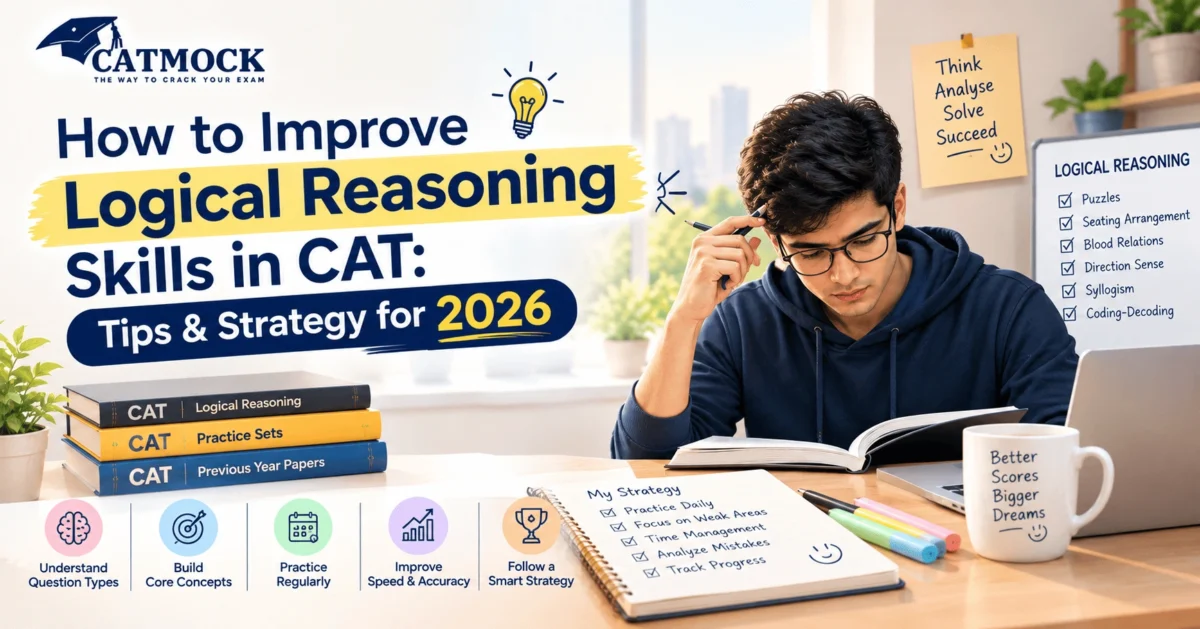
Solved a puzzle in 12 minutes during practice, then froze on an easier one in the actual mock? That’s not bad luck — that’s exactly how CAT Logical Reasoning is designed to behave.
Unlike a fixed-syllabus topic, LR in CAT doesn’t test what you’ve memorised — it tests how fast you can size up a new puzzle, decide if it’s solvable in your remaining time, and execute cleanly under pressure. That’s precisely why generic “practice more” advice doesn’t move the needle much. This guide breaks down why CAT LR feels so unpredictable, the topics that actually repeat most often, and a realistic, step-by-step way to build real logical reasoning for CAT — not just topic familiarity.
Last updated: September 2026 · Compiled by the CATMOCK team using CAT 2025 slot-wise question analysis and recurring topic patterns from CAT papers between 2019 and 2025.
Why Logical Reasoning Feels So Unpredictable in CAT
Here’s the part most guides skip: LR’s difficulty and question count genuinely shift between exam slots in the same year. In CAT 2025, Slot 1 carried 13 LR questions, Slot 2 had 9, and Slot 3 had only 8 — all within the same DILR section, same exam, same day. That’s not a fluke; it’s a structural feature of how CAT builds its DILR sets.
| DILR Section Detail | Typical Value |
|---|---|
| Total DILR Questions | 20–22 |
| Number of Sets | 4–5 |
| Approx. LR Share | 40–50% of DILR (varies by slot) |
| Approx. DI Share | 40–50% of DILR (varies by slot) |
| Format | Mixed MCQ + TITA (no negative marking on TITA) |
| Marking | +3 correct, −1 incorrect (MCQ only) |
Because IIMs never release an official topic-wise syllabus, this variability is exactly why treating LR as a fixed checklist of formulas — the way you might approach Quant — tends to backfire. The real skill being tested is adaptive reasoning, not topic recall.
CAT Logical Reasoning Topics You Actually Need to Master
Based on recurring patterns across recent CAT papers, these are the CAT logical reasoning topics worth prioritising, roughly in order of how often they show up:
| Topic | What It Tests | Typical Difficulty |
|---|---|---|
| Seating Arrangements (Linear/Circular) | Spatial logic, constraint elimination | Moderate–Difficult |
| Puzzles (Floor, Grouping, Matrix-based) | Multi-condition logical deduction | Difficult |
| Games & Tournaments | Points tables, win/loss/draw conditions, seeding logic | Difficult |
| Blood Relations & Family Trees | Relationship mapping across generations | Moderate |
| Syllogisms | Deductive logic using “All/Some/None” statements | Easy–Moderate |
| Coding-Decoding | Pattern identification in letters/numbers | Easy–Moderate |
| Venn Diagrams & Set Theory | Overlapping sets, logical grouping | Moderate |
| Direction & Order-based Reasoning | Movement clues, relative positioning | Easy–Moderate |
| Input-Output & Sequences | Step-by-step operation tracking | Moderate |
Puzzles and seating arrangements consistently show up as the highest-weightage categories, which is exactly why building genuine speed here (not just accuracy) pays off more than any other single topic. Our complete DILR syllabus breakdown goes deeper into how each of these topics is typically structured inside a set.
CAT LR vs. Generic Reasoning Tests: Why Your Old Practice Material Might Be Wrong
If you’ve prepared for reasoning sections in other competitive exams, here’s an important correction: CAT logical reasoning preparation is fundamentally different from the verbal-heavy reasoning tested in most government or banking exams.
| Aspect | CAT Logical Reasoning | Typical Govt./Banking Exam Reasoning |
|---|---|---|
| Format | Set-based (4–6 linked questions per puzzle) | Mostly standalone questions |
| Data Style | Combines logic with numerical/tabular data | Largely verbal/symbolic |
| Skill Tested | Set selection, sustained multi-step deduction | Quick individual pattern recognition |
| Time Pressure | ~8–10 minutes per full set | Seconds per question |
| Negative Marking | Only on MCQs, not on TITA | Usually uniform across all questions |
If your current LR practice material is built for a different exam pattern, you’re training the wrong muscle. Prioritise set-based puzzles and data-heavy logical deduction over isolated verbal reasoning drills — that’s the actual skill CAT is testing.
A Step-by-Step Strategy to Improve Logical Reasoning for CAT
Improving LR isn’t about solving more puzzles randomly — it’s about building two specific skills: set selection and execution speed.
Step 1: Build a Set-Selection Habit First
Before you even start solving, spend the first 3–4 minutes of every DILR mock skimming all sets. Rank them by how quickly you can identify the structure — not by which topic you personally like. This single habit, more than any formula, is what separates strong DILR scorers from average ones.
Step 2: Practice Topic-Wise Before Timed Sets
Don’t jump straight into timed, mixed practice. Spend the first few weeks isolating each topic — seating arrangements one week, puzzles the next — so you recognise structures instantly later. Our DILR Bhandara offers 1,000+ free, topic-tagged DILR sets specifically organised this way, moving from foundational arrangements to advanced multi-layered puzzles.
Step 3: Time-Box Every Set During Practice
Give yourself a hard 8–10 minute cap per set, even in untimed practice. If you can’t crack the structure within that window, abandon it and move on — exactly as you would in the real exam. This builds the instinct to cut losses early, which is often worth more marks than perfecting your slowest topic.
Step 4: Simulate Real Exam Conditions Weekly
Topic-wise practice builds skill; sectional mocks build exam temperament. Once you’re comfortable across topics, shift to DILR sectional mocks that mirror the real 40-minute, 4–5 set format, so you’re training the full decision-making process — not just the puzzle-solving part.
Step 5: Deep-Dive Your Weakest High-Weightage Topic
If Games & Tournaments or Puzzles consistently cost you time, don’t just do more generic practice — study the specific patterns. Our dedicated guide to Games and Tournaments questions breaks down a repeatable framework for exactly this topic, since it tends to separate strong scorers from average ones more than any other LR category.
Common Mistakes That Quietly Hurt LR Scores
- Attempting sets in the order they appear, rather than the order that fits your strength — CAT doesn’t reward attempt order, only correct answers.
- Refusing to abandon a set after the time cap, hoping “just two more minutes” will crack it — this is the single biggest silent score-killer in DILR.
- Practising only familiar topics and avoiding weaker ones like Games & Tournaments, which then resurface unpredictably on exam day.
- Solving without reviewing the logic, especially for TITA-based LR questions, where getting the right answer for the wrong reason won’t help you next time.
- Ignoring accuracy for speed in the early practice phase — building sloppy shortcuts now means unlearning them later under pressure.
A Realistic Preparation Timeline for CAT Logical Reasoning
| Phase | Focus | Suggested Practice |
|---|---|---|
| Weeks 1–3 | Topic-wise mastery (one topic at a time) | 5–8 sets per topic, untimed, with full solution review |
| Weeks 4–6 | Timed, topic-mixed practice | 2–3 sets daily with an 8–10 minute cap per set |
| Weeks 7–9 | Full DILR sectional mocks | 2–3 sectional mocks weekly, reviewed within 24 hours |
| Weeks 10 onward | Integration into full-length mocks | Full-length mocks with dedicated DILR set-selection drills |
Key Takeaways
- CAT LR question count genuinely varies by slot (8–13 questions seen across CAT 2025 slots), so treat it as adaptive reasoning practice, not a fixed syllabus checklist.
- Seating arrangements, puzzles, and games & tournaments are the highest-weightage, highest-difficulty LR topics worth prioritising.
- CAT-style LR is set-based and data-heavy — practice material built for government or banking exam reasoning trains the wrong skill.
- Set selection (choosing which puzzles to attempt) matters as much as solving ability — build this habit early in your prep.
- Time-boxing every set to 8–10 minutes, even in untimed practice, builds the instinct to cut losses that pays off directly on exam day.
- A 10-week structured plan — topic mastery, then timed practice, then full sectional mocks — builds both skill and exam temperament.
Frequently Asked Questions
Q1. How can I improve my logical reasoning skills for CAT quickly?
Start by scanning all sets before solving and picking the easiest structure first, instead of attempting in order. Pair this with focused topic-wise practice on seating arrangements and puzzles for the fastest visible improvement.
Q2. What are the most important CAT logical reasoning topics to focus on?
Seating arrangements, multi-constraint puzzles, and games & tournaments are the highest-weightage, toughest topics. Blood relations, syllogisms, and coding-decoding are easier and worth mastering first.
Q3. Is CAT logical reasoning the same as reasoning in other competitive exams?
No. CAT uses set-based reasoning with 4–6 questions tied to one puzzle, mixed with numerical data — unlike the standalone, verbal-style reasoning in banking or government exams.
Q4. How many hours should I practice logical reasoning daily for CAT?
Aim for 45–60 minutes daily in the early weeks, moving to full 40-minute sectional mocks two to three times a week closer to the exam. Consistency matters more than long, occasional sessions.
Q5. Why do I do well in LR practice but struggle in actual mock tests?
This is usually a set-selection problem, not a knowledge gap — you can solve untimed but struggle to judge what’s solvable under pressure. Practise with a strict time cap per set and abandon anything that overruns it.
Conclusion
Improving logical reasoning for CAT isn’t about memorising more puzzle types — it’s about training your judgment on which sets to attempt and how fast you can execute once you commit. Build topic-wise fundamentals first, then layer in strict timing, then test the full skill under real sectional conditions. For the latest exam pattern updates, always cross-check the official CAT website, and if you want to strengthen the underlying logical foundations, NCERT’s mathematics resources remain a solid, free starting point for structured thinking.
You May Also Like : CAT MOCK, CAT MOCK PYQ
Follow Us On : Facebook, Instagram, Youtube