

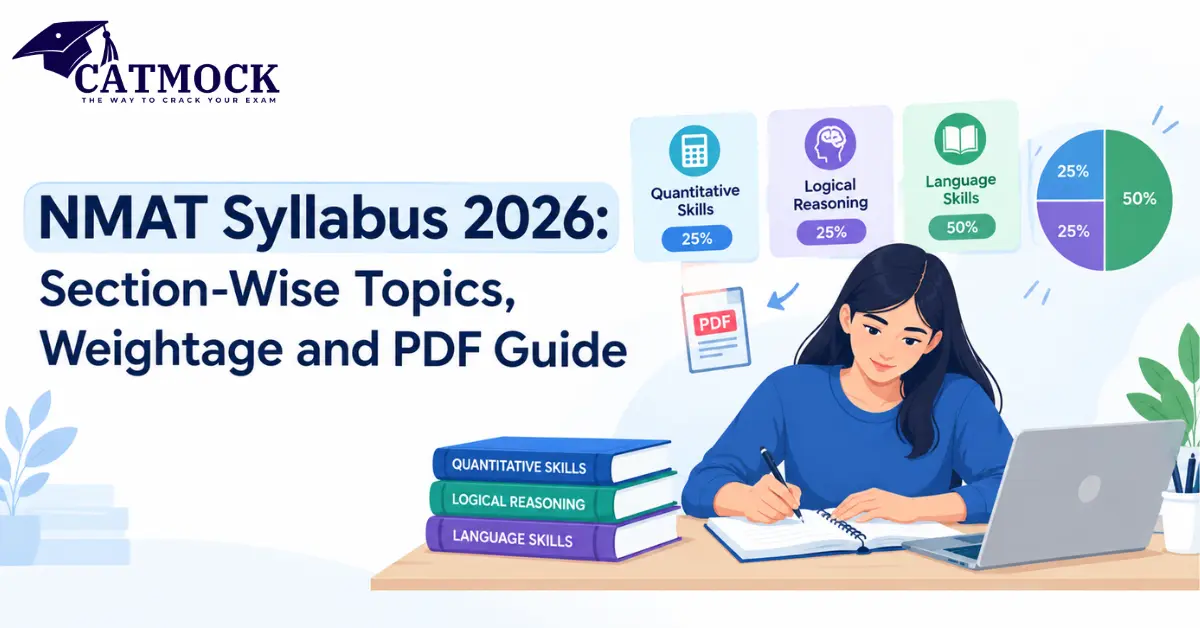
The NMAT syllabus 2026 has three equally weighted sections: Language Skills, Quantitative Skills and Logical Reasoning. Each section has 36 questions, so the paper has 108 questions in 120 minutes. GMAC, which conducts NMAT by GMAC, publishes a section-wise topic list. It does not publish topic-wise weightage or a standalone syllabus PDF. That gap leads many aspirants to study topics that rarely appear and skip ones that do.
This guide gives you the verified NMAT exam syllabus, an honest view of NMAT syllabus weightage, a study-priority map for every section and a list of common mistakes to avoid. Last verified against GMAC’s official NMAT pages on 4 October 2026.
Timing matters. NMAT registration closes on 10 October 2026, and the test window runs from 2 November to 20 December 2026.
NMAT Syllabus 2026 at a Glance
Here is the NMAT by GMAC syllabus 2026 in one table, using the official structure and topic list from GMAC’s NMAT page.
| Section | Questions | Time | Avg. time per question | Score range | Official topics |
|---|---|---|---|---|---|
| Language Skills | 36 | 28 min | ~47 sec | 12–120 | Reading Comprehension, Para Forming, Error Identification, Prepositions, Sentence Completion, Analogies |
| Quantitative Skills | 36 | 52 min | ~87 sec | 12–120 | Number Properties, Arithmetic, Algebra and Probability, Data Interpretation (Caselets and Tables; Graphs and Charts), Data Sufficiency |
| Logical Reasoning | 36 | 40 min | ~67 sec | 12–120 | Critical Reasoning, Analytical Puzzles, Deductions, Other Reasoning |
| Total | 108 | 120 min | — | 36–360 | No negative marking |
Language Skills has the shortest clock, and Quant gives you the most time per question. You can also choose the order of the sections at the start of the exam.
For the full structure, read our NMAT exam pattern 2026 guide.
Is There an Official NMAT Syllabus 2026 PDF?
Aspirants search for “NMAT syllabus PDF” and “NMAT syllabus 2026 PDF download” more than almost anything else. Here is the accurate answer.
GMAC publishes the NMAT exam syllabus as a section-wise topic list on its website. We found no standalone, downloadable syllabus PDF on mba.com. The official downloadable resource is the NMAT sample questions PDF, which shows how questions look in each section. GMAC also lists official NMAT prep materials.
Any page offering an “official NMAT syllabus PDF 2026” is repackaging that topic list. The tables in this guide cover the same ground, so you can save this page as a PDF for offline revision.
How the Adaptive Format Changes the Way You Read the Syllabus
NMAT is computer-adaptive. According to GMAC, questions arrive one at a time, drawn from a pool based on how you answered earlier questions. You cannot go back and change an answer. Higher-scoring candidates generally receive a harder set of questions.
This affects how you use the NMAT topics list:
- Two candidates can see a different mix of sub-topics.
- Every topic on the list is fair game, so prepare broadly.
- Accuracy early in a section matters, because it shapes the difficulty that follows.
NMAT Syllabus 2026 Section-Wise
NMAT Language Skills Syllabus
The Language Skills section tests grammar, vocabulary and reading in 36 questions and 28 minutes. The official topics are:
- Reading Comprehension: passages followed by questions on main idea, inference, tone and detail.
- Para Forming (sentence formation): arranging sentences into a coherent paragraph.
- Error Identification: spotting mistakes such as wrong verb forms, tense and agreement errors.
- Prepositions and Sentence Completion: choosing the right preposition or word to complete a sentence.
- Analogies: identifying word relationships.
With about 47 seconds per question, speed reading and grammar instinct matter more than rare vocabulary.
NMAT Quantitative Skills Syllabus
Quantitative Skills is the longest section: 36 questions in 52 minutes. GMAC groups it into these areas:
- Number Properties: fractions and logarithms. Candidates commonly add divisibility and remainders.
- Arithmetic: percentages, interest, ratios and averages. Profit and loss, time-speed-distance, time and work, and mixtures are commonly practised extensions.
- Algebra and Probability: equations, sequences and combinations. This includes linear and quadratic equations, inequalities, permutations and combinations, and probability.
- Data Interpretation: caselets and tables, plus graphs and charts.
- Data Sufficiency: deciding whether given statements are enough to answer a question.
Is geometry in the NMAT syllabus? GMAC’s official list does not name geometry or mensuration. Some prep sources include basic geometry, so give it low priority. Cover it only after the core areas above are solid.
For fees and the step-by-step process, see our NMAT 2026 registration guide.
NMAT Logical Reasoning Syllabus
Logical Reasoning has 36 questions in 40 minutes. GMAC’s guidance describes it as:
- Critical Reasoning: conclusions, assumptions and inferences, and strengthening or weakening arguments.
- Analytical Puzzles: arrangements, input-output and set theory.
- Deductions: statement-based reasoning.
- Other Reasoning: decision making, syllogisms and Venn diagrams. Coding-decoding, blood relations and series are widely practised here.
NMAT Syllabus 2026 Weightage: Section-Wise and Topic-Wise
Section-wise weightage
The NMAT syllabus weightage across sections is equal. Each section has 36 questions and a 12–120 scaled score range, so each contributes one-third of the 36–360 total.
Topic-wise weightage
GMAC does not release topic-wise weightage or question papers. The ranges below are indicative, compiled from published trend analyses of recent test-taker experience. Because the exam is adaptive, treat them as directional, not exact.
Quantitative Skills (indicative):
| Topic | Approx. questions | Priority |
|---|---|---|
| Arithmetic | 10–12 | Very high |
| Algebra | 5–7 | High |
| Modern Math (P&C, probability, sets) | 5–6 | High |
| Data Interpretation (1–2 sets) | 4–8 | High |
| Data Sufficiency | 4–5 | Medium |
| Number Properties | 3–4 | Medium |
The ranges overlap, so they will not add up to exactly 36.
Language Skills and Logical Reasoning (indicative):
| Section | Topic | Approx. questions | Priority |
|---|---|---|---|
| Language | Reading Comprehension | 8–12 | Very high |
| Language | Error Identification, Prepositions, Grammar | 6–8 | High |
| Language | Sentence Completion | 5–6 | Medium |
| Language | Para Forming | 4–5 | Medium |
| Language | Analogies and Vocabulary | 3–4 | Lower-medium |
| Logical Reasoning | Critical Reasoning | 9–12 | Very high |
| Logical Reasoning | Deductions (statement-based) | 4–6 | High |
| Logical Reasoning | Syllogisms and Venn Logic | 4–5 | Medium |
| Logical Reasoning | Puzzles, Arrangements, Input-Output, Other | 13–19 (the balance) | High |
NMAT Syllabus 2026 Priority Map: What to Study First
The tiers below turn the topic-wise weightage into an order of study. Tier 3 doesn’t mean “skip”. It means “polish last”.
| Tier | Language Skills | Quantitative Skills | Logical Reasoning |
|---|---|---|---|
| Tier 1: start here | Reading Comprehension; Error Identification and Prepositions | Arithmetic; Algebra; Modern Math (P&C, probability) | Critical Reasoning; Deductions; Puzzles and Arrangements |
| Tier 2: build next | Sentence Completion; Para Forming | Data Interpretation; Data Sufficiency; Number Properties | Syllogisms and Venn Logic; Input-Output; Decision Making |
| Tier 3: polish | Analogies and Vocabulary | Basic geometry and mensuration (not in GMAC’s named list) | Coding-Decoding; Blood Relations; Series |
Arithmetic, Reading Comprehension and Critical Reasoning are your three biggest levers.
What Each Section of the NMAT Syllabus Rewards
The per-question time budget shows what each section demands:
- Language Skills (~47 seconds per question): this section rewards fast, accurate reading and clean grammar. There is little room to deliberate, so practise short, timed sets.
- Quantitative Skills (~87 seconds per question): you have the most time per question here, but arithmetic and Data Interpretation questions can be calculation-heavy. Mental maths and smart approximation save minutes.
- Logical Reasoning (~67 seconds per question): this section rewards structured thinking. Critical Reasoning needs careful reading, and puzzles need a quick set-up. Don’t sink five minutes into one arrangement.
Since you can choose the section order, many aspirants start with the section they find most demanding or the one they feel most confident in. Test both approaches in practice, as our NMAT mock score strategies guide suggests.
Common Mistakes When Reading the NMAT Syllabus
- Treating indicative weightage as fixed. GMAC publishes none, and the adaptive format varies the mix.
- Relying on an “official syllabus PDF”. The official source is the topic list on mba.com.
- Over-investing in geometry. It isn’t in GMAC’s named topic list, so keep it behind the core topics.
- Ignoring Data Sufficiency. It is a named Quant topic with its own question format. Practise it so the format doesn’t cost you time.
- Studying topics without sectional clocks. The 28, 52 and 40-minute limits are strict, so practise with them from the start.
- Skipping Language Skills. It has the tightest clock, and it counts for one-third of your total score.
How to Cover the NMAT Syllabus 2026 in the Time You Have
As of 4 October 2026, you have roughly four weeks before the test window opens (2 November) and about eleven weeks before it closes (20 December). Scheduling is open until 22 October, so pick a date that matches your readiness. Our NMAT preparation plan by exam date has week-by-week schedules.
- Diagnose first. Take one full-length mock to see where you stand.
- Cover Tier 1 topics. Build accuracy in Arithmetic, RC and Critical Reasoning.
- Add Tier 2 topics. Move to DI, data sufficiency, syllogisms and grammar.
- Drill sections against the clock. Use the real 28/52/40-minute limits.
- Simulate and review. Take full mocks and log every error.
Summary
- The NMAT syllabus 2026 has three sections of 36 questions: Language Skills, Quantitative Skills and Logical Reasoning.
- The exam has 108 questions in 120 minutes (28, 52 and 40 minutes per section), with no negative marking and a 36–360 score range.
- GMAC publishes a topic list, not a standalone syllabus PDF and not topic-wise weightage.
- Section-wise weightage is equal. Topic-wise figures are indicative only.
- Arithmetic, Reading Comprehension and Critical Reasoning are the highest-value topics.
- Use the three-tier priority map to decide what to study first.
- Registration closes 10 October 2026, and the test window runs 2 November to 20 December 2026.
Frequently Asked Questions
1. What is the NMAT syllabus 2026?
The NMAT syllabus 2026 has three sections of 36 questions each. Language Skills covers Reading Comprehension, Para Forming, Error Identification, Prepositions, Sentence Completion and Analogies. Quantitative Skills covers Number Properties, Arithmetic, Algebra and Probability, Data Interpretation and Data Sufficiency. Logical Reasoning covers Critical Reasoning, Analytical Puzzles, Deductions and Other Reasoning.
2. Is there an official NMAT syllabus 2026 PDF to download?
GMAC publishes the section-wise topic list on mba.com but, as of 4 October 2026, no standalone syllabus PDF that we could find. The official downloadable resource is the NMAT sample questions PDF. Verify any “official syllabus PDF” claim against mba.com.
3. What is the NMAT syllabus weightage section-wise?
It is equal. Each section has 36 questions and a 12–120 scaled score range, so each contributes one-third of the 36–360 total.
4. Does NMAT publish topic-wise weightage?
No. GMAC does not release topic-wise weightage or question papers. Figures you see online are indicative estimates, and the adaptive format means they vary by candidate.
5. Which topics are most important in the NMAT syllabus 2026?
Arithmetic, Reading Comprehension and Critical Reasoning typically carry the most questions. Algebra, Modern Math, Data Interpretation, grammar and Deductions come next.
7. Does NMAT 2026 have negative marking?
No. There is no penalty for wrong answers, so attempt every question.
8. When is NMAT 2026?
Per mba.com, registration runs until 10 October 2026 and scheduling until 22 October. Exam delivery runs from 2 November to 20 December 2026.
Conclusion
The NMAT syllabus 2026 is compact and predictable: three equal sections and a clearly defined topic list from GMAC. Your edge comes from knowing what is officially listed, what is estimated, and where your hours earn the most marks. Start with the Tier 1 topics, widen to the rest, and keep checking mba.com for updates. Then put the syllabus under exam conditions with CATMOCK’s NMAT mock tests.
You May Also Like : CAT MOCK