

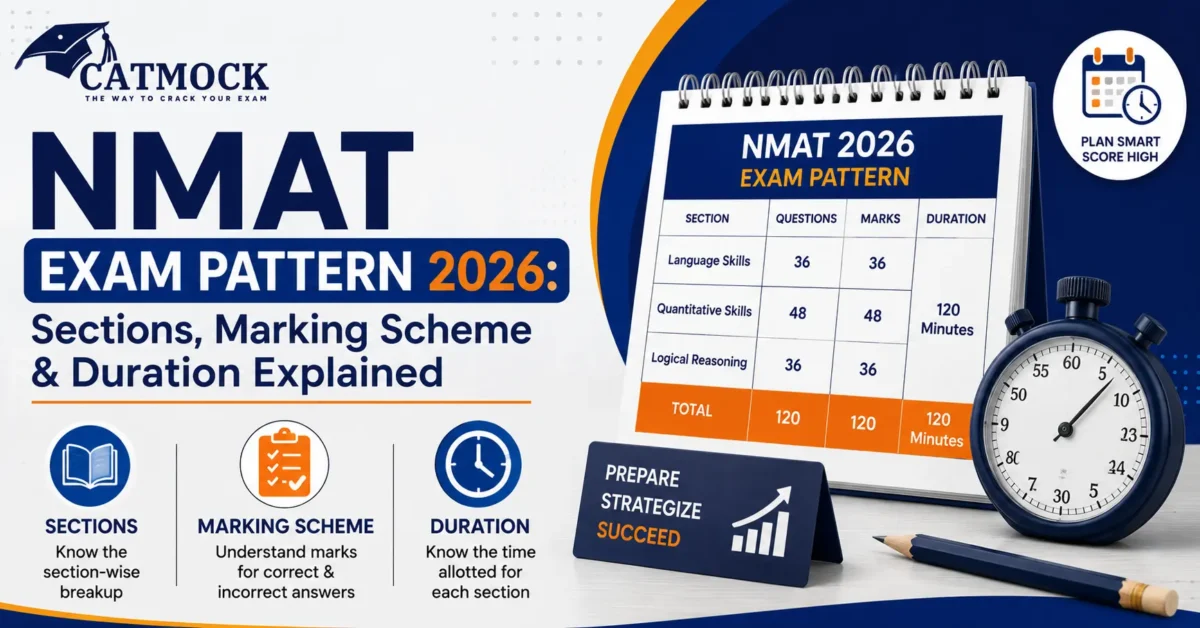
The NMAT exam pattern 2026 consists of 108 questions across three sections — Language Skills, Quantitative Skills, and Logical Reasoning — to be completed in 120 minutes, with no negative marking and a computer-adaptive format. This guide breaks down every part of that structure — section-wise questions and timing, the marking scheme, scoring, and how it should shape your preparation — using only officially confirmed information from NMAT by GMAC.
NMAT Exam Pattern 2026 — Quick Overview
| Feature | NMAT 2026 |
|---|---|
| Conducting Body | GMAC (Graduate Management Admission Council) |
| Mode | Computer-based, computer-adaptive |
| Sections | 3 — Language Skills, Quantitative Skills, Logical Reasoning |
| Total Questions | 108 |
| Total Duration | 120 minutes |
| Sectional Timing | 28 / 52 / 40 minutes (fixed per section) |
| Marking Scheme | No negative marking |
| Scoring | Scaled score, 36–360 (12–120 per section) |
| Section Order | Candidate’s choice, selected before the test starts |
| Attempts Allowed | Up to 3 (1 original + 2 retakes), 15-day gap required |
| Exam Window (2026) | November 2 – December 20, 2026 |
Source: NMAT by GMAC — Exam Structure and Important Dates & Fees
Before you build a study plan for NMIMS, TAPMI, KJ Somaiya, SPJIMR, or any other institute that accepts NMAT scores, it helps to lock down these dates first — see the full NMAT exam dates 2026 schedule for the registration, scheduling, and retake windows.
NMAT 2026 Section-Wise Exam Pattern
Each of the three NMAT sections is individually timed, and unused time from one section cannot be carried over to the next. Candidates answer questions one at a time and must complete the current question before the next one is presented.
| Section | Questions | Time Limit | Score Range |
|---|---|---|---|
| Language Skills | 36 | 28 minutes | 12–120 |
| Quantitative Skills | 36 | 52 minutes | 12–120 |
| Logical Reasoning | 36 | 40 minutes | 12–120 |
| Total | 108 | 120 minutes | 36–360 |
Source: NMAT by GMAC — Exam Structure
Language Skills
Language Skills has 36 questions and the tightest window of the exam at 28 minutes. Officially confirmed topics include Reading Comprehension, Para Forming, Error Identification, Prepositions, Sentence Completion, and Analogies. Because this section allows the least time per question, reading speed and quick grammar recall matter more here than in the other two sections.
Quantitative Skills
Quantitative Skills also has 36 questions but the longest sectional window, at 52 minutes — reflecting its calculation-heavy nature. Officially confirmed topics include Number Properties, Arithmetic, Algebra and Probability, Data Interpretation (Caselets and Tables), Data Interpretation (Graphs and Charts), and Data Sufficiency.
Logical Reasoning
Logical Reasoning has 36 questions in 40 minutes, covering Critical Reasoning, Analytical Puzzles, Deductions, and other reasoning question types.
NMAT Marking Scheme 2026
Because the marking scheme is central to how you should approach the exam, here’s exactly what’s officially confirmed and what isn’t.
- No negative marking. No marks are deducted for a wrong answer or an unattempted question.
- Scoring is scaled, not a simple raw count. Each section is scored on a scale of 12 to 120, and the total score is the sum of the three sectional scores, giving a range of 36 to 360.
- How the scaling works: Because NMAT is computer-adaptive, no two candidates see an identical question set. GMAC calculates a candidate’s final ability estimate using a probabilistic model, then converts that estimate into the scaled score. This means a candidate who receives a harder question pool isn’t disadvantaged compared to one who receives an easier pool.
- What is not officially published: mba.com does not publish a fixed “marks per correct answer” figure or a maximum raw score. Some third-party sites state figures like “+1” or “+3” per question — GMAC does not confirm these figures, so this guide does not present them as fact. If you see a raw-marks formula elsewhere, treat it as unverified.
Source: NMAT by GMAC — Exam Structure
Is There Negative Marking in NMAT?
No. NMAT has zero negative marking — it does not deduct marks for an incorrect answer or a skipped question.. Since there’s no penalty for guessing, it’s generally advisable to attempt every question rather than leave one blank, since a blank question guarantees no credit while a guess at least has a chance.
NMAT Exam Duration and Sectional Timing
The full NMAT exam runs for 120 minutes across all three sections combined. Each section has its own fixed timer — 28 minutes for Language Skills, 52 minutes for Quantitative Skills, and 40 minutes for Logical Reasoning — and you cannot transfer time between sections. Once you finish a section, you cannot go back and review or change your answers in it.
Is NMAT Computer-Adaptive?
Yes. NMAT is a computer-adaptive test, meaning the system determines the difficulty of each question based on how you answered the previous one. The system draws questions one at a time from a pool based on your ongoing performance within that section, and you must answer the current question before the system shows the next one — you cannot skip questions the way you might on a static paper. The number of questions, the difficulty pool, and the time limit for each section stay the same regardless of when or where you take the exam.
NMAT Section Order — Can You Choose It?
Yes. Candidates can choose the order in which they attempt the three sections, and this choice is made before the test begins. There’s no single “correct” order — some aspirants start with their strongest section to build momentum, others clear their most time-pressured section first. The only reliable way to find what works for you is testing different orders across full-length mocks well before exam day, for example through CatMock’s NMAT full-length mock test series.
NMAT Syllabus 2026: What Each Section Covers
NMAT doesn’t publish a separate, standalone syllabus document — its “syllabus” is effectively the section-wise topic list above. A quick recap:
- Language Skills: Reading Comprehension, Para Forming, Error Identification, Prepositions, Sentence Completion, Analogies
- Quantitative Skills: Number Properties, Arithmetic, Algebra and Probability, Data Interpretation (Caselets/Tables and Graphs/Charts), Data Sufficiency
- Logical Reasoning: Critical Reasoning, Analytical Puzzles, Deductions, and other reasoning question types
Source: NMAT by GMAC — Exam Structure
NMAT Difficulty Level
NMAT has a moderate level of difficulty rather than an extremely difficult one, largely because its topic pool is narrower and more predictable than exams like CAT. However, the computer-adaptive format means your personal experience of difficulty depends heavily on your own accuracy — answering early questions correctly within a section tends to bring harder questions next, which can make the section feel tougher for stronger performers. GMAC does not publish any official difficulty rating, so treat “moderate difficulty” as a general, widely shared impression among test-takers rather than a confirmed metric.
NMAT Attempts, Retakes and Scorecard
Candidates can take NMAT up to three times in a single testing window (one original attempt plus two retakes, including no-shows), with a mandatory 15-day gap between attempts. Your scorecard becomes available for download within 48 hours of taking the exam. Whether an admitting institute considers your best score or your first valid score across multiple attempts varies by school — for example, NMIMS specifically counts the first valid score rather than automatically applying the best of three, so it’s worth checking each target institute’s own policy rather than assuming.
Source: NMAT by GMAC — FAQ
Before you register, it’s also worth double-checking that you meet the exam’s NMAT eligibility criteria for 2026, since eligibility and score-acceptance rules are handled separately by GMAC and by each participating institute.
How the NMAT Exam Pattern Should Shape Your Preparation
Once the structure above is clear, a few practical implications follow directly from it:
- Attempt every question. With zero negative marking, an unattempted question is a guaranteed zero, while a guess at least has a chance.
- Slow down slightly on the first few questions of each section. Because the format is adaptive, early accuracy within a section tends to shape the difficulty — and scoring potential — of the rest of that section.
- Respect the uneven sectional timing. Quantitative Skills gets 52 minutes for the same 36 questions that Language Skills must finish in 28 — plan your pacing per section, not as one uniform 120-minute block.
- Test your section order in advance. Since you choose your sequence before the exam starts, rotate different orders across a few full-length mocks to find what suits you, rather than deciding on exam day.
Practicing against the real 108-question, three-section, no-negative-marking format — for example with CatMock’s NMAT sectional and full-length test series — is the most direct way to convert this understanding of the exam pattern into exam-day readiness.
Frequently Asked Questions
What is the NMAT Exam Pattern 2026?
NMAT 2026 has 108 questions across three sections — Language Skills, Quantitative Skills, and Logical Reasoning — that you must complete in 120 minutes, with no negative marking and a computer-adaptive format.
How many sections are there in NMAT?
There are three sections: Language Skills, Quantitative Skills, and Logical Reasoning, each individually timed.
How many questions are asked in NMAT?
NMAT has 108 questions in total — 36 in each of the three sections.
What is the NMAT exam duration?
The total exam duration is 120 minutes, split into fixed sectional windows of 28, 52, and 40 minutes.
Is there negative marking in NMAT?
No. NMAT has zero negative marking, so the exam does not deduct marks for wrong or unattempted questions.
Is NMAT computer-adaptive?
Yes. The difficulty of each question adjusts based on your performance on the previous question within that section.
Can I choose the order of NMAT sections?
Yes. Candidates select their preferred section sequence before the test begins.
What is the NMAT score range?
The total score ranges from 36 to 360, made up of three sectional scores each ranging from 12 to 120.
How many attempts can I take NMAT?
Up to three attempts in a single testing window, with a mandatory 15-day gap between attempts.
Is NMAT syllabus the same as NMAT exam pattern? Not exactly. The exam pattern refers to the structure — sections, questions, timing, and scoring — while the syllabus refers to the topics tested within each section. NMAT doesn’t publish a separate syllabus document; the topic list is drawn from the section structure itself.
Conclusion
The NMAT exam pattern for 2026 includes three clearly timed sections, zero negative marking, and a computer-adaptive scaled scoring model ranging from 36 to 360. This guide draws the figures — 108 questions, 120 minutes, section-wise timing, and scoring range — directly from official NMAT by GMAC documentation, and flags anything not officially confirmed (like a raw marks-per-question formula) rather than presenting it as fact. Once this structure is clear, pairing it with focused, pattern-matched mock practice is the most reliable way to turn exam-pattern knowledge into exam-day readiness.
This information has not yet been officially confirmed for anything beyond what GMAC has published as of the last update above; always cross-check against the official NMAT by GMAC website closer to your exam date, since exam administrators occasionally revise details between cycles.
You May Also Like : CATMOCK / CATMOCK PYQ
Follow Us On : Facebook / Instagram