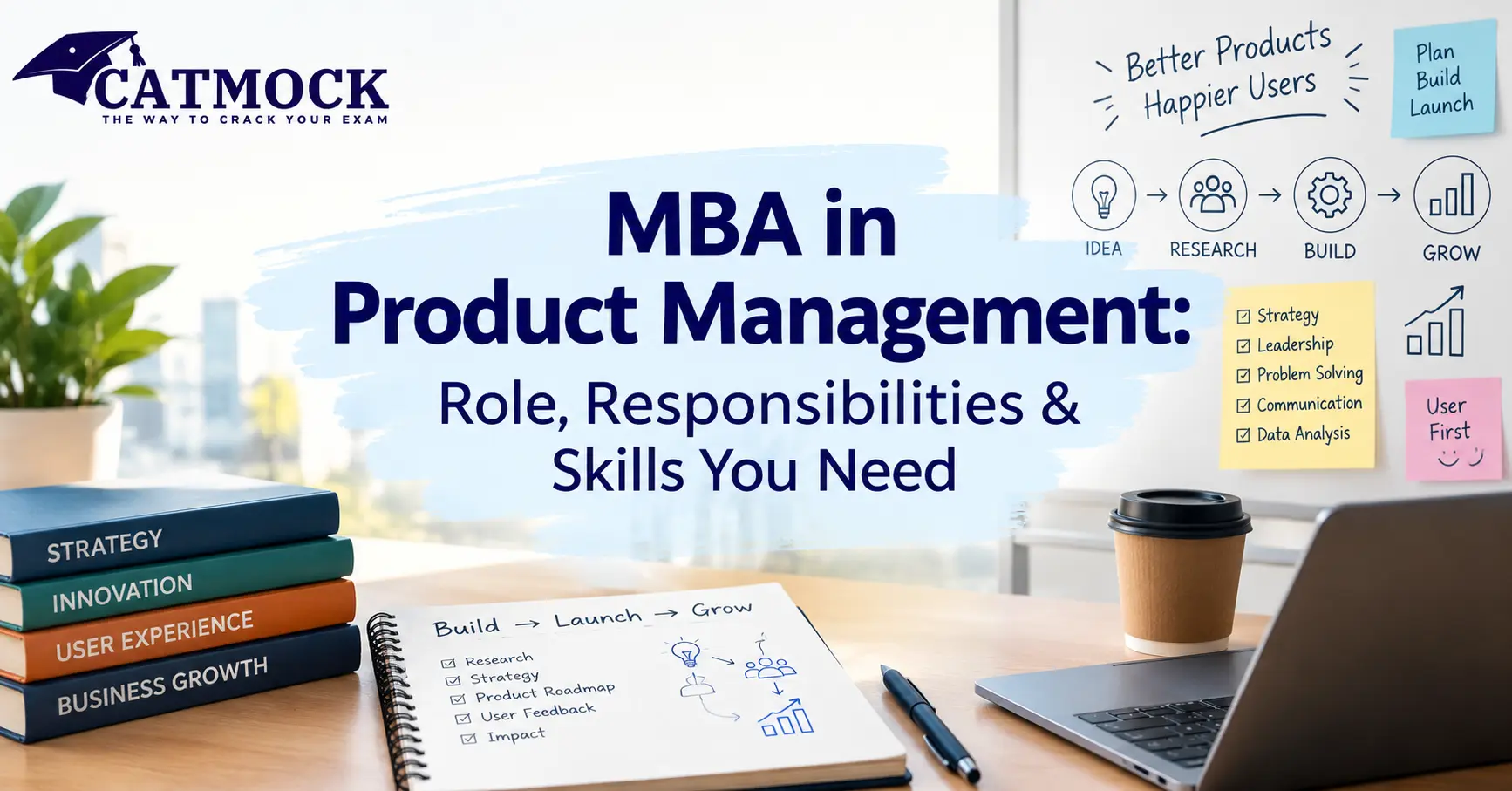
Every app you open, every gadget you unbox and every subscription you renew began as a decision made by a product manager. That is why an MBA in Product Management has become one of the most sought-after business specialisations in India and abroad. It sits at the meeting point of business strategy, technology and customer psychology, and it trains you to own a product from the first idea to the final sunset.
If you are wondering what the job really involves, which responsibilities you will carry and which skills actually matter, this guide answers all of it. You will also see how the product management MBA compares with other routes, what it costs, what you can earn and how to plan your career.
Quick Summary (Key Takeaways)
- An MBA in Product Management is a specialisation that teaches you to plan, build, launch and grow products using business, data and technology skills.
- A product manager acts as the “CEO of the product”: defining the vision, prioritising features and aligning engineering, design, marketing and sales.
- Core skills include strategic thinking, data analysis, stakeholder management, user research and basic technical fluency.
- Typical roles after the programme are Associate Product Manager, Product Manager, Product Marketing Manager and Technical Product Manager.
- An MBA is helpful but not mandatory. It speeds up career switches, builds a network and opens leadership tracks.
What Is an MBA in Product Management?
An MBA in Product Management is a postgraduate business programme, usually two years long, that focuses on the full product lifecycle: discovery, design, development, launch, growth and retirement. Some schools offer it as a full specialisation, while others deliver it as a track inside a general MBA or a PGDM programme.
Unlike a generic management degree, the MBA specialisation in product management blends three worlds:
- Business: pricing, market sizing, financial modelling, competitive strategy.
- Technology: software development methods, APIs, data and analytics, AI basics.
- Customer: user research, behavioural insight, design thinking, experimentation.
Graduates learn to turn a vague customer problem into a profitable, scalable product, and to do it through influence rather than authority, since a product manager rarely manages the people who build the product.
Why Product Management Is in Demand
Companies in e-commerce, fintech, health-tech, SaaS, edtech and even manufacturing now run on digital products. Each of these needs people who can decide what to build and why. That demand explains the steady rise in MBA graduates choosing product careers over traditional consulting or finance paths.
The Role of a Product Manager
A product manager (PM) is the person accountable for a product’s success. The PM does not write the code, design the screens or run the ad campaigns, yet is answerable for all of those outcomes. Think of the role as the hub of a wheel, with engineering, design, marketing, sales, support and leadership as the spokes.
In practice, the product manager role has three dimensions:
- Vision and strategy: deciding where the product should go and how it wins in the market.
- Execution: turning strategy into a roadmap, writing requirements and unblocking the team.
- Outcomes: measuring adoption, revenue, retention and customer satisfaction, then iterating.
Types of Product Manager Roles
| Role Type | Primary Focus | Best Suited For |
|---|---|---|
| Associate Product Manager (APM) | Supports a senior PM, owns small features | Fresh MBA graduates |
| Product Manager | Owns a product or product area end to end | MBAs with 1–4 years of experience |
| Technical Product Manager | APIs, platforms, infrastructure, developer tools | Engineers who add an MBA |
| Growth Product Manager | Acquisition, activation, retention experiments | Data-minded, marketing-leaning MBAs |
| Product Marketing Manager | Positioning, messaging, go-to-market | MBAs from marketing backgrounds |
| Group or Director of Product | Leads multiple PMs and the portfolio | Experienced leaders |
Key Responsibilities of a Product Manager
The day-to-day work changes by company size and industry, but most responsibilities fall into predictable stages of the product lifecycle. Understanding them helps you choose electives and internships wisely during your MBA in Product Management.
1. Discover Customer Problems
PMs interview users, study support tickets, analyse usage data and scan the market to find problems worth solving. The goal is to separate what customers say from what they actually need.
2. Define Vision, Strategy and Roadmap
The PM translates insights into a product vision and a prioritised roadmap. Frameworks such as RICE, MoSCoW and the Kano model help justify why one feature ships before another.
3. Write Requirements and Work With Engineering
Product requirement documents (PRDs), user stories and acceptance criteria give engineers clarity. In agile teams, the PM joins sprint planning, backlog grooming and demos, and decides trade-offs when time or budget runs short.
4. Launch and Go to Market
A great product still fails without a good launch. PMs coordinate pricing, packaging, messaging, sales enablement and release plans with marketing and sales teams.
5. Measure, Learn and Iterate
After launch, the PM tracks metrics such as activation rate, retention, churn, net promoter score and revenue per user, then runs experiments to improve them.
| Lifecycle Stage | What the PM Does | Typical Deliverable |
|---|---|---|
| Discovery | User interviews, market research, competitor scans | Problem statement, personas |
| Strategy | Vision, goals, prioritisation | Product strategy, roadmap |
| Build | Requirements, sprint decisions, trade-offs | PRD, user stories, backlog |
| Launch | Pricing, positioning, release coordination | Go-to-market plan |
| Growth | Experiments, funnel analysis, feature iteration | Dashboards, A/B test reports |
| Sunset | Retire or replace products responsibly | Migration and communication plan |
Skills You Need for an MBA in Product Management
Hiring managers look for a blend of hard skills, which can be taught in a classroom, and soft skills, which are sharpened through projects and real-world practice. A well-designed product management MBA builds both.
Hard Skills
- Data analysis and metrics: reading dashboards, writing basic SQL queries, interpreting cohorts and funnels.
- Market and competitive analysis: sizing opportunities and understanding positioning.
- Product strategy and prioritisation: applying frameworks to make defensible choices.
- Technical fluency: knowing how software is built, what APIs do and how AI and machine learning features work, without needing to code.
- Financial acumen: unit economics, pricing models, business cases and budgeting.
- UX and design thinking: wireframes, usability testing and journey mapping.
Soft Skills
- Communication and storytelling: explaining the “why” to engineers, executives and customers in their own language.
- Stakeholder management: influencing without authority and handling conflicting priorities.
- Leadership: inspiring cross-functional teams to rally around a goal.
- Empathy: staying close to the user’s pain points.
- Decision-making under uncertainty: choosing a direction with incomplete data and adjusting quickly.
| Skill Category | Skills | How an MBA Helps |
|---|---|---|
| Strategic | Vision, roadmapping, prioritisation | Case studies, strategy courses |
| Analytical | SQL, metrics, A/B testing | Analytics electives, live projects |
| Technical | APIs, agile, AI basics | Tech-management modules, workshops |
| Business | Pricing, finance, go-to-market | Finance and marketing core courses |
| Interpersonal | Influence, negotiation, leadership | Group assignments, simulations |
Is an MBA Required for Product Management?
No, an MBA is not a legal or universal requirement. Many successful product managers come from engineering, design, consulting or marketing backgrounds. Yet a product management MBA can still be a smart investment in specific situations:
- You are switching careers from a non-tech or non-product function.
- You want access to campus recruitment at top technology and consumer companies.
- You need structured training in finance, strategy and leadership.
- You aim for senior or general-management roles in the long run.
MBA vs Certification vs Self-Learning
| Factor | MBA in Product Management | Product Certification | Self-Learning |
|---|---|---|---|
| Duration | 1–2 years | 2–6 months | Flexible |
| Depth | Business, strategy and leadership | Focused PM tools and methods | Depends on discipline |
| Network and placements | Strong campus recruitment | Limited | Self-built |
| Cost | Higher | Moderate | Low |
| Best for | Career switchers, future leaders | Working professionals upskilling | Self-starters with experience |
The honest answer is that an MBA accelerates your entry and your growth, but proof of skill, such as shipped projects, case studies and internships, matters just as much.
Eligibility and Admission Process
Although each institute sets its own rules, the general requirements are:
- A bachelor’s degree from a recognised university, usually with at least 50% marks.
- A valid score in CAT, XAT, MAT, CMAT, GMAT or an institute-specific test.
- Group discussion, personal interview and sometimes a written ability test.
- Work experience, which is optional at many Indian schools but valued at premium programmes and executive formats.
Check the accreditation of any programme with bodies such as AICTE and the UGC, and compare institutions using the NIRF rankings before applying.
Typical Syllabus of an MBA in Product Management
The structure varies, but you can expect the following mix:
- Year 1 (core): Marketing management, financial accounting, organisational behaviour, business analytics, operations, economics and strategy.
- Year 2 (specialisation): Product strategy, product lifecycle management, agile and scrum, user experience design, product analytics, pricing, digital marketing, new product development, AI for business and a capstone or live project.
Look for programmes that include internships and industry mentoring, because applied experience often decides interview outcomes.
Fees and Duration
Costs differ widely by institute type, location and format. As a rough guide:
- Government and top-tier private institutes in India: several lakh to well over ten lakh rupees for the full programme.
- Mid-tier private universities and online programmes: often below five lakh rupees.
- Top international schools: many times higher, frequently running into tens of lakhs of rupees.
Programmes usually last two years full-time, while executive and online options may run from 12 to 24 months. Always compare placement records, not only brochure promises.
Career Opportunities After an MBA in Product Management
The scope of a product management MBA is broad because every industry builds products. Common roles include:
- Product Manager and Senior Product Manager
- Associate Product Manager
- Technical Product Manager
- Product Marketing Manager
- Business Analyst or Product Analyst
- Growth Manager
- Chief Product Officer (long-term goal)
Top recruiters span global technology firms, e-commerce platforms, fintech start-ups, banks, consulting firms and consumer brands.
Career Path and Salary Snapshot
Salaries depend on the college, city, employer and your prior experience. The figures below are indicative ranges for India and change with the market, so verify current data before making decisions.
| Career Stage | Typical Role | Indicative Annual Pay (India) |
|---|---|---|
| Entry | Associate Product Manager | ₹8–20 LPA |
| Mid | Product Manager | ₹18–40 LPA |
| Senior | Senior or Lead Product Manager | ₹35–70 LPA |
| Leadership | Director or Head of Product | ₹60 LPA and above |
Pay at leading technology employers can sit well above these averages, particularly when stock options and bonuses are included.
How to Build a Strong Product Management Profile During Your MBA
Admission is only the first step. To stand out in campus interviews:
- Join the product club: run case competitions, product teardowns and mock interviews.
- Do a real internship: even a small start-up gives you stories to tell.
- Build a portfolio: document a product teardown, a feature proposal or a prototype with your reasoning.
- Learn the tools: practise with Jira, Figma, Notion, Google Analytics, Mixpanel and basic SQL.
- Study frameworks: the Atlassian product management guide is a useful starting reference for agile terms and practices.
- Network deliberately: talk to alumni who are PMs and ask about daily work, not just job openings.
- Prepare for interviews: expect product design, estimation, metrics, strategy and behavioural rounds.
Future Scope of Product Management
Product careers are evolving quickly. Generative AI, personalisation, data privacy rules and platform ecosystems are creating new categories such as AI product management and data product management. Professionals who understand both business models and responsible technology will be in high demand. Cross-functional leadership, a strong ethical compass and comfort with experimentation will remain the most durable advantages.
Common Mistakes to Avoid
- Choosing a programme for its name alone, without checking product-specific electives and placements.
- Treating the PM as a project manager who only tracks deadlines. The PM owns the “why” and “what”, not just the “when”.
- Ignoring technical basics and then struggling to earn engineers’ trust.
- Skipping hands-on practice and relying only on theory.
- Chasing features instead of customer outcomes.
Frequently Asked Questions (FAQs)
1. What is an MBA in Product Management?
It is a specialised MBA that teaches you to manage a product through its entire lifecycle, combining business strategy, technology understanding, analytics and customer research.
2. What does a product manager do every day?
A product manager talks to users, reviews data, writes requirements, prioritises the backlog, aligns teams, supports launches and tracks product metrics.
3. Which skills are most important for a product manager?
Strategic thinking, data analysis, communication, stakeholder management, technical fluency, user empathy and decision-making are the most valued skills.
4. Is an MBA necessary to become a product manager?
No. Many PMs enter through engineering, design or marketing. However, an MBA helps career switchers, builds a network and supports a path into senior leadership.
5. What is the difference between a product manager and a project manager?
A product manager decides what to build and why, focusing on outcomes. A project manager focuses on delivering a defined scope on time and within budget.
6. What is the salary after an MBA in Product Management?
In India, entry-level roles commonly start around ₹8–20 LPA and rise sharply with experience and employer quality. Top technology firms may pay considerably more.
7. Can a non-technical graduate become a product manager?
Yes. You need to learn technical basics such as how apps are built, what APIs do and how to read data, but you do not need to be a programmer.
8. How long does an MBA in Product Management take?
Full-time programmes run for two years, while executive and online formats can take 12 to 24 months.
9. Which entrance exams are accepted?
CAT, XAT, GMAT, MAT and CMAT are widely accepted, along with institute-specific tests. Always confirm on the official admissions page.
10. Is a product management MBA worth it?
It is worth it if you pick a programme with strong product electives, internships and placement support, and if you actively build a portfolio during the course.
Conclusion
An MBA in Product Management is more than a degree. It is a structured way to learn how great products are imagined, built, launched and grown. The role asks you to be strategist, analyst, diplomat and storyteller at once, and the responsibilities stretch from discovering customer problems to measuring results long after launch. Develop a balanced skill set, choose a programme that offers real exposure, and back your learning with projects and internships. Do that, and you will be well placed for one of the most rewarding and future-proof careers in business today.
Ready to take the next step? Shortlist two or three programmes, compare their curriculum and placement outcomes, and start building your first product case study today.
You May Also Like : CAT MOCK, CAT MOCK PYQ
Follow Us On : Facebook, Instagram, Youtube