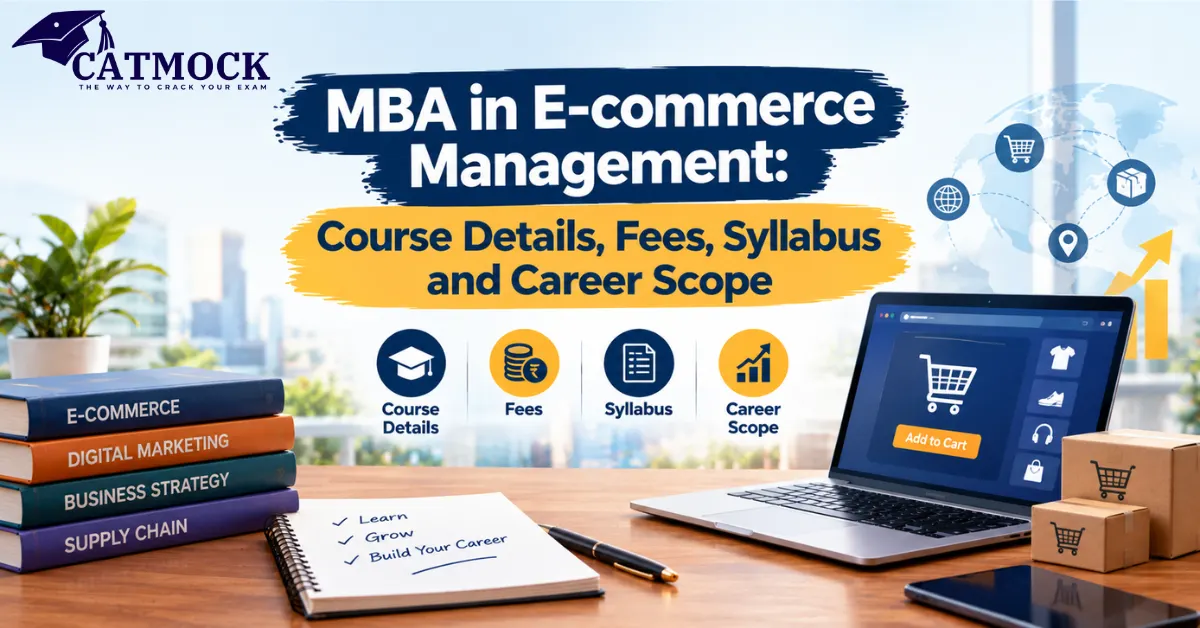
Every time you open a shopping app, a food-delivery app or a 10-minute grocery service, a team of managers has planned that experience: what to stock, how to price it, how fast to ship it, and how to bring you back next week. An MBA in E-commerce Management is the postgraduate programme built to train exactly those people.
But this course is also confusing. Some colleges teach it as a full two-year programme. Some offer it as a specialisation inside a general MBA. Online universities sell it as a dual specialisation. And the fees range from under ₹1 lakh to over ₹24 lakh. So what is it, who should take it, and is it actually worth it?
This guide answers all of that with real numbers: eligibility, a semester-wise syllabus, fees by type of programme, salary data, job roles and an honest comparison with other MBA specialisations.
Quick answer: An MBA in E-commerce Management is a two-year postgraduate management programme (also offered online) that combines core business subjects with digital marketing, e-commerce operations, supply chain, analytics and technology. Graduates in any stream with at least 50% marks can usually apply. Fees range widely, from about ₹59,000 at a state university to ₹24 lakh for a four-year integrated programme. It suits you if you want to work in online retail, marketplaces, quick commerce, D2C brands or digital product teams.
What Is an MBA in E-commerce Management?
An MBA in E-commerce Management (often called an e-commerce MBA or MBA in E-commerce) is a postgraduate business degree that trains you to plan, run and grow online businesses. You study the usual management subjects, such as finance, marketing, HR and operations, and then specialise in how business works when the shop is a website or an app.
That specialisation usually covers:
- How online business models work (marketplaces, direct-to-consumer, subscription, quick commerce)
- Digital marketing, e-advertising and managing online sales channels
- Logistics, warehousing and supply chain for online orders
- E-business technologies, data and business analytics
- Cyber security, online payments and the legal side of selling online
The difference from a general MBA is focus. A general MBA prepares you for many industries. An e-commerce MBA prepares you for one fast-growing part of the economy, with the tools that part uses every day.
Why an MBA in E-commerce Management Matters in India Right Now
The case for this degree rests on one thing: demand for people who can run online commerce.
A research projection reported in April 2026 estimated India’s e-commerce market at roughly USD 120–140 billion today and USD 280–300 billion by 2030. The same report put the number of online shoppers at about 300 million, expected to reach 440 million by 2030. It also noted that quick commerce was growing at more than 100% a year and social and chat commerce at 40–45% a year.
Two practical points follow for a student.
- E-commerce is still a small share of total spending (about 7–8% in that report). That leaves a lot of room to grow, and companies need managers who understand both online and offline retail.
- New formats create new jobs. Quick-commerce companies need people for dark-store operations, demand forecasting and category management. D2C brands need growth and marketplace managers. Logistics firms need supply chain planners.
A fair caution: market projections are estimates, and they differ between sources. Treat them as a signal of direction, not a guarantee of jobs.
Also Read: MBA in International Business 2027: Curriculum, Career Options and Skills for Global Roles
MBA in E-commerce Management: Quick Facts
| Detail | What to know |
|---|---|
| Level | Postgraduate |
| Duration | Usually 2 years (4 semesters); integrated versions run 4 years |
| Mode | Full-time, online and some part-time |
| Basic eligibility | Bachelor’s degree in any stream with about 50% marks (relaxation for reserved categories at many universities) |
| Admission | University entrance test, or national and state exams such as CAT, XAT, CMAT, MAT and SNAP, depending on the college |
| Fees | About ₹59,000 to ₹3 lakh for most 2-year and online options; up to about ₹24 lakh for an integrated programme |
| Typical roles | E-commerce manager, digital marketing manager, category or product manager, supply chain manager, business analyst |
| Entry-level pay (indicative) | About ₹2 lakh to ₹6 lakh a year, depending on the college and role |
Figures are drawn from college listings, university syllabi and salary platforms. Check each college’s official page before applying.
MBA in E-commerce Management Eligibility and Admission
Who can apply?
For most standalone programmes, the rule is simple:
- A bachelor’s degree in any discipline from a recognised university
- A minimum of about 50% marks (a 5% relaxation is common for some reserved categories)
- Final-year students can often apply, provided they meet the marks requirement by the college’s cut-off date
One state-university programme, for example, allows final-year candidates if results are declared before 14 August of the admission year. An online dual-specialisation programme lists the same 50% requirement for graduates from UGC-recognised universities.
Entrance exams
Your route depends on the type of college.
| Type of college | Typical admission route |
|---|---|
| State and central universities | University-conducted entrance test, then merit list |
| Private universities and B-schools | CAT, XAT, CMAT, MAT, SNAP, NMAT or their own test, followed by group discussion and interview |
| Online universities | Usually direct admission on graduation marks, with no entrance exam |
| Integrated (UG + MBA) programmes | Class 12 marks and a personal interview |
Online route: check accreditation first
Online MBA programmes are legitimate when the university is approved by the UGC Distance Education Bureau (UGC-DEB). Before paying any fee, verify approval on the UGC-DEB website. A degree from an unapproved provider can be rejected by employers and for higher studies.
MBA in E-commerce Management Syllabus: Semester-Wise Subjects
Syllabi differ by university, but most follow the same pattern: two semesters of core management, then two semesters of e-commerce focus. The table below is based on a university’s published MBA E-Commerce curriculum.
Year 1: Management foundations
| Semester I | Semester II |
|---|---|
| Management Process and Organisational Behaviour | Fundamentals of E-Commerce |
| Quantitative Methods | Business Policy and Strategic Analysis |
| Managerial Economics | Human Resource Management |
| Environment Management | Financial Management |
| Business Communication | Marketing Management |
| Business Legislation and Ethics | Production and Operations Management |
| Accounting for Managers | Research Methodology |
| Computers and MIS | International Business Environment and Management |
Year 2: E-commerce specialisation
| Semester III | Semester IV |
|---|---|
| E-Commerce Progression | E-Business Philosophy |
| Digital Marketing | E-Business Technologies and Trends |
| E-Advertising | Warehouse Management and Data Mining |
| Managing E-Channels | Business Analytics |
| Logistics and Supply Chain Management | Major Research Project |
| Marketing Research | Specialisation papers (for example, database management and knowledge management systems) |
| Entrepreneurship Development | |
| Summer Training Project |
Some integrated or private programmes go further. One four-year B.Com (Hons) plus MBA in E-commerce lists topics such as online consumer behaviour, website development, e-commerce security, e-commerce analytics, AI and machine learning, blockchain, digital advertising, funding and e-commerce law.
What to ask a college: How much of the syllabus is current (quick commerce, social commerce, AI in retail) and how much is older theory? Ask to see the latest syllabus, not the brochure summary.
MBA in E-commerce Management Fees: What You Will Pay
Fees vary more for this course than almost any other MBA. The listings below show why you must compare by type of programme.
| Type of programme | Example duration | Approximate total fee |
|---|---|---|
| State university department (full-time) | 2 years | About ₹59,000 |
| University institute of management (full-time) | 2 years | About ₹1.27 lakh |
| Online dual MBA (digital marketing and e-commerce) | 2 years | About ₹80,000 to ₹3 lakh |
| Integrated B.Com (Hons) + MBA in E-commerce at a private university | 4 years | About ₹24.1 lakh |
Fees are as listed by the colleges and on education portals for the general category and may change each year. Online-programme fees on one portal were inconsistent, so confirm the exact figure with the university.
Also Read: MBA in Product Management: Role, Responsibilities & Skills You Need
Is the low fee a sign of low quality?
Not necessarily. State-university programmes are subsidised, so they cost far less than private B-schools. But do not choose on price alone. Check placement records, faculty strength and whether the syllabus is up to date. A cheap degree with no placements can cost you more in the end than a pricier one that gets you interviews.
MBA in E-commerce Management Career Scope: Jobs and Salary
Job roles after an MBA in E-commerce
| Role | What you do |
|---|---|
| E-commerce Manager | Run an online store or marketplace presence, from listings to sales targets |
| Digital Marketing Manager | Plan paid, social, search and email campaigns |
| Category or Product Manager | Own a product range or feature, from pricing to roadmap |
| Supply Chain and Logistics Manager | Manage inventory, warehouses and last-mile delivery |
| Business Development Manager | Onboard sellers, partners and brands |
| Business or E-commerce Analyst | Turn customer and sales data into decisions |
| Online Retail Consultant | Advise brands on going online or improving online sales |
Where you can work
- Online marketplaces and retail platforms
- Quick-commerce and grocery delivery companies
- Direct-to-consumer brands and start-ups
- Digital marketing and growth agencies
- Logistics and supply chain firms
- Technology and fintech companies with online products
Salary: what the data actually shows
Salary depends heavily on the college, your skills and the city. There is no single number, so here are the figures that are available.
| Source and role | Figure |
|---|---|
| PayScale (April 2026): eCommerce Manager, average base | About ₹5.7 lakh a year (range roughly ₹1.9 lakh to ₹10 lakh) |
| PayScale: entry level (under 1 year) | About ₹2 lakh average total pay |
| PayScale: 1–4 years of experience | About ₹4.4 lakh average total pay |
| Online dual MBA provider (expectation) | Entry-level ₹4–6 lakh a year |
For adjacent roles that e-commerce MBAs often move into, one education portal citing AmbitionBox and Glassdoor lists figures such as ₹19.3 lakh for a growth marketing manager, ₹18 lakh for a product marketing manager and ₹13.8 lakh for a digital marketing manager. Those are broader, undated averages across experience levels, so do not treat them as fresher salaries.
Honest takeaway: A fresher from an average programme should plan for a modest start. Pay rises quickly with experience in growth, category and product roles. Placements at top-tier B-schools, where e-commerce is often a track within a general MBA, are usually much higher. Always ask a college for its last two years of placement reports.
MBA in E-commerce Management vs Other MBA Specialisations
Many students ask whether to take an e-commerce MBA or a more common specialisation.
| Factor | MBA in E-commerce Management | MBA in Marketing | MBA in Digital Marketing | MBA in Business Analytics |
|---|---|---|---|---|
| Focus | Running online businesses end to end | Brand, consumers, sales | Online campaigns and channels | Data, modelling, insight |
| Operations and supply chain | Yes, a core part | Limited | Limited | Limited |
| Technology content | Moderate | Low | Moderate | High |
| Best for | Online retail, marketplaces, D2C, quick commerce | Brand and sales careers | Performance and growth marketing | Analyst and data roles |
| Flexibility across industries | Moderate | High | Moderate | High |
The first two semesters of most marketing and digital-marketing MBAs are almost the same as general MBA cores. Real differences appear in the final two semesters, which is also where an e-commerce MBA brings in logistics, e-channels and e-business technology. That is useful if you want the whole online-business picture, not just marketing.
Thinking about alternatives? Compare with our guides to MBA in Digital Marketing, MBA in Business Analytics.
Skills You Will Build in an MBA in E-commerce Management
- Digital marketing and growth: search, social, email, marketplace advertising
- Data and analytics: reading dashboards, conversion funnels and customer cohorts
- Operations: inventory, warehousing, fulfilment and returns
- Pricing and category thinking: margins, assortment and promotions
- Technology awareness: how storefronts, payments and security work
- Legal and ethical basics: consumer protection, data privacy and online contracts
Skills alone will not get you hired, though. Employers also look for internships, live projects and proof you can use tools such as spreadsheets, analytics platforms and marketplace dashboards. Build a small portfolio while you study, such as a test online store or a campaign case study.
Is an MBA in E-commerce Management Worth It?
It can be, but it depends on who you are and which college you pick.
It is a good fit if you:
- Already know you want a career in online retail, marketplaces, D2C or quick commerce
- Are comfortable with data, marketing and operations together
- Can pick a college with real industry links, internships and recent placement data
- Want a lower-cost route (state university) or a flexible route (accredited online programme)
Think twice if you:
- Are unsure about your industry and want maximum flexibility
- Are comparing it to a top-tier general MBA, which usually has stronger brand and recruiters
- Are considering an unapproved online provider that promises guaranteed jobs
A smart middle path is to look at top B-schools that offer e-commerce, digital business or growth as an elective track inside a general MBA. You then keep the brand and flexibility of a general degree while specialising.
How to Choose the Right MBA in E-commerce Management Programme
- Check approval. For online programmes, confirm UGC-DEB approval. For regular programmes, check the university’s recognition and, where relevant, AICTE approval on AICTE’s website.
- Read the latest syllabus. Look for quick commerce, analytics, AI and supply chain, not only older theory.
- Ask for placement reports. Request two years of data, including the number of students placed, not just the highest package.
- Look for live projects and internships. These matter more than any brochure promise.
- Compare total cost. Include hostel, travel, exam fees and, for online programmes, any exam centre charges.
- Talk to alumni. A short conversation tells you more than a ranking.
Summary: MBA in E-commerce Management in Short
- An MBA in E-commerce Management is a two-year (or integrated four-year) programme that blends core management with online business, digital marketing, logistics and analytics.
- Most programmes need a bachelor’s degree with about 50% marks. Admission is by university tests, national exams or direct entry (online).
- Fees range from roughly ₹59,000 to ₹24 lakh depending on the type of programme.
- India’s e-commerce market is projected to grow to USD 280–300 billion by 2030, which supports demand for trained managers.
- Entry-level salaries are modest on average, but grow with experience, and vary strongly by college.
- Check approval, syllabus and placements before you commit.
MBA in E-commerce Management: Frequently Asked Questions
What is an MBA in E-commerce Management?
It is a postgraduate management programme that combines core MBA subjects with e-commerce topics such as digital marketing, online channel management, logistics, analytics and e-business technology. It prepares you to manage online businesses, marketplaces and digital retail operations.
Is an MBA in E-commerce Management worth it?
It is worth it if you want a career in online retail, marketplaces, D2C brands or quick commerce and you choose a college with strong placements and a current syllabus. If you want broad flexibility across industries, a general MBA or a top B-school with an e-commerce track may be a better fit.
What is the eligibility for an MBA in E-commerce?
Most programmes require a bachelor’s degree in any discipline with about 50% marks from a recognised university. Final-year students can often apply if they meet the marks requirement by the cut-off date. Private B-schools may also ask for a CAT, XAT, CMAT or MAT score.
What is the fee for an MBA in E-commerce Management?
Fees vary widely. State-university programmes can cost about ₹59,000 to ₹1.27 lakh in total, online programmes about ₹80,000 to ₹3 lakh, and an integrated four-year programme at a private university around ₹24 lakh. Always confirm the current fee with the college.
What subjects are taught in an MBA in E-commerce Management?
The first year covers management foundations such as organisational behaviour, finance, marketing and operations. The second year covers e-commerce, digital marketing, e-advertising, managing e-channels, logistics and supply chain, business analytics and e-business technologies.
What is the salary after an MBA in E-commerce?
It depends on the college and role. PayScale’s April 2026 data shows an average base of about ₹5.7 lakh a year for eCommerce Managers, about ₹2 lakh at entry level and about ₹4.4 lakh at 1–4 years of experience. Top-tier B-school graduates usually earn more.
Can I do an MBA in E-commerce Management online?
Yes. Several universities offer online MBAs with e-commerce as a specialisation or dual specialisation. Make sure the university is approved by the UGC Distance Education Bureau before you enrol.
What is the difference between an MBA in E-commerce and an MBA in Digital Marketing?
Both share a similar management core. An e-commerce MBA covers the whole online business, including logistics, warehouse management, e-channels and technology. A digital marketing MBA focuses mainly on campaigns, channels and growth.
Conclusion: Is an MBA in E-commerce Management Right for You?
An MBA in E-commerce Management is not a magic key, but it is a focused, practical programme for anyone who wants to build a career in online business. It teaches you how to sell, ship, measure and grow in a market that continues to expand. The best results come from choosing the right programme: approved, current, and backed by real placement records.
You May Also Like : CAT MOCK, CAT MOCK PYQ
Follow Us On : Facebook, Instagram, Youtube