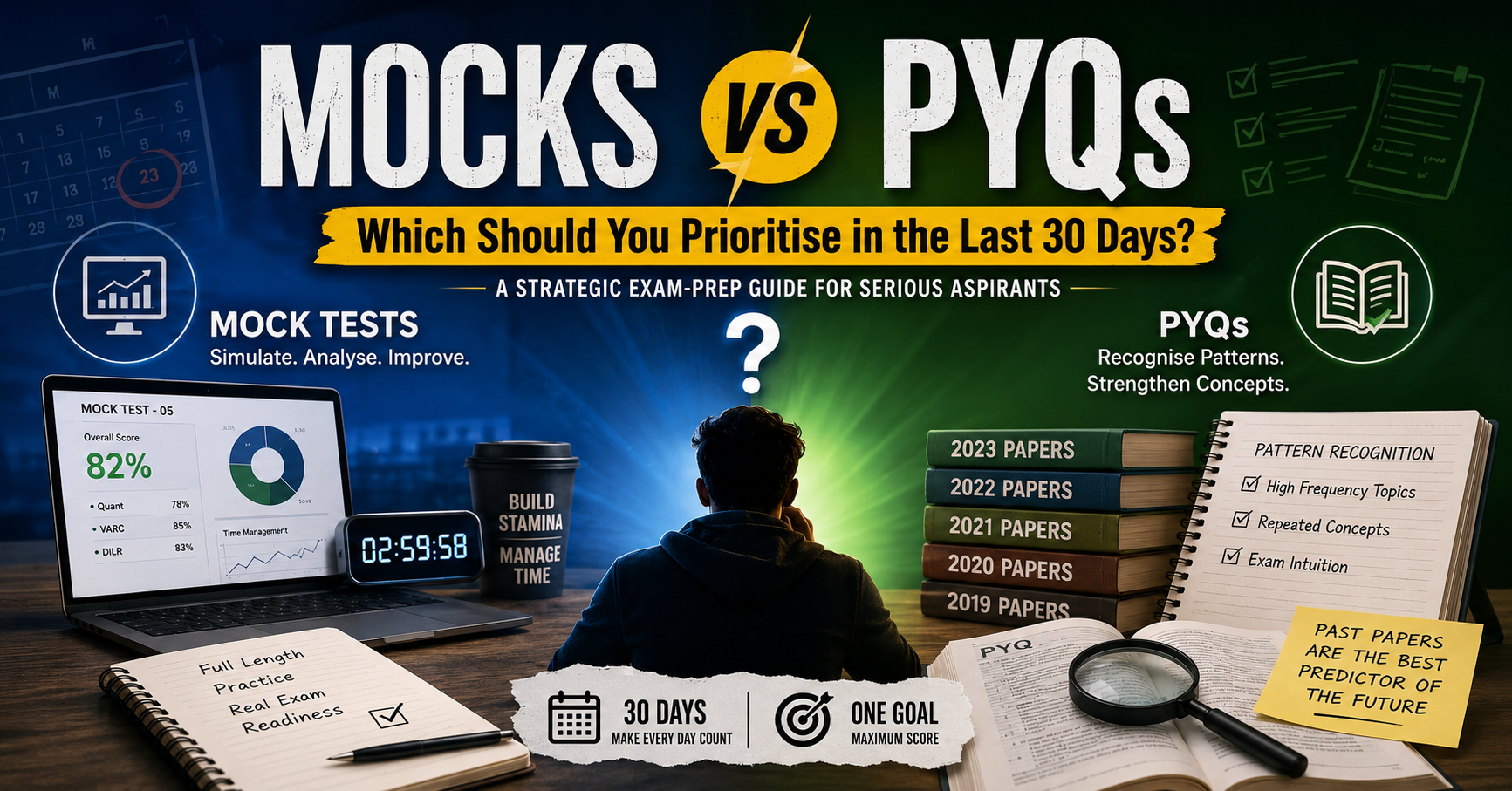
| Which Should You Prioritise in the Last 30 Days? |
A strategic exam-prep guide for serious aspirants
Table of Contents
- Introduction: The Final-Month Dilemma
- Understanding Mocks vs PYQs
- 2.1 What Are PYQs and Why Do They Matter?
- 2.2 What Are Mock Tests and What Do They Train?
- 2.3 Mocks vs PYQs: Head-to-Head Comparison
- Why You Should Prioritise PYQs in the Last 30 Days
- 3.1 Pattern Recognition Advantage
- 3.2 Building Real Exam Confidence
- Why Mock Tests Are Equally Important
- 4.1 Stamina and Time Management
- 4.2 Identifying Weak Areas Through Mocks
- The Ideal 30-Day Strategy (Phase-Wise Plan)
- 5.1 Week 1: PYQ-Focused Foundation
- 5.2 Week 2: Hybrid Approach (Mocks + PYQs)
- 5.3 Week 3: Mock-Dominant Practice
- 5.4 Week 4: Final Revision & Consolidation
- Common Mistakes to Avoid in the Last 30 Days
- Frequently Asked Questions (FAQs)
- Final Strategy: Mocks vs PYQs — The Right Balance
1. Introduction: The Final-Month Dilemma
With just 30 days remaining before a high-stakes competitive exam, every aspirant faces the same nerve-wracking question: should time be spent grinding through mock tests, or is it better invested revisiting previous year questions (PYQs)? Both approaches carry genuine merit, yet the answer is far more nuanced than most coaching guides suggest.
Fortunately, this choice does not have to be an either-or battle. Instead, it can be framed as a strategic allocation problem — where your limited time is distributed intelligently based on your current preparation level, target score, and exam-specific patterns.
Throughout this blog, both sides of the debate will be examined in detail. By the end, a clear, phase-wise plan will be presented so that the final 30 days are spent as productively as possible.
2. Understanding What Each Resource Offers
2.1 What Are PYQs and Why Do They Matter?
Previous Year Questions (PYQs) are the actual questions that were asked in prior editions of your target exam. They are considered the gold standard of preparation because they directly reflect the examiner’s mindset, recurring themes, and the difficulty calibration used year after year.
Moreover, PYQs allow you to identify high-frequency topics — concepts that have been tested repeatedly across multiple years. When these patterns are recognized, effort can be concentrated where it matters the most, rather than spreading thin across an entire syllabus.
Additionally, solving PYQs builds what seasoned aspirants call ‘exam intuition’ — the subconscious ability to recognize question structures and eliminate distractors rapidly. This skill, once developed, dramatically improves both accuracy and speed.
2.2 What Are Mock Tests and What Do They Train?
Mock tests, on the other hand, are full-length simulated exams designed to replicate the conditions of the actual test. They are primarily used to build stamina, develop time management skills, and reveal performance under pressure.
Furthermore, mocks expose gaps that topic-wise practice often misses. When you attempt a full paper against the clock, weak sections become impossible to ignore — the data from your score report tells a brutally honest story that no chapter-by-chapter study plan can replicate.
However, mocks are only as useful as the analysis that follows them. Simply taking test after test without a thorough post-test review is one of the most common — and costly — mistakes made during the final stretch of preparation.
2.3 Head-to-Head Comparison at a Glance
| Criteria | Mock Tests | PYQs (Previous Year Qs) |
| Familiarity with Format | Simulates full exam pressure | Reflects actual difficulty & style |
| Concept Reinforcement | Tests a variety of new scenarios | Strengthens core, repeated concepts |
| Time Management Skill | Sharpens speed under timed pressure | Builds intuition on question types |
| Confidence Building | Reveals your weak zones quickly | Shows pattern mastery over years |
| Last 30-Day Priority | 3–4 mocks per week (final weeks) | Daily PYQ practice until Week 2 |
| 📊 Infographic: PYQ vs Mock — Preparation Value by Phase Visual breakdown of when PYQs and mock tests deliver maximum return on effort across a 30-day revision plan. Weeks 1–2 favour PYQ consolidation; Weeks 3–4 shift toward full mock simulation. |
3. The Case for Prioritising PYQs in the Last 30 Days
3.1 Pattern Recognition Is a Skill That Builds Quickly
One of the strongest arguments for PYQs in the final month is the speed at which pattern recognition develops. When a large number of past papers from the same exam are solved in succession, the brain begins to notice structural similarities across questions — even when the surface content changes.
Consequently, this recognition reduces the cognitive load during the actual exam. Instead of approaching each question from scratch, the experienced aspirant sees familiar scaffolding and applies tested strategies almost automatically.
In competitive exams like CAT, UPSC, SSC CGL, and GATE, the conceptual bandwidth tested is actually narrower than the full syllabus suggests. Therefore, PYQs help draw the real boundary of what is tested versus what merely appears in textbooks.
3.2 PYQs Build the Right Kind of Confidence
Confidence that is grounded in repeated correct performance is qualitatively different from confidence built on assumption. Solving PYQs — and solving them well — produces the former. Each correctly answered question from a real exam reinforces the belief that the actual paper can be handled.
In contrast, mock tests from third-party coaching institutes sometimes include questions that are either too easy, too obscure, or structurally unlike the original exam. As a result, scores on such mocks can be misleading indicators of actual readiness.
| Key Insight: Research on competitive exam toppers consistently shows that solving at least 10 years of PYQs in the final month correlates with significantly higher accuracy in the actual exam — particularly in sections with high conceptual repetition. |
4. The Case for Prioritising Mock Tests in the Last 30 Days
4.1 Stamina and Pacing Cannot Be Learned from PYQs Alone
A 3-hour competitive exam is a physical and mental endurance challenge, not just a test of knowledge. Consequently, the body and mind must be trained to sustain peak performance for the entire duration — and only full-length mock tests can replicate that specific kind of stress.
Many aspirants who are otherwise thorough in their preparation report cognitive fatigue in the final hour of their actual exam. This happens primarily because they failed to condition themselves through regular, timed full-length practice during preparation.
Moreover, pacing strategy — knowing when to skip, when to attempt, and how to allocate sectional time — is a practical skill that develops exclusively through doing, not reading about it.
4.2 Mock Tests Diagnose What Revision Misses
Even after extensive revision, blind spots tend to persist in preparation. These are topics or question types that seem familiar during study but break down under timed, full-paper conditions. Mock tests surface these blind spots reliably, whereas topic-wise revision often masks them.
Furthermore, the analytical data generated after a mock — section-wise accuracy, time per question, attempt rate — gives you a granular map of where preparation stands. This map is far more actionable than a general sense of ‘I’ve covered everything.’
5. The Smart Strategy: A Phase-Wise 30-Day Plan
5.1 Week 1 — Days 1 to 7: Deep Dive into PYQs
During the opening week, focus should be placed almost entirely on PYQs. Aim to solve at least two to three full previous-year papers from your target exam, analyse every error, and classify mistakes into knowledge gaps versus careless mistakes.
Additionally, create a topic-frequency chart from at least five years of PYQs. This chart will guide your revision priorities for the rest of the month, ensuring that high-yield areas receive disproportionate attention.
- Solve 2–3 full PYQ papers (timed)
- Build a topic-frequency chart from 5+ years
- Categorise all errors: knowledge vs. carelessness
- Revise weak topics identified from PYQ errors
5.2 Week 2 — Days 8 to 15: Hybrid Practice
By the second week, a transition toward hybrid practice is advisable. Continue solving PYQs sectionally — focusing specifically on the high-frequency topics identified in Week 1 — while simultaneously introducing two to three mock tests into the weekly schedule.
This blended approach works because it reinforces concepts from PYQs while also beginning the process of stamina-building through mocks. The two activities complement each other rather than compete for the same learning bandwidth.
- 2 full mock tests per week (analyse each within 24 hours)
- Sectional PYQ practice for identified weak areas
- Review and revise concepts from mock errors
5.3 Week 3 — Days 16 to 22: Mock-Heavy with Targeted PYQ Revision
The third week marks a clear shift in emphasis. By this stage, concept clarity should largely be in place, and the primary goal becomes execution — specifically, performing accurately and efficiently under timed exam conditions.
Therefore, mock frequency should increase to three to four tests per week. Each mock should be followed by a focused one-to-two-hour analysis session, during which errors are traced back to specific concepts. Only those concepts should then be revisited in PYQ form.
- 3–4 mocks per week with full analysis
- PYQ revision limited to error-driven topics only
- Refine time-allocation strategy per section
5.4 Week 4 — Days 23 to 30: Consolidation and Confidence
In the final week, the goal shifts from improvement to consolidation. Avoid starting any new topic or attempting unfamiliar question types — doing so at this stage introduces anxiety without adding proportional benefit.
Instead, one to two light mocks can be taken for rhythm maintenance, while the bulk of time is invested in reviewing previous mock analyses and revisiting the PYQs on which errors were made earlier in the month.
- 1–2 light mocks for rhythm (no pressure analysis)
- Revisit PYQ errors from earlier weeks
- Strengthen exam-day strategy and section sequencing
- Prioritise sleep, nutrition, and mental freshness
| 📊 Chart: Recommended PYQ vs Mock Split Across 30 Days Week 1: 80% PYQ / 20% Mock → Week 2: 60% PYQ / 40% Mock → Week 3: 30% PYQ / 70% Mock → Week 4: 20% PYQ / 80% Mock. Time allocation gradually shifts as the exam date approaches. |
6. Common Mistakes to Avoid in the Final 30 Days
Mistake 1: Taking Mocks Without Analysing Them
Taking five mocks a week sounds impressive — but if each one is not followed by a structured review, the effort is largely wasted. The insight lies not in the score but in the error pattern. Always allocate more time to analysis than to the test itself.
Mistake 2: Solving PYQs Without Timing Yourself
PYQs solved at leisure, without a timer, build a false sense of familiarity. Since speed and accuracy must go hand in hand during the actual exam, all PYQ practice — even sectional — should be done under timed conditions from Week 2 onward.
Mistake 3: Abandoning Weak Topics Entirely
A common rationalization is: ‘I’m weak in this area, so I’ll skip it and focus on strengths.’ Unfortunately, this logic backfires when the actual paper allocates a significant number of questions to that very topic. Instead, weak areas should be converted into ‘at least average’ zones through targeted, PYQ-driven revision.
Mistake 4: Starting New Topics in the Final Week
The final week is not the time for exploration. Starting an unfamiliar topic in Week 4 introduces confusion without the time to solidify it. Stick to consolidation, revision, and exam-readiness activities exclusively.
7. Frequently Asked Questions (FAQs)
How many mock tests should I take in the last 30 days?
You should aim for 10–15 full-length mocks in the final 30 days. However, quality matters more than quantity. Analysing each mock properly is far more beneficial than attempting too many without review.
How many years of PYQs are enough for CAT preparation?
For CAT, solving 7–10 years of PYQs is generally sufficient. For exams with repetitive patterns like SSC or UPSC, covering up to 15–20 years is recommended.
Should I prioritise mocks or PYQs in the last month?
You should follow a balanced approach. Start with PYQs in the first two weeks to build concepts and pattern recognition, then gradually shift towards mocks in the final weeks for exam simulation.
Should PYQs be solved topic-wise or as full-length papers?
In the early phase, use a mix of topic-wise and full-length PYQs. As the exam approaches, focus more on full-length papers to simulate real exam conditions.
What is the best time to take mock tests?
Take mock tests at the same time as your actual exam slot. This helps align your mental performance with exam-day conditions.
How much time should I spend analysing a mock test?
You should spend 1–2 hours analysing each mock. Focus on mistakes, skipped questions, and guesses to improve accuracy and strategy.
Can I rely only on PYQs if I have very little time?
Yes, if you have less than 15 days, focusing on PYQs is more effective. They provide the most exam-relevant insights in limited time.
What should I do if my mock scores are decreasing?
A drop in scores usually indicates fatigue or lack of revision. Reduce mock frequency temporarily and revise weak areas using PYQs, then resume testing.
Is it okay to skip a mock test if I feel unprepared?
No, skipping mocks is not advisable. Mock tests help identify gaps in preparation and provide valuable feedback, even if your score is low.
How many PYQ sessions should I do per week?
In Weeks 1–2, aim for 4–5 PYQ sessions per week. In later weeks, reduce this to 2–3 sessions, focusing only on weak areas.
Should I attempt sectional mocks along with full mocks?
Yes. Sectional mocks are useful in the early phase to build speed and accuracy, while full-length mocks are essential closer to the exam.
Are coaching institute mock tests reliable?
Yes, provided they are exam-specific and high quality. Avoid generic test series that do not match actual exam patterns.
Are online PYQ resources trustworthy?
Official papers are the most reliable. However, reputed platforms offering verified solutions can also be used for practice.
Does the mocks vs PYQs strategy change for different exams?
Yes. Exams with stable patterns favour PYQs, while dynamic exams like CAT require a stronger focus on mocks.
What is the most important habit in the last 30 days?
The most important habit is consistent mock analysis combined with PYQ-based revision. Learning from mistakes is key to improving your score.
| Final Thought The debate between mocks and PYQs ultimately dissolves when both are seen as complementary tools rather than competing alternatives. PYQs tell you what the exam truly wants; mocks tell you whether you can deliver it under pressure. Master both, deploy them strategically across four well-structured weeks, and walk into the exam hall not with hope — but with evidence. |