| Last updated: 13 October 2026 | Facts checked against GMAC’s official NMAT pages
You can take NMAT three times. That’s exactly why so many aspirants waste the first attempt.
They treat it like a trial run. They walk in with half-finished preparation, then spend the next month fixing mistakes they could have fixed before test day. Some colleges may also count only your first score, and the rules differ from college to college.
So, can you crack NMAT 2026 in one go? Yes, if you prepare for the exam NMAT really is: adaptive, timed section by section, and free of negative marking. This guide gives you eight tips built around that format, a simple 30-day plan, and the official dates as of 13 October 2026.
Quick answer: To crack NMAT 2026 on your first attempt, learn the adaptive format, take a diagnostic mock in week one, fix your basics section by section, test your section order in mocks, answer every question, practise under sectional timers, review every mock in detail, and book your slot early. Most beginners need two to three months of steady practice. If you have already prepared for CAT, a few weeks of NMAT-specific practice often covers the gap.
NMAT 2026 at a Glance
These are the facts that shape your strategy. I checked them on GMAC’s official NMAT pages on 13 October 2026.
| Detail | NMAT by GMAC 2026 |
|---|---|
| Conducted by | Graduate Management Admission Council (GMAC) |
| Sections | Language Skills, Quantitative Skills, Logical Reasoning |
| Questions and total time | 108 questions, 120 minutes (36 questions per section) |
| Section timing | Language 28 min, Quant 52 min, Logical Reasoning 40 min |
| Format | Computer-adaptive; you choose the section order |
| Scoring | 12–120 per section, 36–360 total; no penalty for wrong answers |
| Scorecard | Within 48 hours of your exam |
| Registration and scheduling | 20 August – 25 October 2026 |
| Test window | 2 November – 20 December 2026 |
| Retake registration and scheduling | 3 November – 17 December 2026 |
| Rescheduling | Until 17 December 2026 |
| Attempts | Up to 3 per testing year, with a 15-day gap |
| Fees | ₹3,000 + taxes per attempt; ₹1,200 + taxes to reschedule |
GMAC’s important dates and fees page lists 25 October as the last day to register and schedule, so you still have time to lock a slot. Recheck the page before you pay, because dates can change. For a deeper look at the calendar, read our NMAT exam dates 2026 guide.
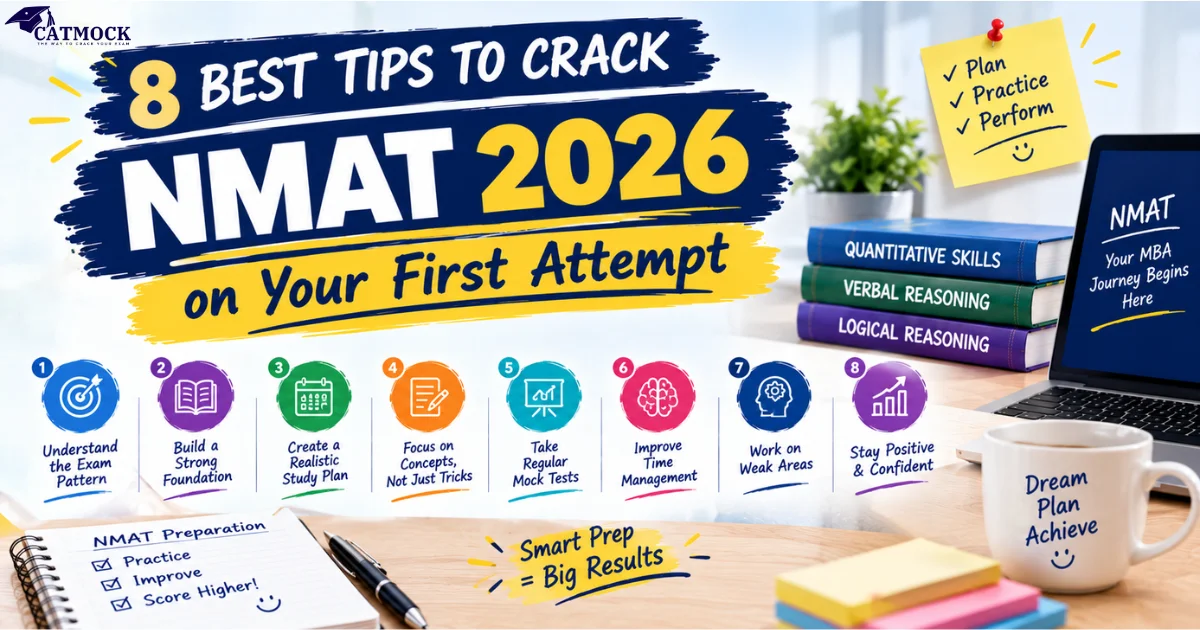
How to Crack NMAT 2026: 8 Tips That Work on the First Attempt
1. Learn how NMAT works before you study for it
NMAT isn’t a regular paper test. GMAC’s exam structure page explains that the test picks each question based on how you answered the earlier ones. Your section scores run from 12 to 120, and they add up to a total between 36 and 360.
Three things follow from this:
- You can’t skip a question and come back to it. The test needs your answer before it moves on.
- Each section runs on its own clock. Minutes you save in one section don’t carry over to the next.
- A wrong answer costs nothing extra. GMAC applies no penalty for guessing.
Our NMAT exam pattern 2026 guide walks through each section in more detail.
2. Take a diagnostic mock in week one
Don’t open a single textbook before you know where you stand. Sit one full-length NMAT mock in a single go, with the timer on. Use GMAC’s official practice material or a well-built NMAT-style mock.
Then note three numbers for each section: your score, how many answers you guessed, and how many minutes you had left. Those numbers show whether your real problem is knowledge, speed or nerves. Without that baseline, you tend to study what you enjoy instead of what you need.
3. Fix the basics, section by section
NMAT rewards clean fundamentals more than clever tricks. This table shows how much time each question gets and where to start. The topics are the ones that come up most often in NMAT-style papers.
| Section | Time per question | Topics to cover | Start with |
|---|---|---|---|
| Language Skills (36 Qs, 28 min) | About 47 seconds | Reading comprehension, grammar, vocabulary, para jumbles, fill in the blanks | One editorial a day, then short timed RC sets |
| Quantitative Skills (36 Qs, 52 min) | About 87 seconds | Arithmetic, number properties, algebra, probability, data interpretation, data sufficiency | Percentages, ratios and averages; squares, cubes and fraction-percentage pairs |
| Logical Reasoning (36 Qs, 40 min) | About 67 seconds | Critical reasoning, puzzles, syllogisms, Venn diagrams, input-output, deductions | One puzzle type a day, until you spot its structure quickly |
Start with your weakest section, but never drop the other two. All three sections carry equal weight in your total.
4. Choose your section order through practice
NMAT lets you pick the order before the test begins, so use that freedom on purpose. Many aspirants copy a friend’s order or stick with the default. Neither one is a strategy.
Run a simple experiment. Over your next four mocks, use two different orders, two mocks each. Compare your total scores and how you felt during the last section. Fatigue is real. Quant is the longest section at 52 minutes, so ask yourself whether you’d rather meet it fresh or after a warm-up.
Lock in the winner for your final mocks. Test day isn’t the time to try something new.
5. Play the adaptive format smartly
Because the test adapts to your answers, your early questions set the tone for each section. Spend a little extra time on the first handful and avoid careless errors there. Then settle into your normal pace. If questions suddenly feel tougher, that usually means you answered the earlier ones correctly. Don’t panic.
Since there’s no negative marking, a blank answer is the one move you can’t afford. When a few questions remain and the clock runs low, eliminate what you can and guess.
Also watch for time traps. If one Quant question has already eaten twice its average time, cut your loss, pick your best option and move on. You can’t return to it later, so make that call quickly.
6. Build speed with timed sets and mental maths
Speed on NMAT comes from practice under a clock. Use short sets that mirror the real sectional pace:
- Language Skills: 12 questions in about 9 minutes
- Logical Reasoning: 12 questions in about 13 minutes
- Quantitative Skills: 12 questions in about 17 minutes
Learn the method untimed first. Add the clock once you solve most of a set correctly.
Add a 10-minute mental-maths drill to your day. Cover tables up to 20, squares up to 25, cubes up to 15, and common fractions with their percentage values. These small savings add up across 36 Quant questions.
7. Treat every mock as a lesson, not a scorecard
A mock only helps if you study it afterwards. Take one full mock a week for the first two or three weeks. Then take two a week in the final stretch. Spend as long reviewing each mock as you spent taking it.
Keep an error log and tag every mistake with one of three labels:
- Concept gap: you didn’t know the idea.
- Careless slip: you knew it but fumbled.
- Time trap: you knew it but took too long.
Review the questions you guessed right too. Lucky guesses hide weak topics. Your log also becomes your revision sheet for the last week. For more prep guides, browse our blogs.
8. Book early and treat attempt one as the real one
GMAC runs the NMAT 2026 window from 2 November to 20 December. You can attempt the test up to three times in a testing year (1 July to 30 June), counting no-shows, with at least 15 days between attempts. Slots fill up fast, so an early booking gives you more choice.
An early first slot also leaves room for a retake. If you test on 8 November, for example, your earliest retake falls on 23 November.
Still, prepare as if you only get one shot. Colleges set their own rules on which score they count, and those rules differ and change. Read the admission page of every college on your list. To build that list, start with the Ministry of Education’s NIRF India Rankings, which rank management institutes by category. Then check each college’s own score expectations.
Your 30-Day NMAT Study Plan
Short on time? Follow this plan. If you have more time, stretch each week into two.
| Week | Focus | Mocks |
|---|---|---|
| Week 1 | Take a diagnostic mock. Learn the format. Revise arithmetic, grammar basics and one puzzle type daily. | 1 full mock + review |
| Week 2 | Timed sectional sets. Add data interpretation, data sufficiency, syllogisms and daily RC. Start your error log. | 1 full mock + review |
| Week 3 | Test two section orders. Run mixed timed sets. Fix repeat mistakes from your log. | 2 full mocks + review |
| Week 4 | Revise your error log. Take one mock at the same time of day as your real slot. Ease off in the last two days. | 2 full mocks + review |
Aim for about two to three hours on weekdays and a longer block on weekends. Adjust the load to your routine, but keep it steady.
What to Do in the Last 48 Hours
- Stop learning new topics. Revise your error log only.
- Skip the full mock on the day before. Do a light 30-minute set instead.
- Download your admit card and read its instructions.
- Plan your route to the centre, or test your setup if you’re taking the exam at home.
- Sleep well and eat light on test day.
Summary: Key Takeaways
- NMAT is adaptive, with separate section clocks and no penalty for wrong answers.
- Take a diagnostic mock in week one so you study your gaps, not your comfort zone.
- Cover the basics in all three sections and start with your weakest.
- Test two section orders in mocks, then lock one in.
- Spend extra care on early questions, and answer everything.
- Practise in short timed sets and sharpen your mental maths.
- Review every mock and keep an error log.
- Book early, prepare for one attempt, and keep retakes as a safety net.
Frequently Asked Questions
Can I crack NMAT 2026 on my first attempt?
Yes, if you prepare for the format as well as the syllabus. Take timed mocks, analyse each one, and fix your weakest section first. Keep retakes as a safety net, not a plan.
How long does it take to prepare for NMAT 2026?
Most beginners need two to three months of steady practice. If you have already prepared for CAT, a few weeks of NMAT-specific mocks often cover the gap. With only a month left, follow the 30-day plan above.
Is there negative marking in NMAT?
No. GMAC applies no penalty for wrong answers, so answer every question before the time runs out.
How many times can I take NMAT in 2026?
You can take it up to three times in a testing year (1 July to 30 June), counting no-shows, with at least 15 days between attempts. Each attempt costs ₹3,000 plus taxes.
Which section should I attempt first in NMAT?
No single order works for everyone. Pick the section where you start strongest, then test two orders in your mocks and compare total scores. NMAT lets you choose before the exam begins.
Can I crack NMAT 2026 without coaching?
Yes. NMAT rewards consistent practice, solid basics and honest mock analysis. You can get all three through self-study with a structured plan. Coaching mainly helps with accountability and doubt-solving.
What is a good NMAT score?
It depends on your target college. GMAC doesn’t publish cutoffs, and each college sets its own expectations. Check the admission page and past-year score ranges of your shortlisted colleges, then aim above that range.
What is the last date to register for NMAT 2026?
GMAC’s official dates page lists 25 October 2026 as the last date to register and schedule. The test window runs from 2 November to 20 December 2026. Check the page again before you pay, because dates can change.
Conclusion
Cracking NMAT on the first attempt doesn’t take luck or a magic trick. It takes a clear picture of the exam, a baseline mock, steady practice under a timer, and honest review of your mistakes. Follow the eight tips above, stick to the 30-day plan, and walk into your slot ready to treat it as the real thing.
You May Also Like : CAT MOCK, CAT MOCK PYQ
Follow Us On : Facebook, Instagram, Youtube