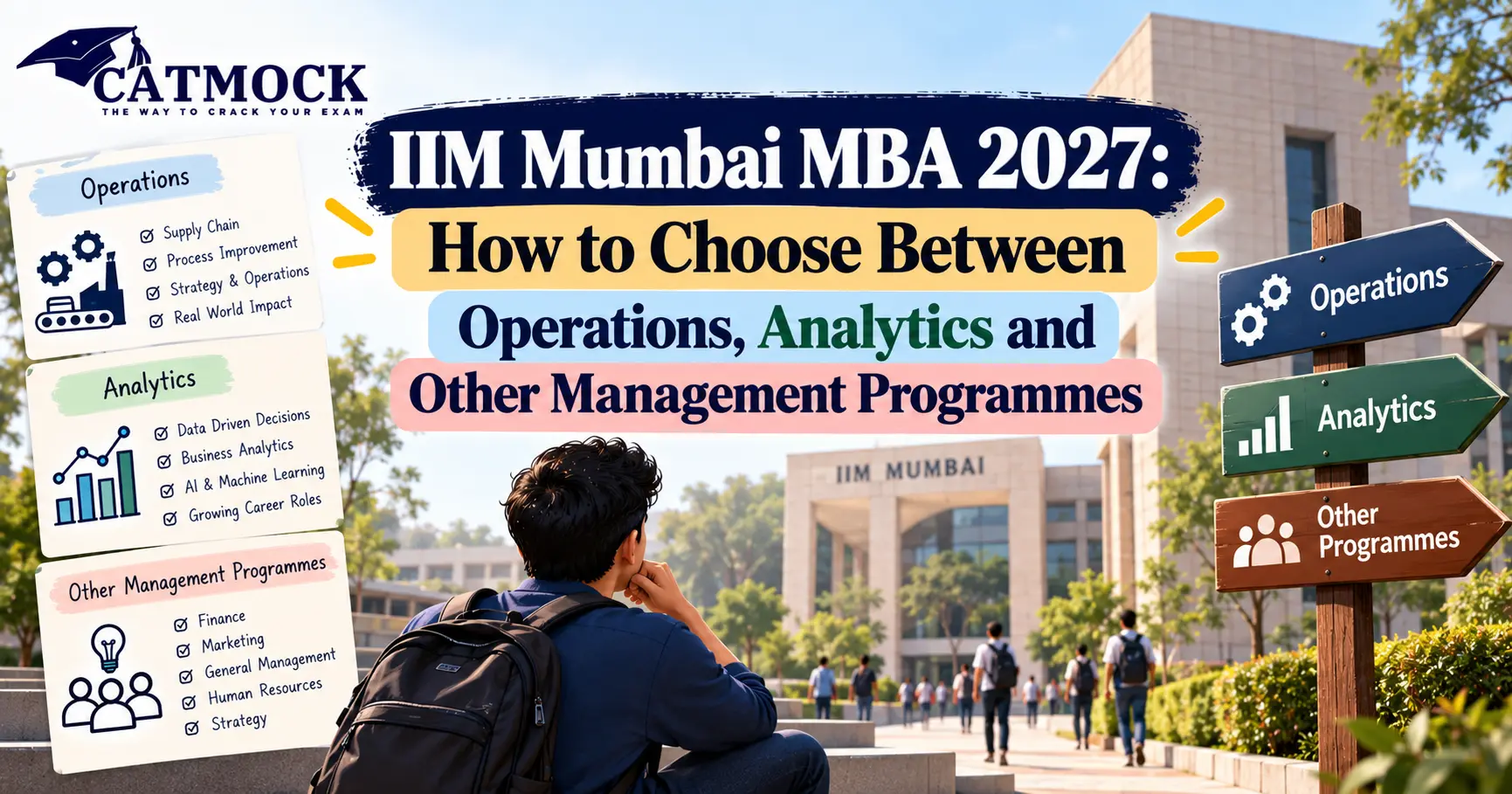
You have a strong CAT percentile in sight, IIM Mumbai is on your shortlist, and then comes the question that keeps many aspirants awake: which programme should I pick? The general MBA looks versatile. The operations and supply chain programme looks specialised and respected. Everyone talks about analytics. And there is a sustainability programme you barely know anything about.
This guide cuts through the noise. You will learn what each programme at IIM Mumbai offers, who it suits, how analytics fits in, and how to make a clear, confident choice for the IIM Mumbai MBA 2027 cycle.
IIM Mumbai at a Glance: From NITIE to IIM
IIM Mumbai was formerly known as the National Institute of Industrial Engineering (NITIE). It adopted the IIM identity in 2023, and it carries a long legacy in operations, supply chain management and industrial engineering education. That heritage is why the institute is still strongly associated with operations and supply chain roles, while also building breadth in general management, analytics and sustainability. The official IIM Mumbai website is the authoritative source for programme details, fees and admission policy.
Admissions for the 2027-29 batch are linked to CAT 2026 scores. You can confirm CAT details at the official CAT website.
The Three Full-Time MBA Programmes Explained
Based on the programme lists reviewed, IIM Mumbai offers three two-year, full-time residential MBA programmes:
- MBA (general management)
- MBA in Operations and Supply Chain Management (MBA-OSCM)
- MBA in Sustainability Management (MBA-SM)
All three use a CAT-based admission process. The differences lie in eligibility, curriculum emphasis and career direction.
Table 1: IIM Mumbai Full-Time MBA Programmes Compared
| Feature | MBA (General) | MBA-OSCM | MBA-SM (Sustainability) |
|---|---|---|---|
| Duration | 2 years, full-time | 2 years, full-time | 2 years, full-time |
| Core focus | Broad management: strategy, finance, marketing, HR, operations, analytics | Operations, logistics, procurement, supply chain, analytics | Sustainability, ESG, circular economy, responsible business |
| Typical eligibility | Bachelor’s degree with at least 50% (45% for reserved categories) | Engineering or technology degree, or specified science or maths postgraduate backgrounds, with minimum marks | Bachelor’s degree with at least 50% (45% for reserved categories) |
| Entrance exam | CAT | CAT | CAT |
| Best for | Candidates unsure of their specialisation | Engineers and quant-minded candidates targeting operations roles | Candidates drawn to ESG, sustainability and impact careers |
Important: Eligibility rules, seat structure and fees change between cycles. Always verify the latest IIM Mumbai admission policy before applying.
A Note on Fees
Fee figures reported across sources vary, from roughly ₹21 lakh to about ₹25.5 lakh for the two-year programmes, and some pages mention a refundable caution deposit. Because of this inconsistency, rely only on the official fee notice for the 2027-29 batch when you plan your finances.
The “Analytics Programme” Question: Clearing the Confusion
Many aspirants search for an “IIM Mumbai analytics MBA”. Here is the honest picture.
- In the programme lists we reviewed, there is no separate full-time MBA in analytics. The flagship offerings are the general MBA, MBA-OSCM and MBA-SM.
- Analytics and Data Science exists as an academic area at the institute. Faculty and doctoral research in this area appear alongside operations, marketing, finance, HR and strategy.
- Analytics shows up inside the curriculum as electives and applied content, particularly within operations and supply chain, and as a skill thread across the general MBA.
In other words, analytics at IIM Mumbai is best understood as a capability you build inside a programme, not a programme you apply to. That reframes your decision: instead of “Which programme is the analytics one?”, ask “Which programme lets me build the analytics profile I want, for the roles I want?” Confirm the current elective list on the official curriculum page, because course offerings change.
For background on the field itself, see the overview of business analytics.
MBA-OSCM: Who Should Choose Operations and Supply Chain?
The MBA-OSCM is the programme most closely tied to the institute’s heritage. It focuses on operations, logistics, procurement, supply chain and the analytics that support them. For fundamentals, see these overviews of operations management and supply chain management.
This programme suits you if you:
- Hold an engineering or technology background and enjoy process, systems and efficiency
- Like problem-solving with data, optimisation and logic
- Are drawn to manufacturing, logistics, e-commerce operations, procurement or supply chain consulting
- Want depth in a well-recognised niche rather than broad exposure
Think twice if you:
- Are keen on pure finance, brand marketing or HR roles
- Do not meet the eligibility conditions, since the OSCM track has a narrower eligibility base than the general MBA
- Prefer to keep every career option open
Typical career directions include operations management, supply chain planning, procurement, logistics, analytics-driven operations roles and operations consulting. Work experience is reported as not mandatory for this track, but check the current policy.
MBA (General): Who Should Choose the Flagship Programme?
The general MBA offers exposure across finance, marketing, operations, human resources, strategy, analytics and sustainability. It is the option for candidates who want breadth and flexibility, or who want to decide on a specialisation after seeing the courses.
This programme suits you if you:
- Come from any discipline (commerce, arts, science, engineering)
- Are open to multiple career paths such as consulting, general management, marketing, finance or analytics-linked roles
- Want to use electives to shape a profile over two years
Think twice if you:
- Already know you want a deep operations career and qualify for OSCM, in which case the specialised track may signal your intent more sharply
- Expect the programme to hand you a fixed specialisation without effort. In a general MBA, you must design your own depth through electives, projects and internships
MBA-SM: Who Should Choose Sustainability Management?
The MBA in Sustainability Management combines business strategy, operations and supply chain thinking with sustainability, ESG and responsible business practice. It is a newer, more focused niche, and its value depends on your interest in the field. For context, see this overview of sustainability.
This programme suits you if you:
- Are genuinely interested in ESG, climate-linked business, circular economy or sustainable operations
- Want to work in corporate sustainability, ESG consulting, impact organisations or green supply chains
- See sustainability as a growing management function, not a passing trend
Think twice if you:
- Chose it only because the cutoff seemed easier. Admission rules reported for the three MBA programmes are broadly similar, so motive matters more than strategy here
- Want a conventional finance or marketing career
What About the Executive and Other Programmes?
Beyond the full-time MBA family, the institute runs executive and working-professional programmes. Reported examples include the PGPEx, PGDEX-VLFM (a manufacturing leadership programme developed with IIT partners), executive MBA tracks and doctoral programmes. Executive programmes generally require several years of full-time work experience and follow separate application calendars.
If you are a fresher or have limited experience, the full-time MBA family is your relevant pool. If you already have five or more years of experience, explore the executive routes on the IIM Mumbai website.
A Five-Question Framework to Choose Your Programme
Use these questions in order. Write your honest answer to each one.
Question 1: Do I meet each programme’s eligibility?
Start with the hard filter. If you lack the engineering or related background for OSCM, the decision is simpler. Always check the latest admission policy.
Question 2: What kind of work do I want on a Tuesday afternoon?
Imagine your day five years out. Building a supply plan? Pitching a brand? Modelling data? Auditing ESG metrics? Pick the answer that makes you lean forward.
Question 3: How strong is my quantitative comfort?
Operations and analytics-heavy tracks reward numerical ease. If you enjoyed the quant section of CAT, OSCM or an analytics-rich elective path fits naturally.
Question 4: How certain am I about my direction?
Certain about operations? OSCM. Unsure and curious? The general MBA. Strongly drawn to sustainability? MBA-SM.
Question 5: How do I want to be seen by recruiters?
A specialised programme signals clear intent. A general programme signals adaptability. Both can work, but they send different messages.
Table 2: Profile-Based Programme Fit Guide
| Your profile | Likely best fit | Why |
|---|---|---|
| Engineer, loves systems and optimisation | MBA-OSCM | Eligibility fits and curriculum aligns with your strengths |
| Engineer, unsure of function | MBA (General) | Breadth and electives keep options open |
| Commerce or arts graduate, interested in operations roles | MBA (General) | OSCM eligibility may not apply; electives can build operations skills |
| Data-curious candidate wanting analytics roles | MBA-OSCM or MBA (General) with analytics electives | Analytics is built within programmes, not a separate degree |
| Passionate about ESG and impact | MBA-SM | Focus and career pathway match your interest |
| Wants consulting or general management | MBA (General) | Wide exposure and flexible profile |
| Experienced professional (5+ years) | Executive programmes | Separate admission route built for experience |
How to Build an Analytics Profile Inside Any Programme
Since analytics is a skill thread, here is how to build it, whichever programme you join:
- Choose analytics-oriented electives. Look for courses in data analysis, forecasting, optimisation, decision models and business analytics.
- Do an analytics-heavy project or internship. Recruiters value applied work more than course titles.
- Learn tools in parallel. Spreadsheet modelling, SQL, Python or R and a visualisation tool all help.
- Join relevant clubs and competitions. Analytics and operations clubs give practice and peer learning.
- Show outcomes. Quantify your project impact, such as cost saved, accuracy improved or time reduced.
This approach works in OSCM, where operations and analytics naturally overlap, and in the general MBA, where electives let you build the thread yourself.
Admission Snapshot: What the Process Looks Like
Admissions to the full-time MBA family are CAT-based. IIM Mumbai runs its own selection process and, according to the programme summaries reviewed, does not participate in the common IIM admission process.
Table 3: Reported 2026-28 Admission Snapshot (Use as a Guide Only)
| Element | Reported detail | What to do |
|---|---|---|
| Entrance exam | CAT | Check your CAT 2026 score against the 2027-29 policy |
| Overall percentile cutoff (Open, 2026-28) | About 85 | Treat as indicative; the 2027-29 cutoff may differ |
| Sectional cutoffs (Open, 2026-28) | About 80 (VARC), 80 (DILR), 75 (QA) | Check sectional scores, not just the overall percentile |
| Selection stages | CAT-based shortlisting, personal interview, and academic profile and work experience | Prepare for the interview with programme-specific reasons |
| Reported weightage (2026-28) | CAT about 60%, interview about 20%, academic profile and work experience about 20% | Confirm the 2027-29 weightage in the official policy |
| Separate applications | Candidates interested in more than one programme may need separate applications | Confirm the rule before submitting |
Reality check: Real selection depends on the composite score and competition, not on the minimum cutoff alone. Treat published figures as a baseline, and read the official policy for 2027-29.
Career Pathways by Programme
Table 4: Career Directions and Skills by Programme
| Programme | Typical career directions | Skills to build |
|---|---|---|
| MBA-OSCM | Operations, supply chain planning, procurement, logistics, operations consulting, analytics-driven roles | Optimisation, forecasting, process improvement, ERP and planning tools |
| MBA (General) | Consulting, general management, marketing, finance, analytics-linked roles | Strategy, financial analysis, communication, data skills through electives |
| MBA-SM | Corporate sustainability, ESG consulting, impact organisations, sustainable supply chains | ESG frameworks, reporting, circular economy concepts, stakeholder management |
These are directions, not guarantees. Outcomes depend on your internships, performance and market conditions. For verified placement data, read the institute’s own placement reports.
Common Mistakes When Choosing a Programme
- Choosing by prestige of the label alone. The best programme is the one that fits your strengths and goals.
- Assuming analytics is a separate degree. Check the curriculum and build the skill through electives.
- Picking sustainability only for an easier path. Weak motivation shows up in interviews and in the classroom.
- Ignoring eligibility. Learn the rules for OSCM early.
- Trusting one blog for fees and cutoffs. Data differs across sources, so always check the official site.
- Skipping interview preparation. You must explain why this programme in specific, honest terms.
- Forgetting the second cycle. Policies change every year, so read the 2027-29 documents, not last year’s summary.
Your Action Plan for IIM Mumbai MBA 2027
- Clarify your direction. Use the five-question framework above.
- Verify eligibility for each programme in the official admission policy.
- Track the CAT 2026 timeline on the official CAT website and the IIM Mumbai admissions page.
- Prepare your interview story. Link your background, your target roles and the programme’s strengths.
- Plan finances early, using the official fee notice.
- Build a backup list. Apply broadly and stay flexible.
Summary
- IIM Mumbai (formerly NITIE) offers three full-time two-year MBA programmes: general MBA, MBA-OSCM and MBA-SM, all CAT-based.
- Analytics is not a separate MBA in the programme lists reviewed. It is a skill you build through electives, projects and the operations-focused curriculum.
- MBA-OSCM suits engineers and quant-minded candidates aiming for operations and supply chain roles.
- MBA (General) suits candidates who want breadth and flexibility.
- MBA-SM suits candidates with a real interest in ESG and sustainable business.
- Eligibility is a hard filter, especially for OSCM.
- Fee and cutoff figures differ across sources, so verify everything on the official IIM Mumbai website.
Frequently Asked Questions (FAQs)
1. Does IIM Mumbai offer a separate MBA in analytics?
In the programme lists reviewed, no. The full-time options are the general MBA, MBA-OSCM and MBA in Sustainability Management. Analytics is an academic area and a skill that you can build through electives and projects. Check the official curriculum for the latest courses.
2. Who is eligible for MBA-OSCM at IIM Mumbai?
Reported eligibility points to candidates with an engineering or technology degree, or certain science and maths postgraduate backgrounds, with minimum marks, plus a valid CAT score. Rules can change, so verify them in the 2027-29 admission policy.
3. Is the general MBA or MBA-OSCM better for a career in analytics?
Neither is automatically better. MBA-OSCM combines operations with analytics-driven content, while the general MBA lets you shape your own analytics path through electives. Choose based on your background and the roles you want.
4. What is the CAT cutoff for IIM Mumbai?
For the 2026-28 batch, reported Open category cutoffs were about 85 overall, with sectional cutoffs of about 80 in VARC, 80 in DILR and 75 in QA. The 2027-29 cutoffs may differ, so check the official policy.
5. What are the fees for IIM Mumbai’s MBA programmes?
Reported figures range from about ₹21 lakh to about ₹25.5 lakh across sources. Because they conflict, rely only on the official fee notice for the batch you are applying to.
Conclusion
Choosing among IIM Mumbai’s programmes is less about finding the “best” label and more about finding the best fit for you. If you are an engineer who loves systems and wants a respected operations path, MBA-OSCM deserves serious attention. Or if you want breadth and room to explore, the general MBA gives you space to build your own profile, including a strong analytics thread. If sustainability genuinely excites you, MBA-SM offers a focused route.
Most importantly, remember that analytics is a capability you grow, not a door you choose. Verify the details on the official site, prepare an honest interview story and let your own goals guide the decision. With a clear framework and the right information, you will approach IIM Mumbai MBA 2027 with confidence.
You May Also Like : CAT MOCK, CAT MOCK PYQ
Follow Us On : Facebook, Instagram, Youtube