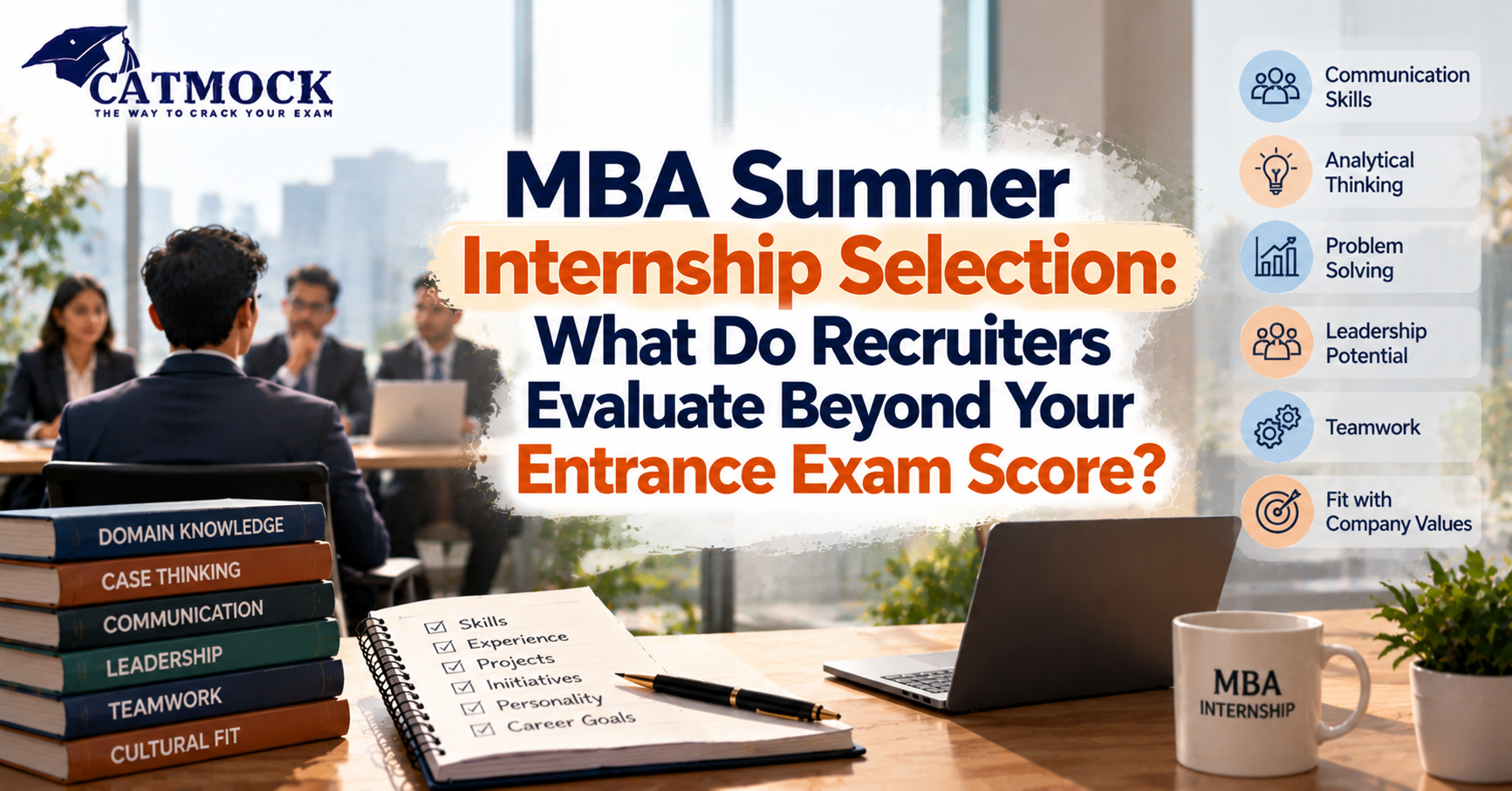
You cracked the entrance exam, survived the interviews and walked into your dream B-school. Then, a few months in, reality hits: the MBA summer internship selection process starts, and nobody asks about your CAT, XAT or GMAT percentile. Recruiters want to know what you can do, how you think and whether they would enjoy working with you for eight weeks.
If you have ever wondered what recruiters evaluate beyond your entrance exam score, this guide is for you. We break down the full internship selection journey, the exact signals recruiters look for, role-wise expectations and a practical preparation roadmap. The focus is the Indian MBA/PGDM context, though the principles apply to business schools worldwide.
Why Your Entrance Exam Score Stops Mattering After Admission
Your entrance exam score did its job: it helped you get shortlisted and admitted. Once you are on campus, every classmate has cleared a similar bar. Recruiters visiting the campus for summer internship hiring are choosing among students who are already academically strong, so they look for what separates one strong candidate from another.
Think of it this way. The entrance score is a qualifying ticket, not a performance guarantee. Recruiters need evidence that you can turn knowledge into contribution during a short, high-stakes project. That is why internship shortlisting leans on your CV, communication, structured thinking, teamwork and attitude much more than a number from a test you wrote months or years earlier.
What recruiters are really trying to answer:
- Can this student handle a real business problem with limited guidance?
- Will they communicate clearly with seniors, peers and clients?
- Are they coachable and professional?
- Do they genuinely want this role, or are they applying everywhere?
How MBA Summer Internship Selection Works: The Typical Process
Process details differ by school and company, but most MBA internship placement processes follow a similar pattern. Many B-schools make the summer internship a mandatory, roughly eight-week component of the two-year programme, usually in the April–May window of the first year. Companies are slotted by the student placement committee, may hold pre-placement presentations, and then run their selection.
| Stage | What happens | What recruiters are checking |
|---|---|---|
| 1. Pre-placement presentation (PPT) | Company briefs students on roles, projects and expectations | Your interest, questions and professionalism (recruiters often notice who engages thoughtfully) |
| 2. CV shortlisting | Recruiters screen resumes against role requirements | Relevance, clarity, achievements and credibility of your profile |
| 3. Group processes | Group discussions, case studies or written tests (company-dependent) | Structured thinking, collaboration, communication and composure |
| 4. Personal interviews | One or more rounds, often the final deciding stage | Role fit, motivation, depth of thought and self-awareness |
| 5. Selection and waitlist | Company shares selected names and often a waitlist with the placement committee | Final comparison of candidates against the opening |
| 6. Offer letters | Issued through the student placement committee | Documentation and formal acceptance |
Notice something: the entrance exam score does not appear as a stage. It might subtly influence how your academic profile reads on a CV, but it is rarely a deciding factor on its own. For a real example of this flow, review how an IIM publishes its summer internship placement process, where shortlisting starts from resumes and finalises through interviews.
What Do Recruiters Evaluate Beyond Your Entrance Exam Score?
Here is the evaluation framework recruiters typically apply. Each factor connects to a stage in the process above, so you know where to show it.
| Evaluation factor | What recruiters look for | How you can demonstrate it |
|---|---|---|
| CV and profile quality | Clear, concise, relevant, results-driven | Quantified achievements, clean formatting, role-aligned highlights |
| Academic consistency | Steady performance, not just one peak score | Strong grades across school, graduation and MBA coursework |
| Prior experience and projects | Evidence of applying knowledge | Work experience, live projects, case competitions, internships |
| Communication skills | Clarity, structure, listening, confidence | Crisp answers, good GD contributions, polished written communication |
| Analytical and problem-solving ability | Structured thinking under pressure | Frameworks, estimation, case reasoning, logical explanation |
| Teamwork and leadership | Collaboration, initiative, accountability | Club roles, team projects, examples where you influenced outcomes |
| Domain and role knowledge | Understanding of the function and company | Research, relevant coursework, informed questions |
| Attitude and coachability | Curiosity, humility, resilience | Thoughtful answers about failures, openness to feedback |
Let us look at the most important of these in detail.
1. CV and Profile Screening
Your CV is your first interview. Recruiters scan quickly, so every line must earn its place. Replace duty-based bullets (“handled social media”) with outcome-based ones (“grew club event registrations by a measurable margin through a targeted campaign”). Keep it to one page, put the most relevant achievements at the top and make sure every claim can survive a follow-up question. If you cannot discuss a line confidently in an interview, remove it.
2. Academic Record and Consistency
Recruiters do look at academics, but as a pattern, not a single data point. Consistent performance across school, graduation and your MBA term grades signals discipline and reliability. A strong entrance score with weak graduation or MBA grades can raise questions, while an average score with steady, improving performance reads as growth. Many companies also set minimum academic cut-offs at the CV stage, so protect your grades once you enter business school.
3. Prior Experience, Projects and Extracurriculars
Recruiters appreciate candidates who have already tried to apply theory. This does not have to be full-time work. Live projects, case competitions, college club leadership, volunteering, freelancing and earlier internships all show initiative. If you are a fresher, projects and leadership roles become your main proof of capability.
4. Communication Skills
Communication is not about fluent English alone. Recruiters assess whether you can structure your thoughts, answer the question that was asked, listen actively and adapt your tone to the audience. In group discussions, quality beats volume. A short, well-timed point that moves the discussion forward impresses more than constant interruptions.
5. Analytical Thinking and Problem Solving
Companies want interns who can break down messy problems. Recruiters often test this through case discussions, estimation questions, business simulations and situational interviews. They are not always looking for the “right” answer; they are watching how you structure the problem, state assumptions and reach a logical recommendation.
6. Teamwork, Leadership and Initiative
An internship is a team experience. Recruiters value candidates who cooperate, accept feedback and work smoothly with others. Be prepared with specific examples: a time you led a team, resolved a conflict, took ownership of a failing task or influenced a decision without formal authority. Use a simple structure (situation, action, result) to keep stories tight.
7. Role Fit and Business Awareness
Recruiters can tell quickly whether you have researched the company and the role. Know what the company does, who its competitors are, what recent developments affect it and why this function suits your strengths. Business awareness does not mean memorising definitions from textbooks. It means understanding what drives performance in that industry.
8. Attitude, Curiosity and Professionalism
Often the most overlooked quality is curiosity. Recruiters notice candidates who ask thoughtful questions, admit what they do not know and show eagerness to learn. Professionalism also counts: punctuality, respectful behaviour during presentations, clear emails and keeping commitments to the placement committee. Small behaviours add up to an impression of reliability.
What Recruiters Expect by Function: Role-Wise Breakdown
Different functions weigh the same factors differently. The table below gives a general picture; actual expectations vary by company, so always read the job description and company materials.
| Function | Typically emphasised | Common selection tools |
|---|---|---|
| Consulting | Structured problem solving, communication, logical reasoning | Case interviews, guesstimates, behavioural rounds |
| Finance and banking | Numerical comfort, financial concepts, market awareness, accuracy | Technical interviews, written tests, market discussions |
| Marketing and sales | Consumer insight, creativity, persuasion, commercial thinking | GDs, case studies, brand discussions, role-plays |
| Operations and supply chain | Process thinking, data comfort, practical problem solving | Case rounds, technical questions, situational scenarios |
| Analytics and technology | Data skills, logical reasoning, business translation | Written or technical tests, case problems, project discussions |
| Human resources | Empathy, communication, judgement, people understanding | Interviews, situational judgement, group exercises |
Use this table to tailor your preparation. A finance aspirant should revise accounting and market basics; a consulting aspirant should practise cases weekly; a marketing aspirant should build a habit of analysing brand campaigns.
Why Internship Performance Matters Beyond Selection
Getting selected is only half the story. A strong summer internship can convert into a pre-placement offer (PPO), which is why recruiters treat the internship as an extended interview. Students who deliver good work, stay professional and show ownership often receive full-time offers before final placements begin. Even if you decide not to accept the offer, a PPO from a respected company strengthens your profile.
This is also why recruiters look for long-term potential during selection. They are not just filling an eight-week gap. They are scouting future employees.
How to Prepare: A Practical Roadmap for MBA Summer Internship Selection
Preparation works best when it starts early and follows a sequence. Use this roadmap as a starting framework and adjust it to your school’s calendar.
| Phase | Timeline (approximate) | Action items |
|---|---|---|
| Foundation | First weeks of the programme | Build a strong academic base, join relevant clubs, identify 2–3 target functions |
| Profile building | First term | Draft your CV, collect achievements, take on a leadership or project role |
| Skill sharpening | Before the placement season | Practise GDs, solve cases weekly, revise functional concepts, do mock interviews |
| Company research | Before each pre-placement talk | Study the company, role, competitors and recent news; prepare questions to ask |
| Execution | During the selection window | Submit accurate applications, stay punctual, follow placement committee rules |
| Review | After each round | Note feedback, fix gaps, improve before the next company |
A simple weekly habit that helps: solve one case, read one business article and do one short mock answer on “Tell me about yourself.” Small, consistent practice beats last-minute cramming.
Common Mistakes That Cost Students Internship Offers
- Relying on entrance exam glory. Recruiters rarely care about a past percentile.
- An overloaded, unfocused CV. Too many generic bullets bury your real strengths.
- Applying without researching the company. Generic answers are easy to spot.
- Dominating group discussions. Aggression is not leadership.
- Memorising answers. Recruiters can sense scripted responses and will probe deeper.
- Ignoring behavioural questions. Many students prepare for cases but not stories about teamwork or failure.
- Unprofessional conduct. Late arrivals, missed deadlines or careless emails damage your reputation.
- Choosing based on brand alone. The right learning experience matters more than a famous name.
Quick Application Checklist
- One-page, role-aligned CV with quantified achievements
- 3–4 prepared stories (leadership, conflict, failure, initiative)
- Company and role research notes
- Practised case and guesstimate approach
- Updated knowledge of current business news
- Mock interview feedback incorporated
- Professional email and communication etiquette
Summary
- Your entrance exam score gets you admission; it rarely decides internship selection.
- Typical MBA summer internship selection runs through presentations, CV shortlisting, group processes (GD, case or written test), personal interviews and a waitlist.
- Recruiters evaluate CV quality, academic consistency, experience, communication, analytical thinking, teamwork, role fit and attitude.
- Different functions weigh these factors differently, so tailor your preparation by role.
- A good internship can lead to a PPO, which is why recruiters scout for long-term potential.
- Start early, practise consistently and build proof for every claim you make.
Frequently Asked Questions (FAQs)
1. Do recruiters consider entrance exam scores during MBA summer internship selection?
Rarely as a deciding factor. Your academic profile may appear on the CV, but recruiters mostly focus on communication, skills, projects, role fit and interview performance.
2. What is the typical MBA summer internship selection process?
Most schools follow presentations, resume shortlisting, group processes such as GDs, cases or written tests, personal interviews and a final selection with a waitlist.
3. How long is an MBA summer internship?
It varies by school. Many two-year programmes run it for around eight weeks, commonly in the April–May period after the first year.
4. What matters most on an MBA internship CV?
Clarity, relevance and measurable results. Use concise bullets that show what you achieved, not just what you were responsible for.
5. Can a fresher without work experience get a good MBA internship?
Yes. Live projects, case competitions, club leadership and strong communication can offset the lack of work experience.
6. How important are group discussions and case rounds?
Their importance depends on the company, but they are a common way to assess structured thinking, collaboration and communication. Quality contributions matter more than speaking the most.
7. Does a summer internship lead to a full-time job?
It can. Strong performers often receive pre-placement offers (PPOs), though this depends on the company, the role and your performance.
8. When should I start preparing for MBA summer internship selection?
As early as possible, ideally from the first weeks of the programme. Build your profile, practise cases and research target functions well before the placement season.
Conclusion
The MBA summer internship selection process rewards preparation, clarity and character far more than a past entrance exam score. Recruiters want to see how you think, communicate, collaborate and learn. Build a focused CV, practise structured problem solving, research companies deeply and treat every interaction with the placement process as part of your professional reputation. Do that consistently, and the question of what recruiters evaluate beyond your entrance exam score will answer itself in the offers you receive.
You May Also Like : CAT MOCK, CAT MOCK PYQ
Follow Us On : Facebook, Instagram, Youtube