
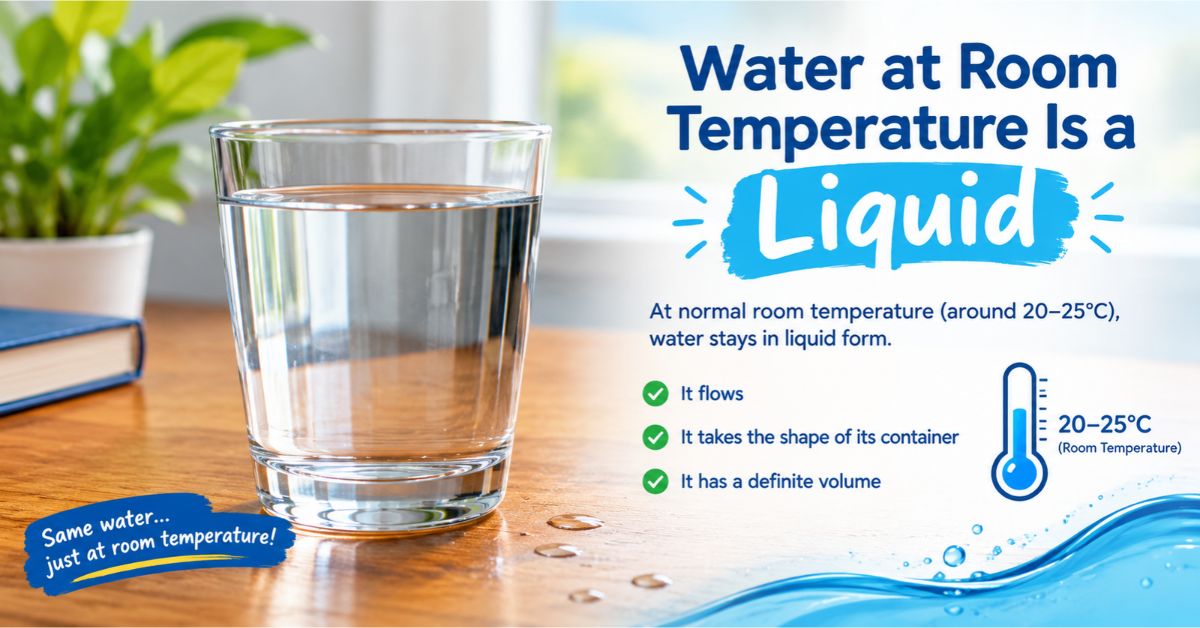
Direct answer: Water at room temperature is a liquid because of two reasons. First, room temperature (about 20–25 °C) lies between water’s melting point (0 °C) and boiling point (100 °C at 1 atm). Second, attractions between water molecules, helped by hydrogen bonds, keep them close but let them slide past each other.
Voice-assistant answer: Water is a liquid at room temperature because 20–25 °C lies between its melting point (0 °C) and boiling point (100 °C), and its molecules attract enough to stay together.
Quick Facts
- Melting point of water: 0 °C at standard pressure (1 atm).
- Boiling point of water: 100 °C at 1 atm.
- Room temperature in school science: about 20–25 °C. It has no single exact value.
- State of water at 25 °C and 1 atm: liquid.
- The question appears in the older NCERT Class 9 book as Chapter 1 exercise question 6(a). Check your own textbook.
Key Takeaways
- Water is a liquid between 0 °C and 100 °C at 1 atm.
- Forces of attraction hold water molecules close. They do not lock them in place.
- Hydrogen bonds act between molecules, not inside them.
- Always write “at 1 atm” when you quote a boiling point.
- A good two-mark answer gives one temperature reason and one particle reason.
This page is for learning. Always follow your own textbook and teacher for exam answers.
The Short Answer: Why Water Is a Liquid at Room Temperature
You can answer this question in two steps. One step looks at temperature. The other looks at the tiny particles inside water.
Why is water a liquid at room temperature?
Water is a liquid at room temperature because 20–25 °C is above its melting point (0 °C) and below its boiling point (100 °C at 1 atm). At these temperatures, forces between water molecules hold them close together but allow them to slide past each other, so water flows.
The rest of this guide explains each step. It also gives you copy-ready answers for 1, 2 and 3 marks.
What Does “Room Temperature” Mean?
What is room temperature in science?
Room temperature has no single exact value. In school science it usually means about 20–25 °C, and many chemistry sources use 25 °C as a reference. Hot summer rooms can be warmer, but even 40 °C is far below water’s boiling point of 100 °C.
Write “about 20–25 °C” in your answer. That shows the examiner you know it is a range.
States of Matter and Particle Arrangement
Matter is anything that has mass and takes up space. It exists as a solid, a liquid or a gas. These are called the states of matter.
All particles are always moving. They have kinetic energy, which is energy of movement. In a solid, particles only vibrate in fixed positions. In a liquid, they slide past each other. In a gas, they move freely and far apart.
| Property | Solid | Liquid | Gas | Source / Official Link |
|---|---|---|---|---|
| Particle arrangement | Fixed, regular positions | Close, but can move around | Far apart, random | NCERT textbook page |
| Force of attraction | Strongest | Medium | Weakest | NCERT textbook page |
| Shape | Fixed | Takes the container’s shape | Takes the container’s shape | NCERT textbook page |
| Volume | Fixed | Fixed | Not fixed | NCERT textbook page |
| Compressibility | Almost none | Very small | Large | NCERT textbook page |
| Flow | Does not flow | Flows | Flows | NCERT textbook page |
Liquid water sits in the middle. It is close-packed like a solid but free-moving like a gas.
Reason 1: Room Temperature Lies Between 0 °C and 100 °C
The melting point is the temperature at which a solid turns into a liquid. The boiling point is the temperature at which a liquid turns into a gas. Both depend on pressure, so scientists quote them at standard pressure, which is 1 atm (one atmosphere, normal air pressure at sea level).
For pure water at 1 atm, the NIST Chemistry WebBook lists a melting point of 273.15 K (0 °C) and a boiling point of 373.15 K (100 °C).
Now compare:
- Below 0 °C, water is ice (solid).
- From 0 °C to 100 °C, water is a liquid.
- Above 100 °C, water is steam (gas).
Room temperature (20–25 °C) falls in step 2. So water is a liquid. The USGS Water Science School explains more about water’s properties.
This reason is only true for water. Other substances have different melting and boiling points.
Reason 2: Intermolecular Forces and Hydrogen Bonding
An intermolecular force is a force of attraction between molecules. Water molecules attract each other strongly because they form hydrogen bonds.
At room temperature, two things balance:
- Attraction is strong enough to keep molecules close. So water does not become a gas.
- Attraction is not strong enough to lock molecules in fixed positions. So water does not stay a solid.
Because molecules can slide past each other, water flows. It takes the shape of its container. A fixed amount of water has a fixed volume.
What is a hydrogen bond?
A hydrogen bond is a force of attraction between a hydrogen atom of one water molecule and the oxygen atom of a neighbouring molecule. It acts between molecules, not inside them. These attractions make water’s boiling point much higher than that of similar molecules such as hydrogen sulfide.
Do hydrogen bonds break when water boils?
When water boils, the attractions between molecules (hydrogen bonds and other intermolecular forces) are overcome so molecules escape as steam. The H–O bonds inside each molecule stay intact, which is why steam is still H2O. Boiling is a physical change, not a chemical one.
Give Two Reasons to Justify: Water at Room Temperature Is a Liquid (Board-Ready Answer)
Examiners often phrase this as “give two reasons to justify water at room temperature is a liquid”. Here is a clear answer.
What are the two reasons to justify that water at room temperature is a liquid?
(1) Room temperature, about 20–25 °C, lies between water’s melting point (0 °C) and boiling point (100 °C) at normal pressure. (2) Attractions between water molecules, strengthened by hydrogen bonds, keep them close without locking them in fixed positions, so water flows and has a fixed volume.
Many answer keys use a property-based version instead. They say water flows, takes the shape of its container, and has a fixed volume. Both versions rest on the same science. Follow the style your teacher uses.
Class 9 NCERT Answer: Water at Room Temperature Is a Liquid Give Reason Class 9
In the older NCERT Class 9 Science book, this is exercise question 6(a) in Chapter 1, “Matter in Our Surroundings”. Many solution sets show it as “Give two reasons to justify: (a) water at room temperature is a liquid”.
Which chapter covers this in the new book?
NCERT introduced a new Class 9 Science textbook, Exploration, for the 2026-27 session. Third-party chapter lists show 13 chapters and no chapter titled “Matter in Our Surroundings”. One report says the matter topics are spread across other chapters. We could not confirm this on the NCERT site. Check your own textbook’s chapter list. Schools may still use the older book.
Marks-wise model answers
| Marks | Model answer to copy | Key words examiners look for | Source / Official Link |
|---|---|---|---|
| 1 mark | Water is a liquid at room temperature because room temperature (20–25 °C) lies between its melting point (0 °C) and boiling point (100 °C). | melting point, boiling point, room temperature | NCERT (question); answer written by author |
| 2 marks | (i) Room temperature (20–25 °C) lies between the melting point (0 °C) and boiling point (100 °C) of water at 1 atm. (ii) Forces of attraction between water molecules keep them close but let them slide past each other, so water flows and has a fixed volume. | between 0 °C and 100 °C, 1 atm, force of attraction, flows, fixed volume | CBSE Academic (syllabus); answer written by author |
| 3 marks | Add a third point to the 2-mark answer: water takes the shape of its container, has no fixed shape, and is only slightly compressible. | takes shape of container, definite volume, compressible | NCERT (question); answer written by author |
Classroom tips for a two-mark answer
- Write two numbered points. Give each its own line.
- Underline: between 0 °C and 100 °C, force of attraction, flows, fixed volume.
- Never write a boiling point without “at 1 atm” or “at normal pressure”.
- Do not write “because it is H2O” or “because it is wet”.
Water vs Other Substances at Room Temperature
Not every liquid has the same melting and boiling range. Compare these substances at about 25 °C and 1 atm.
| Substance | Melting point (°C) | Boiling point at 1 atm (°C) | State at about 25 °C | Source / Official Link |
|---|---|---|---|---|
| Water | 0 | 100 | Liquid | NIST WebBook |
| Ethanol | about −114 | about 78 | Liquid | PubChem |
| Mercury | −38.83 | 356.73 | Liquid | PubChem |
| Iron | 1538 | about 2862 | Solid | PubChem |
| Oxygen | −218.79 | −182.95 | Gas | PubChem |
| Hydrogen sulfide | about −85.5 | about −60 | Gas | PubChem |
Values are rounded. Sources differ slightly in the last digits.
Why is hydrogen sulfide a gas but water a liquid at room temperature?
Hydrogen sulfide (H2S) boils at about −60 °C, so it is a gas at room temperature. Its molecules attract each other much more weakly than water molecules do, because water forms strong hydrogen bonds. Water has lighter molecules than H2S yet boils at 100 °C.
Iron is a solid because its melting point is far above room temperature. Oxygen is a gas because its boiling point is far below it. Ethanol and mercury are liquids because 25 °C lies between their melting and boiling points.
How Temperature and Pressure Change the State of Water
Temperature changes how fast particles move. Pressure changes how close they are pushed. Both can change the state.
Is water always a liquid at room temperature?
Water is a liquid at room temperature under normal pressure (1 atm). Lower pressure lowers the boiling point, so water boils below 100 °C on high mountains. Higher pressure, as in a pressure cooker, raises it. In a strong vacuum, even room-temperature water would boil.
Why does ice melt and steam condense?
Ice melts when its particles gain enough kinetic energy (energy of movement) to break free from fixed positions, which happens at 0 °C and above at 1 atm. Steam condenses when it cools: particles slow down, attractions pull them together, and they form liquid water.
| State | Temperature range at 1 atm | Particle movement | Example | Source / Official Link |
|---|---|---|---|---|
| Ice (solid) | At or below 0 °C | Vibrate in fixed positions | Ice cube | NIST WebBook |
| Water (liquid) | 0 °C to 100 °C | Slide past each other | Drinking water | USGS |
| Steam (gas) | Forms at 100 °C when water boils | Move fast, far apart | Kettle steam | NIST WebBook |
Water vapour can also form below 100 °C by evaporation, such as wet clothes drying.
| Change | Effect on water | Source / Official Link |
|---|---|---|
| Heat ice above 0 °C (1 atm) | Melts to liquid | NIST WebBook |
| Lower the pressure (mountain) | Boils below 100 °C | USGS |
| Raise the pressure (pressure cooker) | Boils above 100 °C | USGS |
Real-life examples and a home activity
- Ice melts in a glass on your table. That is solid to liquid.
- Wet clothes dry in the sun. That is liquid to vapour.
- Droplets form on a cold glass. That is vapour to liquid.
Home activity (adult supervision needed): Place an ice cube in a bowl. Note how long it takes to melt at room temperature. For boiling, ask an adult to heat water in a kettle. Stay back. Steam and hot water cause burns. Never touch the kettle or the steam yourself.
Common Mistakes to Avoid
- Wrong: “Water is a liquid because it is H2O.” Fix: Use the temperature and particle reasons.
- Wrong: “Particles stop moving in a solid.” Fix: They vibrate in fixed positions.
- Wrong: “Boiling point is 100 °C.” Fix: Add “at 1 atm”.
- Wrong: “Hydrogen bonds break inside the molecule.” Fix: They act between molecules. The H–O bonds stay.
- Wrong: “Room temperature is always between 0 °C and 100 °C for every liquid.” Fix: That range is for water only.
- Wrong: Swapping the two points. Fix: Melting point is 0 °C. Boiling point is 100 °C.
Practice Questions with Answers
Try these before you read the answers. For more exam practice, try general mock tests and previous year question practice once you are older.
- (MCQ) At 25 °C and 1 atm, water is: (a) solid (b) liquid (c) gas (d) plasma. Answer: (b) liquid.
- (MCQ) Which is a gas at room temperature? (a) ethanol (b) mercury (c) hydrogen sulfide (d) iron. Answer: (c). Its boiling point is about −60 °C.
- (MCQ) When water boils, which attractions are overcome? (a) H–O bonds inside molecules (b) forces between molecules. Answer: (b).
- (Short) Why does a liquid have a fixed volume but no fixed shape? Answer: Attractions keep particles close, so volume is fixed. Particles can slide past each other, so the liquid takes the shape of its container.
- (Short) A friend says, “Water is a liquid because it is H2O.” Correct this. Answer: The formula does not decide the state. Room temperature lies between 0 °C and 100 °C, and the forces between molecules let them stay close but still flow.
For Older Students and Parents: Looking Ahead
If you are a parent or an older student exploring later options, these resources may help. Explore CAT PYQ practice, XAT PYQ practice, SNAP mock tests and SNAP resources. These are for management entrance exams, not for Class 9 science.
Frequently Asked Questions
1. Why is water a liquid at room temperature in one line?
Room temperature (20–25 °C) lies between water’s melting point (0 °C) and boiling point (100 °C at 1 atm), and the forces between its molecules keep them close but free to move past each other.
2. What is the melting point of water?
The melting point of pure water at 1 atm is 0 °C (273.15 K). Below this temperature, water freezes to ice. Always mention pressure when you quote this value in an exam.
3. What is the boiling point of water?
The boiling point of pure water at 1 atm is 100 °C (373.15 K). On high mountains, where pressure is lower, water boils at a lower temperature. Write “at 1 atm” in your answer.
4. Can I write “fixed volume and flows” as the reasons?
Many answer keys accept it, because it describes liquid properties. A stronger answer also adds the temperature range, since that explains why water is a liquid at room temperature. Follow your teacher’s style.
5. Why is iron a solid at room temperature?
Iron melts at about 1538 °C. Room temperature is far below this, so the particles stay in fixed positions. Iron is the usual second part of this NCERT question.
6. Are hydrogen bonds the same as the bonds inside a water molecule?
No. The bonds inside a molecule are H–O bonds. Hydrogen bonds are weaker attractions between neighbouring molecules. Boiling overcomes the attractions between molecules, not the H–O bonds.
7. Does water have a fixed shape?
No. A liquid has no fixed shape. Water takes the shape of its container. It does have a fixed volume, because its molecules stay close together.
8. Does water stay a liquid at 40 °C?
Yes, at 1 atm. Water is a liquid from 0 °C to 100 °C. A hot day at 40 °C is well inside that range, so water remains a liquid.
Conclusion and Next Step
Water at room temperature is a liquid for two reasons: room temperature sits between 0 °C and 100 °C, and the forces between water molecules keep them close but still free to flow. Remember to write “at 1 atm” with every boiling point.
Your next step: Close this page and write the two-mark answer from memory. Then check it against the marks-wise table. For more practice, visit CAT Mock.