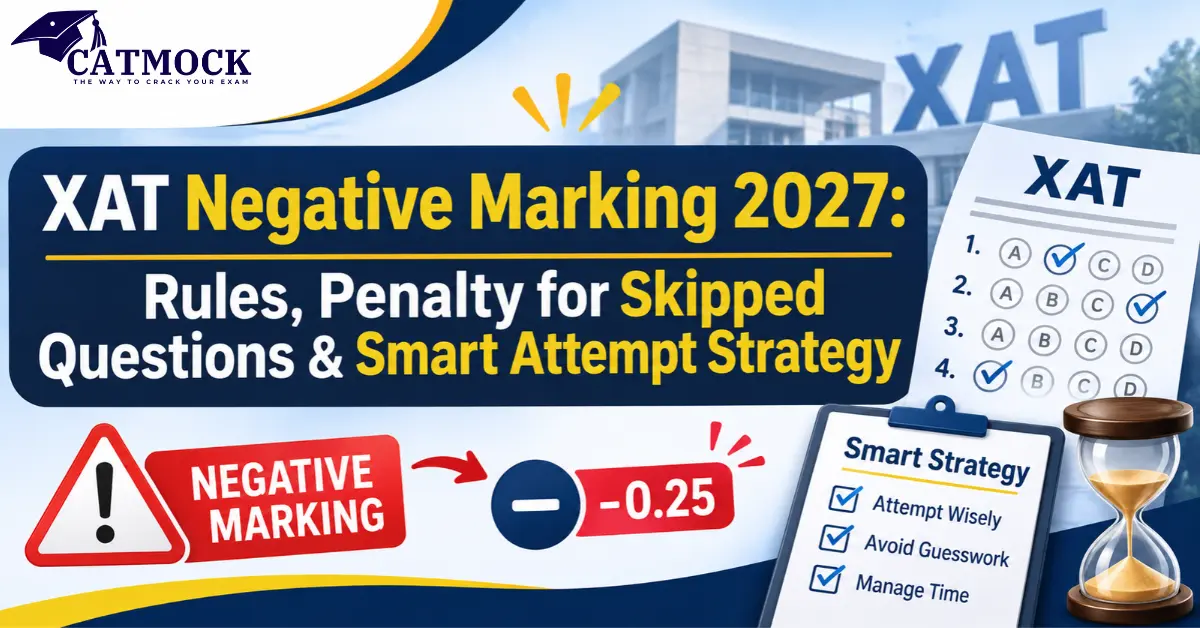
XAT negative marking is the rule that quietly decides how a 75-question Part 1 ends. Most MBA entrance exams penalise only wrong answers. XAT also charges a small penalty when you leave too many questions blank. That makes the XAT exam negative marking a two-way balancing act between guessing too much and skipping too much.
This guide explains how XAT negative marking works for XAT 2026 and XAT 2027, how your score changes with each wrong or skipped question, and when guessing is worth the risk.
Quick Answer: XAT Negative Marking at a Glance
| Rule | XAT 2026 and XAT 2027 |
|---|---|
| Correct answer | +1 mark |
| Wrong answer (Part 1) | −0.25 mark |
| Unattempted questions (Part 1) | No penalty for the first 8; −0.10 for each one after that |
| General Knowledge (Part 2) | No negative marking |
| XAT 2027 exam date | 3 January 2027, 2:00 PM to 5:00 PM (online) |
Is There Negative Marking in XAT?
Yes. If you are asking “Does XAT have negative marking?”, the answer is yes, but only in Part 1.
Part 1 holds three sections: Verbal Ability & Logical Reasoning (VALR), Decision Making (DM), and Quantitative Ability & Data Interpretation (QA & DI). In these 75 questions, every incorrect answer costs you one-fourth of a mark. Part 2 is the General Knowledge section, which has no negative marking at all.
The penalty on skipped questions is what makes XAT different. It pushes you to attempt questions you can reasonably eliminate options on, rather than leaving large blocks blank.
XAT Marking Scheme 2027 (Same as the XAT Marking Scheme 2026)
The XAT marking scheme 2026 and the 2027 scheme are identical. The exam pattern published for 2027 shows no structural change from the 2026 paper held on 4 January 2026.
| Part | Section | Questions | Marks for correct | Wrong answer | Unattempted |
|---|---|---|---|---|---|
| Part 1 | Verbal Ability & Logical Reasoning | 26 | +1 | −0.25 | Free up to 8 across Part 1, then −0.10 each |
| Part 1 | Decision Making | 21 | +1 | −0.25 | Same rule |
| Part 1 | Quantitative Ability & Data Interpretation | 28 | +1 | −0.25 | Same rule |
| Part 2 | General Knowledge | 20 | +1 | 0 | 0 |
The paper has 95 MCQs in 180 minutes. Part 1 gets 170 minutes with no sectional time limits, and Part 2 gets 10 minutes. The question split above is the one reported for XAT 2026 and carried into the 2027 pattern. Check the final numbers against the official XAT notification before exam day.
Also Read: XAT Syllabus 2027 PDF: Section-Wise Topics, Exam Pattern & Preparation Guide
XAT Negative Marking Rules Explained
XAT 0.25 Negative Marking for Wrong Answers
Under the 0.25 negative marking rule in XAT, each wrong answer in Part 1 subtracts 0.25 mark from your score. A correct answer adds 1 mark, so the swing between getting a question right and wrong is 1.25 marks. Compared with leaving a question blank, a wrong answer costs you 0.25 mark, or 0.15 mark once you have passed your 8 free skips, because each extra skip already carries a 0.10 penalty.
The penalty is lighter than in some other exams, which is why moderate, calculated guessing can pay off.
XAT 0.10 Negative Marking for Unattempted Questions
The XAT unattempted questions penalty works like a skip allowance. You can leave 8 questions unattempted in Part 1 without any deduction. From the 9th unattempted question onward, each blank costs 0.10 mark.
XAT 0.10 negative marking looks tiny, but it adds up. If you leave 28 questions blank, you lose 2 marks, which is the same as getting 8 questions wrong. That is why the XAT wrong answer negative marking and the skip penalty need to be planned together.
A note on the wording. A few websites describe the penalty as applying to “8 consecutive” unattempted questions. Most pattern guides and the XAT 2026 exam analyses describe it as a penalty on each unattempted question beyond the first eight in Part 1. Plan for the stricter reading (total skips) and confirm the wording in the official brochure on the XAT official website.
XAT GK Negative Marking
There is no XAT GK negative marking. A wrong or blank answer in the General Knowledge section costs you nothing, so you should attempt all 20 questions. The GK score does not feed into the XAT percentile. XLRI uses it in its own selection process, as do some other institutes.
Also Read: XAT 2027 GK Preparation How to Balance General Knowledge with Core Sections
Does the Skip Rule Apply Section by Section?
No. Published pattern summaries describe the 8-question allowance as running across Part 1, not as separate allowances for each section. Since there are no sectional time limits, you can move freely between VALR, DM and QA & DI while keeping one running count of blanks.
How Many Questions Can I Skip in XAT?
You can skip up to 8 questions in Part 1 without any penalty. That is roughly 10% of the 75 Part 1 questions.
Treat these 8 as free passes for your hardest questions, such as a lengthy Data Interpretation set or a Decision Making case where two options look equally defensible. After the eighth, each skip costs 0.10 mark, which is a small but real price.
XAT Exam Pattern and Negative Marking: Section-wise View
| Section | Part | Questions | Negative marking | Practical approach |
|---|---|---|---|---|
| VALR | 1 | 26 | −0.25 per wrong answer | Attempt the ones you can narrow down |
| Decision Making | 1 | 21 | −0.25 per wrong answer | Options are often closely framed, so accuracy matters more than volume |
| QA & DI | 1 | 28 | −0.25 per wrong answer | Pick solvable sets first |
| General Knowledge | 2 | 20 | None | Attempt everything |
XAT Negative Marking 2026 vs 2027
| Exam edition | Date | Wrong answer | Unattempted penalty | GK |
|---|---|---|---|---|
| XAT 2019 | Earlier pattern | −0.25 | −0.05 beyond 8 (as reported) | None |
| XAT 2023 and 2024 | Earlier editions | −0.25 | −0.10 beyond 8 | None |
| XAT 2026 | 4 Jan 2026 | −0.25 | −0.10 beyond 8 | None |
| XAT 2027 | 3 Jan 2027 | −0.25 | −0.10 beyond 8 | None |
So XAT negative marking 2026 and XAT negative marking 2027 are the same. If you are using last year’s mock tests, the scoring logic still applies.
How Your XAT Score Is Calculated: Worked Examples
Part 1 score = correct answers − (0.25 × wrong answers) − (0.10 × unattempted questions beyond 8)
| Scenario | Correct | Wrong | Unattempted | Calculation | Part 1 score |
|---|---|---|---|---|---|
| A: Balanced | 48 | 12 | 15 | 48 − 3.00 − 0.70 | 44.30 |
| B: Over-cautious | 42 | 8 | 25 | 42 − 2.00 − 1.70 | 38.30 |
| C: Attempt everything | 45 | 30 | 0 | 45 − 7.50 − 0 | 37.50 |
| D: Uses exactly 8 skips | 50 | 17 | 8 | 50 − 4.25 − 0 | 45.75 |
Over-attempting (C) and over-skipping (B) both lead to lower scores than a measured approach (A and D).
Should You Guess? The Maths Behind XAT Wrong Answer Negative Marking
XAT MCQs typically offer five options, so a blind guess has a 20% chance of being right.
Break-even accuracy for a guess = 20%, because 0.20 × (+1) + 0.80 × (−0.25) = 0.
The skip penalty changes the maths. Once you have used your 8 free skips, leaving a question blank costs 0.10, so guessing becomes favourable at a lower accuracy:
| Options left after elimination | Chance of being right | Expected value of guessing | Better than skipping? |
|---|---|---|---|
| 5 (blind guess) | 20% | 0.00 | Yes, once you are past 8 skips (skip = −0.10) |
| 4 | 25% | +0.06 | Yes, once you are past 8 skips |
| 3 | 33% | +0.17 | Yes, even within your free 8 |
| 2 | 50% | +0.38 | Definitely |
Over the long run, if you can remove even one option, guessing beats skipping. Within your first 8 skips, guess only if you have narrowed it to three options or fewer.
XAT vs CAT Negative Marking
| Feature | XAT | CAT |
|---|---|---|
| Marks for correct MCQ | +1 | +3 |
| Wrong MCQ | −0.25 (25% of a mark) | −1 (about 33% of a mark) |
| Unattempted penalty | −0.10 after 8 in Part 1 | None |
| Break-even accuracy for guessing | 20% | 25% |
CAT-style habits can hurt you in XAT. In CAT, skipping is free, so leaving many questions blank is a sound tactic. In XAT, skipping past 8 costs marks.
CAT vs XAT — and How to Strategise Both
Smart Strategy for XAT Negative Marking
- Treat the 8 free skips as a budget. Spend them on the questions that are lengthy or unfamiliar, not the first difficult-looking one you see.
- Keep a live count of blanks. Note your unattempted total as you move through the question palette so you do not drift past 8 unknowingly.
- Guess only with elimination. Removing one or two options makes the odds work for you.
- Be strict in Decision Making. Options are often close, so choose carefully and do not guess on questions where you cannot justify your choice.
- Attempt all 20 GK questions. There is no penalty, and one extra correct answer can help in the XLRI selection stage.
- Use the last minutes for a skip audit. If you have more than 8 blanks, convert the best of them into educated guesses.
- Practise under the real scheme. Take XAT mock tests on CATMOCK with the same marking so your instincts adjust.
- Aim for accuracy over volume. Post-exam analyses of XAT 2026 broadly put good attempts in Part 1 at around the mid-50s to about 60, with accuracy mattering more than the raw count. The exact figures differ by institute, so use them as a guide only.
Common Mistakes Students Make
- Using the CAT rule that unattempted questions are free.
- Dismissing the 0.10 penalty as negligible, when 20 extra blanks cost 2 marks.
- Skipping the GK section or guessing nothing in it.
- Assuming the GK score counts toward the XAT percentile.
- Panic-guessing in the final minutes with no elimination.
Summary: XAT Negative Marking 2027
- XAT negative marking applies to Part 1 only: −0.25 for each wrong answer.
- You can leave 8 questions unattempted for free. Each blank after that costs −0.10.
- There is no XAT GK negative marking, so attempt all 20 questions.
- The scheme is the same for XAT 2026 and XAT 2027.
- Guessing pays off once you can eliminate at least one option.
- Maximise your score by balancing accuracy, your 8 free skips, and educated guesses.
FAQs on XAT Negative Marking
1. Is there negative marking in XAT?
Yes. In Part 1 (VALR, DM and QA & DI), each wrong answer costs 0.25 mark, and each unattempted question beyond the first 8 costs 0.10 mark. The GK section in Part 2 has no negative marking.
2. How much is the XAT negative marking?
The XAT wrong answer negative marking is 0.25 mark per incorrect response. The unattempted-question penalty is 0.10 mark, applied only after the first 8 blanks in Part 1.
3. Does XAT have negative marking for unattempted questions?
Yes, but only beyond a limit. The first 8 unattempted questions in Part 1 carry no penalty. From the 9th onward, each one costs 0.10 mark.
4. How many questions can I skip in XAT?
You can skip up to 8 questions in Part 1 without losing marks. Use them on your toughest questions.
5. Is there negative marking in the XAT GK section?
No. A wrong or unattempted GK question has no penalty, so attempt all 20. The GK score is not part of the XAT percentile but is used by XLRI in its selection process.
6. Is XAT negative marking the same in 2026 and 2027?
Yes. XAT 2027 follows the same scheme as XAT 2026: +1 for correct, −0.25 for wrong and −0.10 per unattempted question beyond 8 in Part 1. XAT 2027 is scheduled for 3 January 2027.
7. Is XAT negative marking tougher than CAT?
It depends. A wrong answer costs less in XAT (25% of a mark vs about 33% in CAT), but XAT also penalises skipping beyond 8 questions, which CAT does not.
8. Should I guess in XAT?
Guess when you can eliminate at least one option. A blind guess has an expected value of zero, while narrowing to three or fewer options turns the odds in your favour.
XAT Negative Marking 2027 Conclusion
XAT negative marking is simple to learn but rewards careful planning. Each wrong answer in Part 1 costs 0.25 mark, and each unattempted question beyond the first 8 costs 0.10, while the GK section carries no penalty at all. The same scheme applies to XAT 2026 and XAT 2027, so smart question selection, educated guesses and strong accuracy will decide your final score. Practise with mock tests under the real marking scheme, and confirm the final rules on the official XAT website before exam day.
You May Also Like : CATMOCK, XAT PYQ
Follow Us On : Facebook, Instagram, Youtube