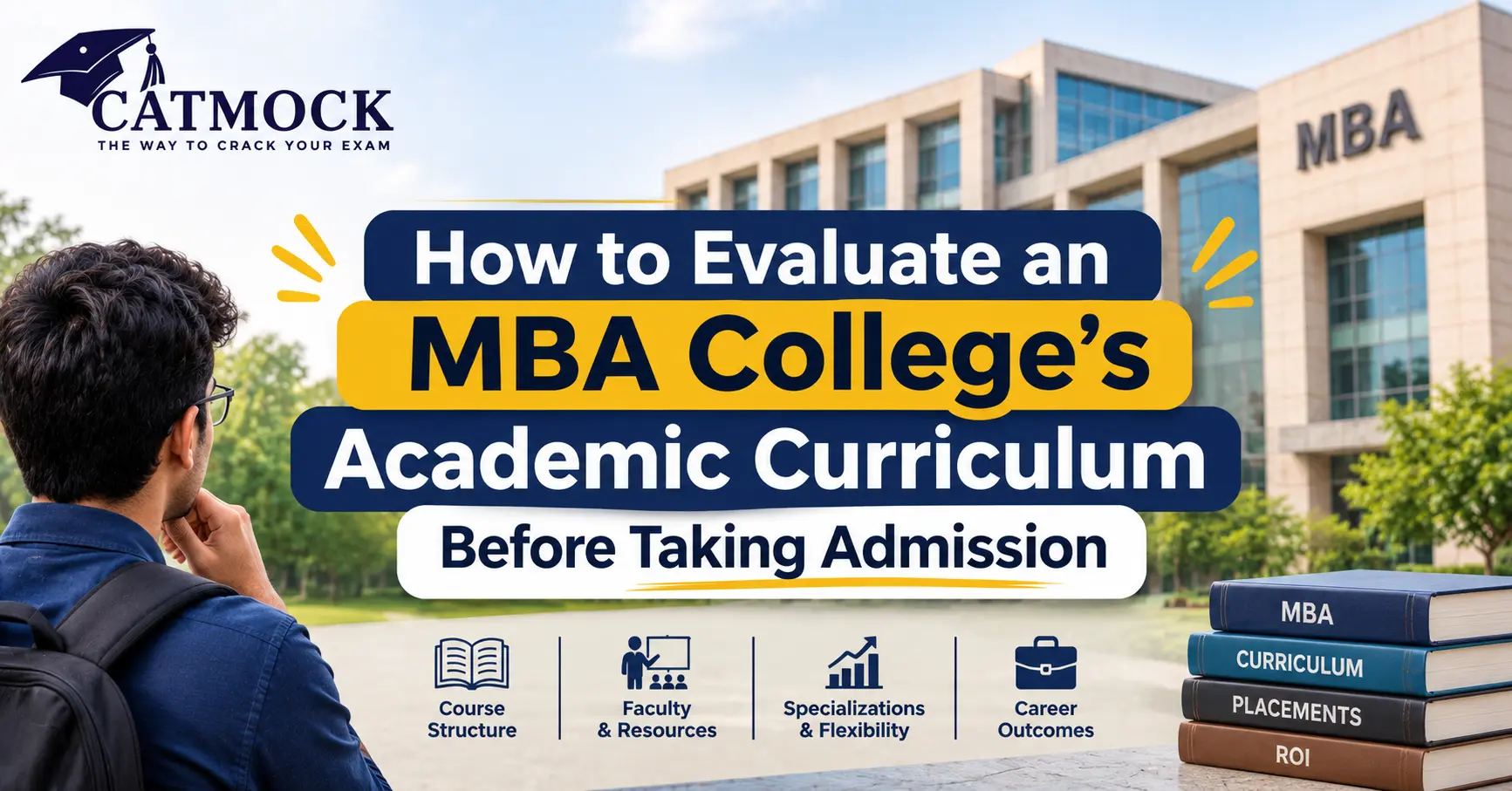
Two MBA colleges can charge similar fees, advertise similar placement numbers and still deliver completely different learning. The difference sits inside the curriculum: what you study, in what order, how deeply, how it is taught and how it is assessed. Yet most applicants spend weeks comparing rankings and minutes reading the syllabus. If you want to know how to evaluate an MBA college’s academic curriculum before taking admission, this guide gives you a clear, practical method you can apply to any campus.
You will learn what a strong MBA curriculum looks like, which documents to ask for, which questions expose weak programmes, and how to score colleges side by side before you pay a single rupee.
Why Curriculum Evaluation Should Come Before Fees and Rankings
A ranking is a snapshot of reputation, while a curriculum is the actual product you will consume for two years. Evaluating the MBA course structure early protects you in four ways:
- Career fit: You confirm that the specialisations match the roles you want.
- Skill depth: You can tell whether subjects build real capability or only cover theory.
- Return on investment: You avoid paying for electives that never run or faculty who never teach them.
- Flexibility: You learn whether you can pivot between functions after the first year.
Think of curriculum review as due diligence. The same care you would give to a house loan deserves to be given to a programme that shapes your next two decades.
Step 1: Verify Recognition and Accreditation First
Before you study the syllabus, confirm that the programme itself is legitimate. A well-designed curriculum means little if the degree is not recognised.
Check Regulatory Approval
In India, check whether the institute is approved by the All India Council for Technical Education (AICTE) or recognised by the University Grants Commission (UGC), depending on its status. Autonomous institutes offering a PGDM should also be able to explain how their diploma is treated for further study and employment. Always verify claims on official portals such as AICTE and UGC rather than relying on brochures.
Look for Quality Accreditation
Accreditation from bodies such as the National Board of Accreditation (NBA), NAAC, or international agencies like AACSB, AMBA and EQUIS signals that the curriculum has been reviewed against external standards.
Accreditation Checklist
| Check | Where to Verify | Why It Matters |
|---|---|---|
| AICTE or UGC approval | Official regulator portals | Confirms the degree or diploma is legitimate |
| NBA or NAAC status | Accreditation body websites | Shows external review of academic quality |
| International accreditation | AACSB, AMBA, EQUIS listings | Indicates global benchmarking of curriculum |
| University affiliation or autonomy status | College documents, regulator pages | Decides who designs and updates the syllabus |
| Ranking framework participation | NIRF | Provides comparable teaching and outcome data |
Step 2: Understand the Overall Programme Structure
Ask for the complete academic handbook or course structure document. A trustworthy college will share it without hesitation. Then map the structure across the full duration.
Core, Elective and Experiential Components
A balanced MBA curriculum usually blends three layers:
- Foundation or core courses: Finance, marketing, operations, human resources, strategy, analytics, economics and business communication.
- Specialisation or elective courses: Deeper, function-specific subjects such as financial modelling, brand management, supply chain analytics or organisational behaviour.
- Experiential components: Internships, live projects, simulations, case competitions and capstone projects.
Credit Distribution and Workload
Study how credits are divided between core and electives, and how many courses run in each term. If almost everything is compulsory, you have little room to specialise. If almost everything is optional, you may miss fundamentals.
Sample Curriculum Balance Table
| Component | Healthy Range (Indicative) | Red Flag |
|---|---|---|
| Core foundation courses | 35 to 50% of credits | Over 70% with no real choice |
| Specialisation electives | 25 to 40% of credits | Fewer than three electives per specialisation |
| Experiential learning (internship, projects) | 15 to 25% of credits | Treated as optional or unscored |
| Soft skills and communication | 5 to 10% of credits | Absent or only a one-day workshop |
These ranges are indicative guides for comparison, not regulatory rules. Different institutes design differently, so use them to ask sharper questions rather than to reject a programme outright.
Step 3: Examine Course Content and Syllabus Depth
The course list is only the surface. The syllabus reveals whether the programme is current and rigorous.
What to Look for in Each Syllabus
- Clear learning outcomes: Each course should say what you will be able to do after completing it.
- Updated topics: Look for data analytics, digital marketing, sustainability, fintech, artificial intelligence applications and ethics, not only textbook chapters from decades ago.
- Balanced reading lists: A mix of foundational texts, recent journal articles and contemporary cases is a strong sign.
- Assessment methods: Check the weight given to exams, assignments, projects, presentations and class participation.
- Prerequisites: Good syllabi explain which earlier courses prepare you for advanced ones.
Check How Recently the Curriculum Was Revised
Ask when the syllabus was last updated and who approved the changes. A curriculum that is reviewed with industry and academic advisors at regular intervals is more likely to stay relevant. If the answer is vague, treat it as a warning.
Step 4: Assess the Specialisations on Offer
Specialisations convert general management knowledge into a career lane. Evaluate them carefully rather than counting the brochure’s list.
Questions to Ask About Each Specialisation
- How many courses actually belong to the specialisation?
- Are all advertised electives offered every year, or only when enough students enrol?
- Which faculty members teach them, and what is their background?
- Are there certifications, software tools or labs attached to the specialisation?
- Do alumni from this specialisation work in the roles you want?
Comparing Common Specialisations
| Specialisation | Core Subjects to Expect | Tools or Skills to Look For | Typical Career Direction |
|---|---|---|---|
| Finance | Corporate finance, investment analysis, financial modelling | Excel modelling, valuation, risk tools | Banking, equity research, corporate finance |
| Marketing | Consumer behaviour, brand management, digital marketing | Analytics dashboards, campaign simulations | Brand, product and growth roles |
| Operations and Supply Chain | Process design, logistics, procurement | ERP exposure, forecasting tools | Operations, logistics, consulting |
| Human Resources | Talent management, organisational behaviour, labour law | HR analytics, assessment frameworks | Talent, people operations, L&D |
| Business Analytics | Statistics, data visualisation, machine learning basics | Python, SQL, BI platforms | Data, strategy and decision-science roles |
Use the table as a reference while reviewing a college’s own offering. If a specialisation lacks the subjects and tools listed for it, ask why.
Step 5: Evaluate Teaching Methods and Learning Style
A strong curriculum on paper can fail if delivered through slides and memorisation. Check how learning really happens.
Pedagogy Indicators
- Case-based discussion: Builds judgement and communication.
- Live projects and consulting assignments: Connect classroom concepts with real companies.
- Simulations and role plays: Provide safe practice for decisions and negotiation.
- Guest lectures and industry masterclasses: Offer current market perspective.
- Peer learning and group work: Mirror workplace collaboration.
Ask for Evidence
Request a sample timetable, a sample case, or a recent project report. Better still, attend a demo class if the college offers one. Observing how students and faculty interact tells you more than any brochure.
Step 6: Study the Faculty Profile
Faculty are the delivery mechanism of the curriculum. Review their qualifications, research output and industry experience.
What a Strong Faculty Profile Shows
- A healthy share of doctoral qualified teachers across core areas.
- Practitioners who bring recent corporate experience as visiting or adjunct faculty.
- Evidence of research, publications, case writing or consulting work.
- Reasonable student to faculty ratios, so you receive mentoring and feedback.
- Low faculty turnover, which suggests stability in course delivery.
Check the college website for faculty pages and ask whether the people who designed your preferred electives will actually teach them.
Step 7: Check Industry Integration and Practical Exposure
Management is an applied discipline. A curriculum should connect directly to how organisations work.
Key Practical Elements
- Summer internship: How long is it, who arranges it, and is it assessed for credit?
- Live projects: Are they part of regular courses or occasional add-ons?
- Industry advisory board: Does the college involve employers in curriculum design?
- Capstone or dissertation: Is there a structured final project that demonstrates integrated learning?
- Certifications: Does the curriculum prepare you for recognised industry certificates?
Theory vs Practice Evaluation Table
| Practical Feature | Strong Programme | Weak Programme |
|---|---|---|
| Internship | Credit-bearing, mentor assigned, report evaluated | Informal, unscored, student must find own |
| Live projects | Embedded in multiple courses | One-off event |
| Industry input | Advisory board reviews syllabus periodically | No documented employer involvement |
| Capstone | Structured with faculty guidance | Optional or loosely supervised |
| Case material | Mix of Indian and global current cases | Dated or purely textbook examples |
Step 8: Look at Flexibility, Electives and Interdisciplinary Options
The workplace changes faster than a syllabus can. A flexible curriculum lets you adapt.
Check whether you can take electives across specialisations, pursue a dual specialisation, join exchange programmes or complete online micro-credentials for credit. Ask how electives are allotted, because a first-come system or merit based bidding can affect your options. Also ask whether lateral movement is allowed after the first term if your interests shift.
Step 9: Review Assessment, Grading and Learning Support
How you are evaluated shapes how you study. Request details on the grading system, the weight of continuous assessment against end-term exams, and the policy on attendance and re-evaluation.
Also look at academic support: writing and quantitative skills workshops, mentoring, peer tutoring, library and database access, and software licences for analytics. A curriculum that gives you the tools to succeed is more valuable than one that only tests you.
Step 10: Validate Outcomes with Real Evidence
A curriculum proves itself through what graduates do. Cross-check the college’s claims.
- Alumni conversations: Speak with at least three recent graduates from your target specialisation.
- Placement reports: Look at role types and sectors, not just average salary.
- Student feedback: Read independent reviews and ask current students what they would change.
- Learning outcomes: Ask whether the college measures skill improvement, not only grades.
When you speak with alumni, ask which courses they used most in their first job and which felt outdated. These answers show where the curriculum succeeds and where it lags.
Curriculum Scorecard: Compare Colleges Side by Side
Use a simple weighted scorecard so your decision rests on evidence, not impressions. Score each college from 1 (weak) to 5 (excellent) and multiply by the weight.
| Criterion | Suggested Weight | College A Score | College B Score | College C Score |
|---|---|---|---|---|
| Recognition and accreditation | 15% | |||
| Programme structure and credit balance | 10% | |||
| Syllabus depth and recency | 15% | |||
| Specialisation quality | 15% | |||
| Teaching methods and pedagogy | 10% | |||
| Faculty profile | 10% | |||
| Industry integration and internships | 15% | |||
| Flexibility and electives | 5% | |||
| Outcomes and alumni feedback | 5% |
Adjust the weights to your goals. A career switcher might raise internships and specialisation depth, while someone aiming for research might raise faculty profile.
Red Flags to Watch For
- The college refuses to share a detailed syllabus or academic handbook.
- Specialisations are advertised but the elective list is vague.
- The curriculum has not changed in several years.
- Internships and projects are described but not credited or assessed.
- Faculty details are missing or outdated on the website.
- Claims about accreditation cannot be verified on official portals.
- Answers to curriculum questions are replaced with placement promises.
Questions to Ask the Admissions Team
- When was the curriculum last revised, and who was involved?
- Can I see the full course list with credits for each term?
- How many electives run in a typical year for my specialisation?
- Who teaches the core and elective courses I am interested in?
- How are internships arranged and assessed?
- What certifications or tools will I learn?
- Can I speak with current students and recent alumni?
- How do you measure learning outcomes beyond exams?
Summary
- Verify recognition and accreditation before studying any syllabus.
- Review the structure: core, electives and experiential learning, with credit balance.
- Read syllabi for outcomes, updated topics, reading lists and assessment methods.
- Judge specialisations by the number of courses, faculty and tools, not the brochure list.
- Check teaching methods, faculty profile and industry integration for real delivery quality.
- Look for flexibility, strong assessment and learner support.
- Validate everything with alumni, student feedback and outcome data.
- Use a weighted scorecard to compare colleges objectively.
Frequently Asked Questions
How do I evaluate an MBA college’s academic curriculum before admission?
Start by verifying approval and accreditation, then request the full syllabus and credit structure. Review core and elective balance, specialisation depth, teaching methods, faculty profile and practical exposure. Finally, confirm claims through alumni and current students.
What should a good MBA curriculum include?
A good curriculum combines foundation subjects such as finance, marketing, operations and analytics with specialisation electives and experiential learning such as internships, live projects and a capstone. It should also include communication, ethics and up-to-date topics like data analytics and sustainability.
How can I check if an MBA syllabus is up to date?
Ask when it was last revised and who reviewed it. Look for current topics, recent cases and journal readings, and for evidence that industry experts advise on course content.
Is accreditation important when judging an MBA curriculum?
Yes. Accreditation shows that the programme has been reviewed against external standards. Always verify approvals and accreditations on the official regulator or accreditation body websites.
How many specialisations should I look for in an MBA college?
Quantity matters less than depth. Choose a college where your preferred specialisation has multiple dedicated courses, qualified faculty and regular offerings of electives.
Can I see a sample class before taking admission?
Many colleges allow campus visits and demo sessions. If a demo class is not available, ask for a sample case, a recent project report or the chance to speak with current students.
What are the biggest red flags in an MBA curriculum?
Common warning signs include an unwillingness to share the syllabus, vague elective lists, outdated content, unassessed internships, missing faculty details and accreditation claims that cannot be verified.
Conclusion
Learning how to evaluate an MBA college’s academic curriculum before taking admission is one of the most valuable steps in your decision process. It moves you from marketing claims to measurable evidence: recognised credentials, a balanced course structure, a current syllabus, strong specialisations, practical exposure and credible outcomes.
Request the documents, ask direct questions, speak to alumni and use the scorecard to compare your shortlist. A few focused hours of curriculum research can save you two years of regret and put you on a programme that genuinely builds the skills your career needs.
You May Also Like : CATMOCK, CATMOCK PYQ
Follow Us On : Facebook, Instagram, Youtube