
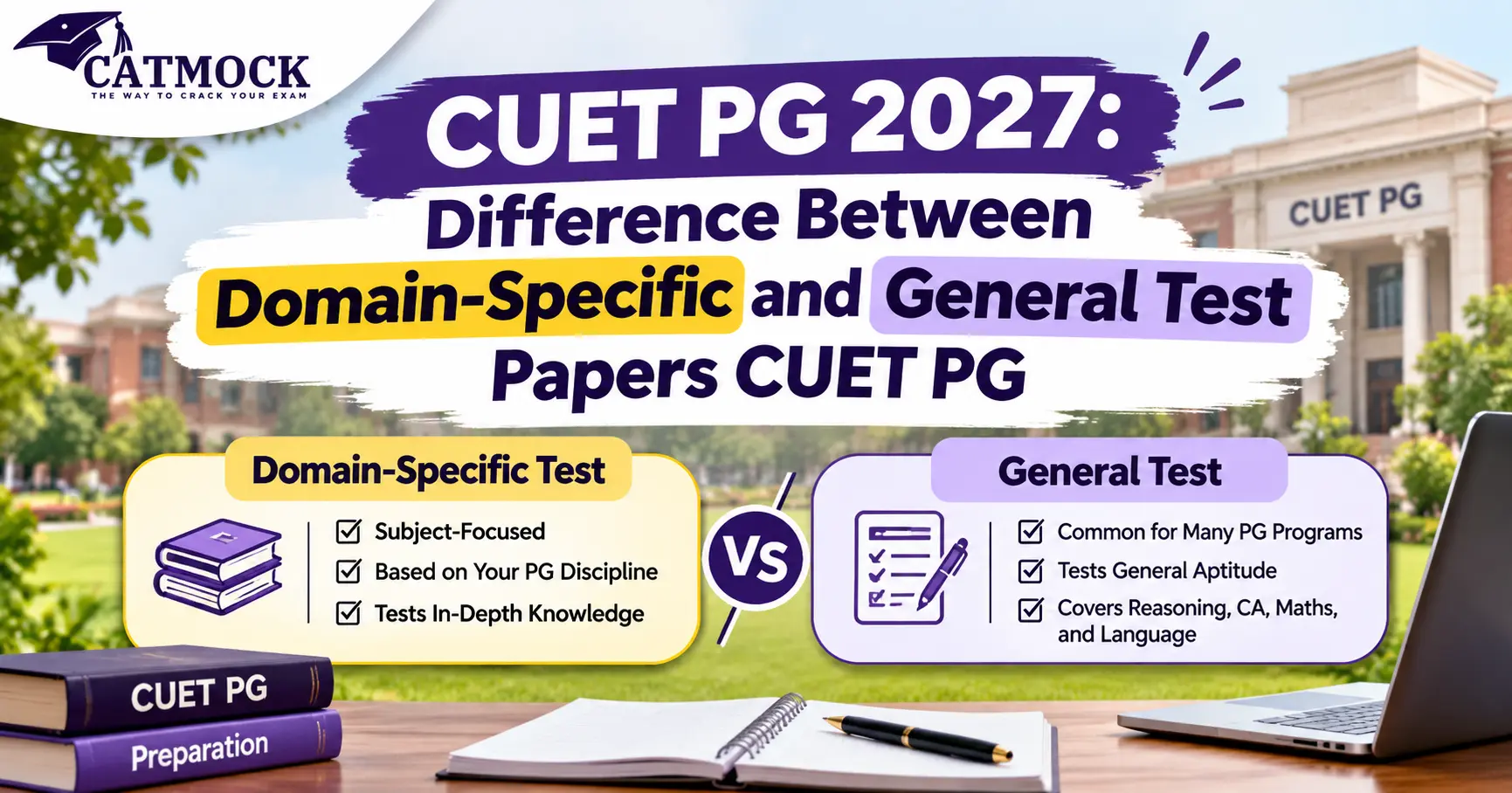
Every year, thousands of postgraduate aspirants open the CUET PG form, reach the paper selection page and freeze. Should you pick the subject paper from your graduation, or a general paper that tests aptitude? Choose wrongly and you may be ineligible for your dream programme, or you may spend months preparing for a paper your university never asked for. Understanding the difference between domain-specific and general test papers in CUET PG 2027 is therefore the first strategic decision of your admission journey.
This guide explains both paper types in plain language, compares them side by side, shows how marking works, and gives you a step-by-step method to choose the right test paper code. It also includes a preparation plan and a list of mistakes to avoid.
Important note: The official CUET PG 2027 information bulletin may not be fully released at the time you read this. The pattern below follows recent editions published by the National Testing Agency (NTA). Always confirm every detail on the official NTA portal before you apply.
CUET PG 2027 at a Glance
The Common University Entrance Test for postgraduate admissions (CUET PG) is conducted by the National Testing Agency for admission to postgraduate programmes in participating central, state, deemed and private universities. Based on recent editions, the broad structure looks like this:
| Feature | Details (Based on Recent Editions) |
|---|---|
| Conducting body | National Testing Agency (NTA) |
| Mode | Computer-based test (CBT) |
| Question type | Multiple-choice questions (MCQs) |
| Questions per paper | 75 |
| Duration per paper | 90 minutes |
| Total marks per paper | 300 |
| Marking scheme | +4 for a correct answer, -1 for a wrong answer, 0 for unattempted |
| Number of test paper codes | Up to four per candidate (per recent NTA guidance) |
| Selection of papers | Depends on the programme and university you target |
Since each test paper is chosen according to the programme and university, the real question becomes: what kind of paper does your course require?
What Is a General Test Paper in CUET PG?
A general test paper, sometimes called a common paper or aptitude-based paper, evaluates your overall readiness for postgraduate study rather than your depth in one academic subject. It is typically required for programmes that welcome graduates from many disciplines, such as management, mass communication, public policy, library science or interdisciplinary studies.
What a General Paper Usually Tests
Depending on the paper code, the content can include:
- Verbal ability and reading comprehension: Grammar, vocabulary, passage-based questions and language usage.
- Quantitative aptitude: Arithmetic, algebra, geometry, percentages, ratios and data-related problems.
- Logical and analytical reasoning: Series, puzzles, arrangements, syllogisms and critical reasoning.
- Data interpretation: Tables, charts and graphs.
- General awareness: Current affairs, static general knowledge, history, polity, economy and science basics.
Who Should Consider a General Paper?
You should look closely at a general paper if:
- Your target programme accepts graduates from any stream.
- You are switching fields, for example from science to management.
- The university lists a common or aptitude paper in its eligibility requirements.
- Your strength lies in reasoning, language and problem-solving rather than a single subject.
What Is a Domain-Specific Test Paper in CUET PG?
A domain-specific test paper assesses your knowledge of a particular academic subject at graduation level. Think of it as an entrance test for the discipline you want to study in depth: chemistry, economics, history, English literature, computer science and many others.
What a Domain-Specific Paper Usually Tests
- Core concepts taught in your undergraduate syllabus.
- Application-based questions that check understanding, not just memory.
- Subject-specific terminology, theories, laws, formulas and case contexts.
- In some papers, a small portion of language or reasoning skills in addition to subject content.
Who Should Consider a Domain-Specific Paper?
Choose this route when:
- You want to pursue an M.A., M.Sc. or specialised programme in the same subject as your graduation.
- Your chosen university requires a specific subject paper code for that course.
- You have a strong foundation in your major and want that to carry your score.
How Education Portals Group Paper Codes
Paper codes are usually grouped by stream. Recent editions, as reported by education portals, organise them into families such as common papers, science papers, humanities papers, language and literature papers, M.Tech or higher sciences papers and Sanskrit-based Acharya papers. Code numbering can change between editions, so always match the code printed in the current official bulletin and the university’s own admission page.
Domain-Specific vs General Test Papers: Key Differences
Here is the comparison that matters most when you fill the form.
| Parameter | General Test Paper | Domain-Specific Test Paper |
|---|---|---|
| Core purpose | Measures aptitude, reasoning and awareness | Measures subject knowledge at graduation level |
| Syllabus nature | Broad and skill-based | Deep and discipline-based |
| Typical content | Verbal ability, quantitative aptitude, logical reasoning, general awareness | Core topics of one subject such as physics, law, economics or literature |
| Best suited for | Management, communication and interdisciplinary programmes; career switchers | Subject-focused M.A., M.Sc. and specialised programmes |
| Preparation style | Practice, speed and accuracy drills | Concept clarity, revision and subject mastery |
| Dependence on your degree | Low, open to varied backgrounds | High, strongly linked to your undergraduate subject |
| Competition pool | Large, cross-disciplinary | Focused on candidates of that discipline |
| Risk factor | Time pressure and accuracy under negative marking | Depth of syllabus and unfamiliar application questions |
Difference in Syllabus
The general paper spreads questions across skills. The domain paper concentrates on a single subject. This means a general paper rewards flexible thinking, while a domain paper rewards depth.
Difference in Preparation Time
A strong graduate in a subject may need fewer months to prepare for a domain paper because the content is familiar. A general paper often needs steady daily practice across several skill areas, especially if you have been away from quantitative or reasoning practice for years.
Difference in Competition
Because general papers attract applicants from many streams, the candidate pool can be broad. Domain papers narrow the field to people from similar academic backgrounds, so competition is about subject mastery.
How to Choose the Right CUET PG 2027 Test Paper
The most important rule is this: do not choose a paper because it feels easier. Choose the paper that your target programme and university accept. Follow these steps.
Step 1: List Your Target Programmes
Write down the courses you want, such as M.A. Economics, M.Sc. Chemistry, MBA-type programmes or M.Com. Include at least three universities for each.
Step 2: Read Each University’s Admission Page
Every participating university publishes the test paper codes it accepts for each programme. Similar programmes at different universities may use different codes, so never assume.
Step 3: Match Eligibility With Paper Codes
Confirm that your graduation stream meets the eligibility rules for the code. Some programmes require a specific subject paper, while others allow a general or common paper.
Step 4: Shortlist Up to Four Codes
Recent NTA guidance allows candidates to select up to four test paper codes. Use this limit wisely. Combine one or two codes that cover most of your target universities, and add a backup only if the preparation load is manageable.
Step 5: Test Your Preparation Fit
Attempt one sample paper for each shortlisted code. Compare your accuracy and comfort. If two codes are equally valid for your goals, pick the one where you can score higher with less stress.
Step 6: Re-Verify Before Submitting
Match the code number, name and language option against the official bulletin before you finalise your application.
Common Scenarios: Which Paper Fits Which Student?
| Student Profile | Likely Best Fit | Reason |
|---|---|---|
| B.Sc. Chemistry graduate aiming for M.Sc. Chemistry | Domain-specific (Chemistry) | The programme tests subject depth |
| B.A. English graduate aiming for M.A. English | Domain-specific (English or related literature code) | The university usually requires the subject paper |
| B.Com graduate aiming for a management programme | General or common paper (if listed) | Management courses often use aptitude-based papers |
| Engineering graduate switching to public policy | General or common paper (if listed) | Open to graduates from varied streams |
| B.A. History graduate applying to both M.A. History and a communication course | One domain paper plus one general paper | Two codes cover two different goals |
This table is illustrative. Your final selection must follow the code listed by each university.
Marking Scheme and Negative Marking Strategy
Both paper types follow the same scoring logic in recent editions: four marks for each correct answer, one mark deducted for each wrong answer and no marks for unattempted questions. With 75 questions, the maximum score is 300.
Sample Score Scenarios
| Correct | Wrong | Unattempted | Calculation | Final Score |
|---|---|---|---|---|
| 70 | 5 | 0 | (70 × 4) – (5 × 1) | 275 |
| 60 | 10 | 5 | (60 × 4) – (10 × 1) | 230 |
| 50 | 15 | 10 | (50 × 4) – (15 × 1) | 185 |
| 40 | 30 | 5 | (40 × 4) – (30 × 1) | 130 |
What the Numbers Teach
Each wrong answer costs a net five marks compared with a correct one, because you lose the potential four marks and also suffer a one-mark penalty. This changes how you should play each paper.
- In a domain paper, attempt questions where you can eliminate at least two options.
- In a general paper, prioritise high-accuracy sections first, then use remaining time on harder reasoning or quantitative items.
- In both, avoid blind guessing when you cannot narrow the choices.
Preparation Strategy for Each Paper Type
How to Prepare for a General Test Paper
- Build a daily routine. Spend 30 to 45 minutes each on verbal, quantitative and reasoning practice.
- Read widely. Newspapers, editorials and magazines improve comprehension and awareness together.
- Master basics first. Revise percentages, ratios, averages, number systems and basic geometry before moving to advanced problems.
- Practise timed sets. Aim to solve 75 questions in 90 minutes with time left for review.
- Track current affairs. Maintain short notes on national and international events, economy, science and sports.
How to Prepare for a Domain-Specific Test Paper
- Download the syllabus for your chosen code from the NTA website and map it to your undergraduate notes.
- Divide topics by weightage. Spend more time on units that appear frequently in previous papers.
- Revise through concept maps and short notes instead of rereading entire textbooks.
- Solve previous year questions to understand question style and difficulty.
- Take full-length mocks every week in the last two months.
Sample Study Time Split
| Preparation Phase | General Paper Focus | Domain Paper Focus |
|---|---|---|
| First month | Basics of quantitative, verbal and reasoning | Complete syllabus first read and note-making |
| Second month | Sectional practice and awareness notes | Topic-wise questions and revision |
| Third month | Full-length timed mocks | Previous year papers and full-length mocks |
| Final two weeks | Error analysis and quick revision | Formula, concept and fact revision |
Mistakes Aspirants Make While Selecting Test Papers
- Choosing by difficulty, not eligibility. If the university requires a specific code, an easier paper will not help.
- Ignoring university-specific requirements. Two universities offering the same course may accept different codes.
- Selecting too many codes. Splitting effort across several unrelated papers can lower performance in each.
- Relying on old code lists. Code numbers and names can change between years.
- Skipping the official syllabus. Coaching notes may not match the current NTA syllabus.
- Neglecting mock tests. Without timed practice, you risk poor pacing and heavy negative marking.
Where to Verify Official Information
Before you submit your application, check the official NTA CUET PG portal for the information bulletin, syllabus, test paper codes and schedule.
Summary
- CUET PG 2027 is expected to follow the recent pattern: computer-based, 75 MCQs, 90 minutes and 300 marks per paper, with +4 and -1 marking.
- General test papers measure aptitude, reasoning, language and awareness, and suit interdisciplinary programmes and career switchers.
- Domain-specific papers measure subject knowledge and suit subject-focused postgraduate programmes.
- Your choice must follow the paper codes accepted by your target programmes and universities.
- Recent guidance allows up to four test paper codes, so plan combinations carefully.
- Prepare differently: skill practice and accuracy for general papers, concept depth and revision for domain papers.
- Always verify patterns, syllabus and codes on the official NTA portal.
Frequently Asked Questions
What is the main difference between domain-specific and general test papers in CUET PG 2027?
A general test paper checks aptitude skills such as verbal ability, quantitative reasoning, logical thinking and general awareness. A domain-specific paper checks your knowledge of one academic subject at graduation level.
Can I choose any test paper I like in CUET PG 2027?
No. You should choose papers according to the programmes and universities you are targeting. Each university lists the test paper codes it accepts for each course, so your selection must match those requirements.
How many test papers can I select in CUET PG?
Recent NTA guidance has allowed candidates to select up to four test paper codes. Check the 2027 information bulletin for the final limit.
Is there negative marking in CUET PG test papers?
In recent editions, each correct answer earns four marks and each wrong answer loses one mark, while unattempted questions score zero. Confirm the scheme in the official 2027 bulletin.
Which paper is easier, general or domain-specific?
Neither is universally easier. A general paper may suit you if you are strong in reasoning and language, while a domain paper may suit you if you have solid subject knowledge. Your choice should depend on eligibility first and comfort second.
Is the duration different for general and domain-specific papers?
Recent editions have set 90 minutes for each paper with 75 questions, regardless of whether it is general or domain-specific. Confirm the 2027 details on the NTA website.
Where can I find the official CUET PG 2027 syllabus and paper codes?
The official information bulletin and syllabus are published on the NTA CUET PG portal. University admission pages also list accepted codes for each programme.
Conclusion
The difference between domain-specific and general test papers in CUET PG 2027 comes down to what each exam measures: subject mastery versus overall aptitude. The right choice is never about which paper looks simpler. It is about which paper your target programme and university accept, and which one lets you perform at your best.
Start by listing your preferred courses, check the codes each university requires, and shortlist your papers within the allowed limit. Then build a preparation plan that suits the paper type, practise with timed mocks, and keep an eye on official NTA updates. With a clear selection strategy and consistent practice, you can turn the CUET PG paper-choice puzzle into a genuine advantage.
You May Also Like : CATMOCK, CATMOCK PYQ
Follow Us On : Facebook, Instagram, Youtube