

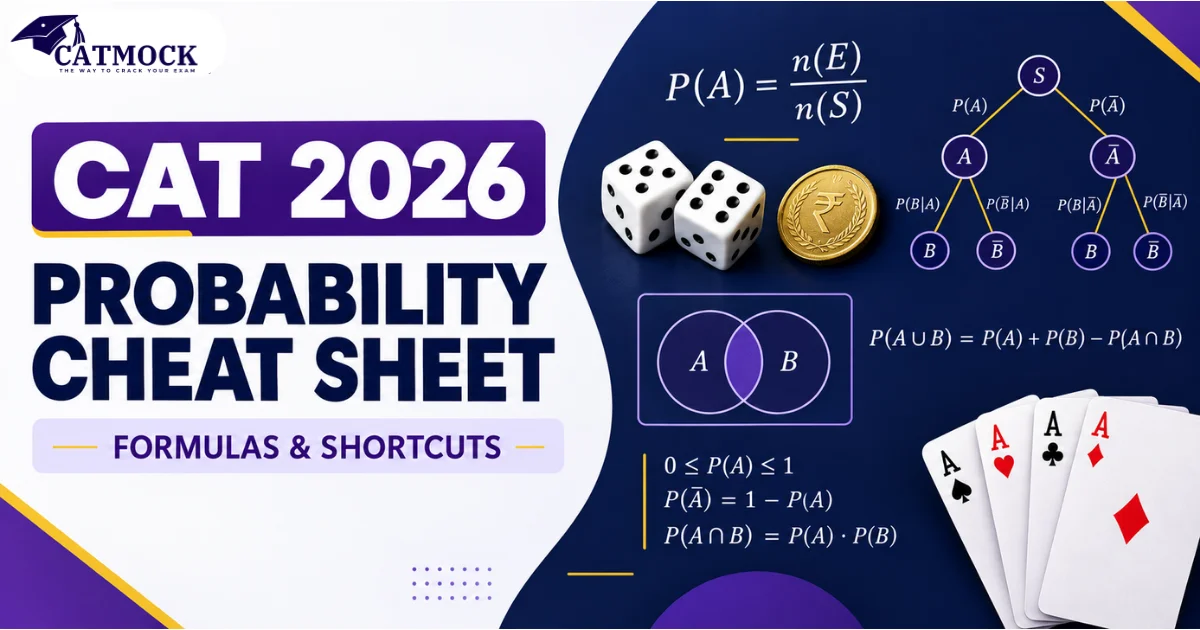
Stuck on probability questions in CAT mock tests? You’re not alone.
Probability looks tricky, but it’s actually one of the most formula-driven topics in CAT Quantitative Aptitude. With the right CAT 2026 Probability Cheat Sheet, you can solve 80% of questions in under 2 minutes.
This guide gives you every probability formula, shortcut, and trick you need for CAT 2026—plus solved examples, common mistakes to avoid, and a quick-revision table. Whether you’re targeting IIMs or other top B-schools, this cheat sheet will save you hours of revision time.
Why Probability Matters in CAT 2026
CAT 2026 is scheduled for November 29, 2026, with 22 questions in the QA section (66 marks total). While probability falls under Modern Maths (alongside Permutation & Combination, Set Theory), it typically contributes 1–2 questions per paper.
But here’s the catch: Probability questions often act as tie-breakers in high-scoring papers. A single correct answer can push your percentile from 98 to 99+.
Also Read: CAT Quant Shortcuts & Tricks: Topic-Wise Methods to Save Time
CAT QA Syllabus – The Complete Breakdown
QA Section Breakdown (CAT 2026)
| Section | Total Questions | Marks | Time |
|---|---|---|---|
| VARC | 24 | 72 | 40 min |
| DILR | 22 | 66 | 40 min |
| QA | 22 | 66 | 40 min |
Modern Maths (including Probability): ~5–8% weightage in QA, roughly 1–2 questions.
The Ultimate CAT 2026 Probability Cheat Sheet
1. Basic Probability Formula
The foundation of every probability question:
P(E)=Total Number of Possible OutcomesNumber of Favorable Outcomes=n(S)n(E)
Where:
- P(E) = Probability of event E
- n(E) = Favorable outcomes
- n(S) = Total outcomes in sample space
Example: What’s the probability of getting a head when tossing a coin?
P(Head)=21=0.5
2. Probability Range (Boundaries)
Every probability value lies between 0 and 1:
0≤P(E)≤1
- P(E)=0 → Impossible event
- P(E)=1 → Certain event
Quick Tip: If your answer is negative or greater than 1, you’ve made a calculation error.
3. Complement Rule (NOT Event)
Probability of an event not happening:
P(E′)=1−P(E)
Also: P(E)+P(E′)=1
Example: If probability of rain is 0.3, probability of no rain = 1−0.3=0.7
Shortcut: For “at least one” questions, use:
P(at least one)=1−P(none)
4. Addition Rule (OR Events)
Probability of A OR B (or both) occurring:
P(A∪B)=P(A)+P(B)−P(A∩B)
Special Case – Mutually Exclusive Events (A and B cannot happen together):
P(A∩B)=0
So, P(A∪B)=P(A)+P(B)
Example: Probability of getting a 2 or 5 on a dice:
P(2∪5)=61+61=62=31
5. Multiplication Rule (AND Events)
Probability of A AND B both occurring:
For Independent Events (one doesn’t affect the other):
P(A∩B)=P(A)×P(B)
For Dependent Events (one affects the other):
P(A∩B)=P(A)×P(B∣A)
Example: Probability of getting two heads in two coin tosses:
P(H∩H)=21×21=41
6. Conditional Probability
Probability of A given that B has already occurred:
P(A∣B)=P(B)P(A∩B),provided P(B)=0
Example: A bag has 3 red and 2 blue balls. You draw one ball (it’s red). What’s the probability the next ball is also red?
- After first red: 2 red, 2 blue left
- P(Second red∣First red)=42=0.5
7. Bayes’ Theorem (Reverse Conditional Probability)
Updates probability based on new evidence:
P(A∣B)=P(B)P(B∣A)×P(A)
When to Use: When you know P(B∣A) but need P(A∣B). Common in CAT questions involving medical tests, quality checks, or multiple scenarios.
Example: A factory has two machines. Machine A produces 60% of items (5% defective), Machine B produces 40% (10% defective). If a randomly picked item is defective, what’s the probability it came from Machine A?
Solution:
- P(A)=0.6,P(B)=0.4
- P(Defective∣A)=0.05,P(Defective∣B)=0.10
- P(Defective)=0.6×0.05+0.4×0.10=0.07
- P(A∣Defective)=0.070.05×0.6=0.070.03≈0.428
8. Binomial Probability (Repeated Trials)
For n independent trials with probability of success p:
P(k successes in n trials)=(kn)×pk×(1−p)n−k
Where: (kn)=k!(n−k)!n! (combination formula)
Example: A coin is tossed 5 times. What’s the probability of getting exactly 3 heads?
- n=5,k=3,p=0.5
- P(3H)=(35)×(0.5)3×(0.5)2=10×0.125×0.25=0.3125
9. At-Least-One Rule (Compound Trials)
For “at least one success in n trials”:
P(at least one)=1−P(none)=1−(1−p)n
Example: Probability of getting at least one head in 3 coin tosses:
P(at least one H)=1−(0.5)3=1−0.125=0.875
10. Permutation & Combination (P&C) Link
Probability questions often need P&C for counting outcomes:
Permutation (arrangement):
nPr=(n−r)!n!
Combination (selection):
nCr=r!(n−r)!n!
Example: From 5 boys and 3 girls, what’s the probability of selecting 2 boys and 1 girl for a team of 3?
- Total ways: (38)=56
- Favorable ways: (25)×(13)=10×3=30
- Probability: 5630=2815
Quick-Revision Probability Formula Table
| Concept | Formula | When to Use |
|---|---|---|
| Basic Probability | P(E)=n(S)n(E) | All probability questions |
| Complement | P(E′)=1−P(E) | “Not E” or “at least one” questions |
| Addition (OR) | P(A∪B)=P(A)+P(B)−P(A∩B) | A or B (or both) occurring |
| Mutually Exclusive | P(A∪B)=P(A)+P(B) | A and B cannot happen together |
| Multiplication (AND) | P(A∩B)=P(A)×P(B) | Independent events both occurring |
| Conditional | ( P(A | B) = \frac{P(A \cap B)}{P(B)} ) |
| Bayes’ Theorem | ( P(A | B) = \frac{P(B |
| Binomial | P(k)=(kn)pk(1−p)n−k | Repeated independent trials |
| At-Least-One | P(≥1)=1−(1−p)n | “At least one success” in n trials |
| Permutation | nPr=(n−r)!n! | Arrangement problems |
| Combination | nCr=r!(n−r)!n! | Selection problems |
Solved CAT-Style Probability Questions
Question 1: Basic Probability
Q: A bag contains 4 red, 5 blue, and 6 green balls. If one ball is drawn at random, what is the probability it is either red or green?
Solution:
- Total balls = 4 + 5 + 6 = 15
- Favorable (red or green) = 4 + 6 = 10
- P(Red or Green)=1510=32
Answer: 32 or 0.67
Question 2: Conditional Probability
Q: Two dice are rolled. Given that the sum is 8, what is the probability that one of the dice shows a 3?
Solution:
- Possible outcomes for sum = 8: (2,6), (3,5), (4,4), (5,3), (6,2) → 5 outcomes
- Favorable (one die shows 3): (3,5), (5,3) → 2 outcomes
- P(One 3∣Sum 8)=52
Answer: 52 or 0.4
Question 3: Binomial Probability
Q: A student answers 5 MCQs randomly (each with 4 options). What is the probability of getting exactly 2 correct?
Solution:
- n=5,k=2,p=41=0.25
- P(2)=(25)×(0.25)2×(0.75)3
- =10×0.0625×0.421875=0.2637
Answer: ~0.264 or 26.4%
Question 4: At-Least-One Rule
Q: A shooter hits the target with probability 0.6. If he fires 4 shots, what is the probability of hitting the target at least once?
Solution:
- P(at least one hit)=1−P(no hits)
- P(no hit)=(1−0.6)4=(0.4)4=0.0256
- P(≥1)=1−0.0256=0.9744
Answer: 0.9744 or 97.44%
Common Mistakes to Avoid in Probability
- Forgetting to subtract P(A∩B)P(A \cap B)P(A∩B) in addition rule → Leads to double-counting.
- Mixing up permutation and combination → Use permutation for arrangement, combination for selectionbschool.
- Ignoring the complement rule → “At least one” is faster as 1−P(none).
- Assuming events are independent when they’re not → Check if one event affects the other.
- Not simplifying fractions → CAT options are often in simplest form.
How to Use This Cheat Sheet for CAT 2026
Step 1: Memorize the Core Formulas
Focus on:
- Basic probability P(E)=n(S)n(E)
- Complement rule P(E′)=1−P(E)
- Addition and multiplication rules
- Conditional probability and Bayes’ theorem
Step 2: Practice with Timed Mocks
Solve 10–15 probability questions daily under 2-minute limits. Use CAT mock tests to simulate exam pressure.
Step 3: Revise with This Table
In the last 2 weeks before CAT (November 29, 2026), use the quick-revision table above for daily 5-minute reviews.
Step 4: Link with P&C
Probability + Permutation & Combination = 2–3 guaranteed questions in Modern Maths. Master both together.
Strengthen your P&C skills with CATMOCK’s Bhandara before tackling probability questions.
FAQs: CAT 2026 Probability Cheat Sheet
Q1: How many probability questions appear in CAT?
Typically 1–2 questions from probability (under Modern Maths, which has 5–8% QA weightage).
Q2: Is Bayes’ theorem important for CAT?
Yes. Bayes’ theorem appears in 1–2 questions every 2–3 years, especially in high-difficulty papers.
Q3: Should I memorize all formulas or understand concepts?
Both. CAT tests conceptual application, but formula recall saves time. Use this cheat sheet for quick revision.
Q4: What’s the easiest way to solve “at least one” probability questions?
Use the complement rule: P(at least one)=1−P(none). It’s faster and reduces calculation errors.
Q5: Can I skip probability and focus on Arithmetic instead?
Not recommended. Arithmetic has higher weightage (35–40%), but probability questions are easier to score if you know formulas. Don’t skip.
Q6: Where can I find official CAT 2026 updates?
Check the official CAT website: iimcat.ac.in for notifications, admit cards, and exam dates.
Final Thoughts: Master Probability, Boost Your CAT Score
Probability isn’t about luck—it’s about applying the right formula at the right time. With this CAT 2026 Probability Cheat Sheet, you now have:
✅ All essential formulas in one place
✅ Solved examples matching CAT difficulty
✅ Quick-revision table for last-minute prep
✅ Common mistakes to avoid
Next Step: Download this page, print the formula table, and solve 20+ probability questions from CAT mock tests this week.
Remember: CAT 2026 is on November 29, 2026. Every formula you master today is a percentile point gained tomorrow.
You May Also Like : CAT MOCK, CAT MOCK PYQ
Follow Us On : Facebook, Instagram, Youtube