
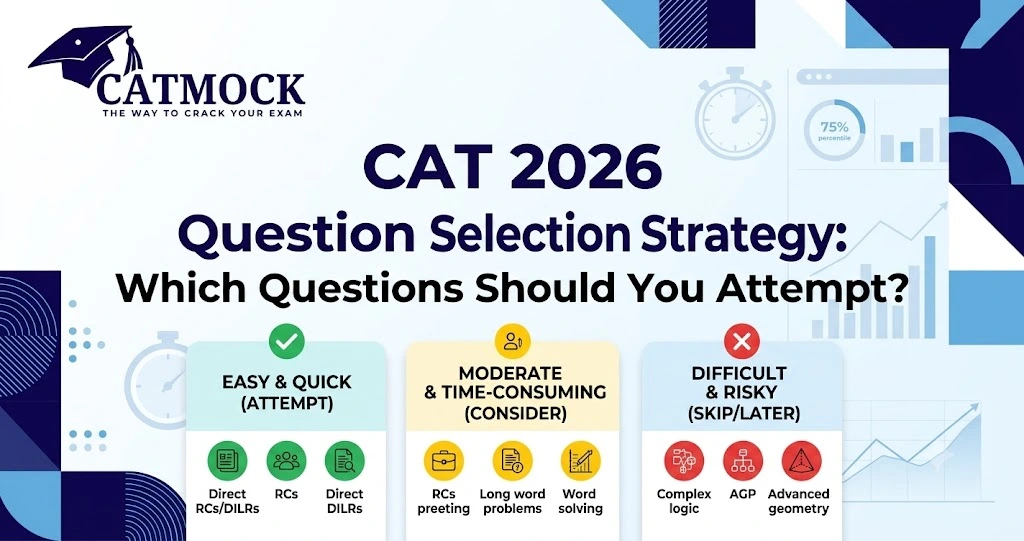
Most CAT aspirants spend months mastering concepts and almost no time mastering a skill that quietly decides their final percentile: knowing which questions to leave alone. A strong CAT question selection strategy isn’t about how much you know — it’s about how well you can judge, in real time, which questions deserve your next 90 seconds and which don’t. This guide breaks down exactly how to build that judgment, section by section, with clear attempt targets and a repeatable decision framework you can practise before exam day.
If you’ve ever walked out of a mock wondering how someone with fewer attempts scored a higher percentile than you, the answer almost always comes down to question selection — not raw knowledge.
Why Question Selection Matters More Than Attempt Count
CAT is a percentile-based exam, not a marks-maximisation exam. Your score is compared against every other test-taker in your slot, which means the goal is never to attempt the maximum number of questions — it’s to maximise your score per attempt. With +3 for a correct MCQ answer and -1 for an incorrect one (non-MCQ/TITA questions carry no negative marking), a poorly chosen attempt can actively pull your score down rather than add to it.
This is the single biggest mental shift required for a strong CAT question selection strategy: in school exams, leaving questions unattempted feels like failure. In CAT, leaving the right questions unattempted is often the exact decision that separates a 90th percentile scorer from a 99th percentile one.
The Real Math Behind High Percentiles
To understand why selective attempting works, it helps to look at how marks actually translate into percentile. Based on recent CAT trends, very high percentiles have come from surprisingly modest raw scores — because accuracy, not volume, drives the outcome.
| Percentile Range | Approximate Marks (out of ~204) | What It Implies |
|---|---|---|
| 99+ percentile | ~84 marks | Around 28 well-chosen, accurate attempts can be enough |
| 99.9 percentile | ~130+ marks | Still far from attempting the full paper — accuracy compounds |
| 95 percentile | Roughly half the paper attempted | Strong accuracy on moderate attempt volume outperforms high-volume guessing |
| 90 percentile | Lower attempt volume with high accuracy | Consistent, careful selection beats rushed attempts |
The pattern is consistent: candidates hitting top percentiles are rarely the ones attempting the most questions. They’re the ones who almost never get their attempted questions wrong.
The Core Question Selection Framework
Before section-wise detail, it helps to have one simple, repeatable framework you can apply to any question, in any section, within seconds of reading it.
Step 1 — Read and classify instantly: Is this a question type you recognise and have solved comfortably before? If yes, proceed. If it looks unfamiliar or oddly worded, treat it with caution.
Step 2 — Estimate solving time: If you can’t see a clear path to the answer within roughly 30-45 seconds of reading, it’s usually not worth committing to immediately. Flag it for a possible second pass instead.
Step 3 — Check your confidence, not just your knowledge: Knowing the topic and being able to solve this specific question accurately under time pressure are different things. If you’re unsure, it’s safer to leave it than to guess.
Step 4 — Apply the skip rule: If a question feels unusually complex, oddly phrased, or unlike anything you’ve practised, leave it and move on immediately. Don’t let curiosity pull you back mid-section.
Step 5 — Reassess mid-section: After attempting the first several questions, judge whether the paper feels easier or harder than expected, and adjust your attempt targets accordingly rather than sticking rigidly to a pre-decided number.
Section-Wise Question Selection Strategy
Each CAT section behaves differently, so your selection approach needs to adapt accordingly.
Quantitative Aptitude (QA)
QA rewards early, comfortable topics. Prioritise Arithmetic and Algebra questions first, since they’re typically more approachable and less calculation-heavy than Geometry or Number Systems under time pressure. Skip calculation-intensive questions on the first pass and return to them only if time permits.
Data Interpretation & Logical Reasoning (DILR)
DILR is less about individual questions and more about set selection. Spend the first few minutes skimming all available sets before committing to any one of them. Prioritise sets that look logically structured and solvable within a reasonable time, and avoid forcing your way through a set that feels unclear from the start — a half-solved difficult set often costs more time than two fully solved easier ones.
Verbal Ability & Reading Comprehension (VARC)
In VARC, question selection starts with passage selection. Prioritise passages that read clearly and hold your attention, since comprehension speed directly affects how many questions you can attempt accurately. For standalone questions (para-jumbles, summary, odd-one-out), attempt them based on how confidently you can eliminate wrong options rather than attempting every one by default.
Section-Wise Attempt Targets (Approximate Benchmarks)
While exact numbers vary by paper difficulty each year, these ranges offer a useful, safe benchmark to calibrate your approach against — treat them as a starting reference, not a fixed rule.
| Section | Suggested Attempt Range | Accuracy Target | Key Selection Tip |
|---|---|---|---|
| VARC | 18-22 questions | 80%+ | Prioritise clearly written passages first |
| DILR | 8-11 questions (2-3 full sets) | 75-85% | Choose sets, don’t force them |
| QA | 10-14 questions | 80-90% | Start with Arithmetic and Algebra |
These ranges are designed around consistency and accuracy rather than aggressive attempting — a candidate hitting the top end of these ranges with high accuracy is typically well-positioned for a strong overall percentile.
Building Your Personal Selection Pattern Through Mock Analysis
No fixed rule works identically for every aspirant, which is why question selection needs to be refined through your own mock performance, not copied wholesale from a benchmark. After every mock, classify your questions into three categories.
| Category | Description | What It Tells You |
|---|---|---|
| Missed Opportunities | Questions you skipped but could likely have solved | You may be too conservative — consider being slightly more aggressive |
| Time Traps | Questions or sets that consumed excessive time for the return | You need faster recognition of when to abandon a question |
| Good Selections | Questions you attempted efficiently and correctly | This is your natural strength zone — lean into it |
Over several mocks, this classification reveals your personal selection tendencies — whether you’re naturally too cautious, too aggressive, or reasonably balanced — and lets you correct course with actual evidence instead of guesswork.
Common Question Selection Mistakes to Avoid
- Chasing every question in a topic you’re strong in, even when a specific question is unusually tricky or time-consuming.
- Guessing blindly with 20-30 seconds left, rather than making an educated elimination-based guess or simply skipping.
- Getting stuck on one DILR set out of stubbornness, instead of moving to a more solvable set early.
- Ignoring difficulty cues mid-section. If a section feels harder than usual, rigidly sticking to a pre-decided attempt count can hurt more than help.
- Leaving the hardest section for last, which adds unnecessary pressure — attempt your strongest section first to build confidence and momentum.
- Treating every mock’s selection pattern as final, instead of continuously refining it based on fresh data.
Should Your Strategy Change if the Paper Feels Easy or Hard?
Yes — and this flexibility is often what separates disciplined high scorers from rigid rule-followers. If a section feels unusually easy, be more ambitious with your attempt count, since a large number of test-takers will likely be scoring well and the bar for a high percentile rises accordingly. If a section feels unusually difficult, resist the urge to over-attempt out of anxiety; a harder section is difficult for everyone, and staying selective and accurate will naturally push your relative percentile higher, even with fewer attempts.
Quick Summary
| Principle | Why It Matters |
|---|---|
| Prioritise accuracy over attempt volume | Percentile depends on relative performance, not raw attempt count |
| Use the 30-45 second rule | Quickly filter out questions without a clear solving path |
| Select DILR sets, don’t force them | A half-solved hard set wastes more time than a full easy one |
| Attempt your strongest section first | Builds confidence and momentum for tougher sections |
| Refine strategy through mock analysis | Personal selection patterns matter more than generic benchmarks |
| Adjust attempt count to paper difficulty | Rigid targets can hurt you when the paper is easier or harder than expected |
Frequently Asked Questions
1. How many questions should I attempt in CAT to get a 99 percentile?
There’s no single fixed number, but recent trends suggest around 25-30 well-chosen, highly accurate attempts across all three sections can be enough for a 99+ percentile, since CAT is scored relative to other candidates, not on raw marks.
2. Is it better to attempt more questions or focus on accuracy in CAT?
Accuracy consistently outperforms attempt volume in CAT. Because of negative marking on MCQs, a high attempt count with mediocre accuracy usually scores lower than a moderate attempt count with strong accuracy.
3. How do I decide which DILR set to attempt first?
Spend the first few minutes of the section skimming all sets before committing. Choose sets that appear logically structured and solvable within a reasonable time frame, rather than the one that looks most familiar at first glance.
4. Should I guess if I’m running out of time?
Only if you can eliminate at least one or two options confidently. Blind guessing with no elimination basis usually hurts your score more than leaving the question unattempted, due to negative marking on MCQs.
5. How can I improve my question selection skills before CAT 2026?
The most effective method is reviewing your mock tests specifically for selection quality — classifying questions into missed opportunities, time traps, and good selections — rather than only reviewing your overall score.
6. Does question selection strategy change based on section difficulty?
Yes. If a section feels easier than usual, being more ambitious with attempts can help, since the relative bar for a high percentile rises. If a section feels harder, staying selective and accurate is usually more effective than over-attempting out of pressure.
Conclusion
A strong CAT question selection strategy is less about talent and more about discipline — the discipline to walk away from a question that doesn’t offer a clear, confident path to the right answer, even when your ego wants to attempt it. Build this skill deliberately: apply the selection framework in every mock, review your missed opportunities and time traps afterward, and calibrate your section-wise attempt targets based on your own accuracy data rather than someone else’s benchmark. Do this consistently through October and November, and by the time you sit for the CAT 2026 exam, question selection will feel less like a nerve-wracking decision and more like second nature.
For the latest exam pattern, marking scheme, and official guidelines, always refer to the official CAT website. For a deeper dive into building your overall exam-day approach, see our detailed CAT preparation strategy guide.
You May Also Like : CAT MOCK, CAT MOCK PYQ
Follow Us On : Facebook, Instagram