
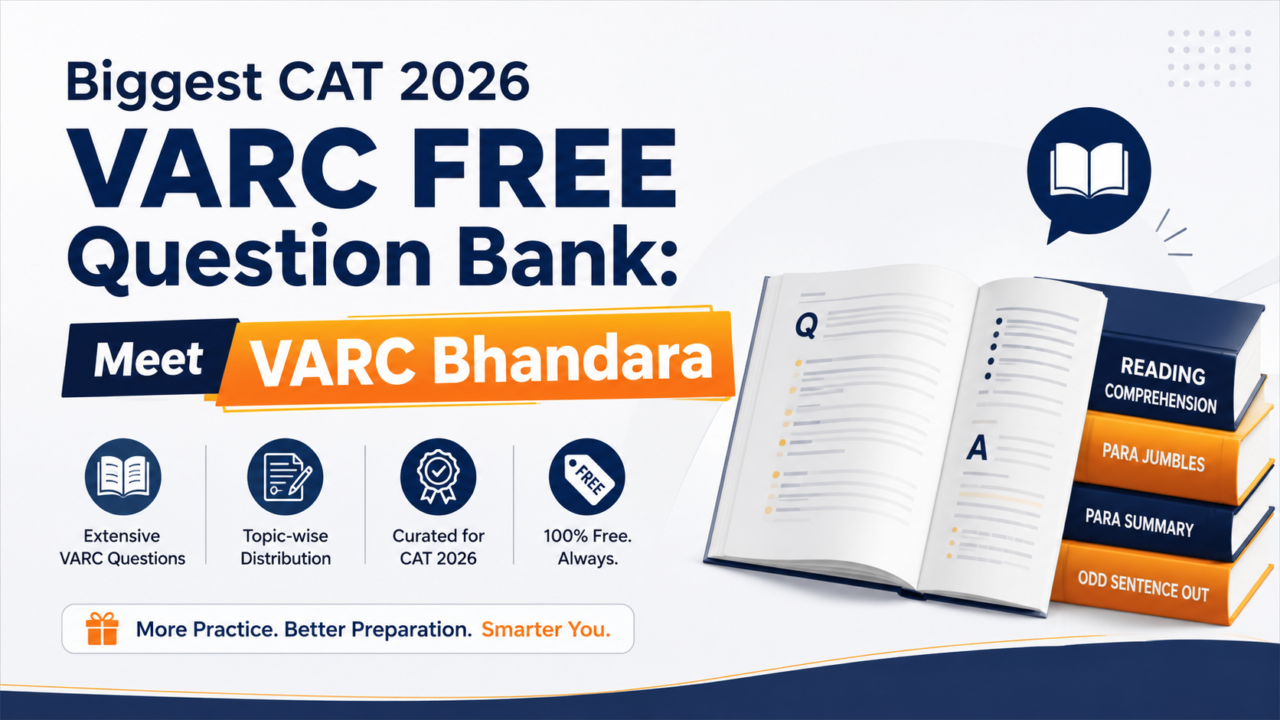
(2000 Verbal Ability Questions + 1000 Reading Comprehension Questions) only at https://www.catmock.com/bhandara/30
Introduction
Cracking CAT 2026 starts with one section that decides the fate of your final percentile — VARC. And now, aspirants finally get access to the biggest CAT 2026 VARC free question bank, built to remove every excuse standing between you and a 99-percentile VARC score. We call it VARC Bhandara — a complete, free, and ever-expanding treasury of 2000 Verbal Ability questions and 1000 Reading Comprehension passages, all mapped to the latest CAT exam pattern.
If you’ve been hunting for a single, reliable, no-signup, no-cost resource that actually covers the full VARC syllabus instead of offering a handful of sample questions, this article walks you through exactly what VARC Bhandara offers, how it’s structured, and how you can use it to transform your VARC preparation this season.
What Is VARC Bhandara?
VARC Bhandara is a free CAT 2026 VARC question bank that brings together 2000 Verbal Ability (VA) questions and 1000 Reading Comprehension (RC) passages under one roof. Instead of scattering your practice across ten different websites, you get a single, organized, topic-wise repository that mirrors the actual difficulty and variety of the CAT exam.
Every question in this bank has been curated to reflect current exam trends, and every passage has been selected to sharpen your comprehension, inference, and vocabulary skills simultaneously. Aspirants no longer need to compromise between quality and quantity — VARC Bhandara delivers both, completely free of cost.
Why CAT 2026 Aspirants Need a Free VARC Question Bank
VARC consistently trips up aspirants who are otherwise strong in Quant and DILR. The section rewards reading stamina, vocabulary depth, and logical sequencing — skills that only sharpen through repeated, varied practice. A narrow or shallow question bank simply cannot build that stamina.
Here’s why volume and variety matter so much for VARC specifically:
- Reading speed only improves with exposure. You cannot train your brain to process dense, abstract passages faster by reading twenty passages; you need hundreds.
- Para Jumbles and Para Summary questions test pattern recognition. The more variations you attempt, the faster you spot mandatory pairs and logical threads.
- Vocabulary-based questions demand constant reinforcement. A rotating question bank keeps your recall sharp instead of letting it fade between study sessions.
- RC genres vary widely, from philosophy and economics to science and literature, so a narrow set of passages leaves major blind spots.
This is precisely the gap that VARC Bhandara closes, offering enough depth that aspirants never run out of fresh, exam-relevant material.
The VARC Section Challenge in CAT
CAT’s VARC section typically allots limited time against a high question count, forcing aspirants to balance speed with accuracy. Without structured, high-volume practice, most candidates either run out of time on RCs or lose easy marks on Verbal Ability due to unfamiliarity with question types. VARC Bhandara directly addresses both problems by giving you enough repetitions to build true fluency, not just familiarity.
What’s Inside VARC Bhandara — Complete Breakdown
VARC Bhandara isn’t a random pile of questions; it’s organized so you can practice topic-wise, track your progress, and identify weak zones quickly.
VARC Bhandara — Overall Question Bank Structure
| Category | Total Questions | Format | Solutions Provided |
| Verbal Ability (VA) | 2000 | MCQ + TITA | Yes, detailed |
| Reading Comprehension (RC) | 1000 passages/sets | MCQ | Yes, detailed |
| Combined VARC Bank | 3000 | Mixed | Yes |
| Difficulty Levels Covered | Easy, Moderate, Difficult | — | Tagged individually |
This structure ensures aspirants can move from foundational practice to exam-level difficulty without switching platforms.
Verbal Ability Question Bank — 2000 Questions
The Verbal Ability portion of VARC Bhandara covers every question type that has appeared in CAT over recent years. Rather than clustering questions around one or two popular types, the bank distributes practice evenly so you build genuine command over the entire VA landscape.
Para Jumbles, Para Summary, and Odd Sentence Out
These three formats form the backbone of CAT’s non-RC VARC questions. Because they’re logic-driven rather than grammar-driven, they reward pattern practice more than memorization. VARC Bhandara offers enough repetitions across all three formats that identifying mandatory pairs, opening lines, and thematic threads becomes second nature.
Sentence Correction and Vocabulary-Based Questions
Grammar-heavy questions appear less frequently in recent CAT papers, but they still carry easy marks for well-prepared aspirants. VARC Bhandara includes a dedicated set of sentence correction and vocabulary questions so you never lose these low-hanging marks on exam day.
Verbal Ability Topic-Wise Distribution
| VA Topic | Approx. Question Count | Skill Tested |
| Para Jumbles | 550 | Logical sequencing |
| Para Summary | 500 | Central idea extraction |
| Odd Sentence Out | 400 | Thematic coherence |
| Sentence Correction | 300 | Grammar accuracy |
| Vocabulary & Usage | 250 | Word application |
Reading Comprehension Bank — 1000 Passages
Reading Comprehension carries the single largest weightage in VARC, and VARC Bhandara reflects that with 1000 curated passages spanning multiple genres, tones, and difficulty bands. Each passage is followed by exam-style questions that test inference, tone identification, main idea extraction, and factual accuracy — exactly what CAT demands.
Passage Genres Covered
Aspirants often underperform on RC not because they lack comprehension skills, but because they’ve never encountered a particular genre before. VARC Bhandara solves this by including passages from philosophy, economics, science, sociology, history, literature, and current affairs, so nothing on exam day feels unfamiliar.
RC Genre-Wise Passage Distribution
| Passage Genre | Approx. Passages | Focus Area |
| Economics & Business | 200 | Data-driven reasoning |
| Science & Technology | 200 | Technical comprehension |
| Philosophy & Abstract Ideas | 180 | Inference and tone |
| History & Culture | 170 | Contextual understanding |
| Sociology & Psychology | 150 | Argument evaluation |
| Literature & Arts | 100 | Narrative analysis |
How to Use VARC Bhandara for Maximum Score Improvement
Simply having access to a large question bank isn’t enough — aspirants improve fastest when they follow a structured plan. Below is a practical eight-week roadmap built specifically around VARC Bhandara’s structure.
Week VARC Bhandara Study Plan
| Week | Focus Area | Daily Target |
| 1–2 | Vocabulary + Sentence Correction | 20 VA questions/day |
| 3–4 | Para Jumbles + Odd Sentence Out | 25 VA questions/day |
| 5–6 | RC — Easy to Moderate Passages | 3–4 passages/day |
| 7 | RC — Difficult Passages + Timed Sets | 4–5 passages/day |
| 8 | Full-Length Mixed Practice | Mixed VA + RC sectional sets |
Following this plan converts VARC Bhandara from a static resource into an active preparation engine, ensuring every question you attempt builds toward exam-day readiness.
Key Features That Make VARC Bhandara Different
Several features set VARC Bhandara apart as a genuinely useful resource rather than a marketing gimmick:
- Massive, balanced volume — 2000 VA and 1000 RC questions ensure you never run out of fresh material.
- Completely free access — no hidden paywalls, no forced sign-ups blocking core content.
- Detailed solutions — every question includes a clear explanation so you learn the “why,” not just the “what.”
- Difficulty tagging — questions are labeled Easy, Moderate, or Difficult, letting you build progressively.
- Genre-diverse RC sets — passages span the exact range of topics CAT has historically tested.
- Structured organization — topic-wise segmentation lets you target weak areas directly instead of practicing randomly.
Benefits of Practicing With a Large-Scale Free Question Bank
Consistent, high-volume practice compounds quickly. Aspirants who use VARC Bhandara regularly typically notice several benefits within weeks.
Firstly, reading speed improves naturally because exposure to varied passages trains the brain to process unfamiliar structures faster. Secondly, accuracy on Para Jumbles and Para Summary sharpens because repeated exposure builds intuitive pattern recognition. Thirdly, vocabulary retention strengthens since questions recur in varied contexts, reinforcing memory far better than flashcards alone. Finally, exam-day confidence rises significantly, since nothing on the actual CAT paper feels genuinely unfamiliar after working through this bank.
Who Should Use VARC Bhandara
VARC Bhandara works equally well for three distinct groups of aspirants. First-time CAT takers benefit from its structured, topic-wise foundation. Repeaters targeting a specific weak area — whether RC speed or Para Jumbles accuracy — can drill that exact topic without wading through irrelevant material. And aspirants in their final revision phase can use the difficulty-tagged difficult sets to simulate real exam pressure before test day.
Sample Questions from VARC Bhandara — Try Them Now
To give you a real feel of what’s inside, here are a few sample questions in the exact style you’ll find across the 3000-question bank — four Verbal Ability questions and one Reading Comprehension passage with its question set.
Sample VA Question 1 — Para Jumble
Arrange sentences A, B, C, and D into a coherent paragraph.
- A. However, this growing reliance on convenience often comes at the cost of critical thinking.
- B. Search engines have transformed the way people access information in daily life.
- C. As a result, users increasingly accept the first answer they see without questioning its accuracy.
- D. Today, a person can retrieve an answer to almost any question within seconds.
Answer: B D A C
Sample VA Question 2 — Para Summary
Read the passage and choose the best summary.
“Economists have long debated whether happiness rises indefinitely with income or plateaus after a certain threshold. Recent studies suggest that while day-to-day emotional well-being does level off past a moderate income, overall life satisfaction continues to climb as earnings grow. This distinction implies that money influences how people evaluate their lives differently from how it affects their moment-to-moment mood.”
- 1. Money makes people happier in the short term but not the long term.
- 2. Income affects daily mood and long-term life satisfaction differently, with only the latter continuing to rise with earnings.
- 3. Economists agree that money has no effect on happiness.
- 4. Life satisfaction and daily mood are the same thing, both rising with income.
Answer: Option 2
Sample VA Question 3 — Odd Sentence Out
Identify the sentence that does not fit with the rest.
- 1. Urban farming has gained popularity as cities look for sustainable food sources.
- 2. Rooftop gardens and vertical farms now supply fresh produce to local markets.
- 3. Many city dwellers say gardening reduces their stress levels significantly.
- 4. Community-supported agriculture programs have also expanded within urban limits.
Answer: Sentence 3 (it shifts focus from urban food systems to personal well-being)
Sample VA Question 4 — Sentence Correction
Identify and correct the grammatical error.
Original: “Neither the manager nor the employees was informed about the change in policy.”
Corrected: “Neither the manager nor the employees were informed about the change in policy.” (The verb agrees with the noun closest to it — “employees” is plural, so “were” is correct.)
Sample VA Question 5 — Vocabulary Usage
Choose the word closest in meaning to “Ephemeral”:
- a) Everlasting
- b) Fleeting
- c) Robust
- d) Ancient
Answer: b) Fleeting
Sample RC Passage — With Question Set
For centuries, cartographers treated maps as neutral representations of physical space, mere mirrors of geography rendered onto paper. Yet historians of cartography now argue that maps have never been ideologically innocent. Every map involves selection: a cartographer decides what to include, what to omit, and how to scale relative importance. These choices, however unconscious, encode assumptions about power, ownership, and worth.
Consider the Mercator projection, still used in many classrooms today. While mathematically useful for navigation, it distorts the relative size of landmasses, enlarging regions near the poles and shrinking those near the equator. The practical consequence is that wealthier, temperate-zone nations appear disproportionately large, while much of the Global South appears smaller than its true landmass warrants. Few students realize that the map hanging in their classroom carries this quiet distortion.
Cartographic bias is not confined to projection choices. The very borders drawn on political maps often reflect colonial-era decisions rather than the lived realities of the people within them. Ethnic and linguistic communities have frequently been split across arbitrary lines, a legacy that continues to shape conflict and governance today.
Recognizing this bias does not mean abandoning maps altogether; it means reading them critically, the way one might read a persuasive essay rather than a neutral document. Alternative projections, such as the Gall-Peters projection, attempt to correct for size distortion, though they introduce distortions of shape instead. No projection, in fact, can perfectly preserve both shape and area simultaneously — a mathematical certainty rather than a cartographer’s failing.
The broader lesson extends beyond geography classrooms. Any tool that claims neutrality — whether a map, an algorithm, or a statistic — deserves scrutiny precisely because its apparent objectivity can obscure the choices embedded within it.
Q1. According to the passage, what is the primary criticism directed at the Mercator projection?
- a) It is mathematically inaccurate for navigation
- b) It exaggerates the size of regions near the poles while shrinking equatorial regions
- c) It was invented during the colonial era
- d) It fails to show political borders correctly
Answer: b
Q2. The author mentions the Gall-Peters projection primarily to:
- a) Prove that all projections are equally biased
- b) Show an alternative that solves distortion perfectly
- c) Illustrate that correcting one distortion often introduces another
- d) Argue that classrooms should stop using maps entirely
Answer: c
Q3. Which of the following best captures the author’s central argument?
- a) Maps are neutral tools that simply represent geography
- b) All cartographers intentionally manipulate maps for political gain
- c) Maps, like other seemingly objective tools, embed choices that deserve critical scrutiny
- d) The Mercator projection should be banned from schools
Answer: c
Q4. The tone of the passage can best be described as:
- a) Alarmist and accusatory
- b) Analytical and reflective
- c) Dismissive of cartography as a discipline
- d) Purely descriptive with no argument
Answer: b
Frequently Asked Questions
Q1. Is VARC Bhandara completely free to access?
Yes. VARC Bhandara is a fully free CAT 2026 VARC question bank, and every question and passage comes with a detailed solution at no cost.
Q2. How many questions does VARC Bhandara include in total?
VARC Bhandara includes 2000 Verbal Ability questions and 1000 Reading Comprehension passages, totaling 3000 practice items.
Q3. Is VARC Bhandara suitable for beginners?
Absolutely. Since questions are tagged by difficulty level, beginners can start with easy sets and progressively move toward moderate and difficult questions as their confidence builds.
Q4. Does VARC Bhandara cover the latest CAT exam pattern?
Yes. The question bank is regularly aligned with recent CAT trends, ensuring every question type and passage genre reflects what aspirants can expect in CAT 2026.
Q5. How should I structure my practice using VARC Bhandara?
We recommend a phased approach — starting with Verbal Ability fundamentals, then moving into Reading Comprehension, and finally combining both in timed, full-length sectional practice, as outlined in the 8-week plan above.
Q6. Can repeaters benefit from VARC Bhandara as much as first-time aspirants?
Yes. Repeaters can use the topic-wise segmentation to isolate and strengthen specific weak areas without repeating content they’ve already mastered.
Conclusion
VARC preparation rewards volume, variety, and consistency — and VARC Bhandara delivers all three without charging a single rupee. With 2000 Verbal Ability questions and 1000 Reading Comprehension passages organized by topic and difficulty, this genuinely is the biggest CAT 2026 VARC free question bank available to aspirants today. Start practicing consistently, follow a structured plan, and let volume work in your favor this CAT 2026 season.