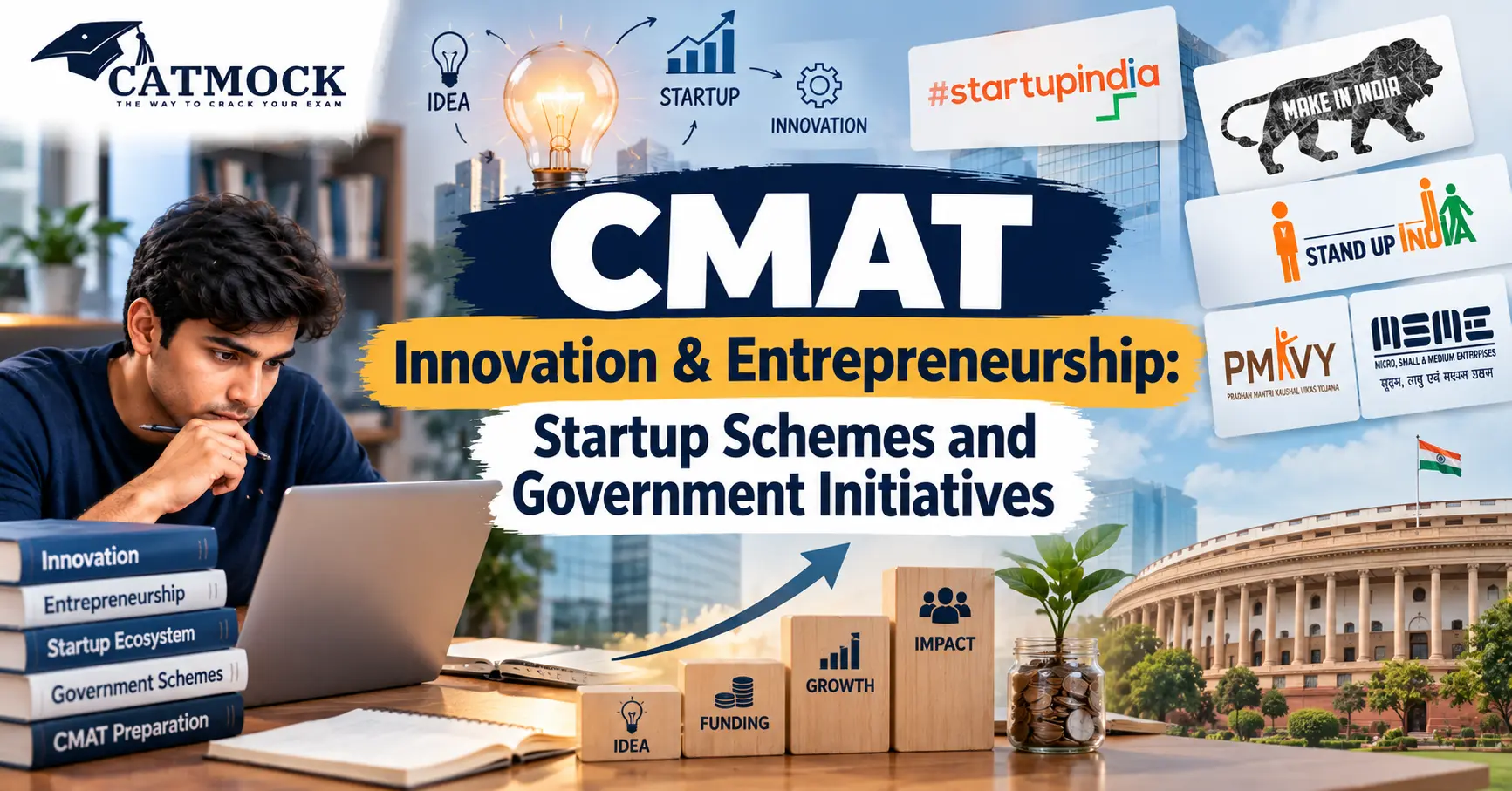
Most MBA entrance exams test your maths, logic and English. CMAT adds something different. It asks whether you understand how businesses are born, funded and supported. That is the purpose of the CMAT Innovation and Entrepreneurship section, and it is also one of the quickest places to pick up marks if you prepare in the right way.
The section carries a full fifth of the paper. It rewards candidates who know the startup schemes and government initiatives that shape India’s entrepreneurial landscape, and who can apply simple business thinking to scenario questions. This guide explains what to study, how each scheme works, how questions are framed, and how to build a revision plan that fits into your CMAT 2027 preparation.
Key Summary: What You Need to Know
- CMAT has five sections, and Innovation and Entrepreneurship (I&E) has 20 questions worth 80 marks, the same weight as Quant, Reasoning, Language and General Awareness.
- The section blends concept questions (types of innovation, lean startup, business models) with awareness questions (Startup India, Fund of Funds, MUDRA, Stand-Up India).
- The Startup India initiative, launched on 16 January 2016, is the backbone of most government startup support.
- Three flagship schemes under Startup India are Fund of Funds for Startups (FFS), Startup India Seed Fund Scheme (SISFS) and Credit Guarantee Scheme for Startups (CGSS).
- Scheme names, purposes and target groups matter more than memorising exact figures, but know the headline limits.
- A few weeks of focused revision can make this section a high-scoring one.
CMAT Exam Pattern and Where I&E Fits
Before diving into schemes, it helps to see how this section sits in the paper. CMAT is conducted by the National Testing Agency (NTA) for admission to MBA and PGDM programmes. CMAT 2027 is reported for 7 February 2027.
Table 1: CMAT Section-wise Structure (Current Pattern)
| Section | Questions | Marks |
|---|---|---|
| Quantitative Techniques and Data Interpretation | 20 | 80 |
| Logical Reasoning | 20 | 80 |
| Language Comprehension | 20 | 80 |
| General Awareness | 20 | 80 |
| Innovation and Entrepreneurship | 20 | 80 |
| Total | 100 | 400 |
Each correct answer carries four marks, and each wrong answer attracts a one-mark penalty. That ratio means a careful attempt beats a wild guess.
Why This Section Matters
The I&E section was introduced as an optional section in 2021 and became a regular part of the paper in 2022. Few other MBA exams include anything like it, so you cannot rely on generic aptitude prep. Treat it as a mix of business studies and current affairs. Because it overlaps with General Awareness, time invested here pays off twice.
Core Concepts You Must Know for CMAT Innovation and Entrepreneurship
Scheme knowledge sits on top of a few basic ideas. If you understand these, scenario questions become much easier.
Innovation: Types and Terms
Innovation means turning a new idea into something that creates value. Questions often test whether you can tell the types apart.
Table 2: Key Innovation and Entrepreneurship Concepts at a Glance
| Concept | Simple Meaning | Quick Example |
|---|---|---|
| Incremental Innovation | Small improvements to an existing product | A phone with a better camera |
| Radical Innovation | A major breakthrough, new to the market | The first smartphone |
| Disruptive Innovation | A simpler, cheaper offer that reshapes a market | Streaming replacing rental stores |
| Open Innovation | Using outside ideas and partners | Hackathons and partnerships |
| Lean Startup | Build, measure, learn in short cycles | Launching an early version and iterating |
| MVP (Minimum Viable Product) | The simplest version that tests an idea | A basic app with one core feature |
| Business Model | How a firm creates, delivers and earns value | Subscription, freemium or marketplace |
| Bootstrapping | Funding growth from personal savings and revenue | Founder self-funding the first year |
Entrepreneurship: The Basics
An entrepreneur starts and manages a venture and accepts the risk that comes with it. A startup is generally a young company built around a scalable idea. In India, government support is tied to formal recognition, which leads us to the next section. Also revise intellectual property basics (patents, trademarks, copyrights), types of funding (angel, venture capital, crowdfunding), and social entrepreneurship, since all appear in practice papers.
Startup India: The Foundation of Government Support
When CMAT asks about government initiatives, Startup India is the most important name. It was launched on 16 January 2016 to build a strong ecosystem for nurturing innovation and encouraging investment in startups. It is managed by the Department for Promotion of Industry and Internal Trade (DPIIT).
What DPIIT Recognition Means
A company that meets the official definition of a startup can apply for DPIIT recognition on the Startup India portal. Recognition is often the gateway to other benefits, such as tax exemptions for eligible startups, easier compliance and access to funding schemes. For exam purposes, remember the sequence: recognition first, scheme benefits next.
The Three Flagship Funding Schemes
Under Startup India, the government implements three flagship schemes that support startups at different stages of their life cycle. These are the Fund of Funds for Startups (FFS), the Startup India Seed Fund Scheme (SISFS) and the Credit Guarantee Scheme for Startups (CGSS). The table below summarises them along with other popular initiatives. Always check current limits on official sites, as ceilings are revised from time to time.
Table 3: Major Government Startup Schemes and Initiatives
| Scheme | Main Purpose | Who Benefits | Key Point to Remember |
|---|---|---|---|
| Startup India | Ecosystem building, recognition, easier compliance | Recognised startups | Launched 16 January 2016 |
| Fund of Funds for Startups (FFS) | Equity support through venture funds | Startups funded by SEBI-registered AIFs | Run through SIDBI; invests in funds, not directly in startups |
| Startup India Seed Fund Scheme (SISFS) | Seed funding via incubators | Early-stage startups | Started 1 April 2021; grants and convertible instruments |
| Credit Guarantee Scheme for Startups (CGSS) | Collateral-free loans through guarantees | Startup borrowers | Run through NCGTC; ceiling reportedly raised in 2025 |
| Pradhan Mantri MUDRA Yojana | Small business loans | Micro and small enterprises | Shishu, Kishore, Tarun categories |
| Stand-Up India | Loans for women and SC/ST entrepreneurs | New (greenfield) enterprises | Loans from ₹10 lakh to ₹1 crore |
| Atal Innovation Mission (AIM) | Innovation culture in schools and incubation | Students, startups | Atal Tinkering Labs and Atal Incubation Centres |
| PMEGP | Subsidy-linked self-employment | First-time entrepreneurs | Credit-linked subsidy for new units |
Understanding Each Scheme in Simple Terms
Fund of Funds for Startups (FFS)
The government does not hand money to startups directly through FFS. Instead, it commits capital to SEBI-registered Alternative Investment Funds (AIFs), which then invest in startups. Official statements describe a condition that these funds must invest at least twice the FFS commitment into startups. This multiplies the money that reaches founders.
A newer tranche, often referred to as FFS 2.0, has been reported with a corpus of ₹10,000 crore notified in April 2026. Treat this as a current-affairs point and confirm the details on the SIDBI website.
Exam angle: A common trap is to say FFS invests directly in startups. It does not. It invests in funds.
Startup India Seed Fund Scheme (SISFS)
SISFS provides financial help to seed-stage startups through incubators. The scheme has been implemented since 1 April 2021. Broadly, it supports proof of concept, prototype development and product trials through grants, and supports market entry and scaling through convertible debentures or similar instruments. Reported ceilings are about ₹20 lakh for validation and about ₹50 lakh for investment support, but check the portal for current rules.
Exam angle: Remember the word incubators. Money flows through them to selected startups.
Credit Guarantee Scheme for Startups (CGSS)
CGSS lets eligible lenders give collateral-free loans to startups, with a government-backed guarantee covering part of the risk. It is operated through the National Credit Guarantee Trustee Company (NCGTC). Secondary sources report that the guarantee ceiling per borrower was doubled to ₹20 crore in 2025. Verify this before quoting it in any formal content.
Exam angle: The keyword is guarantee. It reduces the lender’s risk and the startup’s need for collateral.
Pradhan Mantri MUDRA Yojana (PMMY)
MUDRA supports micro and small businesses with loans in three bands, named Shishu (smallest), Kishore (middle) and Tarun (largest). Shishu loans go up to ₹50,000. Loans under MUDRA are collateral-free, and DPIIT recognition is not required, so it serves small traders and service providers as well as startups.
Exam angle: Remember the order Shishu, Kishore, Tarun as child, adolescent and young adult, rising in loan size.
Stand-Up India
Stand-Up India encourages entrepreneurship among women and Scheduled Caste/Scheduled Tribe borrowers. It offers composite loans between ₹10 lakh and ₹1 crore for setting up a new enterprise in manufacturing, services or trading.
Exam angle: Look for the words greenfield, women and SC/ST.
Atal Innovation Mission (AIM)
AIM, run under NITI Aayog, builds an innovation culture through Atal Tinkering Labs in schools and Atal Incubation Centres for startups. It focuses on creativity among young people and on incubation support.
Other Initiatives Worth a Quick Revision
Also revise the Skill India Mission, the Venture Capital Assistance Scheme, state startup policies, and technology business incubator schemes. Several states run their own startup missions, and exam questions sometimes ask about the role of central versus state governments in promoting entrepreneurship.
How Government Schemes Map to the Startup Journey
Questions are easier when you picture a founder’s journey. Think of support as a staircase that rises with the business.
- Idea stage: Atal Tinkering Labs, incubators and AIM nurture the idea.
- Recognition: DPIIT recognition under Startup India opens the door.
- Seed stage: SISFS provides early funds through incubators.
- Growth stage: Fund of Funds routes equity capital through venture funds.
- Debt needs: CGSS and MUDRA support loans without heavy collateral.
- Inclusion: Stand-Up India supports women and SC/ST founders.
When a question describes a founder’s situation, match it to the stage. This approach is faster and more reliable than raw memorisation.
How CMAT Questions on This Topic Are Framed
Based on common practice-paper patterns, expect these formats:
- Direct recall: “Which scheme provides collateral-free credit to startups?”
- Match the following: Scheme names matched with their purpose or target group.
- Assertion and reason: A statement about innovation or funding, followed by a reason to evaluate.
- Scenario-based: A short business situation with a question on the best decision.
- Passage-based: A paragraph on innovation or entrepreneurship, followed by comprehension questions.
For scenario questions, think like a founder with limited money and high uncertainty. Options that test an idea cheaply (such as an MVP) usually beat options that need heavy upfront spending.
Common Traps to Avoid
- Confusing incubator-based seed funding (SISFS) with fund-based equity (FFS)
- Mixing up MUDRA (small business loans) with Stand-Up India (women and SC/ST focus)
- Assuming every scheme needs DPIIT recognition, when MUDRA does not
- Treating “innovation” and “invention” as the same thing
- Memorising old loan limits without checking whether they have changed
A Four-Week Study Plan for CMAT Innovation and Entrepreneurship
You do not need months for this section. A short, focused plan can work well alongside your other preparation.
Table 4: Four-Week Revision Plan
| Week | Focus | Tasks |
|---|---|---|
| Week 1 | Core concepts | Types of innovation, lean startup, business models, funding types |
| Week 2 | Government schemes | Startup India, FFS, SISFS, CGSS, MUDRA, Stand-Up India, AIM |
| Week 3 | Practice | Topic-wise questions, match-the-following sets, assertion-reason drills |
| Week 4 | Revision and mocks | Error log, current-affairs update, full CMAT mocks with timing |
Practical Preparation Tips
- Make a one-page scheme sheet. Write the scheme name, purpose, target group and one memory hook for each.
- Follow startup news weekly. Budget announcements and new fund tranches can appear as GA or I&E questions.
- Read business case summaries. Short stories about Indian startups help with scenario questions.
- Practise elimination. With a −1 penalty, remove clearly wrong options before guessing.
- Link with General Awareness. Revise economy and budget updates in the same sitting.
- Use previous papers. This section has few equivalents in other exams, so past CMAT papers are your best practice material.
How I&E Knowledge Helps Beyond the Exam
This topic is useful after the exam too. Many CMAT-accepting B-schools run incubation cells and entrepreneurship programmes, and interviewers sometimes ask about startups and policy. Understanding the funding ecosystem gives you real material for group discussions and personal interviews. If you plan to start a venture after your MBA, these schemes become a practical toolkit, not just exam facts.
Summary
The CMAT Innovation and Entrepreneurship section tests whether you understand how ideas become businesses and how the government helps them grow. It has 20 questions worth 80 marks, the same weight as every other section. Master the basic concepts (types of innovation, lean startup, MVP, business models), then learn the major schemes: Startup India, Fund of Funds, SISFS, CGSS, MUDRA, Stand-Up India and Atal Innovation Mission. Match each scheme to its purpose and target group, and picture the startup journey from idea to growth. Practise scenario and assertion-reason questions, avoid common traps, and verify current limits on official websites.
Frequently Asked Questions (FAQs)
1. How many questions come from Innovation and Entrepreneurship in CMAT?
The section has 20 questions worth 80 marks, which is one fifth of the 100-question paper.
2. Is the Innovation and Entrepreneurship section compulsory in CMAT?
It was introduced as optional in 2021 and became part of the regular paper from 2022. Check the latest NTA information bulletin for CMAT 2027.
3. Which government schemes are most important for CMAT?
Startup India, Fund of Funds for Startups, Startup India Seed Fund Scheme, Credit Guarantee Scheme for Startups, MUDRA, Stand-Up India and Atal Innovation Mission are the key ones.
4. Do I need to remember exact loan limits and amounts?
Know the headline figures for the main schemes, but focus more on purpose, target group and how each scheme works. Limits are revised from time to time, so verify them on official sites.
5. How is the Fund of Funds different from the Seed Fund Scheme?
The Fund of Funds invests in SEBI-registered venture funds, which then invest in startups. The Seed Fund Scheme gives early-stage support to startups through selected incubators.
6. How can I prepare this section quickly?
Spend a week on concepts, a week on schemes, a week on practice questions and a week on revision with mocks. A one-page scheme sheet and weekly startup news updates help a lot.
Conclusion
The CMAT Innovation and Entrepreneurship section rewards clear thinking and steady revision more than heavy study. Learn the core ideas, understand how each government scheme fits into a founder’s journey, and practise the question styles that appear in the paper. Keep an eye on official updates from NTA, Startup India, SIDBI and MUDRA, because figures and notifications change. With a structured plan, this section can become one of the most reliable scoring areas in your paper.
You May Also Like : CAT MOCK, CAT MOCK PYQ
Follow Us On : Facebook, Instagram, Youtube