

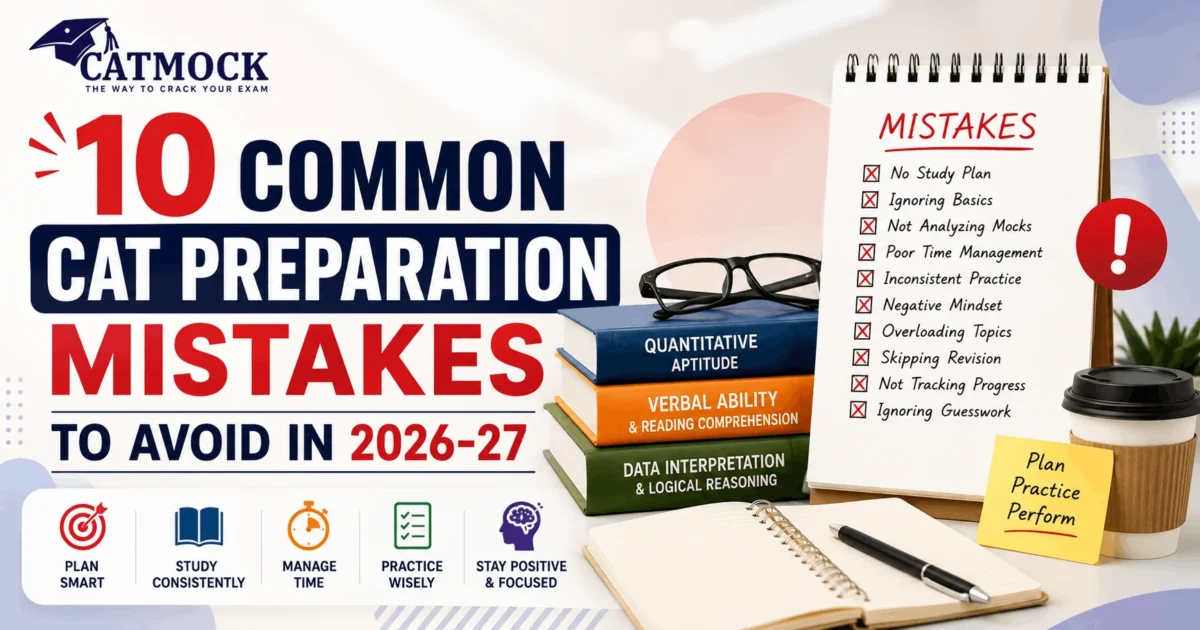
Every year, over 2.5 lakh candidates register for the Common Admission Test, yet only a small fraction crack the 99+ percentile mark that top IIMs demand. The gap rarely comes down to intelligence or hard work — it comes down to how that effort is spent. Most aspirants who fall short aren’t lacking ability; they’re repeating the same avoidable errors that quietly derail months of preparation, and these errors rarely feel like mistakes while you’re making them — a plateaued score weeks later is usually the first sign.
If you’re gearing up for CAT 2026 or CAT 2027, this guide breaks down the 10 most common CAT preparation mistakes candidates make, and exactly how to fix each one, so you can build a genuinely effective CAT preparation strategy for the year ahead. You can check the exact registration and exam-day details for this cycle on the official CAT website (iimcat.ac.in), which remains the only authoritative source for dates, eligibility, and admit card updates. Below, we’ve broken down each mistake with practical, actionable fixes you can start applying this week. a full preparation cycle, rather than after. Below, we’ve broken down each mistake with practical, actionable fixes you can start applying this week.
1. Starting Preparation Without a Diagnostic Test
One of the most common CAT mistakes is diving straight into study material — books, video lectures, question banks — without first understanding your baseline. Without a diagnostic test, you’re studying blind, spending equal time on topics you’ve already mastered and ones you desperately need to work on.
The Fix: Take a full-length diagnostic mock in your very first week. You can attempt a free CAT mock test to get an accurate baseline across VARC, DILR, and QA. Use the result to map your strengths and weaknesses — this single step reshapes your entire CAT preparation strategy around real data instead of guesswork.
2. Ignoring Mock Test Analysis
Taking mocks without a structured review process is arguably the single biggest reason candidates plateau. Many aspirants take 20-30 mocks yet see almost no percentile improvement, simply because they never analyze why they got questions wrong.
The Fix: Spend at least twice as long analyzing a mock as you spent taking it. Categorize errors into three buckets: conceptual gaps, silly mistakes, and time-management errors.
Common Mock Analysis Errors
| Mistake | Impact on Score | Correction |
|---|---|---|
| Only checking the final score | No insight into error patterns | Review the question-by-question breakdown |
| Skipping review of correctly-answered questions | Missed faster methods | Check if a quicker approach existed |
| Not tracking time per question | Poor time allocation persists | Log time spent per section and question type |
| Re-attempting mocks without a gap | False sense of improvement | Space mocks 3-4 days apart, with analysis in between |
3. Neglecting Reading Comprehension and Vocabulary Building
Many quant-heavy aspirants treat VARC as an afterthought, assuming their existing reading speed will suffice. This is one of the costliest mistakes to avoid in CAT preparation, since VARC often decides sectional cutoffs at top IIMs.
The Fix: Read editorials, opinion pieces, and long-form articles daily from varied sources — economics, philosophy, science, and abstract topics included. Build the habit of summarizing paragraphs in your own words to strengthen comprehension speed and inference skills.
4. Over-Relying on Shortcuts Without Conceptual Clarity
Shortcuts and tricks are useful, but only once the underlying concept is solid. Aspirants who memorize formulas without understanding their derivation often freeze when CAT presents a twisted, non-standard version of a familiar question.
The Fix: Build concepts from the ground up — especially in Arithmetic, Algebra, and Modern Math — before layering shortcuts on top. Practicing against previous years’ CAT question papers is one of the fastest ways to see how concepts actually get twisted in the real exam, so shortcuts don’t collapse the moment the format changes.
5. Poor Time Management During Preparation and in the Exam
Time mismanagement shows up in two forms: an unstructured daily study routine, and poor sectional time allocation during the actual exam. Both are among the most common CAT mistakes flagged by past toppers.
The Fix: Build a weekly study timetable with fixed slots for each section, and simulate exact exam-day timing (40 minutes per section) in every mock from month two onward.
Ideal Weekly Time Allocation (Sample)
| Activity | Hours/Week (Working Professionals) | Hours/Week (Full-Time Students) |
|---|---|---|
| Concept Building | 6-8 hrs | 10-12 hrs |
| Practice Sets | 5-7 hrs | 8-10 hrs |
| Mock Tests + Analysis | 4-6 hrs | 6-8 hrs |
| Revision | 3-4 hrs | 5-6 hrs |
6. Studying Everything Instead of Focusing on High-Yield Topics
Not all topics carry equal weight in the CAT exam. Aspirants who try to master every topic equally often run out of time before exam day, leaving high-frequency areas under-practiced.
The Fix: Prioritize topics based on historical frequency and your own accuracy data. Arithmetic, Reading Comprehension, and Data Interpretation caselets typically deliver the highest returns on preparation time. If DILR consistently drags down your score, a focused resource like this guide on improving DILR for CAT can help you build a set-selection strategy instead of attempting sets in random order.
High-Yield vs Low-Yield Topic Focus
| Section | High-Yield Topics | Lower-Frequency Topics |
|---|---|---|
| QA | Arithmetic, Algebra, Numbers | Geometry (advanced), Trigonometry |
| DILR | Data Caselets, Puzzles, Seating Arrangement | Advanced Set Theory Puzzles |
| VARC | Reading Comprehension, Para Summary | Grammar-based questions (rare in CAT) |
7. Comparing Progress with Others Instead of Tracking Personal Growth
Social media and coaching WhatsApp groups are full of candidates claiming 99+ percentile mocks. Constantly comparing your scores to others is a mental trap that fuels anxiety and distracts from your own improvement curve — a mistake that has little to do with academics and everything to do with mindset.
The Fix: Maintain a personal mock-score tracker and measure progress against your own baseline, not anonymous internet claims. Percentile inflation on forums is common and rarely verifiable.
8. Delaying Revision Until the Last Month
Cramming months of concepts into the final few weeks before the exam is a recipe for burnout and shallow recall. Revision should be a continuous, layered process — not a last-minute scramble.
The Fix: Adopt a spaced revision system: revisit each topic at 1 week, 1 month, and 3 months after first learning it. This cements long-term retention far better than a single intensive revision phase. If you’re preparing largely on your own, this self-study guide for cracking CAT without coaching lays out a realistic weekly rhythm that folds revision in rather than treating it as an afterthought.
9. Ignoring Sectional Cutoffs and Overall IIM Selection Criteria
Some aspirants focus purely on overall percentile while ignoring that top IIMs enforce strict sectional cutoffs. A lopsided preparation — excelling in QA while neglecting VARC or DILR — can tank your overall composite score even with a high total percentile.
The Fix: Research each target IIM’s selection criteria (CAT percentile weightage, academic profile, work experience, and personal interview weightage) early, and calibrate your section-wise targets accordingly. A candidate scoring 99 overall but 65 in DILR can still miss the shortlist at institutes with strict sectional cutoffs, while a more balanced 96-97 percentile profile across all three sections often converts better. This is why chasing a single “target percentile” number is misleading — you need three targets, not one.
Sample Section-wise Target Percentile (For Top IIM Aspirants)
| Section | Target Percentile |
|---|---|
| VARC | 90+ |
| DILR | 90+ |
| QA | 90+ |
| Overall | 99+ |
10. Not Simulating Real Exam Conditions Before the Actual CAT
Practicing in a relaxed home environment with breaks, snacks, and no time pressure creates a false sense of readiness. Come exam day, the unfamiliar test-center environment, strict proctoring, and psychological pressure can throw off even well-prepared candidates.
The Fix: From the last two months before the exam, take every mock exactly as you would take the real CAT — same time of day, no pauses, and a proper 3-hour block with zero interruptions. A structured full-length CAT test series that mirrors the actual interface and difficulty level makes this simulation far more realistic than solving questions from a book.
A Quick Action Plan for the Weeks Ahead
If you only take one thing away from this guide, let it be this: sequence matters as much as effort. In the first two weeks, take a diagnostic mock and build a topic-wise priority list based on the results. Over the following two to three months, alternate between concept-building and timed practice, while keeping a running revision cycle in the background rather than pushing it to the end. In the final two months, shift the balance heavily toward full-length mocks under real exam conditions, with detailed analysis after every single attempt. Treat each of the ten mistakes above as a checkpoint — if you catch yourself repeating one, course-correct immediately rather than waiting for the next mock to “prove” it’s a problem.
Key Takeaways: CAT Preparation Mistakes to Avoid in 2026-27
- Always begin with a diagnostic test before committing to a study plan.
- Treat mock analysis as more important than the mock itself.
- Don’t neglect VARC in favor of QA or DILR.
- Build conceptual clarity before relying on shortcuts.
- Structure your time — both weekly study hours and in-exam sectional timing.
- Focus on high-yield topics rather than spreading effort too thin.
- Track your own growth instead of comparing with others online.
- Revise continuously, not just in the final month.
- Understand sectional cutoffs for your target IIMs.
- Simulate real exam-day conditions in your final two months of mocks.
Avoiding these common CAT mistakes won’t guarantee a 100 percentile, but it removes the self-inflicted obstacles that hold back thousands of otherwise capable candidates every year.
Frequently Asked Questions
1. What is the biggest mistake CAT aspirants make in their preparation?
The most common CAT preparation mistake is taking mock tests without a structured analysis process. Scoring well on mocks means little if you don’t understand the specific reasons behind each wrong or slow answer, since that analysis is what actually drives percentile improvement.
2. How many mock tests should I take for CAT 2026 or CAT 2027?
Most successful candidates take between 25 and 35 full-length mocks over their preparation window, spaced 3-4 days apart to allow sufficient time for detailed analysis. Quality of analysis matters far more than the sheer number of mocks attempted.
3. Is it possible to crack CAT with only 3-4 months of preparation?
Yes, a focused 3-4 month preparation plan can work well, especially for candidates with a strong academic foundation, provided they prioritize high-yield topics, take regular mocks from week one, and avoid scattering effort across low-frequency areas.
4. How important is Reading Comprehension for a good CAT percentile?
Reading Comprehension typically makes up a significant portion of the VARC section and directly affects your sectional cutoff at top IIMs. Neglecting daily reading practice is one of the most common mistakes to avoid in CAT preparation, since RC skills take months, not weeks, to build.
5. Should working professionals prepare differently for CAT compared to full-time students?
Working professionals generally have less daily study time and should prioritize a leaner, high-yield topic list along with weekend-heavy mock practice, while full-time students can afford a broader concept-building phase. Both groups benefit equally from consistent mock analysis and spaced revision.
Conclusion: Turn These Mistakes Into Your Advantage
The difference between an average CAT score and a top percentile often isn’t raw talent — it’s the discipline to avoid these ten recurring mistakes. Start with a diagnostic test, build a mock-analysis habit early, and structure your preparation around high-yield topics and real exam conditions. Put these fixes into practice consistently over the coming months, and you’ll be building a CAT preparation strategy for 2026-27 that’s designed to actually move your percentile — not just your study hours.
Ready to put this into action? Take a free CAT mock test on CATMock and get a personalized breakdown of your strengths and weak areas today.
You May Also Like : CATMOCK / CATMOCK PYQ
Follow Us On : Facebook / Instagram