Viral Leading Challenge: Everything you need to know
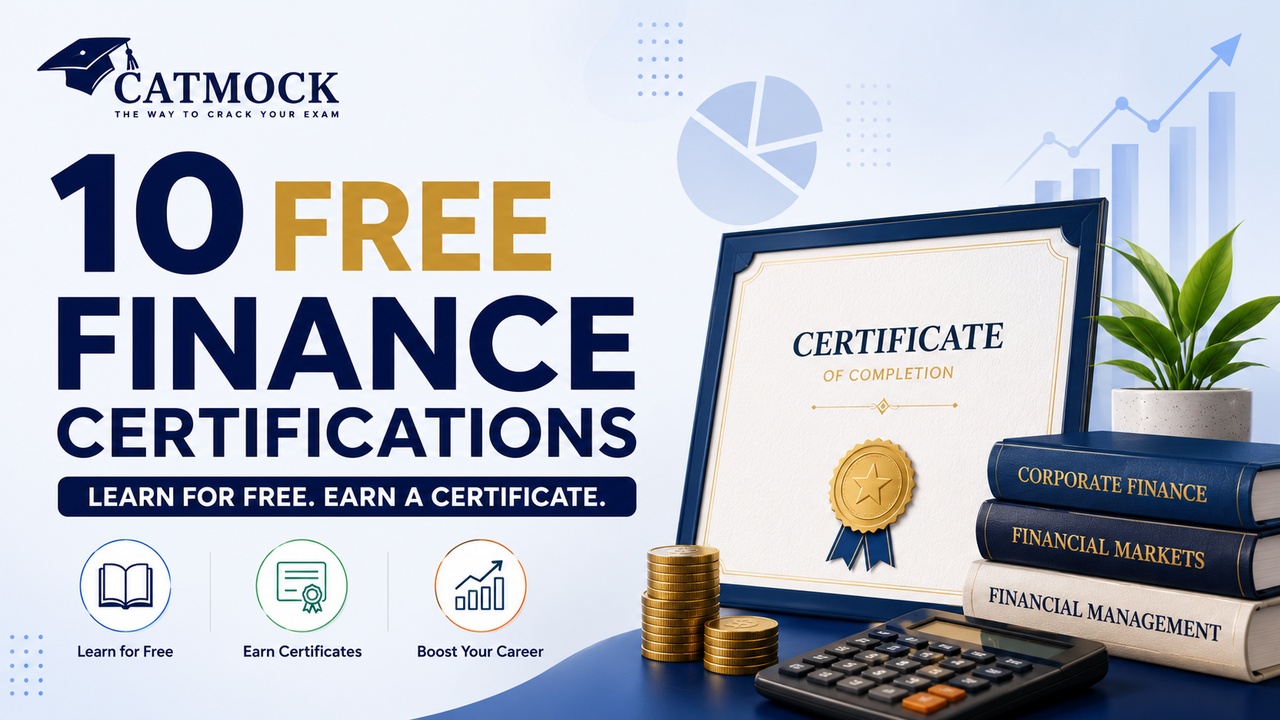
If you’ve come across a graphic listing “10 free finance certifications” from Coursera, Great Learning, and Alison, here’s the honest version of that list. All ten courses below are genuinely free to learn from — you can watch every lecture, work through every module, and pick up real finance fundamentals without paying a rupee. But “free to learn” and “free certificate” aren’t always the same thing, and the two platforms behave very differently on that front. Coursera lets you study for free but generally charges for the certificate at the end (with a financial-aid workaround). Alison’s course itself is free, but the official Diploma is a paid add-on. Great Learning Academy is the one platform here that hands out a genuinely free certificate of completion, no strings attached.
Below is a course-by-course breakdown of what each one actually covers, who teaches it, how long it takes, and — most importantly — what you’ll need to pay if you want a certificate at the end.
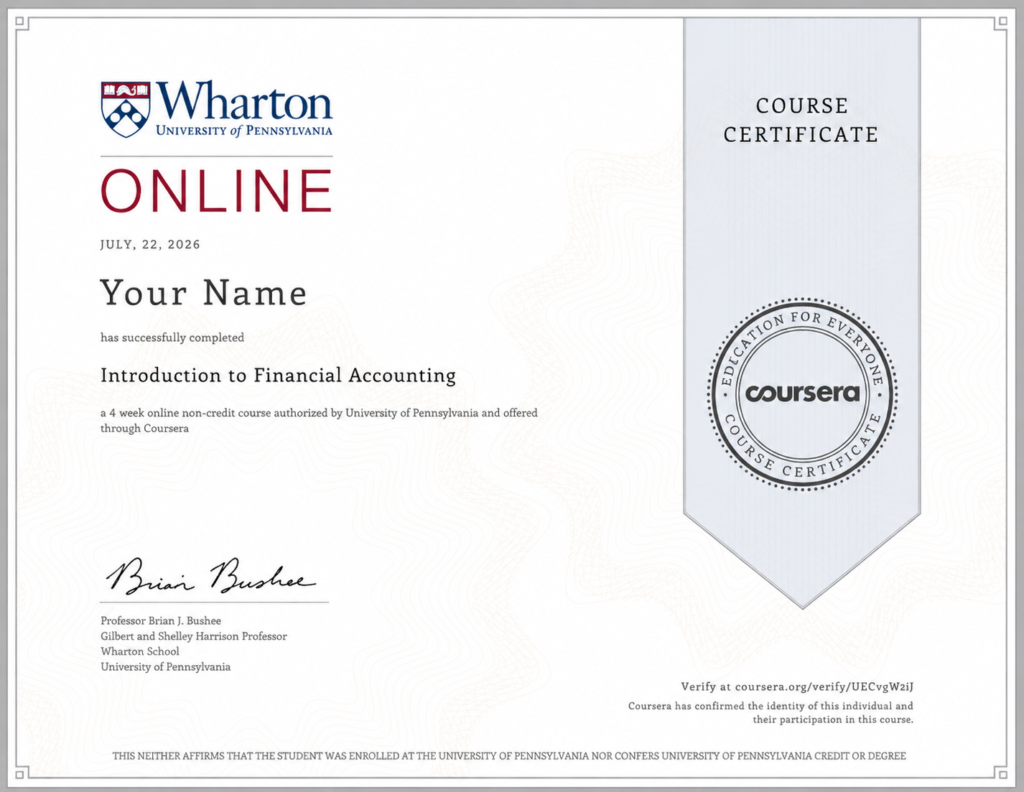
1. Introduction to Finance and Accounting (Coursera — Wharton)
This is a four-course specialization from the University of Pennsylvania’s Wharton School, covering everything from the time value of money and net present value (NPV) to reading a balance sheet, income statement, and cash flow statement. It opens with corporate finance basics—compounding, risk-return tradeoffs, retirement savings, and mortgage financing—before moving into financial accounting, where you learn to interpret the three core financial statements. The specialization is Excel-first, with a hands-on spreadsheet component running through the coursework. Coursera estimates most learners need around six months at a relaxed pace, though the material itself totals roughly 56 hours of content across the four individual courses.
You can audit or watch the entire specialization for free, but earning the shareable Wharton certificate requires paying for the course. If the fee is a barrier, financial aid is available on the enrollment page.
Explore Introduction to Finance and Accounting
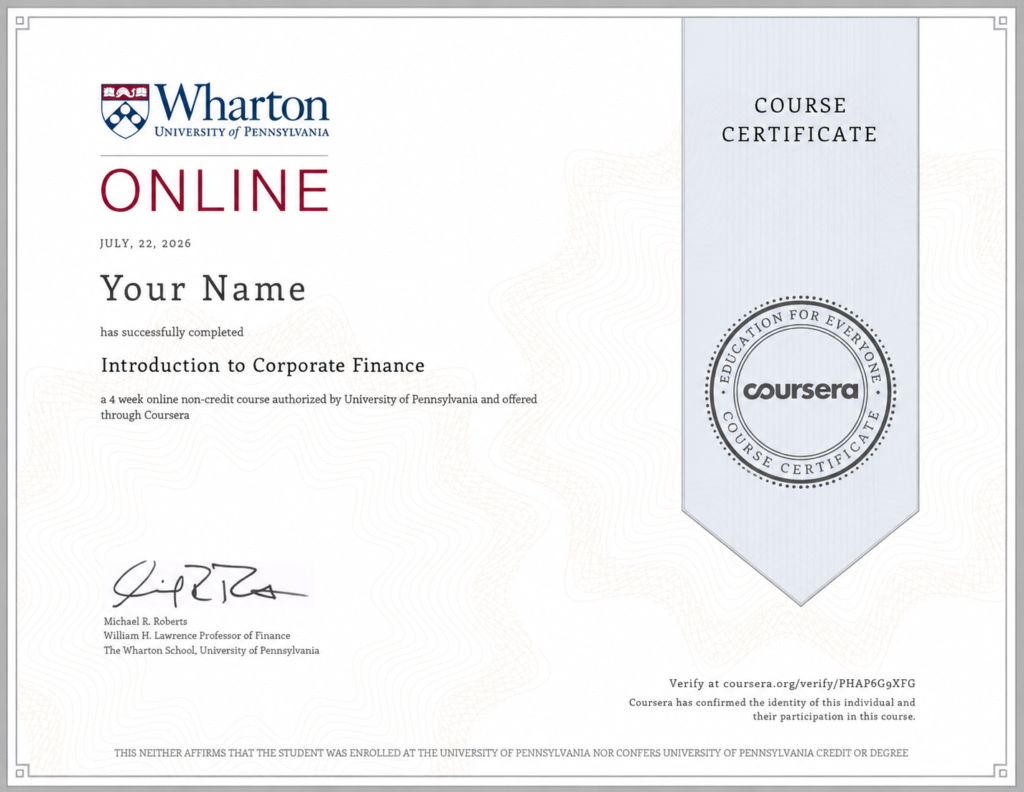
2. Introduction to Corporate Finance (Coursera — Wharton)
This course sits inside the specialization above, but it’s popular enough as a standalone pick to cover separately. Built around Wharton’s pre-term MBA refresher material, it covers time value of money, cost of capital, capital budgeting, discounted cash flow (DCF) analysis, net present value (NPV), internal rate of return (IRR), payback period, and hurdle rates—essentially the toolkit needed to evaluate whether a company should take on a given project. It runs about 9 hours of content and leans on real-world scenarios like auto leasing and mortgage financing to keep the math grounded rather than abstract.
The same certificate rule applies: free to audit, but you’ll need to pay (or apply for financial aid) to unlock the graded assignments and the certificate.
Explore Introduction to Corporate Finance
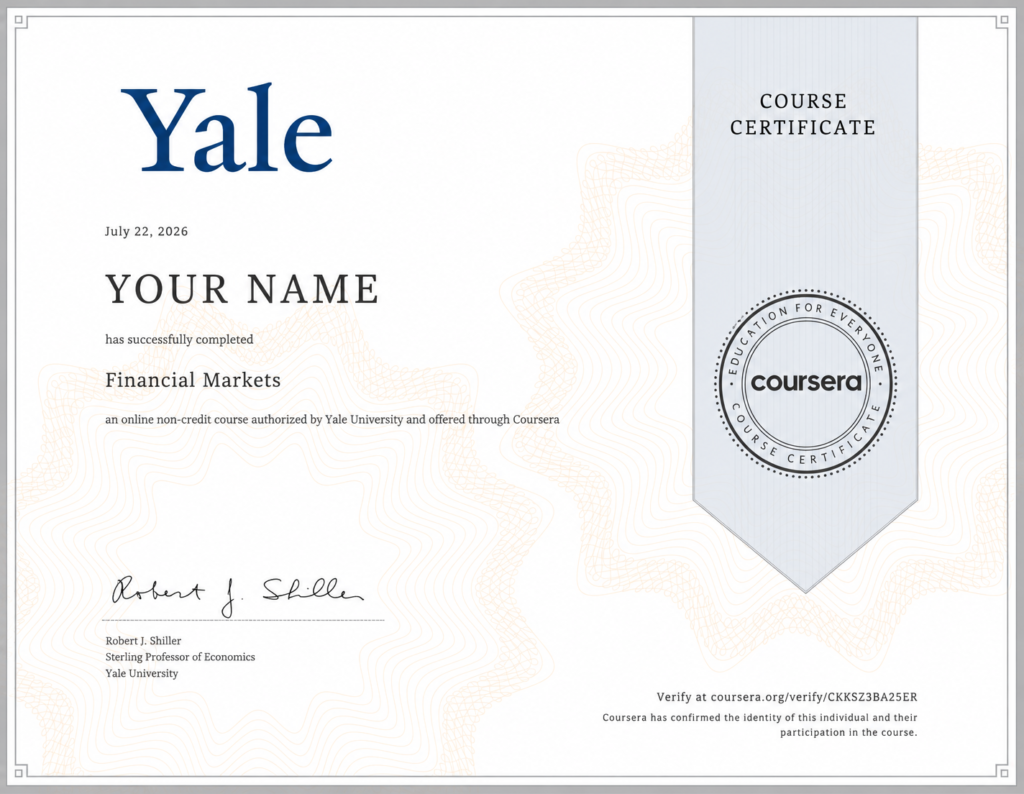
3. Financial Markets (Coursera — Yale University)
Taught by Nobel laureate Robert Shiller, this is one of Coursera’s most-reviewed finance courses, with over 2.4 million learners enrolled and a 4.8 rating across more than 32,000 reviews. It’s a genuinely broad tour of the financial system: risk management, behavioral finance, insurance, the 2008 financial crisis and its regulatory aftermath, stocks, bonds, derivatives, and the role of investment banks. Structured across seven modules with roughly 29 hours of video lectures, quizzes, and guest interviews with senior industry figures, it plays out closer to a full semester course than a quick primer.
You can preview the first module for free and watch the rest without earning credit; the certificate itself is a paid purchase, with financial aid available as an alternative.
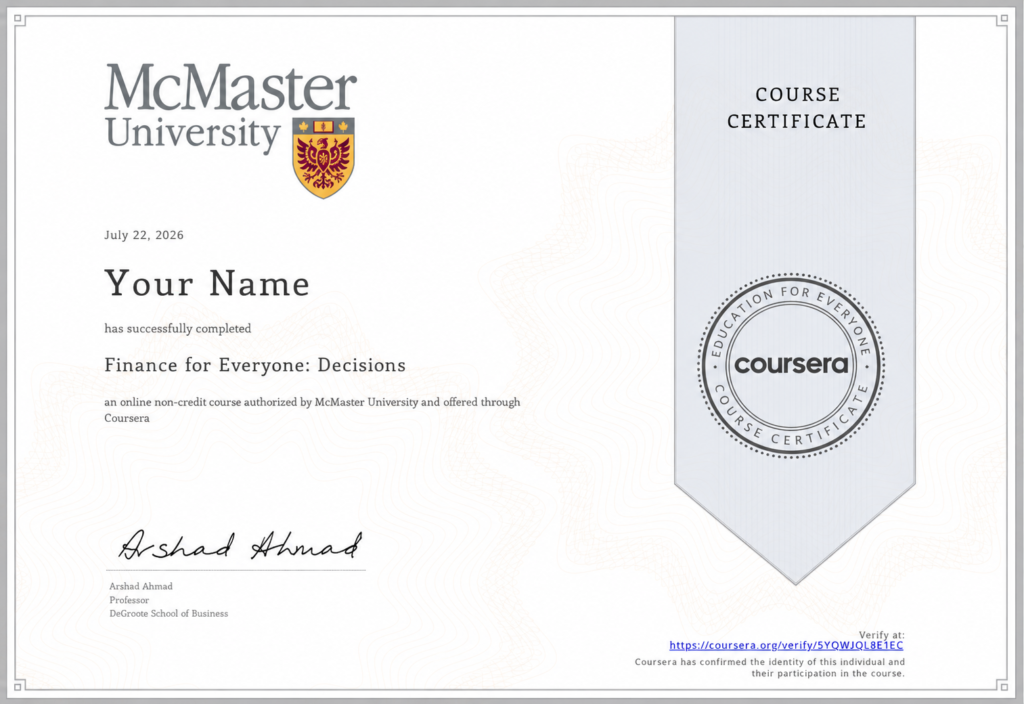
4. Finance for Everyone: Decisions (Coursera — McMaster University)
This course is built for people with no finance background who still need to make real financial decisions in their own lives — compounding, discounting, annuities, and effective interest rates, applied to things like car loans and housing. It’s the first course in McMaster’s “Finance for Everyone” specialization and includes a peer-reviewed op-ed assignment where you apply what you’ve learned to an issue you care about, a nice departure from the usual quiz-only format most MOOCs default to. It’s structured as a 4-week course at roughly 10 hours a week, though the core video content is considerably shorter.
Free to audit, paid certificate (with financial aid available), same as the rest of Coursera’s catalog.
Explore Finance for Everyone: Decisions
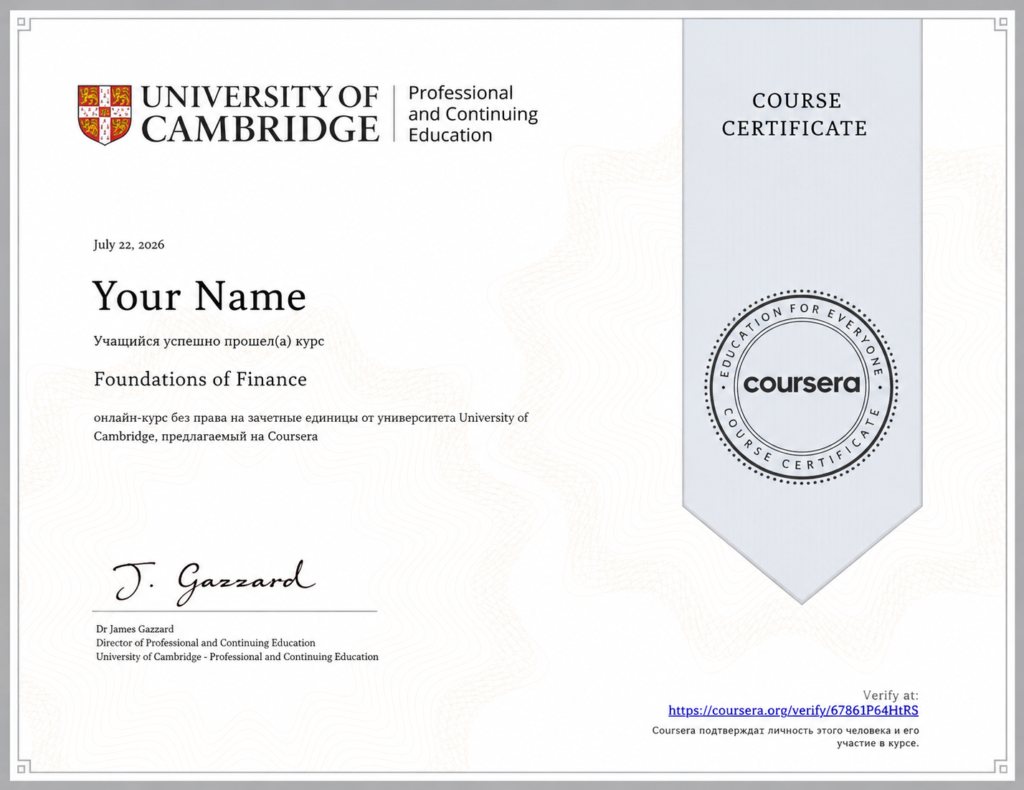
5. Foundations of Finance (Coursera — University of Cambridge)
This course is broader and more conceptual than the Wharton offerings — less about corporate valuation and more about building financial literacy from the ground up. It covers what money and capital actually are, cash flow forecasting, financial reporting (balance sheets, income statements), interest and return, and risk management, using case studies and practitioner interviews rather than pure lecture. It’s aimed at people who work alongside finance teams without being finance specialists themselves, which makes it useful if you’re in a non-finance role but need to speak the language confidently. It runs across six modules totaling roughly 26 hours of combined video and reading.
Same Coursera structure applies: it’s free to audit, and a certificate requires payment or an approved financial-aid application.
Explore Foundations of Finance
6. Business Finance Foundations (Great Learning Academy)
This is where the genuinely free certificate courses on this list begin. Taught by Dr. C.P. Gupta, this 2.5-hour course covers the fundamentals of business finance — the role of a finance manager, core accounting vocabulary, and how to read a real company’s financial statements. It uses an actual Tata Steel balance sheet and profit and loss account as a working example, walking through current versus non-current liabilities and how to interpret exceptional items, which makes it more applied than most intro-level content in this space.
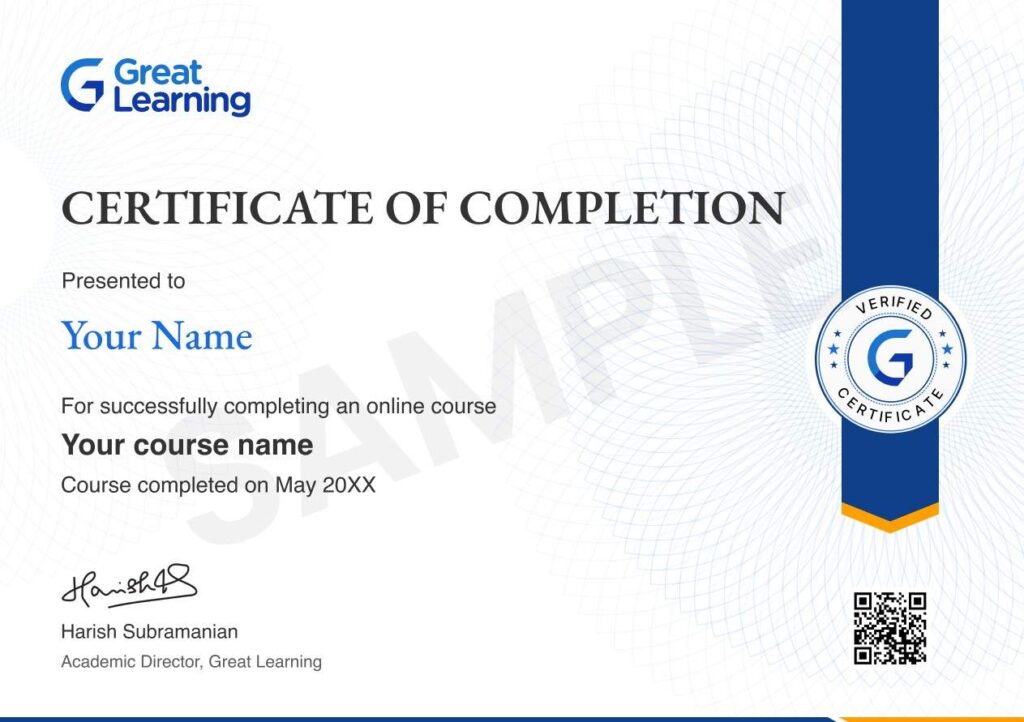
You get a genuine free Certificate of Completion here, typically available on your dashboard within 24 hours of finishing the course and its quiz.
Explore Business Finance Foundations
7. Introduction to Financial Management (Great Learning Academy)
This 1.5-hour course covers what financial management actually means as a business function — its core objectives, including profit maximization, wealth maximization, and improving market share, plus the scope of decisions a financial manager influences and how internal and external stakeholders shape those calls. It pairs well with the Business Finance Foundations course above if you want to move from “how do I read a financial statement” to “how do financial decisions actually get made inside a company.”
A note on the certificate here: Great Learning’s own course page is inconsistent. Most of its FAQ answers describe a free certificate of completion, but one FAQ pair on the same page states that claiming a certificate requires paying a non-refundable fee. Confirm the current policy directly on the enrollment page before telling readers this one is unconditionally free.
Explore Introduction to Financial Management
8. Capital Budgeting Techniques (Great Learning Academy)
A tightly scoped, roughly one-hour course that walks through the four major capital budgeting methods: Payback Period, Net Present Value (NPV), Internal Rate of Return (IRR), and Break-Even Analysis, along with capital structure decisions. If you’ve already covered NPV and IRR conceptually in one of the Coursera courses above, this is a good way to drill the actual calculations and decision framework without sitting through hours of unrelated material.
Free course, free certificate of completion — no purchase required at any step.
Explore Capital Budgeting Techniques
9. Asset Management (Great Learning Academy)
A compact, roughly 75-minute course covering what asset management actually involves — identifying which assets generate returns and which don’t, and the different categories of asset management: digital, fixed, IT, enterprise, financial, and infrastructural. It’s a broader, more conceptual course than the capital budgeting one above, better suited as an introduction to the field than a technical deep-dive.
Free to complete, with a real certificate awarded after passing the assessment.
10. Diploma in International Finance (Alison)
This is the most comprehensive course on the list in terms of scope. It covers GNP, GDP, and productivity as forecasting tools, exposure management, capital mobility, the international financial market (money and capital markets), the euro currency market, and trade promotion policy, finishing with a look at how organizations expand into new markets and manage currency risk along the way. It’s built for people already working in global trade, or students wanting a grounding in how money moves across borders. Like all Alison courses, it’s free to study and includes a graded assessment.
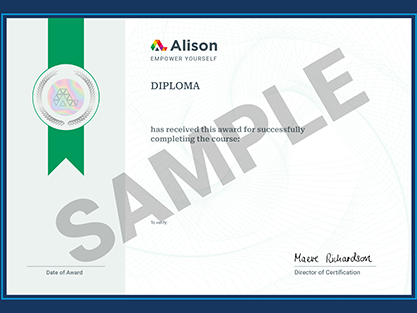
Here’s the catch: the free version only gets you a basic “Learner Achievement Verification,” not the official Diploma. The branded Alison Diploma — the version worth putting on a resume — is a separate purchase, available as a digital PDF or a physical copy, through the Alison Shop.
Explore Diploma in International Finance
FINAL THOUGHT: What You’ll Actually Learn, How the Certificate Models Compare
| Platform | Study Cost | Certificate Cost | Best For |
|---|---|---|---|
| Coursera | Free (audit mode) | Paid, or free via approved financial aid | University-branded credentials (Wharton, Yale, Cambridge) for a resume |
| Great Learning Academy | Free | Free, no conditions (3 of 4 courses confirmed; verify Introduction to Financial Management—see note in course #7) | A genuinely free certificate, fast |
| Alison | Free | Paid Diploma (digital or physical); free basic verification only | Structured, broad-scope content when a paid credential isn’t the goal |
You May Also Like: CAT MOCK, CAT MOCK PYQ
Follow Us On: Facebook, Instagram