

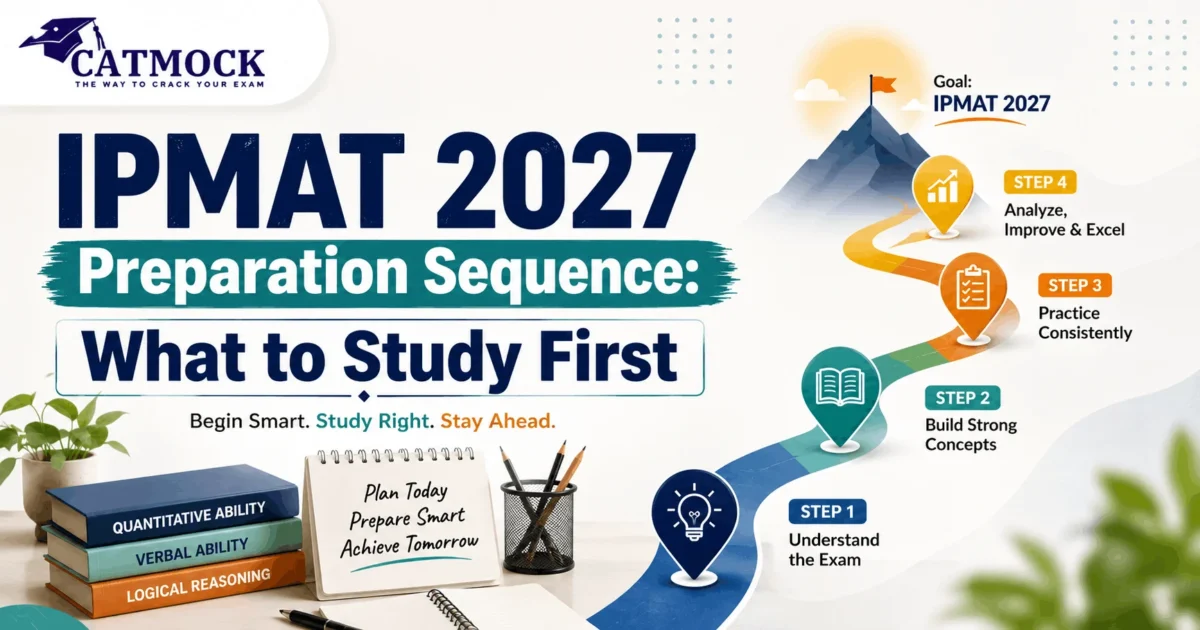
Most IPMAT 2027 aspirants already know the syllabus — Quant, Verbal Ability, and Logical Reasoning aren’t a mystery to anyone who’s opened a prep book. What trips candidates up isn’t what to study, but in what order. Jump into algebra before number systems feel automatic, or start reading comprehension before your vocabulary base is built, and you end up relearning fundamentals mid-way through your timeline — right when you should be taking full-length mocks.
This guide lays out a clear, topic-wise IPMAT 2027 preparation sequence for IIM Indore, IIM Rohtak, and JIPMAT, structured in three phases so you build skills in the order that actually compounds, instead of studying at random.
For a quicker way to test where you currently stand before committing to a 16-week plan, you can explore CATMock’s free mock categories and use the section-wise report to decide how much time each phase genuinely needs.
Understanding the IPMAT 2027 Exam Structure
Before sequencing your IPMAT 2027 study plan, it helps to know exactly what each exam is testing — the three IPM entrance exams overlap in broad skill areas but differ meaningfully in format.
| Exam | Sections Tested | Question Format | Key Distinction |
|---|---|---|---|
| IPMAT Indore | QA (Short Answer), QA (MCQ), Verbal Ability | 15 SA + 30 MCQ (QA) + 45 MCQ (VA) = 90 Qs | Only exam with typed, non-MCQ numerical answers |
| IPMAT Rohtak | Quantitative Ability, Logical Reasoning, Verbal Ability | 120 MCQs (40 per section) | Dedicated Logical Reasoning section; all MCQs |
| JIPMAT (IIM Jammu & IIM Bodh Gaya) | Quantitative Aptitude, Data Interpretation & Logical Reasoning, Verbal Ability | 100 MCQs, no sectional time limit | Conducted by the National Testing Agency (NTA); closer to Class 10 difficulty |
Table 1: Section-wise structure across IPMAT Indore, IPMAT Rohtak, and JIPMAT
Since JIPMAT is administered by the National Testing Agency on behalf of IIM Jammu and IIM Bodh Gaya, and IIM Indore and IIM Rohtak are Institutes of National Importance established under the IIM Act, 2017, candidates should always cross-verify exam-day specifics directly from the respective official notification before finalising their IPMAT 2027 preparation timeline.
Why Sequence Matters More Than Raw Study Hours
Jumping straight into advanced problems without solid fundamentals tends to backfire — candidates end up re-learning basics mid-preparation, which is far more time-costly than building the base correctly the first time. A structured IPMAT 2027 prep sequence — foundations first, core topics next, advanced practice last — builds compounding confidence and avoids the common trap of feeling behind on every topic simultaneously.
Many aspirants also measure progress by hours logged rather than topics genuinely mastered. A clear sequence gives you natural checkpoints: if foundational problems still feel shaky at the end of Phase 1, that’s a signal to close the gap before moving forward, not a reason to push ahead and accumulate weak spots that resurface in mocks later.
The 3-Phase Preparation Sequence
Phase 1: Building Foundational Topics (Weeks 1–4)
Start with topics that form the base for everything else. For Quantitative Ability, this means Class 9–10 level Arithmetic and Number Systems, since nearly every advanced topic in the IPMAT 2027 syllabus builds on these fundamentals. For Verbal Ability, begin with core grammar rules and daily vocabulary building — skills that compound quickly with consistent, low-intensity practice.
- Quantitative Ability: Number systems, basic arithmetic, percentages, ratios, simple and compound interest.
- Verbal Ability: Grammar fundamentals, daily vocabulary building, basic sentence correction.
- Logical Reasoning (Rohtak & JIPMAT aspirants): Arrangements and syllogisms — the most frequently tested basics.
Phase 2: Core Topic Mastery (Weeks 5–10)
Once fundamentals feel solid, move into the highest-weightage topics across recent papers. Algebra and Geometry dominate the Quantitative Ability section for both Indore and Rohtak, while Reading Comprehension and para-jumbles carry significant weight in Verbal Ability.
- Quantitative Ability: Algebra, geometry, mensuration, time-speed-distance, time-and-work problems.
- Verbal Ability: Reading comprehension practice, para-jumbles, sentence completion.
- Logical Reasoning (Rohtak & JIPMAT aspirants): Blood relations, coding-decoding, data-based puzzles.
Phase 3: Advanced Practice and Mocks (Weeks 11–16)
Shift almost entirely to timed practice in the final phase. Solve full-length mock tests regularly, review every mistake in detail, and revisit weak topics identified through mock performance rather than starting new topics this late in your IPMAT 2027 preparation sequence.
- Take at least two full-length mock tests per week, simulating actual exam-day conditions — CATMock’s full-length test series is built specifically for this section-wise, exam-day-accurate practice.
- Focus revision time on topics where mock-test accuracy stays below your personal target.
- Practise typed numerical answers under time pressure if targeting IPMAT Indore’s Short Answer section, since this format has no MCQ safety net.
Quantitative Ability: Topic-Wise Study Order
| Order | Topic | Why This Position |
|---|---|---|
| 1 | Number Systems and Arithmetic | Forms the base for nearly every other quant topic |
| 2 | Percentages, Ratios, and Interest | Directly builds on arithmetic fundamentals |
| 3 | Algebra | High-weightage topic requiring strong arithmetic first |
| 4 | Geometry and Mensuration | Best tackled once algebra fundamentals are solid |
| 5 | Time-Speed-Distance and Time-Work | Combines arithmetic and algebra skills together |
| 6 | Modern Math (P&C, Probability) | Best left until core topics feel comfortable |
Table 2: Recommended Quantitative Ability study sequence for IPMAT Indore and Rohtak
Verbal Ability and Logical Reasoning: Study Order
| Order | Verbal Ability Topic | Logical Reasoning Topic (Rohtak/JIPMAT) |
|---|---|---|
| 1 | Grammar fundamentals and vocabulary | Seating arrangements and syllogisms |
| 2 | Sentence correction and para-jumbles | Blood relations and coding-decoding |
| 3 | Reading comprehension practice | Data-based puzzles and statement-conclusion |
Table 3: Recommended Verbal Ability and Logical Reasoning study sequence
Sample 16-Week Study Timetable
| Weeks | Focus Area |
|---|---|
| 1–4 | Foundational arithmetic, grammar, and vocabulary building |
| 5–7 | Algebra, geometry, and sentence-level verbal topics |
| 8–10 | Reading comprehension, advanced quant, and reasoning puzzles |
| 11–13 | Sectional mock tests and topic-wise revision |
| 14–16 | Full-length mocks, error analysis, and final revision |
Table 4: Sample 16-week preparation timetable
Once you enter Weeks 11–16, revisit CATMock’s previous year papers alongside your full-length mocks so revision time goes to genuinely weak areas instead of topics that only feel weak.
Common Sequencing Mistakes to Avoid
- Starting with advanced topics like Modern Math before mastering arithmetic and algebra fundamentals.
- Ignoring vocabulary building early on, then scrambling to catch up right before the exam.
- Delaying mock tests until the final two weeks, leaving little time to fix identified weaknesses.
- Studying all three exams’ unique topics simultaneously instead of prioritising your primary target exam first.
- Treating hours studied as a proxy for topics mastered, rather than tracking actual mock-test accuracy.
Additional Preparation Tips
- Start preparation at least four to six months before your target exam date for a comfortable, low-stress pace.
- Solve previous years’ papers regularly to understand real question difficulty and framing.
- Read one editorial or long-form article daily to build both vocabulary and comprehension stamina.
- Review every mock test in detail, focusing on why each mistake happened rather than just the final score — CATMock’s daily practice sets with detailed solutions are designed for exactly this kind of review.
- Keep your target exam’s official notification page bookmarked — IIM Indore and IIM Rohtak publish updates directly, and JIPMAT candidates should follow the NTA JIPMAT portal for authoritative announcements.
Key Takeaways
- A well-sequenced IPMAT 2027 preparation plan matters more than raw study hours — foundations first, core topics next, mocks last.
- IPMAT Indore (90 Qs), IPMAT Rohtak (120 Qs, MCQ-only), and JIPMAT (100 Qs, NTA-conducted) differ enough in format that your target exam should drive your sequence.
- Begin Quantitative Ability with Number Systems and Arithmetic; begin Verbal Ability with grammar and vocabulary.
- Shift to full-length, timed mocks from around Week 11 onward, not in the final two weeks.
- Track weak areas through mock-test accuracy, not by how many hours you’ve logged on a topic.
Frequently Asked Questions
1. When should I start preparing for IPMAT 2027?
Most successful aspirants start at least four to six months before their target exam date, allowing time for foundational, core, and advanced practice phases within a structured IPMAT 2027 preparation sequence.
2. Which topic should I study first for Quantitative Ability?
Begin with Number Systems and basic Arithmetic, since these fundamentals support nearly every other quantitative topic tested across IPMAT Indore, IPMAT Rohtak, and JIPMAT.
3. Is the IPMAT Rohtak syllabus different from IPMAT Indore?
Yes. IPMAT Rohtak adds a dedicated Logical Reasoning section and is entirely MCQ-based (120 questions), while IPMAT Indore includes a Short Answer quant format alongside MCQs (90 questions total).
4. How is JIPMAT different in difficulty from IPMAT Indore and Rohtak? JIPMAT, conducted by the National Testing Agency, keeps its Quantitative Aptitude section closer to Class 10 difficulty and has no sectional time limit, making it comparatively more approachable for non-mathematical backgrounds.
5. When should I start taking mock tests for IPMAT 2027?
Begin sectional mocks around Week 8–10 of your preparation, then shift to full-length mocks in the final month before the exam — pairing this with CATMock’s free live sessions helps you fix concept gaps mocks reveal.
6. Should I prepare for all three IPM entrance exams together?
It’s best to prioritise your primary target exam first, then adapt your preparation to cover any additional unique topics for the other exams closer to your final revision phase.
Conclusion: Build Your Sequence, Then Execute It
Whether you’re targeting IIM Indore, IIM Rohtak, or JIPMAT, the exam names change but the underlying preparation logic doesn’t: fundamentals first, high-weightage core topics next, and timed mock practice in the final stretch. Use the tables above as your working checklist, revisit your IPMAT 2027 study plan every few weeks against your actual mock-test performance, and adjust the pace rather than the sequence.
Ready to test where you currently stand? Explore CATMock’s free mock tests and get a section-wise breakdown to fine-tune your Phase 1 starting point.
You May Also Like : CATMOCK / CATMOCK PYQ
Follow Us On : Facebook / Instagram