Most aspirants think the MBA admission process is mostly about the entrance exam. It isn’t. The exam is only the first gate. After it come college forms, shortlisting formulas, a written test, a group discussion, an interview and a final merit list. People who understand these stages plan better and miss fewer deadlines.
This guide walks through the whole MBA admission process in India, step by step, so you know what happens, who decides it and where candidates usually slip.
Quick answer: what is the MBA admission process?
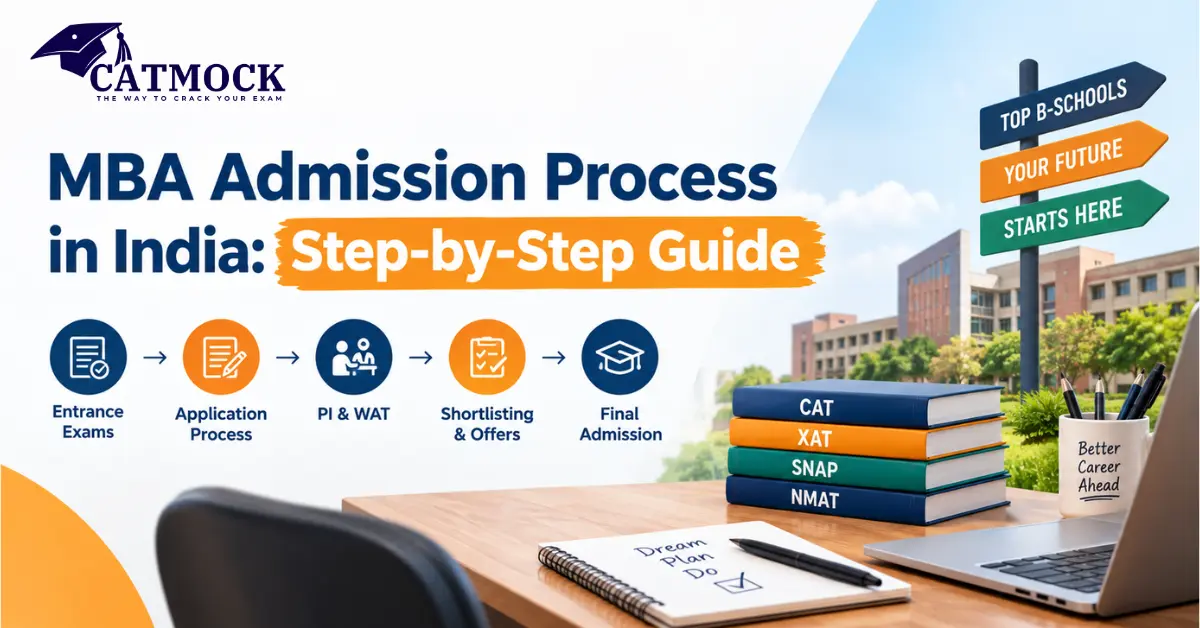
The MBA admission process in India has four core stages:
- Register for and write an entrance exam (CAT, XAT, NMAT, SNAP, CMAT or similar).
- Get shortlisted by each college.
- Clear the final selection round: WAT, GD and/or PI.
- Accept the offer by paying the fee and submitting your documents.
Many colleges also need a separate application form on top of your exam registration.
| Stage | What happens | Who runs it | Typical timing |
|---|---|---|---|
| Exam registration | You register for an accepted entrance test | Exam body | Aug–Nov |
| Entrance exam | You take the test and get a score | Exam body | Nov–Jan (varies) |
| College application | You apply to individual B-schools | Each college | Alongside or after the exam |
| Shortlisting | A formula picks who gets interview calls | Each college | Jan–Mar |
| WAT-GD-PI | Written test, discussion, interview | Each college | Jan–Apr |
| Final offer | Composite merit list, fee, documents | Each college | Feb–May |
How the MBA admission process works: two routes
Broadly, there are two routes into an MBA in India:
- The entrance-exam route. You take a national or state-level test, then go through the college’s selection rounds. IIMs, IITs and most top B-schools follow this route.
- The direct-admission route. Some private colleges admit candidates based on academics, work experience and an interview, without a standalone test. This is available at select private colleges.
Most of this guide covers the entrance-exam route, because that’s where competition is and where the process is the most detailed.
MBA admission process step by step
Step 1: Choose your exams and target colleges
Your exam choice decides which colleges you can apply to. Here’s a typical mapping:
| Exam | Typically accepted by |
|---|---|
| CAT | IIMs, IIT management programmes, FMS Delhi, MDI Gurgaon and many other B-schools |
| XAT | XLRI and many private B-schools |
| NMAT | NMIMS campuses and several private institutes |
| SNAP | Symbiosis institutes |
| CMAT and state-level tests | Many AICTE-approved and state institutes |
Acceptance changes by year and by programme, so confirm on each college’s official page. Build a list of 8–12 colleges across ambitious, realistic and safe tiers, and take at least one backup exam. Backups matter because one bad exam day shouldn’t end your year.
Step 2: Check MBA eligibility
The usual baseline:
- Graduation: a bachelor’s degree in any discipline. A common minimum at IIMs is 50% marks (45% for reserved categories). Some IIT programmes ask for more, so check each brochure.
- Final-year students: usually allowed to apply, with proof of completion due by a set date.
- Work experience: optional for most full-time MBA/PGDM programmes. There is no mandatory work experience requirement for CAT, and freshers can still get admission across the IIM spectrum.
Step 3: Register for and write the entrance exam
You register on the exam’s official website and write the test in a computer-based format. For the current cycle, CAT 2026 is on Sunday, November 29, 2026, in three sessions, conducted by IIM Indore. Registration ran from August 3 and closed on September 22 after an extension.
Results are tentative. Expect late December 2026 to the first week of January 2027, and treat any date as provisional until the official announcement. Official updates are on iimcat.ac.in.
Step 4: Submit college applications
This is the step many first-timers miss. Exam registration is not a college application. Many colleges, including some newer IIMs and the IITs, run their own forms with their own fees and deadlines. The forms ask for academics, work experience, essays and preferences.
Exam score to college form: you usually need both. Missing the second one can cost you the entire year, even with a great score.
Also Read: MBA Admission 2027: B-School Applications Opening in October 2026
Step 5: Shortlisting
After results, each college calculates a shortlisting score. Candidates who clear the overall and sectional cutoffs are called for the GD-PI or WAT-PI process. The formula usually combines your exam percentile, your Class 10 and 12 marks, graduation marks, and sometimes work experience and diversity points.
Clearing a cutoff doesn’t guarantee a call. Shortlists are typically a few times larger than the seat count, so the cutoff is an entry ticket, not a target.
Step 6: WAT, GD and PI
Shortlisted candidates face the final selection round:
- Written Ability Test (WAT): a short essay under time pressure that tests clarity, structure and argument.
- Group Discussion (GD): a test of how you think and communicate in a group.
- Personal Interview (PI): questions on your background, academics, work experience, goals and current affairs.
IIMs lean on WAT and PI, while many other colleges use GD as well. This stage often decides the final result, as the next section shows.
Step 7: Final offer, fee and documents
Each business school calculates a composite score on its predefined criteria and declares a merit list. Selected candidates then submit the fee and the required documents. Offers go out in rank order within each category, and waitlists move as others accept or decline. Hold on to every receipt and confirmation email.
How MBA selection actually works: weightage examples
Different colleges weigh the stages differently, which is why the same percentile can lead to different outcomes. Here are two published examples from the latest policies we reviewed (these can change for the next batch, so check the official policy):
IIM Calcutta final selection (2026–28 policy)
| Component | Weightage |
|---|---|
| Personal Interview | 48 |
| CAT score | 30 |
| Written Ability Test | 8 |
| Work experience | up to 8 |
| Academic diversity | up to 6 |
At IIM Calcutta’s shortlisting stage, CAT carries 56 points, along with Class 10 and 12 marks and gender diversity. By the final stage its weight drops to 30, while the interview carries 48.
Also Read: IIM Calcutta MBA Admission Criteria 2027: Eligibility, Selection Process & Weightage
IIM Bangalore final composite (as reported)
| Component | Weightage |
|---|---|
| WAT-PI | 50 (PI 40) |
| CAT | 25 |
| Academics | 15 |
| Work experience / professional course | 10 |
What this tells you: a high percentile gets you the interview call, but the interview and written test decide the final rank. Prepare for both.
Documents you’ll need
| Document | Note |
|---|---|
| Passport-size photo and signature | Recent, in the size the portal asks for |
| Class 10 and 12 marksheets | Scanned PDFs |
| Graduation marksheets or provisional certificate | All semesters |
| Category, PwD or EWS certificate | If applicable, valid copy |
| Work experience letters | For working candidates |
| ID proof | Name must match your forms |
| Exam admit card and scorecard | Needed in later rounds |
| Active email and phone number | For OTPs and shortlist alerts |
Any mismatch in names, dates or marks across forms can put your candidature at risk, so keep them identical.
MBA admission process without an entrance exam
Direct admission exists, but it’s narrower than it sounds. It’s mostly offered by some private colleges and by executive or online programmes, which weigh academics, work experience and an interview more heavily. Even then, “direct admission” rarely means zero eligibility checks, interviews or screening. Don’t pick a college only because it says “no exam required”. Look at fees, outcomes and accreditation as well. catmock
A realistic MBA admission timeline
| When | What usually happens |
|---|---|
| August–September | CAT registration opens and closes (2026: Aug 3 to Sept 22) |
| September–December | Other exam and college forms, backup exams |
| Late November | CAT exam (2026: Nov 29) |
| Late December–January | Results, percentile analysis, shortlist updates |
| January–March | Shortlists, WAT-GD-PI invitations |
| February–May | Interviews, final offers, waitlists, fee deposits |
From first registration to a final offer, the cycle runs roughly nine to ten months.
Common mistakes in the MBA admission process
- Treating the exam score as the whole process. Shortlisting formulas and interviews decide the final outcome.
- Confusing exam registration with college application. Complete both wherever required.
- Waiting for the last day. Portals slow down near deadlines.
- Relying on a single exam. Take a backup.
- Ignoring sectional cutoffs. A strong overall percentile won’t save a weak section.
- Skipping the brochure. Weightage, cutoffs and eligibility change by year.
- Delaying WAT-GD-PI practice until results. Start before the result, not after.
How to prepare for each stage
Treat the process as a pipeline, not a single event. Use full-length mocks and careful analysis for the exam, build sectional balance before you worry about the overall percentile, and start writing short WAT essays and practising interview answers while you wait for results. A mock test series with analysis, like the ones on CATMock, helps you find weak sections early, when you can still fix them.
FAQs for MBA admission process
1. What is the MBA admission process in India?
It has four main stages: register for and write an entrance exam, get shortlisted by each college, clear the WAT-GD-PI round, and accept your offer by paying the fee and submitting documents. Many colleges also require a separate application form.
2. Is an entrance exam mandatory for MBA admission?
For IIMs, IITs and most top B-schools, yes. Some private colleges offer direct admission based on academics, work experience and an interview. Always confirm the process on the official admission page.
3. Is CAT registration enough to apply to MBA colleges?
No. Registering for CAT lets you take the exam. Many colleges require a separate application on their own portal, with their own fee and deadline.
4. What is the minimum percentage required for MBA admission?
A common minimum is 50% in graduation (45% for reserved categories) at IIMs. Some IIT programmes ask for around 60%. Rules vary, so check the brochure.
5. How long does the MBA admission process take?
Roughly nine to ten months, from exam registration around August to final offers by April or May.
6. What happens after the CAT result?
Colleges calculate shortlisting scores and invite candidates for WAT, GD and PI. A final composite score then produces the merit list and offers.
7. Can freshers apply for MBA admission?
Yes. Work experience is optional for most full-time MBA/PGDM programmes. It earns extra points at some institutes but isn’t a requirement.
MBA admission process Conclusion
The MBA admission process rewards candidates who see it as a pipeline: the right exam, a clean application, a strong shortlist score and an interview that backs it up. The exam gets you in the door, but the final stages are what decide the seat.
Check the eligibility rules, apply to more than one college, keep your documents ready and track official dates. Start with a diagnostic mock this week, because your first score will show you where to focus.
You May Also Like : CAT MOCK, CAT MOCK PYQ
Follow Us On : Facebook, Instagram, Youtube