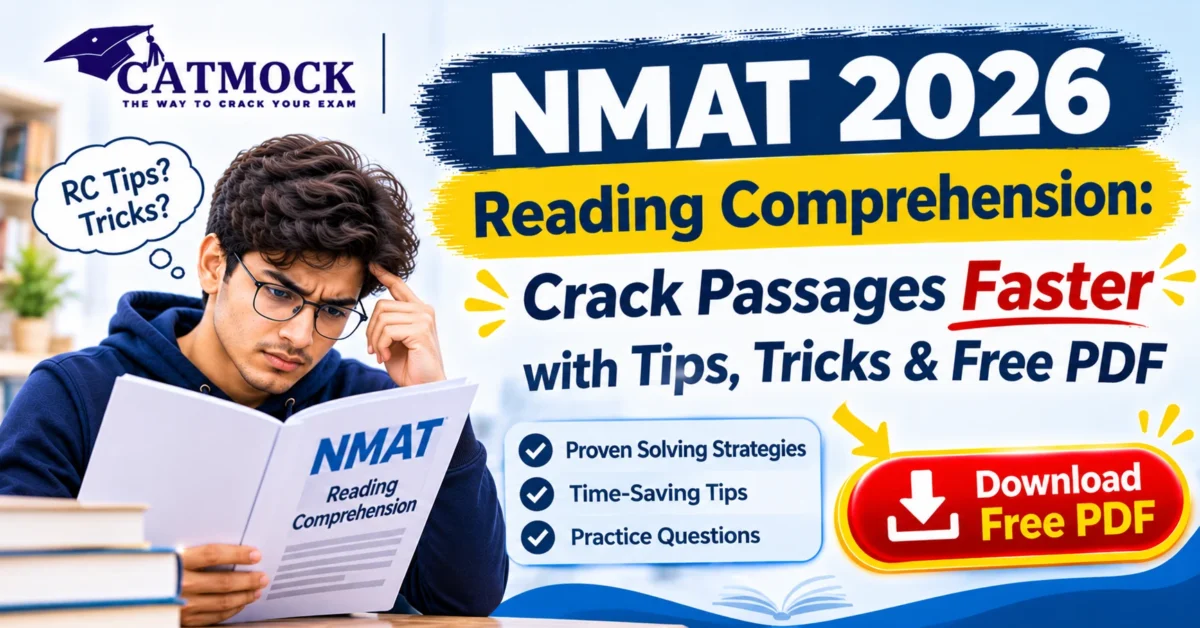
Three passages. Twelve questions. A third of your Language Skills section, and a clock that gives you less than a minute per question. If you are searching for NMAT 2026 Reading Comprehension tips, you probably ask one thing: how do I read faster without losing accuracy? This guide answers it with the pattern analysts report, a minute-by-minute plan, a method you can copy and a free practice PDF.
Quick answer: NMAT Reading Comprehension usually brings 3 passages with 4 questions each, which is 12 of the 36 Language Skills questions. You get 28 minutes for the whole section and face no negative marking. Give RC about 13 minutes, read each passage once with a purpose, and answer every question.
Want to practise right now? Download the free NMAT RC practice PDF with 3 original passages, 12 questions and an answer key.
NMAT 2026 Reading Comprehension at a Glance
| Detail | What to know |
|---|---|
| Section | Language Skills |
| Questions and time | 36 questions in 28 minutes |
| RC share | 12 questions: 3 passages with 4 questions each, as analysts report for the 2024, 2025 and 2026 papers |
| Passage length | Roughly 300 to 500 words, according to candidate reports |
| Difficulty | Easy to moderate in recent analyses |
| Marking | No negative marking |
| Section score | Scaled 12 to 120 |
| 2026 test window | 2 November to 20 December 2026 |
GMAC does not publish a fixed RC count, so treat the numbers above as a reliable trend, not a guarantee. Each section has its own timer, and you cannot move time from one section to another. Check the official NMAT page by GMAC for the latest rules, and read our NMAT 2026 exam pattern guide for the full structure.
What Kind of Passages Does NMAT Ask?
Candidates who sat the 2 November 2026 slot reported three passages on very different subjects.
| Passage | Subject area | Questions |
|---|---|---|
| 1 | Psychology: the bystander effect | 4 |
| 2 | Plant science: the white sage plant | 4 |
| 3 | Philosophy: Occam’s razor | 4 |
The spread tells you something useful. NMAT does not test subject knowledge. It tests whether you can follow an argument in unfamiliar territory. Read widely across psychology, science, business, society and ideas, and you will rarely feel lost.
Question Types and How to Solve Them
NMAT 2026 Reading Comprehension usually test five skills.
| Question type | What it asks | How to solve it | Common trap |
|---|---|---|---|
| Main idea | What the whole passage argues | Combine the first and last sentences of the paragraphs | Options that cover only one paragraph |
| Specific detail | What the passage states | Find the line, then match it word for word | Options that sound true but add new claims |
| Inference | What the passage suggests | Pick the option the text supports without extra assumptions | Options that go too far |
| Vocabulary in context | What a word means here | Replace the word with each option and re-read the sentence | The most common dictionary meaning |
| Tone and attitude | How the author feels | Look for adjectives and balancing words like “however” | Extreme tones such as “angry” or “sarcastic” |
Your 28-Minute Plan for the Language Skills Section
Do the maths before test day. NMAT gives you 28 minutes for 36 questions, so you have about 47 seconds for each one on average. RC takes longer per question than grammar or vocabulary, so split the time deliberately.
| Block | Questions | Time | Pace |
|---|---|---|---|
| Reading Comprehension | 12 | 13 minutes | About 100 seconds to read, then 40 seconds per question |
| All other questions | 24 | 15 minutes | About 37 seconds per question |
| Total | 36 | 28 minutes |
Because NMAT has no negative marking, never leave a question blank. If time runs out, pick the best remaining option and move on.
7 Tips and Tricks to Read NMAT Passages Faster
- Read with a purpose. Ask yourself, “What is the author trying to prove?” before you start. A purpose makes you skim less and absorb more.
- Give the first and last sentences extra attention. They usually state the point and the conclusion of each paragraph.
- Circle the signal words. Words such as “however”, “but”, “therefore” and “yet” mark a shift in the argument, and questions often target them.
- Summarise each paragraph in four or five words. A short mental note, such as “benefits of mangroves”, saves you from re-reading later.
- Predict before you look at the options. Form your own answer first. Then match it to the closest option, so the wrong options cannot sway you.
- Eliminate extreme options. Words such as “always”, “never”, “only” and “all” rarely match a balanced passage.
- Go back to the text for details. Never trust memory for a detail question. A quick look at the line costs ten seconds and saves a mark.
A Worked Example
Read this short passage, then see how the method works.
Many city offices now run rooftop gardens. Managers like them because they cool the building and look good in brochures. Staff, however, value something less visible: a place to step away from screens. In a survey of one firm, employees who used the garden at least twice a week reported lower stress than those who did not. The firm’s own researchers warned against reading too much into this. People who already feel calm may simply be the ones who visit the garden.
Question: Which conclusion does the researchers’ warning support?
- The garden has no effect on stress.
- The survey shows a link, but it does not prove that the garden reduces stress.
- Managers built the garden for the wrong reasons.
- Employees who skip the garden are more stressed.
How to solve it:
- Predict first. The last sentence says calm people may visit more. So the link could run the other way, and the survey cannot prove the garden causes calm.
- Eliminate extremes. Option 1 says “no effect”, which is too strong. The researchers only said the proof is weak.
- Check the rest. Option 3 goes beyond the text, and option 4 repeats the claim the researchers doubt.
- Answer: Option 2.
Build Your Reading Speed in 4 Weeks
If your slot is still ahead, or you plan a retake, follow this routine for about 30 minutes a day.
| Week | Focus | Daily task |
|---|---|---|
| 1 | Baseline | Time yourself on one passage and note your errors by question type |
| 2 | Method | Practise the tips above and write a five-word summary for each paragraph |
| 3 | Speed | Solve two timed passages a day, then review every wrong answer |
| 4 | Section practice | Attempt full Language Skills sets of 36 questions in 28 minutes |
Common Mistakes That Cost RC Marks
- Reading too slowly. Do not read every word aloud in your head. Look for ideas, not words.
- Using outside knowledge. Answer only from the passage, even when you know more about the subject.
- Falling for extreme options. Balanced passages rarely support absolute statements.
- Skipping the review. Reviewing mistakes teaches more than solving new passages.
- Spending too long on one question. Take your best option and move on after 40 seconds.
Free NMAT Reading Comprehension Practice PDF
Practice works best when it mirrors the real test. Our free pack includes:
- 3 original passages on environment, psychology and policy
- 12 questions across main idea, detail, inference, vocabulary and tone
- A full answer key with a short explanation for each question
- A timing log to track your speed and mistake types
Frequently Asked Questions
How many Reading Comprehension passages come in NMAT 2026?
Analysts report 3 passages with 4 questions each, which is 12 questions. GMAC does not publish a fixed count, so the number can vary.
Is NMAT Reading Comprehension easy?
Recent analyses describe Language Skills as the easiest NMAT section and RC as easy to moderate. The short time limit creates the pressure.
How much time should I spend on NMAT RC?
Give RC about 13 minutes of the 28-minute Language Skills section. That means roughly 100 seconds to read each passage and 40 seconds per question.
Is there negative marking in NMAT Reading Comprehension?
No. NMAT has no negative marking, so answer every question.
How long are NMAT RC passages?
Candidates report passages of roughly 300 to 500 words.
Which topics appear in NMAT RC passages?
Passages cover general, non-technical subjects. Candidates on 2 November 2026 reported psychology, plant science and philosophy.
Is NMAT RC different from CAT RC?
NMAT passages are generally shorter, and the section has a strict 28-minute limit. CAT passages usually run longer and demand deeper reasoning.
How can I improve my RC speed for NMAT?
Read daily, summarise each paragraph in a few words, predict answers before reading the options and practise with a timer. Review every mistake.
Should I guess if I do not know an RC answer?
Yes. NMAT does not deduct marks for wrong answers, so a guess can only help.
Where can I get free RC practice for NMAT?
You can use our free practice PDF, and read Yojana from the Publications Division and articles on the National Digital Library of India for daily reading practice.
Conclusion: NMAT 2026 Reading Comprehension
NMAT Reading Comprehension rewards a calm, structured approach more than raw speed. Know the pattern, split your 28 minutes wisely, read with a purpose and review every mistake.
Start today with the practice PDF and note which question type costs you marks. If you are aiming for NMIMS, see how our NMIMS Mumbai placements guide compares packages and recruiters, and find more exam guides on the CATMOCK blog.
You May Also Like : CATMOCK, CATMOCK PYQ
Follow Us On : Facebook, Instagram, Youtube