Fifteen questions. Fifteen minutes if you split time evenly. That is all the SNAP 2026 General English section asks of you, and still, thousands of candidates drop easy marks here every year.
The reason is rarely a lack of English. It is a mismatch of method. Candidates apply a grammar rule to a question that needed context, or rely on “what sounds right” for a question that a rule would have solved in five seconds.
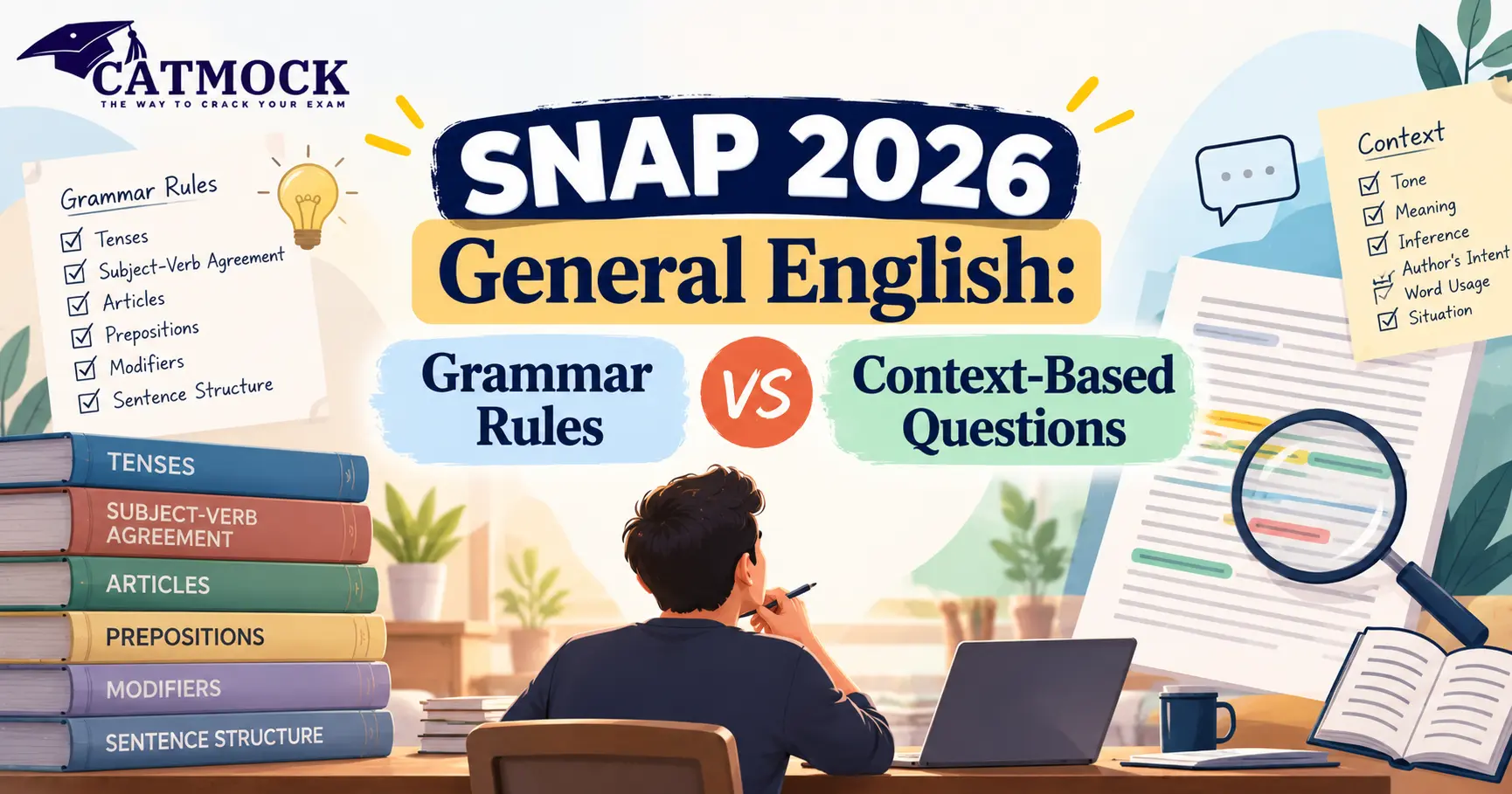
This guide shows you how to tell the two apart. You will learn when grammar rules decide the answer, when context decides it, and how to practise both before the December tests.
SNAP 2026 General English at a Glance
Start with the structure so you know what you are working with. SNAP is a computer-based test, and the exam is divided into three sections: General English with 15 questions, Analytical and Logical Reasoning with 25, and Quantitative Ability, Data Interpretation and Data Sufficiency with 20. The format is MCQ, with negative marking for wrong answers, and candidates get 60 questions in 60 minutes.
SNAP 2026 Dates
The exam is scheduled in three sessions on December 13, December 19, and December 26, 2026, and the last date to register is November 25, 2026. Always confirm on the official site, snaptest.org, before you plan around any date.
Section Snapshot
| Section | Questions | Marks | Suggested Time |
|---|---|---|---|
| General English | 15 | 15 | 12-14 minutes |
| Analytical & Logical Reasoning | 25 | 25 | 25-28 minutes |
| Quant, DI & Data Sufficiency | 20 | 20 | 18-20 minutes |
| Total | 60 | 60 | 60 minutes |
With only one mark per question and a penalty for errors, each wrong answer in English hurts. That is why knowing which method to apply matters so much.
What Does the SNAP General English Section Test?
The section is short, but it covers a lot of ground. Prep guides generally group the content into vocabulary, grammar, reading comprehension, verbal reasoning, sentence construction and contextual understanding.
One point deserves honesty. Sources disagree on Reading Comprehension. Some syllabus pages say Reading Comprehension appears inconsistently from year to year, while others list the section’s topics as grammar, vocabulary, sentence correction, idioms, error spotting and figures of speech, without Reading Comprehension. The safe approach is to prepare for short passages, but spend most of your time on grammar, vocabulary, and sentence-level questions.
Grammar Rules vs Context-Based Questions: The Core Difference
Every General English question falls on a spectrum between two poles.
Grammar-Rule Questions
These have an answer that a rule fixes, regardless of the topic of the sentence. If you know the rule, you do not need to understand the meaning deeply.
Example: “Neither of the candidates were selected.”
The rule: “neither” takes a singular verb. The answer is was. The topic is irrelevant.
Context-Based Questions
These have an answer that depends on meaning, tone, or the surrounding sentences. Two options may both be grammatically valid, but only one fits.
Example: “The manager’s decision was ______, so the team trusted it.”
Options: arbitrary / considered / hasty / reckless.
Grammar cannot choose here. Context says the team trusted it, so considered fits.
Side-by-Side Comparison
| Feature | Grammar-Rule Questions | Context-Based Questions |
|---|---|---|
| What decides the answer | A fixed rule | Meaning, tone, logic of the sentence |
| Typical types | Subject-verb agreement, tenses, articles, prepositions, error spotting | Fill in the blanks, vocabulary in context, idioms, para-jumbles, short passages |
| Speed | Fast if the rule is known | Slower: needs reading and judgement |
| Main risk | Forgetting an exception | Choosing what “sounds nice” over what fits |
| Best prep method | Rule drills and error logs | Wide reading and elimination practice |
| Ideal time per question | 30-45 seconds | 50-80 seconds |
The R.U.L.E. Test: How to Decide Which Method to Use
When you read a question, run this four-step check in a few seconds.
R: Read the Question Stem
Look at what is asked. “Identify the error,” “choose the correct form,” and “fill the blank” point to different methods.
U: Underline the Signal Words
Words like however, therefore, although, despite, unless signal context and logic. Words like each, either, neither, has/have, was/were signal rules.
L: Look at the Options
If the options differ in form (was/were, who/whom, in/on), it is probably a rule. If they differ in meaning (hasty/considered/reckless), it is probably context.
E: Eliminate, Then Choose
Cut out options that break a rule first. Then use context to choose among those that remain.
R.U.L.E. Quick Reference
| Clue in the Question | Likely Type | First Move |
|---|---|---|
| Options differ by verb form or article | Grammar | Apply the rule |
| Options are synonyms with different tones | Context | Read the full sentence for tone |
| “Choose the correct sentence” | Mixed | Check grammar first, then clarity |
| Blank with a connector (but, hence) | Context/logic | Find the relationship between ideas |
| Underlined portion in a sentence | Grammar | Test agreement, tense, preposition |
| Idiom or phrase | Vocabulary + context | Recall meaning, then check fit |
Grammar Rules That Pay Off in SNAP General English
You do not need every grammar rule. You need the ones that repeat. Prep sources list the high-yield areas as tenses, articles and prepositions, along with sentence correction, para jumbles, fill in the blanks and idioms.
High-Yield Grammar Areas
- Subject-verb agreement: “Each of the students has submitted,” not “have.”
- Tenses and sequence: “By the time he arrived, the meeting had ended.”
- Articles: “The United Nations,” “an MBA,” “a university.”
- Prepositions: interested in, capable of, different from, prohibit from.
- Pronoun reference: Avoid ambiguity in “He told his friend that he had won.”
- Parallel structure: “She likes reading, writing, and to travel” is wrong. Make it “reading, writing, and travelling.”
- Modifiers: “Walking down the street, the building looked old” has a dangling modifier.
- Conditionals: “If I were you, I would apply.”
Quick Grammar Checks in Under 30 Seconds
- Find the subject and verb first, ignoring phrases between them.
- Check whether the tense matches the time words (yesterday, since, by next year).
- Test each underlined part separately.
- If all parts look fine, consider “no error.”
Context-Based Questions: How to Read the Clues
Context questions reward careful reading more than rules. These are the main clue types.
| Context Clue Type | What to Look For | Example Signal |
|---|---|---|
| Contrast | Opposite ideas | but, however, although, yet |
| Cause and effect | Reason and result | because, so, therefore, hence |
| Tone and attitude | Positive or negative feel | praised, criticised, doubtful, enthusiastic |
| Definition or restatement | Meaning explained nearby | that is, in other words, which means |
| Example | Illustration of the blank | such as, for instance |
| Sentence flow (para-jumbles) | Opening, link, conclusion | Pronouns, connectors, chronology |
A Worked Example
“Although the plan seemed ______ at first, it eventually delivered strong results.”
- The word although signals contrast.
- The result was strong, so the first impression must have been weak or doubtful.
- Best fit: unpromising, not impressive.
Notice that no grammar rule helped. The connector did the work.
Where Grammar and Context Overlap
Some questions need both. Sentence correction is the best example.
Take: “The committee have decided to postpone the meeting because it lacks quorum.”
- Grammar check: committee as a single unit takes has, matching it lacks.
- Context check: The sentence treats the committee as one body, so singular is consistent.
In such cases, grammar narrows the options, and context confirms the final choice.
Mixed-Type Strategy Table
| Question Type | Grammar Role | Context Role | Suggested Order |
|---|---|---|---|
| Sentence correction | Remove rule-breaking options | Choose the clearest remaining option | Grammar → Context |
| Fill in the blanks (word choice) | Check form (noun/verb/adjective) | Choose the meaning that fits | Form → Meaning |
| Idioms and phrases | Minimal | High | Meaning → Fit |
| Para-jumbles | Pronoun and tense clues | Logical flow | Opening → Links |
| Error spotting | High | Low | Rule scan |
| Short passage questions | Low | High | Read → Infer |
Common Traps and How to Avoid Them
- “It sounds right” bias. In rule questions, a wrong option may sound natural in speech. Trust the rule.
- Ignoring the connector. In context questions, skipping words like however flips the meaning.
- Over-reading grammar. If options differ in meaning only, grammar will not help.
- Choosing difficult vocabulary. The longer word is not always the answer. Pick the one that fits.
- Spending too long on one question. With a negative-marking test, skip and return.
- Assuming “no error” is rare. Sometimes the sentence is correct.
- Forgetting the exception. Rules like “each” and “every” have special handling. Keep an exceptions list.
- Ignoring tone. A neutral sentence rarely needs an emotional word.
A 30-Day Plan for SNAP 2026 General English
The tests start on December 13, so a focused month is realistic. Adapt the plan to your available time.
| Week | Focus | Daily Tasks |
|---|---|---|
| Week 1 | Grammar foundations | 15 rule questions per day. Log every error with the rule it broke. |
| Week 2 | Vocabulary and idioms in context | 10 new words per day. Practise fill-in-the-blanks with elimination. |
| Week 3 | Mixed practice | Sentence correction, para-jumbles, and short passages. Use the R.U.L.E. test. |
| Week 4 | Timed sectionals and mocks | One 15-question English set daily in 12-14 minutes. Review every mistake. |
Daily Habits That Help
- Read an editorial for 20 minutes. This builds context sense.
- Keep a pocket notebook of new words with example sentences.
- Revise your error log every weekend.
- Take at least two full 60-minute mocks per week in the final fortnight.
For word meanings and usage examples, the Cambridge Dictionary is a reliable reference, and the institute’s page at siu.edu.in provides official programme information.
How to Handle Time and Negative Marking in English
Because the section is short, a systematic order helps.
- First pass (about 8 minutes): Attempt questions you can solve quickly, usually rule-based ones.
- Second pass (about 4 minutes): Return to context questions that need slower reading.
- Skip rule: If you are torn between two options after one re-read, mark it and move on.
- Guess rule: Guess only when you can remove at least two options.
Negative marking punishes blind guesses, so accuracy matters more than the number of attempts.
Quick Self-Check: Are You Weak in Grammar or Context?
After your next three English sets, sort your mistakes.
| If most errors are in… | You likely need… |
|---|---|
| Agreement, tense, articles, prepositions | Rule revision and error logs |
| Word choice, tone, connectors | More reading and elimination practice |
| Para-jumbles | Practice on pronoun and chronology clues |
| Time overruns | Skip discipline and timed sets |
Knowing your weakness turns vague worry into a clear plan.
Summary
- SNAP 2026 General English has 15 questions in a 60-question, 60-minute test with negative marking.
- Tests are scheduled for December 13, 19 and 26, 2026, and registration closes on November 25, 2026. Confirm on the official site.
- Grammar-rule questions are decided by a fixed rule. Context-based questions are decided by meaning, tone, and logic.
- Use the R.U.L.E. test: Read, Underline signal words, Look at the options, Eliminate then choose.
- Many questions need both, so use grammar to narrow options and context to confirm.
- Practise high-yield grammar areas and context clues daily.
- Reading Comprehension may or may not appear, so prepare lightly for short passages.
- A 30-day plan with timed sets and an error log builds both speed and accuracy.
Frequently Asked Questions (FAQs)
1. How many questions are there in SNAP 2026 General English?
The section carries 15 questions out of 60 in the whole paper, each worth one mark, with negative marking for incorrect answers.
2. What is the difference between grammar-rule and context-based questions?
Grammar-rule questions have answers fixed by a rule, such as agreement or tense. Context-based questions depend on meaning, tone, or the logic of the sentence.
3. Does SNAP 2026 have Reading Comprehension?
Sources differ. Some say it appears inconsistently, while others list the section without it. Prepare lightly for short passages, but focus on grammar, vocabulary, and sentence-level questions.
4. Which grammar topics are most important for SNAP?
Subject-verb agreement, tenses, articles, prepositions, pronoun reference, parallel structure, and modifiers are the most useful to master.
5. How can I improve at context-based questions?
Read editorials regularly, learn words with example sentences, and practise spotting connectors and tone words that signal the right answer.
6. How much time should I spend on the English section?
Aim for 12 to 14 minutes for the 15 questions, using a first pass for quick questions and a second pass for harder ones.
7. Should I guess in SNAP General English?
Only guess when you can eliminate at least two options, since wrong answers carry a penalty.
8. When are the SNAP 2026 tests held?
Current listings show three sessions on December 13, 19 and 26, 2026. Check the official SNAP website for any changes.
Conclusion
The SNAP 2026 General English section is small, but it rewards the candidate who knows how to think about each question. Rules give you speed and certainty. Context gives you accuracy when two options both look right. The strongest scorers use both, in the right order.
Start with the R.U.L.E. test on your very next practice set, log your mistakes by type, and follow the 30-day plan. By December, the English section can become your safest source of marks.
You May Also Like : CAT MOCK, CAT MOCK PYQ
Follow Us On : Facebook, Instagram, Youtube