Profit and Loss isn’t a topic you can afford to skip in CAT Quant. Arithmetic makes up close to 35–40% of the entire section, and profit and loss sits right at its core alongside percentages and ratios. The concept itself is simple — Selling Price minus Cost Price — but CAT dresses it up with successive discounts, false weights, and multi-step transactions designed to slow you down.
This guide covers the formulas you need, the traps that catch most aspirants, and solved questions you can practice with right away.
Why This Topic Deserves Your Attention
Within Arithmetic, Time-Speed-Distance, Percentages, Profit and Loss, Mixtures, and Ratio carry the maximum weightage. Percentages and Profit & Loss together usually produce 2–3 questions per slot, mostly at an easy-to-medium difficulty. That’s a real, learnable chunk of your score — unlike Geometry, which takes longer to build intuition for.
Here’s how the topic has actually shown up in recent CAT papers:
CAT Quant Weightage: 2021 vs 2022 (Average Questions per Slot)
| Topic | 2021 | 2022 |
|---|---|---|
| Averages, Ratios, Percentage, Mixtures | 4.3 | 3.3 |
| Profit, Loss and Interest | 1.3 | 1.3 |
| Time, Distance and Work | 3 | 2.3 |
| Quadratic Equations | 1.3 | 2.3 |
| Number Systems | — | 1.7 |
Profit and Loss rarely disappears from any CAT paper, and it often overlaps with Percentages — so it’s worth building both together.
Core Formulas You Need to Know
| Term | Meaning |
|---|---|
| Cost Price (CP) | Price at which an item is bought |
| Selling Price (SP) | Price at which an item is sold |
| Marked Price (MP) | Listed price before any discount |
| Profit | When SP is greater than CP |
| Loss | When SP is less than CP |
| Concept | Formula |
|---|---|
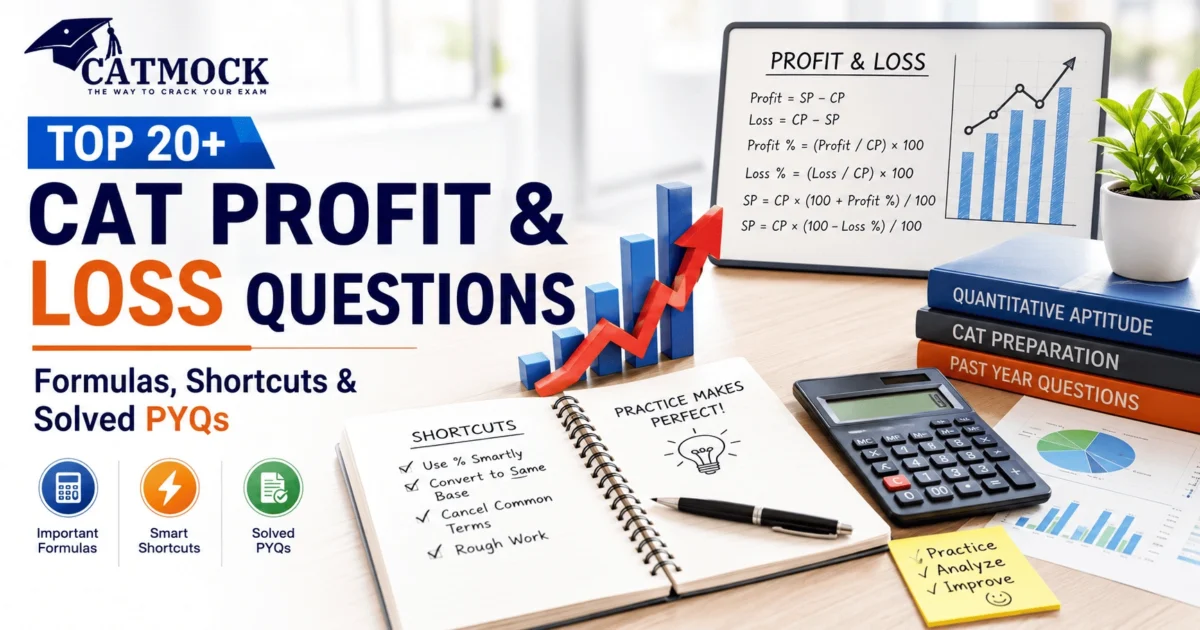
| Profit % | [(SP − CP) ÷ CP] × 100 |
| Loss % | [(CP − SP) ÷ CP] × 100 |
| SP from Profit % | SP = CP × (1 + P%/100) |
| Successive Profit/Loss (x%, y%) | Net% = x + y + xy/100 |
| Markup then Discount | Net% = (1 + m%/100)(1 − d%/100) − 1 |
| Dishonest Trader (False Weight) | [(True Weight − False Weight) ÷ False Weight] × 100 |
Remember this one: a 40% markup followed by a 25% discount does not cancel out to zero. The discount applies on the marked price, while profit is measured against the cost price. Mixing up these two bases is where most silly mistakes happen.
Types of Profit and Loss Questions in CAT
| Question Type | What It Tests | Difficulty |
|---|---|---|
| Basic CP-SP-Profit% | Direct formula application | Easy |
| Successive discounts/markups | Compounding percentages | Easy–Medium |
| Dishonest shopkeeper (false weight) | Converting weight tricks into profit% | Medium |
| Mixed selling price | Weighted average of two transactions | Medium |
| Multi-party resale (A sells to B, B sells to C) | Tracking CP/SP across a chain | Medium–Hard |
| Break-even/contribution problems | Profit = (Actual sales − Break-even sales) × Contribution per unit | Hard |
Chain-resale problems — where one person sells to a second, who resells to a third — show up almost every year in some form. They’re less about formulas and more about carefully tracking whose CP and SP you’re using at each step.
TITA-based profit and loss questions have also become more common. Since they carry no negative marking, attempt them first if you’re confident with the concept.
5 Solved Questions with Approach
Q1. A vendor bought 6 oranges for ₹10 and sold them at 4 for ₹6. Find his loss or profit percentage.
Take the LCM of 6 and 4 (= 12 oranges) so cost and selling price are compared on the same base. Then apply the standard profit/loss formula.
Q2. A shopkeeper sells at cost price but uses a false weight of 900g instead of 1kg. Find his actual profit percentage.
Always divide by the false weight — that’s what he actually paid for, not the true weight he claims to sell.
Q3. A merchant buys two items for ₹3,000 each, sells one at 20% profit and the other at 20% loss. Find the net result.
This is the “common gain or loss” trap. Equal-value items sold at equal and opposite percentages always result in a net loss — never zero. Shortcut: Loss % = (common%/10)².
Q4. Amar sold a bike to Akbar at a 20% loss. Akbar sold it to Anthony at another 20% loss. Akbar’s loss was ₹1,200 less than Amar’s. Find Amar’s cost price.
Let Amar’s CP = x. Find Akbar’s SP (Amar’s post-loss price), then use it as Akbar’s CP. Form an equation using the ₹1,200 difference and solve.
Q5. A shopkeeper sells three-fifths of his rice stock at 12% profit and the rest at 7% profit. Find his overall profit percentage.
Use a weighted average — multiply each stock fraction by its profit percentage and add — instead of simply averaging 12% and 7%.
For more practice at this level, try the CAT PYQ or attempt a QA Daily Practice test built around similar arithmetic questions.
📥 Want more practice? Download our free CAT Profit and Loss Questions PDF — 20 more solved questions with step-by-step solutions.
Common Mistakes to Avoid
- Confusing Marked Price with Cost Price — discounts apply on MP, profit is measured on CP.
- Assuming equal profit and loss percentages cancel out — they never do; there’s always a net loss.
- Ignoring hidden costs — add repair or transport charges to CP before computing profit%.
- Dividing by the wrong weight in false-weight problems — use the false weight, not the true one.
- Losing track of whose CP/SP you’re using in multi-party resale problems.
How to Solve Any Profit and Loss Question Faster
- Identify the base first — is the percentage on CP, SP, or MP? This decides your formula.
- Use fractions, not decimals — 20% as 1/5 is faster to work with mentally.
- Assume convenient values — if actual CP/SP isn’t given, assume CP = 100 to simplify.
- Sanity-check the direction — before finalising, ask if a profit or loss even makes sense here.
Preparation Timeline
| Phase | Focus | Practice |
|---|---|---|
| Week 1–2 | Formulas, basic CP-SP problems | 15–20 questions per sub-topic |
| Week 3–4 | Discounts, false weight, mixed SP | Topic-wise timed sets |
| Week 5–6 | Multi-party resale, break-even | Previous years’ CAT questions |
| Week 7 onward | Integrate with full mocks | Full-length CAT mock tests |
Once you’re comfortable with the concepts, move to CAT Full Length Mock Tests to practice under real exam conditions, or explore the free QA Bhandara practice sets to drill arithmetic questions at scale.
Key Takeaways
- Profit and Loss falls under Arithmetic, the highest-weightage area in CAT Quant.
- Six formulas cover almost every question type: Profit%, Loss%, SP from Profit%, successive profit/loss, markup-discount, and false weight.
- Always identify the base (CP, MP, or SP) before applying a formula.
- Equal and opposite profit/loss percentages on the same value always give a net loss, never zero.
- Practice actual CAT PYQs, not just generic textbook problems — CAT-specific traps rarely appear elsewhere.
- Combine formula practice with timed mocks to build speed along with accuracy.
Frequently Asked Questions
Q1. What is the basic formula for profit and loss in CAT exam questions?
Profit is Selling Price minus Cost Price when SP is higher; Loss is Cost Price minus Selling Price when SP is lower. Profit% = [(SP−CP)/CP] × 100, and Loss% = [(CP−SP)/CP] × 100. Most CAT questions, however complex, reduce to one of these two relationships once you correctly identify the CP and SP.
Q2. How many profit and loss questions come in CAT every year?
Usually 1–3 per slot, often combined with Percentages under Arithmetic. The exact count varies by year and slot, so it’s safer to prepare the topic thoroughly rather than count on a fixed number.
Q3. Are CAT profit and loss questions difficult compared to other Quant topics?
Most aspirants find them easier than Geometry or Modern Math since they’re built on learnable concepts. CAT still raises the difficulty through successive discounts, false weights, or multi-party resale, so conceptual clarity matters more than memorising formulas.
Q4. What is the best way to practice CAT profit and loss questions before the exam?
Solve 15–20 questions per sub-topic first, then move to actual previous years’ CAT questions to see how the topic is disguised, and finally integrate it into full-length timed mocks.
Q5. Can I skip Profit and Loss and still score well in CAT Quant?
Not advisable. It sits within Arithmetic, the largest weightage area in Quant, so skipping it means giving up easily gettable marks in favour of harder topics.
Conclusion
CAT profit and loss questions reward preparation directly — the formulas are fixed, and once you’ve seen the traps, they become easy to spot. Learn the six core formulas, understand each question type, watch for the common mistakes above, and pressure-test everything with timed practice.
Start with the CAT Quantitative Aptitude question bank, then take a free CAT mock test to see where you stand. For official exam updates and registration, check the official CAT website. For foundational arithmetic concepts, NCERT’s mathematics resources are a reliable free reference.
You May Also Like : CAT MOCK / CAT MOCK PYQ
Follow Us On : Facebook / Instagram