
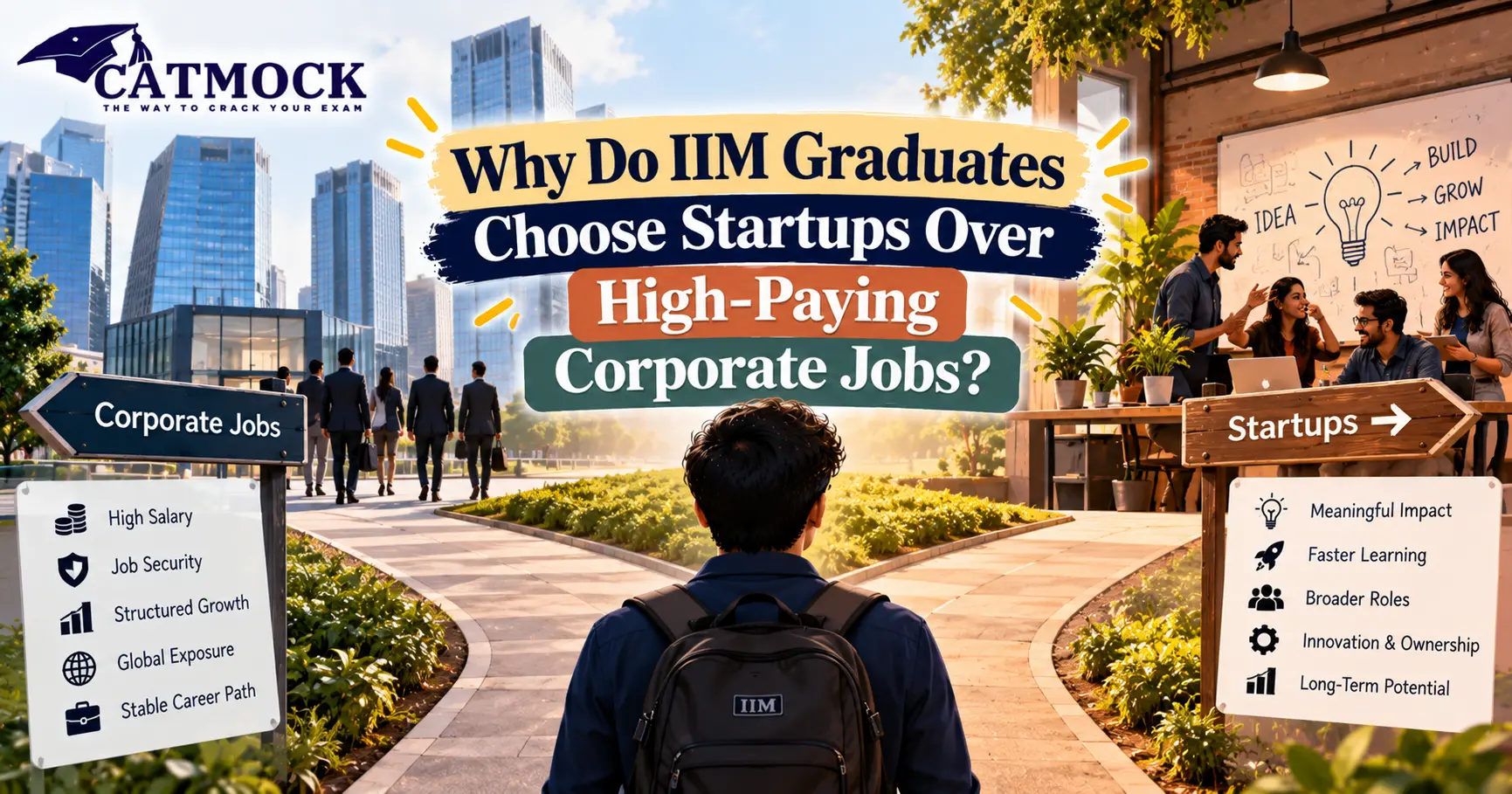
Imagine this. It is placement season. A top consulting firm has offered you a polished, high-paying role with a brand name that makes your parents proud. In your other hand, a three-year-old startup offers a smaller cash package, a vague job title, a stack of stock options and a founder who says, “Come build this with us.”
Which would you pick?
For a small but visible group of MBA graduates, the answer is the startup. That choice puzzles friends, alarms families and fascinates aspirants preparing for CAT. So why do IIM graduates choose startups over high-paying corporate jobs? The honest answer has several layers, and it begins with a reality check that most articles skip.
This guide explains the real motivations, the risks, the pay trade-offs and a practical framework to decide for yourself.
Reality Check: Do Most IIM Graduates Really Choose Startups?
Let us fix the premise first. The popular story says that IIM graduates are abandoning corporate jobs en masse. The data does not support that.
- A widely cited analysis of Tracxn data, reported in 2022, counted about 5,489 startups founded by graduates of seven IITs, against about 1,517 founded by graduates of three IIMs (Ahmedabad, Bangalore and Calcutta).
- The same report notes that India produces an estimated 1.5 million engineers and over 300,000 MBA graduates a year, so the raw numbers are not directly comparable.
- Commentary in business media points to a simple pattern: management graduates tend to enter the job market a few years older than engineers and often carry education loans, which makes stability more attractive.
So the accurate picture is this: most IIM graduates still take corporate jobs, and a minority choose startups. The more interesting question is why that minority does so, and why the group is visibly growing in conversation, even if not in headcount.
Table 1: Popular Myth vs Reality
| Popular belief | What the evidence suggests |
|---|---|
| “IIM graduates are rushing into startups” | Most still choose established corporates; startups attract a minority |
| “Startup jobs always pay less” | Cash pay varies widely; some well-funded startups have matched or beaten traditional sectors, while many pay less in cash and add equity |
| “Startups are for those who cannot get corporate offers” | Many who join startups held strong corporate offers, which is exactly what makes the choice notable |
| “IIM graduates start companies right after graduating” | Many founders work for several years first and start up later |
| “A startup is always riskier than a corporate job” | Risk is real, but corporate roles carry their own risks, such as layoffs and slow growth |
Note that the pay-comparison data you will see quoted online often dates back several years. One frequently cited example from around 2016 compared packages at a leading e-commerce startup with those in banking and financial services. Treat such figures as historical illustrations, not current benchmarks.
The Real Reasons Some IIM Graduates Choose Startups
1. Speed of Growth and Early Responsibility
In a large corporate, a fresh MBA may spend years in a defined role under a layered hierarchy. In an early-stage startup, a graduate can end up owning a market, a product line or a P&L within months. For ambitious people, responsibility per year matters more than the first salary.
2. Equity and Ownership
Startups often offer a smaller cash package plus stock options. The logic is simple: if the company grows, equity could be worth far more than a salary difference. This is a bet, not a promise. Employees stock optoins can become valuable, or they can become worthless if the company fails or does not reach an exit.
3. A Steeper Learning Curve
Startups force generalist thinking. One week you are building a pricing model, the next you are negotiating with a vendor and then fixing a broken process. Many graduates describe this as “two years of learning in six months”, and they see it as a stronger foundation if they later want to found a company or lead a business unit.
4. Autonomy and Impact
In a startup, your decisions visibly move the business. For people who dislike narrow roles and slow approvals, that sense of impact is a strong motivator, and money alone rarely replaces it.
5. Compensation Is Not Always Far Apart
At well-funded startups, cash packages can be competitive with traditional sectors, and equity sits on top. This is not universal. In many early-stage ventures the cash component is lower, so the decision depends on the specific company’s funding and stage.
6. The IIM Brand Acts as a Safety Net
Here is the reason people rarely say aloud. The IIM credential lowers the cost of failure. If the startup shuts down, the graduate can often return to a corporate role. That safety net makes the leap less frightening than it would be for someone without the brand.
7. A Richer Ecosystem
Alumni networks, campus entrepreneurship cells, incubators and a visible founder culture have made startups feel like a normal career path rather than an eccentric one. Government initiatives such as Startup India have also helped normalise the idea, and the broader notion of a startup company is now part of everyday career conversation.
8. Frustration with Rigid Corporate Structures
Some graduates leave or avoid corporate roles because of slow promotion cycles, high churn in certain sectors such as consulting, or a desire for mission-driven work. These are real factors, though they vary by company and role.
Startup vs Corporate: A Side-by-Side Comparison
Table 2: Startup Job vs High-Paying Corporate Job for an MBA Graduate
| Factor | Startup | Large corporate |
|---|---|---|
| Cash compensation | Varies widely; often lower early on | Usually higher and more predictable |
| Equity / upside | Potentially significant, highly uncertain | Limited, but more stable |
| Job security | Lower; depends on funding and growth | Higher, though layoffs still happen |
| Role scope | Broad, undefined, fast-changing | Defined, structured, narrower |
| Learning style | Learn by doing, less formal training | Structured training and mentoring |
| Speed of promotion | Can be fast if the company grows | Usually steady and process-driven |
| Brand value on the CV | Depends on the startup’s reputation | Strong, widely recognised names |
| Work-life balance | Often unpredictable and intense | Varies by industry; often more defined |
| Exit options | Strong if the startup does well or you build skills; weaker if it fails quietly | Broad and well understood |
No column “wins” in every row. The better choice depends on your goals, finances and temperament.
The Risks Nobody Puts in the Brochure
An honest answer to “why do IIM graduates choose startups?” must include what can go wrong.
Table 3: Startup Risks and Practical Mitigations
| Risk | Why it matters | How to reduce it |
|---|---|---|
| Funding runway ends | The startup may shut down or cut staff | Ask how many months of runway remain and who the investors are |
| Equity may be worthless | Options pay only after an exit and only if value grows | Value equity at zero when comparing offers, and treat any payoff as a bonus |
| Education loan EMIs | Lower cash pay can strain repayments | Calculate monthly obligations before accepting; do not rely on equity to pay bills |
| Weak mentorship | No formal training or seniors to learn from | Ask about the manager’s background and how feedback works |
| Vague role and scope creep | You may do many jobs without clear growth | Get the role scope and review criteria in writing |
| Burnout | Long hours and constant pressure | Ask current employees about working norms |
| Reputation risk | A failed or troubled startup can raise questions | Choose companies with credible founders and transparent finances |
Commentary in business media also notes that startups themselves are risky for anyone working in the sector, not just freshers. That is why careful evaluation matters more than enthusiasm.
Why Many IIM Graduates Still Prefer Corporate Jobs
To understand the minority, you must understand the majority.
- Education loans and family expectations. A large fee and a family that has sacrificed for the degree make a stable salary attractive.
- Age and life stage. Graduates entering the market in their mid-twenties often value stability, and some commentators link this directly to the lower rate of founding.
- Brand and structure. Large firms offer training, mentoring and a clear path.
- Credibility with future employers. A recognised corporate name travels well on a CV.
- Opportunity cost. Giving up a high-paying offer carries a real opportunity cost that not everyone can absorb.
None of these is a failure of ambition. For many, corporate success is a deliberate and rational choice.
Four Paths, Not Two
The debate is often framed as “startup or corporate”, but real careers have more options.
Table 4: Four Career Paths and Who They Suit
| Path | What it looks like | Best suited for |
|---|---|---|
| Corporate first, startup later | 2 to 5 years at a large firm, then move to a startup or found one | Those who want skills, savings and credibility before taking risk |
| Join an early-stage startup | Generalist role in a small, funded team | High risk-takers with low financial pressure |
| Join a late-stage or established startup | Structured role with some equity and faster growth | Those who want startup pace with lower risk |
| Found your own company | Full ownership, full uncertainty | Candidates with a strong idea, a team and a financial cushion |
Many people find the corporate-first route the most balanced. It builds skills and a cushion, and the IIM brand keeps the startup door open.
A 7-Question Framework to Decide
Use these questions honestly. Write your answers down.
- What is my monthly financial floor? Include loan EMIs and family commitments. If cash pay does not cover it, equity cannot rescue you.
- How long can I go without a salary or with a pay cut? This tells you your real risk capacity.
- What do I want to learn in the next three years? Pick the environment that teaches it fastest.
- Do I need structure and mentorship, or do I thrive in ambiguity? Be honest about your style.
- Do I believe in this specific company, not startups in general? The founders and the business model matter more than the label.
- What is my exit if it fails? Know your fallback before you jump.
- Will I regret not trying more than trying and failing? This question separates curiosity from impulse.
How to Evaluate a Startup Offer Like a Professional
Before saying yes to any startup, check these points:
- Funding and runway: How much capital remains, and for how many months?
- Founders: What is their track record, and do they communicate openly?
- Business model: Does the company earn money or depend entirely on the next funding round?
- Equity terms: What are the vesting schedule, cliff and strike price? Ask for the documents.
- Role clarity: What exactly will you own, and how will your performance be measured?
- Manager quality: Who will you report to, and what can you learn from them?
- Cash vs equity split: Could you live comfortably on the cash alone?
This is general information, not financial advice. For complex equity or tax questions, consult a qualified professional.
What This Means for MBA Aspirants
If you are preparing for CAT and the IIMs, the startup trend matters for two practical reasons.
First, look beyond headline placement numbers. Check which sectors recruit, how many students join startups and what entrepreneurship support the campus offers.
Second, choose your programme with your goals in mind. If entrepreneurship matters to you, look at incubators, alumni founders and elective options. The Indian Institutes of Management vary in culture and strengths, so research each one carefully. You can also read our guides on IIM Interview Preparation and CAT percentile vs IIM calls.
Summary
- The premise needs correcting: most IIM graduates still choose corporate jobs, and startups attract a minority.
- Reported data show IIM alumni have founded far fewer startups than IIT alumni, though the pool sizes differ.
- Those who choose startups are usually drawn by faster growth, equity, learning, autonomy and impact.
- The IIM brand lowers the cost of failure, which makes the leap less scary.
- The risks are real: funding runway, worthless equity, loan EMIs and weak mentorship.
- Many graduates prefer corporate roles for stability, structure and credibility, and that is a rational choice.
- The corporate-first, startup-later path is a popular middle route.
- Use the seven-question framework and the offer checklist before deciding.
Frequently Asked Questions (FAQs)
1. Do most IIM graduates really join startups?
No. Most still take roles at established corporates, consulting firms and financial institutions. Startups attract a smaller group, and reported data show IIM alumni have founded fewer startups than IIT alumni, although the number of graduates differs between the two groups.
2. Why do some IIM graduates choose startups over high-paying corporate jobs?
Common reasons include faster growth, early responsibility, equity upside, a steeper learning curve and the desire for autonomy and impact. The IIM brand also acts as a safety net, which lowers the perceived cost of failure.
3. Do startups pay less than corporate jobs for MBA graduates?
It depends. Some well-funded startups offer competitive cash packages, while many early-stage ones pay less in cash and add equity. Equity is uncertain, so compare offers on cash value first and treat equity as a possible bonus.
4. Is it better to join a corporate job first and a startup later?
Many people find this route balanced. A few years in a corporate role can build skills, savings and credibility, and the IIM brand keeps startup opportunities open. The right choice still depends on your finances and goals.
5. How can I judge whether a startup offer is worth taking?
Check the funding runway, founder track record, business model, equity terms, role clarity and manager quality. Make sure the cash pay covers your monthly commitments, and have a clear plan for what you will do if the startup fails.
Conclusion
The question “why do IIM graduates choose startups over high-paying corporate jobs?” has a surprising first answer: most do not. The minority who do are rarely chasing glamour. They are trading cash and certainty for growth, ownership and learning, often with the IIM brand quietly cushioning the fall.
For you, the real task is not to copy their choice or reject it, but to understand your own finances, appetite for risk and goals. Run the seven-question framework, evaluate any offer with a cool head and remember that a corporate-first, startup-later path is a perfectly respectable middle road. Whatever you choose, choose it deliberately, and your career will start on firmer ground.
You May Also Like : CAT MOCK, CAT MOCK PYQ
Follow Us On : Facebook, Instagram, Youtube