
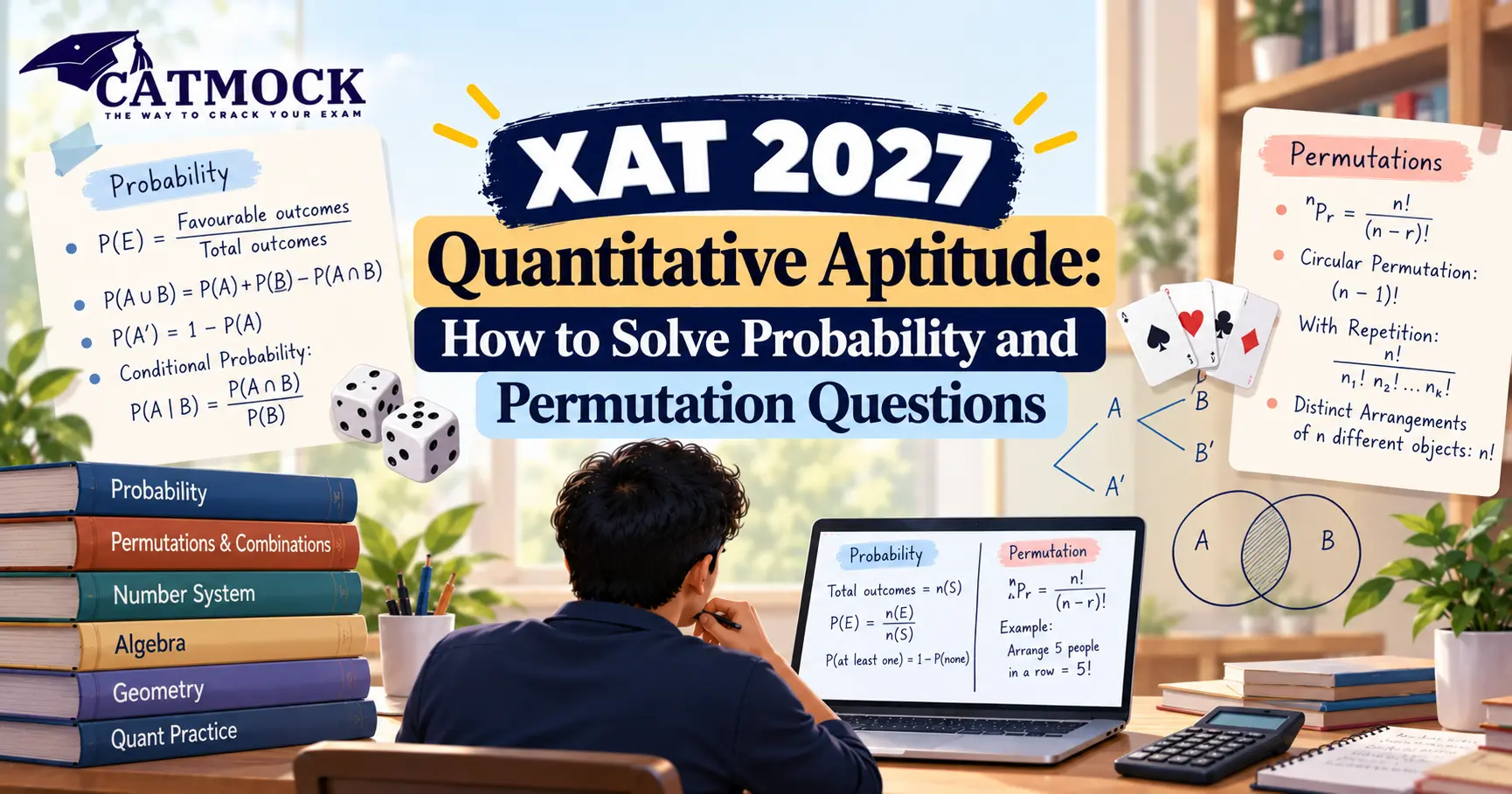
You glance at an XAT quant question: “Five people are to be seated in a row, and two of them refuse to sit apart…” Your mind freezes. Is it a permutation? A combination? Do you multiply, add or divide? Many aspirants lose precious minutes at exactly this point, not because the maths is hard, but because they cannot decide which tool to pick.
This guide fixes that. Whether you are an aspirant in the final stretch or just starting your XAT 2027 Quantitative Aptitude preparation, you will learn a clear decision process, the formulas that matter, ten fully solved questions and a four-week plan. The goal is simple: make probability and permutation questions feel predictable.
Why Probability and Permutation Matter in XAT 2027
Several preparation reviews point to the same fact: the Quantitative Ability and Data Interpretation (QADI) block is the largest in Part 1, with around 28 questions, and Modern Math topics such as probability, permutation and combination, and set theory are repeatedly flagged as high-priority areas. XAT is conducted by XLRI Jamshedpur, and the official XAT website publishes the notification, so always confirm the latest dates and exam pattern there. Current reports place XAT 2027 on 3 January 2027, but treat that as a date to verify.
Here is why this chapter pays off:
- It is conceptual, not calculation-heavy. One clear idea often replaces a page of working.
- XAT likes application. Questions are wrapped in real-world situations rather than plain formula drills.
- It links to other topics. Counting skills help in set theory, DI and even logic-based decision-making questions.
- It is learnable fast. A small toolkit covers a very large share of questions.
Permutation vs Combination: Master the Difference First
Before any formula, answer one question: Does the order matter?
- If order matters (arranging, ranking, forming words or numbers, seating), use a permutation.
- If order does not matter (selecting, choosing, forming a committee or team), use a combination.
A simple memory aid: a combination lock is really a permutation lock, because the order of digits matters. Keep that joke in mind and you will not mix them up.
Table 1: Essential Counting Formulas for XAT
| Situation | Formula | Example use |
|---|---|---|
| Fundamental counting principle | m × n (steps in sequence) | Outfits from shirts and trousers |
| Arranging n distinct objects | n! | Seating in a row |
| Arranging r of n objects | ⁿPᵣ = n!/(n − r)! | Forming 3-letter codes |
| Choosing r of n objects | ⁿCᵣ = n!/(r!(n − r)!) | Selecting a committee |
| Identical objects present | n!/(p! q! r!) | Letters of BANANA |
| Circular arrangement | (n − 1)! | People around a round table |
| Distribution (non-negative) | ⁿ⁺ʳ⁻¹Cᵣ | Dividing identical items among people |
| Distribution (each at least 1) | ⁿ⁻¹Cᵣ₋₁ | Each person gets at least one |
The distribution rows come from the “stars and bars” method. They appear often in XAT-style questions.
The 5-Step Method for Any Counting Question
Use this sequence every time:
- Define the objects. Are they distinct or identical?
- Check the order. Does the arrangement matter (permutation) or only the selection (combination)?
- Spot restrictions. Words like “together”, “not together”, “at least”, “exactly” and “adjacent” change the method.
- Choose a strategy. Direct counting, complement (total − unwanted), or block method.
- Sense-check. Is the answer smaller than the total possible outcomes? Is it a whole number?
Solving Permutation Questions: Worked Examples
Example 1: Arrangements with a “Together” Condition
Question: In how many ways can the letters of the word XAVIER be arranged so that the three vowels A, I and E are not all together?
Solution:
- Total arrangements (all letters distinct) = 6! = 720
- Treat A, I, E as one block: the block plus X, V and R makes 4 units, so 4! = 24 ways
- Inside the block, the vowels can be arranged in 3! = 6 ways
- Together = 24 × 6 = 144
- Not together = 720 − 144 = 576
Lesson: “Not together” is almost always solved by the complement method: count everything, subtract the “together” case.
Example 2: Circular Arrangement
Question: Six people sit around a round table. In how many ways can they sit if two particular people must sit together?
Solution:
- Treat the pair as one block: 5 units around the table = (5 − 1)! = 24
- The pair can swap places: 2 ways
- Total = 24 × 2 = 48
Follow-up: If the two must not sit together, the answer is 5! − 48 = 120 − 48 = 72.
Example 3: Forming Numbers with a Condition
Question: How many even four-digit numbers can be formed from the digits 1, 2, 3, 4, 5 without repetition?
Solution:
- Fill the restricted position first. The units digit must be 2 or 4, so there are 2 choices.
- The remaining three places use the other four digits: 4 × 3 × 2 = 24 ways
- Total = 2 × 24 = 48
Lesson: Always fill the restricted place first. This avoids messy subtraction later.
Example 4: Distribution Question
Question: How many non-negative integer solutions does x + y + z = 10 have?
Solution:
- Use ⁿ⁺ʳ⁻¹Cᵣ with n = 3 variables and r = 10
- ¹²C₂ = 66
- Answer: 66
If each variable must be at least 1, use ⁹C₂ = 36.
Solving Combination (Selection) Questions
Example 5: “At Least” Selection
Question: A committee of 4 is chosen from 6 men and 4 women. In how many ways can it have at least 2 women?
Solution (complement method):
- Total committees = ¹⁰C₄ = 210
- Fewer than 2 women means 0 or 1 woman:
- 0 women: ⁶C₄ = 15
- 1 woman: ⁴C₁ × ⁶C₃ = 4 × 20 = 80
- At least 2 women = 210 − (15 + 80) = 115
Check by direct counting: 2 women (90) + 3 women (24) + 4 women (1) = 115 ✓
Lesson: “At least” and “at most” are hints to use the complement when the opposite case has fewer terms.
Decision Guide: Which Tool Should You Use?
Table 2: Clue Words and the Method They Suggest
| Clue word or phrase | Meaning | Method |
|---|---|---|
| “Arrange”, “seat”, “rank”, “form words or numbers” | Order matters | Permutation |
| “Select”, “choose”, “committee”, “team” | Order does not matter | Combination |
| “Together”, “adjacent” | Group acts as one unit | Block method |
| “Not together”, “not adjacent” | Opposite of block | Total − together |
| “At least” or “at most” | Many cases | Complement |
| “Identical”, “same type” | Repeats exist | Divide by factorials |
| “Round table”, “necklace” | Rotational symmetry | (n − 1)! |
| “Divide among”, “distribute” | Stars and bars | ⁿ⁺ʳ⁻¹Cᵣ |
Probability: The Core Ideas
Probability = Favourable outcomes ÷ Total outcomes, when all outcomes are equally likely. Another word for the same idea is likelihood. A probability is always between 0 and 1.
Table 3: Probability Rules You Must Know
| Concept | Formula | When to use |
|---|---|---|
| Basic probability | P(E) = favourable/total | Equally likely outcomes |
| Complement | P(not E) = 1 − P(E) | “At least one” questions |
| Addition rule | P(A or B) = P(A) + P(B) − P(A and B) | Either event happens |
| Independent events | P(A and B) = P(A) × P(B) | Outcome of one does not affect the other |
| Conditional probability | P(A given B) = P(A and B)/P(B) | Information about B is given |
| Without replacement | Multiply with reduced totals | Cards, balls, draws |
| Expected value | Σ (value × probability) | Games, gains and losses |
Solving Probability Questions: Worked Examples
Example 6: Dice and Sample Space
Question: Two fair dice are rolled. What is the probability that the sum is 8?
Solution:
- Favourable outcomes: (2, 6), (3, 5), (4, 4), (5, 3), (6, 2) = 5
- Total outcomes = 36
- Probability = 5/36
Example 7: The “At Least One” Shortcut
Question: A fair coin is tossed 4 times. What is the probability of getting at least one head?
Solution:
- P(no heads) = (1/2)⁴ = 1/16
- P(at least one head) = 1 − 1/16 = 15/16
Lesson: Whenever you see “at least one”, think 1 − P(none).
Example 8: Drawing Without Replacement
Question: Two cards are drawn one after another, without replacement, from a standard deck. What is the probability that both are aces?
Solution:
- First ace: 4/52
- Second ace: 3/51
- Probability = (4/52) × (3/51) = 12/2652 = 1/221
Example 9: Conditional Probability
Question: A family has two children. Given that at least one is a boy, what is the probability that both are boys?
Solution:
- Possible families: BB, BG, GB, GG
- “At least one boy” removes GG, leaving BB, BG, GB (3 outcomes)
- Only BB has both boys
- Probability = 1/3
Common trap: Many candidates answer 1/2. The word given shrinks the sample space, so always rewrite the sample space after the condition.
Example 10: Permutation Meets Probability
Question: Five people, including A and B, are arranged randomly in a row. What is the probability that A and B stand next to each other?
Solution:
- Total arrangements = 5! = 120
- Favourable: treat A and B as a block, giving 4! = 24 arrangements, times 2 for their internal order = 48
- Probability = 48/120 = 2/5
Lesson: Many XAT questions are really counting problems wearing a probability costume. Count favourable and total outcomes with the same tools.
Bonus: Expected Value
Question: You roll a fair die. If an even number appears, you win that amount in rupees. If an odd number appears, you lose ₹3. What is your expected gain?
Solution:
- Gains: (2 + 4 + 6)/6 = 12/6 = 2
- Losses: 3 × 3/6 = 9/6 = 1.5
- Expected value = 2 − 1.5 = ₹0.50
Common Mistakes That Cost Marks
- Confusing order and selection. This is the number one error. Ask “does order matter?” every time.
- Forgetting internal arrangements in a block. The pair can swap, so multiply by 2.
- Counting identical objects as distinct. Always divide by the factorial of repeats.
- Ignoring the condition in “given” questions. Shrink the sample space first.
- Mixing replacement and non-replacement. In non-replacement draws the denominator falls with each draw.
- Overcounting with “or”. Subtract the overlap, as the addition rule says.
- Skipping the sanity check. A probability above 1 means something is wrong.
How to Manage Time and Attempts in XAT QADI
XAT rewards judgement. Not every question deserves your time. Here are practical rules:
- Do the cleanest counting questions first. Direct, short setups give fast marks.
- Attempt a question only if you can see the method in 30 seconds. Otherwise mark it and move on.
- Skip heavy casework early. Return to it if time remains.
- Check the official rules on unattempted questions and negative marking in the latest XAT notification, since these affect how many questions you should attempt. Never rely on old rules.
Your 4-Week Practice Plan for XAT 2027
Table 4: Four-Week Plan for Probability and Permutation
| Week | Focus | Daily target |
|---|---|---|
| Week 1 | Counting principle, permutations, combinations; clue-word table | 10–12 questions plus 1 revision of formulas |
| Week 2 | Block method, circular arrangements, distributions, “at least” selection | 10–12 questions, restrictions first |
| Week 3 | Probability basics, complement, independent and conditional events, expected value | 10 questions plus 1 timed mini-set |
| Week 4 | Mixed XAT-style questions, previous-year papers and mock tests | 1 timed QADI sectional plus error review |
Pro tips
- Keep a mistake log noting whether each error was in method, calculation or reading.
- Revise Tables 1 to 3 every weekend.
- Combine this chapter with XAT previous year quant questions and a full XAT mock test series.
- For related topics, read our guides on set theory and Venn diagrams for set and XAT Data Interpretation preparation.
Summary
- Probability, permutation and combination sit within XAT’s Modern Math cluster and are repeatedly flagged as high-priority for XAT 2027.
- Decide first: does order matter? Permutation if yes, combination if no.
- Use the block method for “together”, the complement for “not together” and “at least”, and stars and bars for distributions.
- In probability, always define the sample space, shrink it for “given” questions, and use 1 − P(none) for “at least one”.
- Many probability questions are counting questions in disguise.
- Build a mistake log and practise in four stages, from basics to timed mixed sets.
Frequently Asked Questions (FAQs)
1. Are probability and permutation questions important for XAT 2027?
Yes. Preparation reviews consistently list probability, permutation and combination among the high-priority Modern Math topics inside the QADI block, which has about 28 questions. Check the official XAT website for the latest pattern.
2. How do I know whether to use permutation or combination?
Ask whether the order of the result matters. Arranging, ranking and forming numbers or words call for permutations. Selecting, choosing and forming committees or teams call for combinations.
3. What is the fastest way to solve “at least” questions?
Use the complement method. Count the total or find the probability of the opposite case, then subtract. For example, P(at least one) = 1 − P(none).
4. Why do candidates get conditional probability wrong?
They forget that the “given” information shrinks the sample space. Rewrite the list of possible outcomes after applying the condition, then count the favourable ones within that smaller list.
5. How many probability and permutation questions should I practise before XAT 2027?
Aim for about 150 to 200 well-reviewed questions across basic, application and mixed levels. Quality matters more than quantity, so log every error and the reason behind it.
Conclusion
Probability and permutation questions reward the aspirant who asks the right first question: Does order matter, and what are the restrictions? Once you answer that, the rest is a short, predictable chain of steps. Block, complement, divide by repeats or shrink the sample space. That is the entire toolkit.
Start with the formula table, work through the ten solved examples until the reasoning feels natural, and follow the four-week plan. By the time XAT 2027 arrives, a counting question will look less like a trap and more like a reliable source of marks. Practise steadily, review honestly and walk in with confidence.
You May Also Like : CAT MOCK, CAT MOCK PYQ
Follow Us On : Facebook, Instagram, Youtube