

Updated: May 2026Target: CAT 2026 AspirantsReading Time: 8 min
📋 Table of Contents
- Why the Quants Section Decides Your IIM Fate
- CAT 2026 Quants Exam Pattern at a Glance
- Complete Topic-Wise Quants Syllabus for CAT 2026
- Year-Wise Weightage Analysis: CAT 2020–2025
- Topic Priority Visual: 5-Year Average
- Preparation Strategy Based on Weightage
- Frequently Asked Questions (FAQs)
Why the Quants Section Decides Your IIM Fate
Key Insight: The Quantitative Aptitude (QA) section accounts for one-third of the entire CAT exam — and consequently, it is often the section on which top IIM calls are won or lost.
Every year, lakhs of students sit for the Common Admission Test (CAT), dreaming of a seat at IIM Ahmedabad, Bangalore, Calcutta, or other premier B-schools. However, a significant number of those aspirants underestimate the Quantitative Aptitude section — often because their preparation is spread thin across too many topics without any regard for actual weightage.
Therefore, understanding the weightage-wise and year-wise distribution of the Quants syllabus becomes absolutely essential. Rather than approaching every topic with equal effort, a smarter strategy is built on data — specifically, on how the last six years of CAT papers have distributed questions across topics.
This guide has been crafted for three audiences: CAT 2026 aspirants who want clarity, parents who want to understand what their child is preparing for, and students who are just beginning their journey and need a structured starting point.
CAT 2026 Quants Exam Pattern at a Glance
Before diving into topic-wise weightage, the overall structure of the section must be understood. Based on patterns observed from CAT 2021 to CAT 2025, the Quantitative Aptitude section is expected to follow a similar format in CAT 2026.
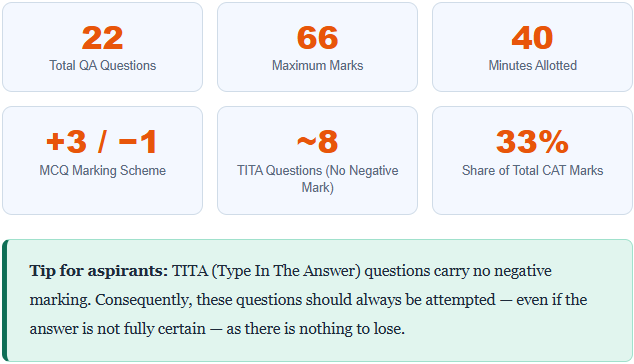
Furthermore, sectional cut-offs for QA at top IIMs typically range between the 70th and 85th percentile. Therefore, a score of approximately 40–45 out of 66 is generally considered competitive for IIM calls.CAT 2026 Quants SyllabusTopic-Wise Weightage Breakdown · Based on CAT 2020–2025 Trends22QuestionsArithmetic40%~8–9 questions per slotAlgebra30%~6–7 questions per slotGeometry & Mensuration15%~3–4 questions per slotNumber System8%~1–2 questions per slotModern Mathematics7%~1–2 questions per slotBased on CAT 2020–2025 average trends · Actual distribution may vary · Always refer to official IIM CAT notifications
Complete Topic-Wise Quants Syllabus for CAT 2026
The Quantitative Aptitude section is officially divided into five broad clusters. Each cluster carries a different weightage, and importantly, the sub-topics within each cluster are tested at varying levels of difficulty. Below, every cluster is covered in detail so that aspirants can plan their preparation accordingly.
1. Arithmetic — The Backbone (≈40% Weightage)
Arithmetic is consistently the most heavily tested cluster in CAT. Over the past six years, arithmetic questions have dominated every paper, regardless of slot or difficulty level. Consequently, this cluster must be treated as the foundation of your Quants preparation.
| Sub-Topic | Expected Questions | Priority | Common Question Types |
|---|---|---|---|
| Percentages | 1–2 | High | Successive %, profit applications |
| Profit, Loss & Discount | 1–2 | High | Cost price, selling price, marked price |
| Time, Speed & Distance (TSD) | 2–4 | High | Trains, boats, relative speed, circular tracks |
| Time & Work | 1–2 | High | Pipe & cistern, efficiency-based |
| Ratio & Proportion / Averages | 2–3 | High | Mixtures, alligation, weighted averages |
| Simple & Compound Interest | 1 | Medium | EMI, population growth, depreciation |
| Mixtures & Alligation | 1 | Medium | Repeated dilution, wine–water |
Expert Advice: TSD and Ratios/Averages are the two sub-topics that have appeared most consistently. Together, they are capable of contributing 4–6 questions in a single slot, which means mastering them can directly translate to 12–18 marks.
2. Algebra — The Game Changer (≈30% Weightage)
Algebra is the second-most important cluster and has grown in prominence over recent years, particularly with inequalities surging in CAT 2025. Moreover, Algebra-based questions tend to be more conceptual than arithmetic ones, meaning deeper understanding — rather than rote application — is rewarded.
| Sub-Topic | Expected Questions | Priority | Key Concepts |
|---|---|---|---|
| Linear & Quadratic Equations | 1–2 | High | Roots, discriminant, Vieta’s formulas |
| Inequalities | 2–4 | High | Modulus, absolute value, AM–GM, boundary conditions |
| Functions & Graphs | 1–2 | High | Domain, range, composite functions, piecewise |
| Sequences & Series / Progressions | 1–2 | High | AP, GP, HP, sum formulas, telescoping |
| Logarithms | 1–2 | Medium | Log rules, change of base, exponential equations |
| Polynomials | 1 | Medium | Remainder theorem, factor theorem |
CAT 2025 Trend Alert: Inequalities appeared 4 times in Slots 1 and 2 of CAT 2025 — the highest frequency in recent history. Therefore, aspirants preparing for CAT 2026 must dedicate significant time to this sub-topic.
3. Geometry & Mensuration — The Consistent Scorer (≈15% Weightage)
Geometry holds a steady presence in CAT, with approximately 3–4 questions appearing in every slot over the past five years. Furthermore, geometry questions are typically formula-intensive and reward those who have practised a wide variety of problem types.
- Lines & Angles: Parallel lines, transversals, angle sum properties
- Triangles: Congruence, similarity, Pythagoras, special triangles (30-60-90, 45-45-90), incentre, circumcentre
- Circles: Chord properties, tangent-secant theorems, angle subtended at centre vs circumference
- Quadrilaterals & Polygons: Properties of parallelogram, trapezium, rhombus
- Coordinate Geometry: Distance formula, section formula, slope, collinearity, locus
- Mensuration (2D & 3D): Areas of standard shapes, surface area and volume of solids
4. Number System — The Wild Card (≈8% Weightage)
Although the number system cluster carries a lower average weightage, it is one of the most unpredictable areas in CAT. In certain years, such as CAT 2023, number theory questions appeared more frequently and at higher difficulty. Additionally, number system questions often appear as TITA-type problems, making them uniquely valuable since there is no negative marking.
- LCM, HCF and their applications
- Divisibility rules and prime factorisation
- Remainders — Fermat’s Little Theorem, Chinese Remainder Theorem (basic)
- Base conversions (binary, octal, hexadecimal)
- Factorials, trailing zeroes, highest power of a prime in n!
- Surds and indices
5. Modern Mathematics — The Bonus Marks (≈7% Weightage)
Modern Maths covers topics like Permutations & Combinations, Probability, Set Theory, and Venn Diagrams. Although this cluster generally contributes only 1–2 questions per slot, it is included in the syllabus and has occasionally surprised aspirants with a higher presence. Moreover, these topics often overlap with Logical Reasoning, making them doubly useful.
- Permutations & Combinations: Arrangements, selections, circular permutations
- Probability: Basic classical probability, conditional probability
- Set Theory & Venn Diagrams: Two-set and three-set problems
Year-Wise Weightage Analysis: CAT 2020–2025
Understanding how the distribution of topics has shifted year by year is one of the most effective ways to build a data-driven preparation plan. Below is a consolidated year-wise analysis based on official CAT papers.
| Year | Total QA Qs | Arithmetic | Algebra | Geometry | Number System | Modern Maths | Difficulty |
|---|---|---|---|---|---|---|---|
| 2025 | 22 | 8–9 | 7–8 | 3 | 2 | 1–2 | Moderate–Hard |
| 2024 | 22 | 9–10 | 6–7 | 3 | 2–3 | 1 | Moderate |
| 2023 | 22 | 8–9 | 6 | 3–4 | 2–3 | 1–2 | Difficult |
| 2022 | 22 | 7–8 | 7 | 4 | 2 | 1–2 | Moderate |
| 2021 | 22 | 8–9 | 5–6 | 3–4 | 2–3 | 1–2 | Moderate |
| 2020 | 26 | 10–11 | 7 | 4 | 3 | 2 | Moderate |
A careful look at this data reveals a very consistent pattern: Arithmetic and Algebra together account for 65–70% of the section in virtually every year. Additionally, Geometry has maintained a steady presence of 3–4 questions, while Number System and Modern Mathematics serve as supporting topics rather than primary scoring areas.
Notably, CAT 2025 brought a significant shift in Algebra — specifically, Inequalities dominated with 4 questions in both Slots 1 and 2. Similarly, TSD surged to 4 questions in Slot 3 of CAT 2025 — the highest single-topic count in recent memory. These trends strongly suggest that CAT 2026 aspirants must be prepared for similar topic surges.
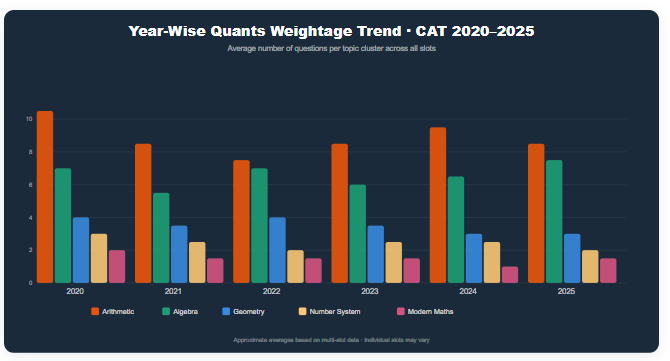
5-Year Average: Topic Priority Visual
The following weightage distribution is drawn from the average of CAT 2020–2025 across all slots. Consequently, this breakdown serves as the most reliable guide for deciding how much preparation time to allocate to each topic cluster.
Arithmetic-40%
Algebra-30%
Geometry & Mensuration-15%
Number System-8%
Modern Mathematics-7%
Preparation Strategy Based on Weightage
Given the data analysed above, a structured and phased preparation strategy is the most effective approach for CAT 2026. However, simply knowing the syllabus is not enough — how time is allocated to each cluster will ultimately determine the score.
Phase 1: Foundation Building (Months 1–3)
During this phase, all five topic clusters should be covered at a fundamental level. Arithmetic and Algebra must receive the most time — ideally 60% of daily study hours — while Geometry, Number System, and Modern Maths can be covered at a slower pace. Additionally, NCERT textbooks (Class 9–10) are highly recommended as starting points for those who are returning to mathematics after a gap.
Phase 2: Intensive Practice & Mock Tests (Months 4–6)
Once the fundamentals are covered, topic-wise mock tests should be introduced. Specifically, aspirants are advised to solve at least 20–30 questions per sub-topic before moving on. Furthermore, timed practice sessions should be started during this phase, as speed is a critical factor in the 40-minute sectional time limit.
Phase 3: Full-Length Mocks & Revision (Months 7–9)
At least two full-length CAT mock tests should be taken per week during this final phase. Moreover, previous years’ CAT papers (2020–2025) should be solved in exam conditions — three slots per year, timed strictly. Error analysis after every mock is non-negotiable.
📐
Prioritise Arithmetic First
Begin with TSD, Percentages, and Averages. These three sub-topics alone can yield 5–7 marks reliably.
📊
Master Inequalities in Algebra
CAT 2025 showed 4 inequality questions in a single slot. This sub-topic cannot be skipped in 2026 preparation.
🎯
Attempt TITA Questions Always
No negative marking on TITA means every attempt is risk-free. Never leave a TITA question unattempted.
🔁
Revise via Previous CAT Papers
Solving CAT 2020–2025 papers is the single most effective mock-preparation tool available.
Recommended Books for CAT 2026 Quants
- Quantitative Aptitude for CAT — Arun Sharma (McGraw Hill)
- How to Prepare for Quantitative Aptitude for the CAT — Arun Sharma
- Quantitative Aptitude Quantum CAT — Sarvesh Kumar Verma (Arihant)
- NCERT Mathematics (Class 9–10) — For foundational arithmetic and algebra
- Previous Year CAT Papers (2015–2025) — IIM official papers with solutions
What Is CAT, and Why Does It Matter?
The Common Admission Test (CAT) is a national-level entrance examination conducted annually by one of the IIMs on a rotational basis. It is the gateway to MBA admission at all 20 IIMs and over 1,200 other business schools across India. A high CAT percentile — ideally above 99 — opens doors to IIM Ahmedabad, Bangalore, and Calcutta, which are globally ranked institutions offering transformative career opportunities.
How Long Does Preparation Take?
A serious CAT preparation journey typically spans 6–12 months. Consequently, aspirants often need to balance preparation with their current college studies or jobs. Therefore, a quiet and supportive environment at home makes a significant difference to focus and consistency.
What Does “Quants” Actually Mean?
The Quantitative Aptitude section — often called “Quants” — tests mathematical reasoning at the Class 10–12 level, but with significantly higher application difficulty. It is not about memorising formulas; rather, it is about understanding concepts deeply enough to apply them in novel, multi-step problem scenarios.
Frequently Asked Questions (FAQs)
Below are the most commonly asked questions by CAT aspirants, their parents, and first-time students. Each answer has been crafted to provide clear and actionable guidance.
The CAT 2026 Quants syllabus covers five major clusters: Arithmetic (Percentages, TSD, Time & Work, Profit & Loss, Ratios & Averages), Algebra (Linear & Quadratic Equations, Inequalities, Functions, Logarithms, Progressions), Geometry & Mensuration (Lines, Triangles, Circles, Coordinate Geometry, 2D/3D figures), Number System (LCM, HCF, Remainders, Divisibility, Base Systems), and Modern Mathematics (Permutations & Combinations, Probability, Set Theory). No official notification is released for syllabus changes — the pattern is inferred from previous years’ papers.
Conclusion: Your CAT 2026 Quants Action Plan
The CAT 2026 Quantitative Aptitude section is fundamentally conquerable with the right strategy. As the data consistently shows, Arithmetic and Algebra together account for nearly 70% of the section — meaning that mastering these two clusters alone is sufficient to reach a strong sectional percentile.
Furthermore, this guide makes clear that the syllabus has not changed dramatically year on year, but the emphasis within topics does shift. Consequently, aspirants who track year-wise trends — rather than treating every topic with equal weight — are better positioned to score high.
Finally, to every aspirant reading this: the journey to a top IIM is demanding but enormously rewarding. Start early, practise consistently, analyse your errors ruthlessly, and trust the process. Your CAT 2026 success story begins with the decision to start today.
You may also visit: CATMOCK INDIA|CATMOCK