


Published: May 2025 | Reading Time: ~10 min | Category: MBA Admissions Guide
📋 Table of Contents
- What Does 85–90 Percentile Mean in CAT?
- Why This Percentile Range Matters More Than You Think
- Top MBA Colleges Accepting 85–90 Percentile
- Understanding the Selection Process
- How Your Overall Profile Plays a Crucial Role
- Smart Application Tips to Maximise Your Chances
- Admission Timeline for CAT 2026
- 15 Frequently Asked Questions
What Does 85–90 Percentile Mean in CAT?
Understanding Your Percentile Score
The CAT percentile score reflects how a candidate performs relative to all other test-takers in that particular year. Specifically, an 85–90 percentile means you outperformed 85 to 90 percent of all participants. Furthermore, this band represents a highly competitive zone — one that unlocks doors to a surprisingly wide range of quality MBA programmes across India.
More Options Than You Realise
Contrary to popular belief, scoring in this range does not restrict aspirants to only second-tier institutions. Rather, numerous reputed and accredited B-schools actively seek candidates who fall within this percentile bracket. Additionally, many of these colleges deliver excellent placements, strong industry connections, and experienced faculty.
Scale of the Competition
Recent trends show that roughly 2.5 lakh candidates score between 85 and 90 percentile each year. Therefore, understanding which colleges best match this profile can significantly sharpen an applicant’s strategy and save both time and effort.
Why This Percentile Range Matters More Than You Think
The Hidden Ecosystem of Mid-Range B-Schools
Many CAT aspirants make the mistake of fixating solely on the IIM-A, B, C dream while neglecting the rich ecosystem of B-schools that operate in this productive middle zone. However, a closer look at placement records and alumni networks reveals that several colleges in this range punch well above their weight. Moreover, these institutes attract sharp competition, and the calibre of peers remains consistently high.
A Richer Classroom Experience
Beyond placements, this percentile band often attracts a more diverse candidate pool — professionals with varied work experience, engineers, commerce graduates, and humanities students alike. Consequently, the classroom environment at these colleges benefits from a wide spectrum of perspectives. Additionally, smaller batch sizes at some institutions mean greater individual attention from faculty.
“An 85–90 percentile in CAT is not a consolation prize — it is a legitimate launchpad for a rewarding management career, provided candidates apply wisely and interview exceptionally.”
Top MBA Colleges Accepting 85–90 Percentile
College Comparison at a Glance
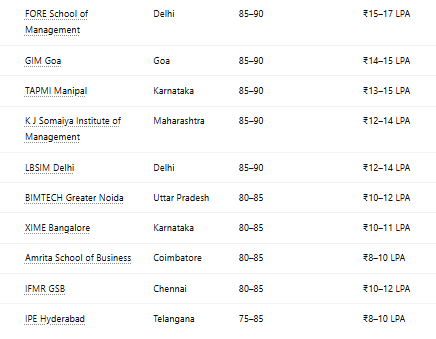
The table below summarises some of the most sought-after business schools where an 85–90 percentile in CAT 2026 stands as a competitive score. Furthermore, the average placement packages come from recent placement reports and may vary annually. Prospective applicants should therefore verify current figures directly from official college websites.
A Note on Cutoff Thresholds
While the table lists minimum percentile thresholds, actual shortlisting cutoffs shift each year based on the number of applicants and seat availability. Consequently, candidates scoring at 85–86 percentile should apply broadly across multiple colleges to maximise their chances.
Understanding the Selection Process
Beyond the CAT Score: A Multi-Stage Journey
Most reputable B-schools run a multi-stage selection process that extends well beyond CAT scores alone. Typically, the journey starts with an initial shortlisting based on CAT percentile, followed by a Written Ability Test (WAT), Group Discussion (GD), and Personal Interview (PI). Therefore, a candidate who performs brilliantly in the PI can often compensate for a relatively modest percentile — especially in the 85–90 range.
Composite Score Formula
Each college applies its own proprietary formula to compute the final composite score. Generally, CAT percentile contributes 30–50% of the total weight, while academic performance, work experience, and interview performance share the remainder. Consequently, a well-rounded profile can propel an 85 percentile candidate above a 90 percentile candidate with weaker overall credentials.
Group Discussion vs. Written Ability Test
Some institutes have replaced the traditional Group Discussion with a Written Ability Test in recent years. The WAT assesses critical thinking, language proficiency, and argument construction under timed conditions. Notably, a well-structured essay that presents a clear position and supports it with evidence consistently scores higher than a lengthy but unfocused piece.
How Your Overall Profile Plays a Crucial Role
Think of Your Application as a Complete Picture
An MBA application tells a complete story — not a single number. Work experience, academic consistency, extracurricular achievements, and diversity of background all contribute meaningfully to admission decisions. Indeed, many IIMs explicitly weight work experience between 15% and 25% in their composite score formulae.
Academic Consistency Across 10th, 12th, and Graduation
Colleges in the 85–90 percentile range often scrutinise academic records more closely than those at the very top, where the CAT score does most of the filtering. Admissions teams may prefer a candidate with 85 percentile and a 9.0 CGPA in a relevant discipline over one with 89 percentile and a moderate academic record. Therefore, applicants should present their academic transcripts accurately and contextualise them effectively in the application essay.
Work Experience as a Differentiator
Admissions teams evaluate freshers and experienced candidates differently at most B-schools. Specifically, experienced candidates must demonstrate how their professional journey will enrich classroom discussions and how an MBA will catalyse their next career phase. Meanwhile, freshers must compensate with strong academics, leadership roles, and clearly articulated career goals.
Smart Application Tips to Maximise Your Chances
Begin Your Strategy Before the Results Arrive
Strategic application planning should begin well before the CAT result appears. While the percentile score matters, it is only the starting point of a well-executed admission strategy. Accordingly, candidates who treat the application process as thoughtfully as exam preparation consistently achieve better outcomes.
Research Beyond Rankings
Rankings published by business magazines offer a useful starting point, but they seldom capture the full picture of a college’s strengths. Instead, candidates should explore placement reports, sector-specific hiring patterns, and faculty research output before deciding on their target list. Additionally, speaking with current students and alumni surfaces invaluable insights that official brochures rarely reveal.
Prepare for the Interview as Seriously as the Exam
Successful admits consistently highlight that interview preparation is where the game is truly won or lost at this percentile level. Practising mock interviews with domain experts, structuring clear answers to “Why MBA?” and “Why this college?” questions, and brushing up on current affairs are all essential steps. Moreover, candidates should defend every line of their CV with confidence and specificity.
Leverage Category-Based Cutoffs
Reserved category candidates — OBC-NC, SC, ST, and PWD — often qualify at considerably lower thresholds, which effectively opens even more prestigious institutions to applicants scoring between 70 and 85 percentile. Furthermore, some institutes maintain special quotas for candidates from diverse academic backgrounds, rural areas, or certain states. Therefore, applicants should thoroughly review category-specific cutoff data before finalising their target list.
| 🎯 Checklist Before You Apply |
| • Download your CAT scorecard and verify all details |
| • Shortlist 8–12 colleges using a stretch-core-backup framework |
| • Tailor your SOP for each college individually |
| • Register on each college’s own admission portal promptly |
| • Book mock GD/PI sessions at least 4 weeks before your interview date |
| • Keep digital copies of all academic certificates, work experience letters, and ID proofs ready |
📅 CAT 2026 — Admission Calendar at a Glance
Key Dates to Mark on Your Calendar
- August 2026 — CAT Registration Opens
The IIM conducting CAT 2026 is expected to release the official notification at this time. Early registration is strongly advisable.
- November 2026 — CAT Exam Day
Traditionally, the exam takes place on the last Sunday of November across multiple cities.
- December 2026 — Results Declared
Candidates can expect scorecard availability within 4–6 weeks of the exam date.
- January–February 2027 — Shortlists Released
Individual B-schools begin announcing shortlists during this period. College-specific application portals also open at this stage.
- February–April 2027 — WAT/GD/PI Rounds
Colleges conduct personal interviews and written ability tests. Final merit lists then follow shortly after.
Frequently Asked Questions
Everything you need to know about applying to MBA colleges with an 85–90 percentile in Common Admission Test 2026.
1. Is 85 percentile in CAT 2026 good enough for a reputed MBA college?
Yes, it is a competitive score. In fact, an 85 percentile qualifies candidates for several well-ranked institutions, including newer Indian Institutes of Management and top private B-schools. However, it may not be sufficient for older IIMs like IIM Ahmedabad, IIM Bangalore, and IIM Calcutta. Therefore, expectations should be aligned accordingly.
2. Which IIMs can a candidate target with 85–90 percentile in CAT?
At this range, candidates can realistically target several newer IIMs. For instance, institutes like IIM Ranchi, IIM Raipur, and IIM Kashipur have shortlisted candidates near this percentile. However, cutoffs vary each year based on competition and seat availability.
3. Can a candidate improve their chances despite a modest CAT score?
Yes, significantly. Most B-schools evaluate candidates using a composite score, which includes academics, work experience, and interview performance. Therefore, a strong WAT-PI performance, along with a consistent academic record, can substantially improve overall chances.
4. Do non-IIM colleges offer comparable placements for this percentile range?
Yes, several non-IIM institutions offer strong placements. For example, SP Jain Institute of Management and Research often reports competitive salary figures. Similarly, Management Development Institute and National Institute of Industrial Engineering maintain solid placement outcomes across domains.
5. Is work experience mandatory for admission in this percentile range?
No, it is not mandatory. However, it acts as a strong differentiator in the selection process. While freshers can secure admission through strong academics and internships, experienced candidates often gain an advantage in composite scoring.
6. How many colleges should a candidate apply to with 85–90 percentile?
Ideally, candidates should apply to 8–12 colleges. Moreover, these should be distributed strategically:
- 2–3 aspirational colleges
- 3–4 core targets
- 3–4 backup options
This approach ensures balanced risk and maximizes interview opportunities.
7. What is the typical fee structure at colleges accepting this percentile?
Fees vary across institutions. For example:
- Newer IIMs: ₹12–18 lakhs
- Private B-schools: ₹18–25 lakhs
Additionally, most institutes offer loans, and some also provide merit-based scholarships.
8. Are sectional cutoffs important for colleges in this range?
Yes, they are critical. In fact, most IIMs and top B-schools require candidates to clear minimum thresholds in VARC, DILR, and QA. Therefore, a high overall percentile alone is not sufficient without sectional balance.
9. Can OBC-NC candidates access better colleges with 85–90 percentile?
Yes, they can. OBC-NC candidates benefit from relatively lower cutoff thresholds at many institutions. Consequently, an 85 percentile may be competitive for colleges that require higher percentiles for general category candidates.
10. Does gender diversity affect admission chances?
Yes, it does. Many IIMs and top B-schools award gender diversity points in their selection criteria. Therefore, female candidates may receive a slight advantage during shortlisting.
11. When do colleges typically release shortlists for the 2027 admission cycle?
Shortlists are usually released after the CAT results in December 2026. Typically, colleges publish calls between January and February 2027. Hence, candidates should regularly monitor official updates.
12. Do colleges in this range accept GMAT or XAT as alternatives to CAT?
Yes, some colleges accept alternative exams. For instance, institutes like Institute of Management Technology Ghaziabad accept XAT scores. Similarly, SP Jain Institute of Management and Research accepts GMAT for certain programs. However, CAT remains the primary exam for most colleges.
13. What should an SOP include for these colleges?
A strong SOP should clearly explain:
- Past achievements
- Motivation for pursuing an MBA
- Career goals
Additionally, it should demonstrate alignment between the candidate’s profile and the institute’s strengths.
14. How important is the Personal Interview at this percentile level?
The Personal Interview is extremely important. Since many candidates have similar CAT scores in this range, the PI becomes the key differentiator. Therefore, preparation in communication, clarity of thought, and domain knowledge is essential.
15. Should candidates consider retaking CAT if they score 85–90 percentile?
It depends on the candidate’s profile. For instance, freshers may benefit from retaking the exam to improve their percentile. However, candidates with strong academics or work experience may instead focus on converting existing opportunities.
You may also visit: CATMOCK INDIA|CATMOCK