

Table of Contents
- Introduction
- What Is Arithmetic?
- Basic Arithmetic Operations
- Arithmetic Formula Sheet (All Key Formulas)
- Percentage
- Profit & Loss
- Simple Interest (SI)
- Compound Interest (CI)
- Ratio & Proportion
- Average
- Mixture & Alligation
- Time & Work
- Pipes & Cisterns
- Time, Speed & Distance
- Trains
- Boats & Streams
- Partnership
- Ages
- Tips to Remember Arithmetic Formulas
- FAQs About Arithmetic Formula Sheet
- Conclusion
1. Introduction
Whether you are a student preparing for exams, a professional brushing up on math skills, or a parent helping your child with homework, having a reliable arithmetic formula sheet can make all the difference.
Arithmetic is the foundation of all mathematics. From simple addition to calculating profit and loss, arithmetic formulas are used every day. Yet many students struggle to remember them all when they need them most.
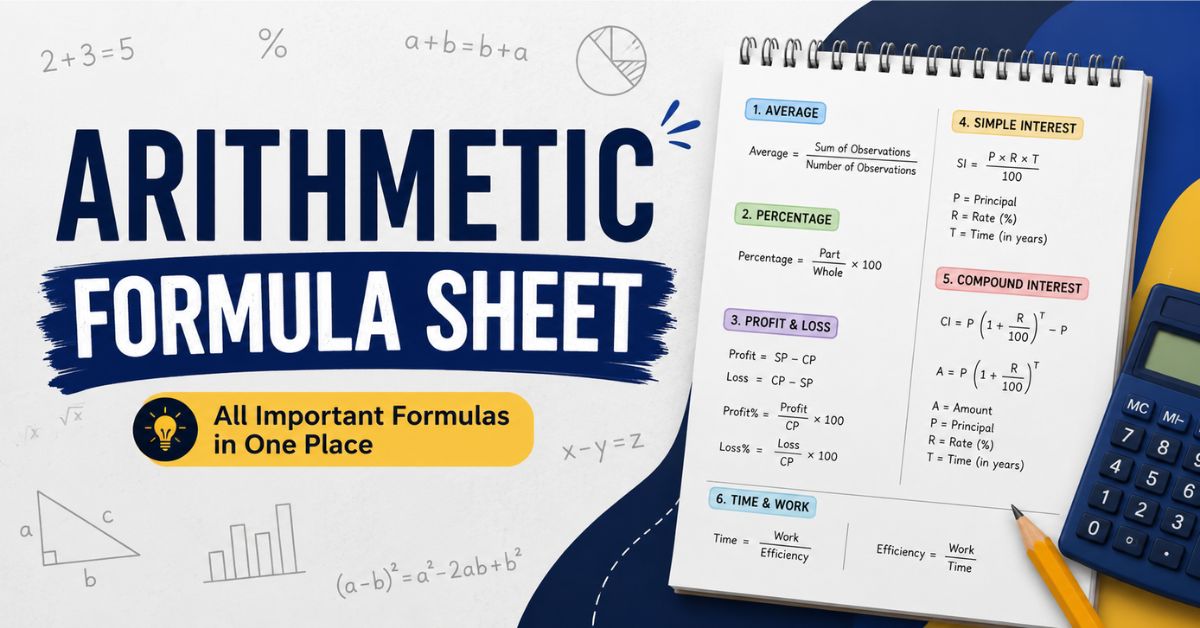
This guide gives you a complete, easy-to-understand arithmetic formula sheet in one place. Each formula is explained with simple language and real examples so you can understand and apply them with confidence.
2. What Is Arithmetic?
Arithmetic is the branch of mathematics that deals with numbers and basic operations like addition, subtraction, multiplication, and division. The word comes from the Greek word arithmos, meaning “number.”
It is the most basic and essential part of math and is used in everyday life — from calculating grocery bills to understanding bank interest rates.
The main topics covered in arithmetic include:
- Basic operations (add, subtract, multiply, divide)
- Fractions and decimals
- Percentages
- Ratios and proportions
- Powers and roots
- Averages

3. Basic Arithmetic Operations
Before we dive into the full arithmetic formula sheet, let’s quickly review the four basic operations:
| Operation | Symbol | Example |
|---|---|---|
| Addition | + | 5 + 3 = 8 |
| Subtraction | − | 9 − 4 = 5 |
| Multiplication | × | 6 × 7 = 42 |
| Division | ÷ | 20 ÷ 4 = 5 |
These four operations are the building blocks of all arithmetic formulas.
4. Arithmetic Formula Sheet (All Key Formulas)
1. Percentage
- x% of y=100x×y
- Percentage Change
- Successive Percentage Change
- If value increases by x%, multiplication factor:
- If value decreases by x%, multiplication factor:
2. Profit & Loss
- Profit
- Loss
- Profit %
- Loss %
- Selling Price
- Selling Price (Loss)
- Discount
- Discount %
3. Simple Interest (SI)
SI=100P×R×T
- Amount
4. Compound Interest (CI)
A=P(1+100R)n
- CI
Important Shortcuts
For 2 years:
For 3 years:
5. Ratio & Proportion
If ratio is
then parts are
Fourth Proportional
Mean Proportional
6. Average
Weighted Average
7. Mixture & Alligation
For two ingredients:where
- C1 = lower value
- C2 = higher value
- M = mean value
8. Time & Work
If A completes work in x days:
If A and B work together:
Total time:
Efficiency
9. Pipes & Cisterns
Same formulas as Time & Work.
- Filling pipe → Positive work
- Emptying pipe → Negative work
10. Time, Speed & Distance
Distance=Speed×Time
- Speed
- Time
Unit Conversion
11. Trains
Pole
Platform
Two Trains
Same direction:
Opposite direction:
12. Boats & Streams
where
- = speed in still water
- = stream speed
Still Water Speed
Stream Speed
13. Partnership
Profit Ratio
For partners A and B:
14. Ages
If present age = x
- After n years = x+n
- n years ago = x−n
Age differences always remain constant.
5. Tips to Remember Arithmetic Formulas
Memorizing an entire arithmetic formula sheet can feel overwhelming. Here are some practical tips to make it easier:
1. Practice Daily The more you use a formula, the more naturally it sticks. Try solving at least five problems per formula every day.
2. Use Flashcards Write the formula on one side and an example on the other. Test yourself regularly.
3. Group Related Formulas Learn percentage and profit/loss formulas together since they share common logic. Grouping helps your brain find connections.
4. Teach Someone Else Explaining a formula to a friend or family member forces you to understand it deeply, not just memorize it.
5. Understand the Logic Don’t just memorize — understand why a formula works. When you understand the concept, you can reconstruct the formula even if you forget it.
6. Make a Quick Reference Sheet Print or write out your own arithmetic formula sheet and keep it on your desk or in your notebook for easy access during study sessions.
6. FAQs About Arithmetic Formula Sheet
Q1. What is an arithmetic formula sheet?
An arithmetic formula sheet is a collection of all the important formulas used in basic arithmetic — including operations like addition, subtraction, multiplication, division, percentages, averages, ratios, and more — organized in a single, easy-to-read reference guide.
Q2. Which arithmetic formulas are most important for competitive exams?
For exams like SSC, UPSC, CAT, and banking tests, the most important arithmetic formulas include percentage, profit and loss, ratio and proportion, average, and number series formulas. These topics appear frequently in quantitative aptitude sections.
Q3. How do I remember arithmetic formulas easily?
The best way is consistent practice. Solve problems daily, use flashcards, and try to understand the logic behind each formula rather than just memorizing it. Grouping related formulas also helps.
Q4. What is the difference between arithmetic and algebra?
Arithmetic deals with specific numbers and basic operations. Algebra introduces variables (like x and y) to represent unknown quantities. For example, 3 + 5 = 8 is arithmetic, while x + 5 = 8 is algebra.
Q5. Is arithmetic formula sheet useful for Class 6–10 students?
Absolutely. Most of the formulas in a standard arithmetic formula sheet are directly aligned with the syllabus for classes 5 through 10. Topics like fractions, percentages, averages, and ratios are core parts of the school curriculum.
Q6. What is the formula for percentage in arithmetic?
The basic percentage formula is: Percentage = (Part / Whole) × 100. For example, if 30 out of 50 students passed a test, the passing percentage is (30 / 50) × 100 = 60%.
Q7. Can I use an arithmetic formula sheet during exams?
This depends on your school or exam rules. In most school tests and competitive exams, you are expected to recall formulas from memory. That said, using a formula sheet during self-study and revision is a great strategy to reinforce your learning.
7. Conclusion
An arithmetic formula sheet is one of the most valuable tools any student or math learner can have. From simple addition rules to profit-loss calculations, these formulas form the backbone of mathematics and appear in everyday life, school exams, and competitive tests alike.
The key to mastering arithmetic is not just memorizing formulas but understanding how and when to apply them. Use this guide as your go-to reference, practice the examples regularly, and soon these formulas will become second nature.
Whether you are a beginner just starting out or a seasoned student reviewing for a big exam, bookmark this arithmetic formula sheet and come back to it whenever you need a quick refresher.
Happy learning — and may your numbers always add up!
You may also visit: CATMOCK INDIA|CATMOCK