

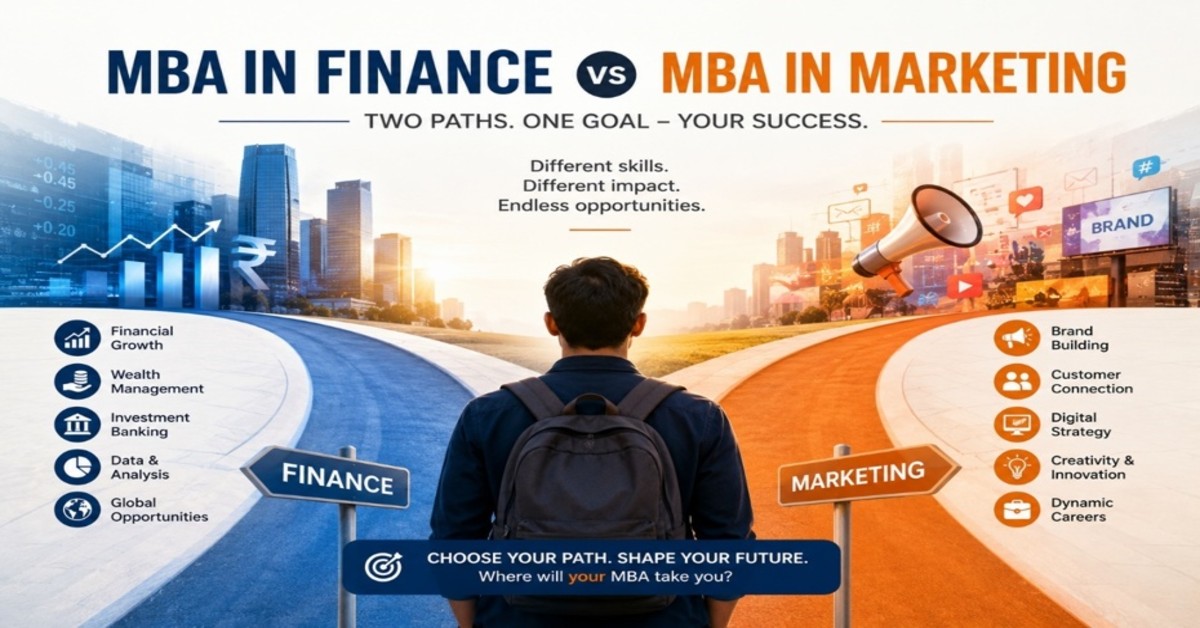
MBA in Finance vs MBA in Marketing: Salary, Career Scope, Skills & Opportunities
Table of Contents: –
1. Introduction
2. MBA Finance vs MBA Marketing: Overview
3. Skills and experience
4. Career path & Roles
5. Salary & ROI
6. Top recruiters
7. Top Colleges in India for Each Specialization
8. The pros & cons
9. What should you choose?
10. Conclusion
11. Frequently Asked Questions (FAQs)
Introduction:
Every year, several thousand first-year B-school students and MBA candidates come to the same decision: should you specialise in MBA marketing or finance? Despite being among the most well-liked, sought-after, and esteemed specializations in any MBA program, they result in radically different daily tasks, career prospects, and skill needs.
One of the most important choices you will make during your MBA journey is selecting the appropriate specialization. It influences the summer internship you pursue, the placement company that shortlists you, and, in the end, the first ten years of your post-MBA career. One of the most frequent mistakes made by B-school students is choosing a specialisation just because it sounds respectable without knowing what the work truly offers
In this comprehensive analysis, we compare an MBA in Finance vs. an MBA in Marketing in every way that matters, including curriculum, required skills, career plans, earning potential, top recruiters, and many more. This essay will assist you in making a confident and educated decision, regardless of whether you are a recent graduate choosing your specialization or a working professional considering a career change.
MBA Finance vs. MBA Marketing: Overview
| Parameter | MBA Finance | MBA Marketing |
| Core Focus | Capital management, valuation, investment, risk | Consumer behaviour, branding, sales, growth |
| Best Suited For | Engineers, commerce graduates, CA/CFA aspirants | Humanities, design, communication-efficient grads |
| Typical Entry Roles | Financial Analyst, Investment Banking Analyst | Brand Executive, Marketing Associate |
| Core Tools Used | Excel, financial models, Bloomberg, SAP FICO | Google Analytics, CRM tools, Canva, SEO/SEM |
| Avg. Starting CTC* | Rs 10 – 20 LPA | Rs 9 – 15 LPA |
| Curriculum & Core Subjects | Financial Management & Corporate Finance Security Analysis & Portfolio Management Financial Derivatives & Risk Management Mergers, Acquisitions & Corporate Restructuring International Finance & Treasury Management Banking, Insurance & Financial Services | Consumer Behaviour & Market Research Brand Management & Positioning Digital Marketing & Social Media Strategy Sales & Distribution Management Product Management & Innovation Marketing Analytics & CRM |
* Actual numbers vary by institute, batch, and economic conditions.
An MBA in Finance teaches you how to manage, analyze, and grow money, whether it’s a company’s capital, an investor’s portfolio, or a bank’s book. The specialization focuses on financial statements, valuation models, investment theory, and risk management. Students develop a strong quantitative, analytical mindset because most financial judgments are based on statistics, ratios, and models rather than intuition.
An MBA in marketing, on the other hand, prepares you to understand consumer behavior and apply that knowledge to develop strategies that establish brands, increase sales, and foster customer loyalty. The specialization combines psychology, creativity, and data analytics; modern marketing is as much about A/B testing and customer analytics as it is about narrative, storytelling, and branding.
In short, finance is about managing and multiplying capital with analytical precision, while marketing is about understanding people and turning that understanding into revenue.
SKILLS AND EXPERIENCE
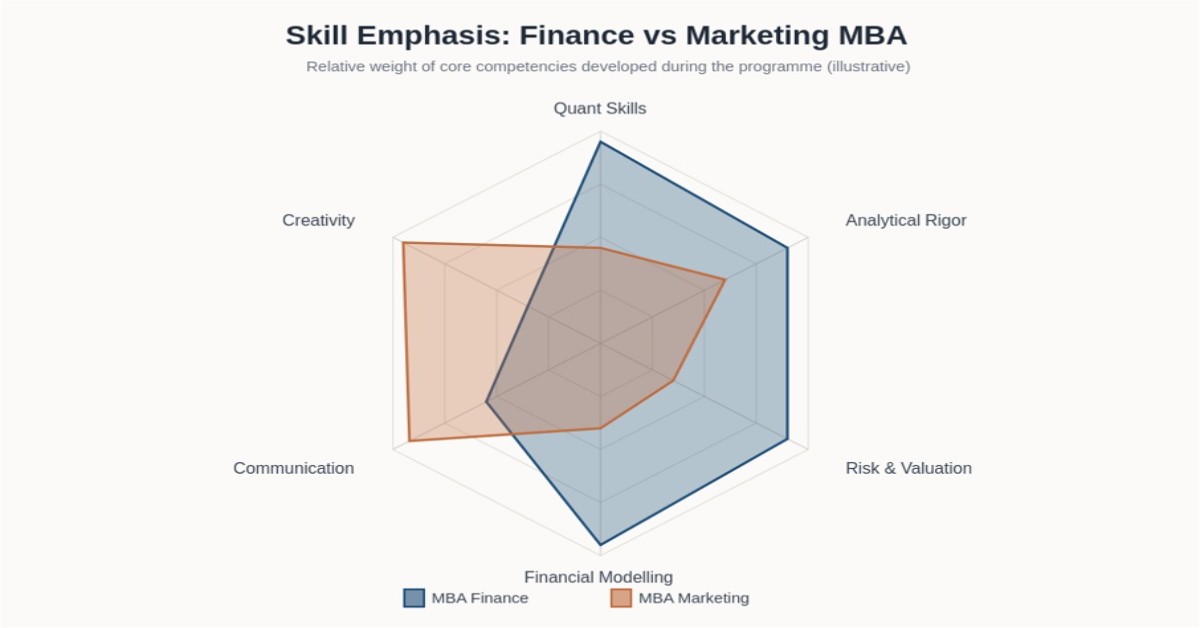
Both specializations need and build a distinct set of skills. Understanding this is one of the best ways to predict which one serves you the best.
Skills For Finance:-
- Strong quantitative and analytical ability
- Comfort with financial statements, ratios, and models
- Logical, structured decision-making under uncertainty
- Proficiency with Excel, financial software, and data tools
Skills for Marketing:
- Creativity and storytelling ability
- Understanding of consumer psychology and trends
- Strong written and verbal communication
- Comfort with data analytics and performance metrics
Career path & Roles
The specialization you choose has a direct impact on the kind of employment you will be qualified for during placement – and across the years that follow in your career.
| Experience Level | Finance Roles | Marketing Roles |
| 0-2 years | Financial Analyst, Credit Analyst, IB Analyst | Brand Executive, Marketing Associate, MarTech Analyst |
| 3-5 years | Finance Manager, Equity Research Associate | Brand Manager, Digital Marketing Manager |
| 5-10 years | Finance Controller, VP – Investments | Marketing Head, Category Manager |
| 10+ years | CFO, Head of Treasury, Fund Manager | CMO, VP – Marketing & Growth |
Salary & ROI
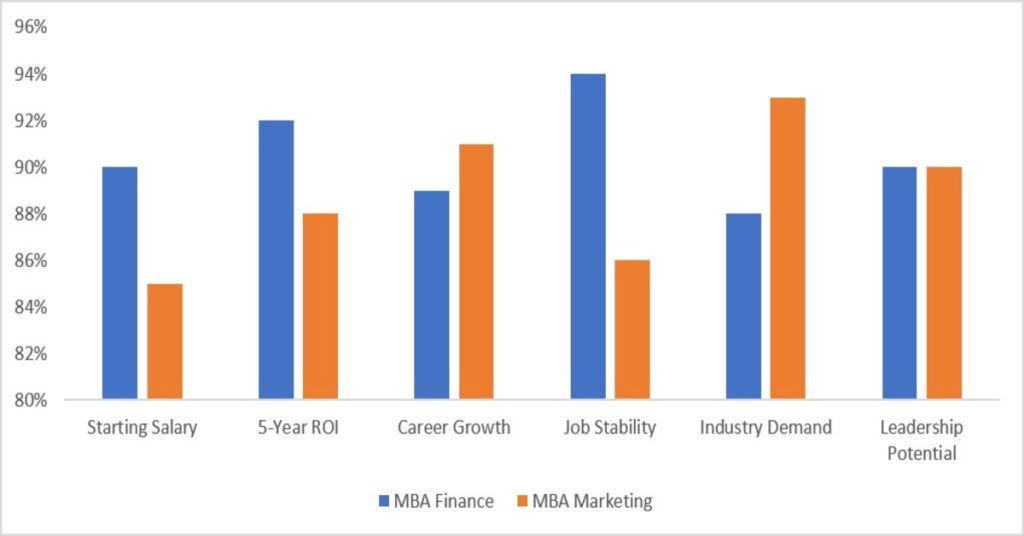
Compensation trends in both specializations follow an identical pattern in the initial stages but gradually diverge as professionals progress into senior leadership roles—particularly because finance leadership roles (CFO, fund manager) frequently command higher compensation than marketing counterparts at the same seniority level in the market.
TOP RECRUITERS
The companies that hire for each specialized field may vary significantly, which should be considered when making your decision if you have a certain industry or company in mind.
Top Recruiters of MBA Finance:
- Goldman Sachs, JP Morgan
- HDFC Bank, ICICI Bank
- Deloitte, KPMG, PwC
Top Recruiters of MBA Marketing:
- Hindustan Unilever (HUL), P&G, ITC
- Amazon, Flipkart, Myntra
- Ogilvy, WPP, Dentsu
Top Colleges in India for Each Specialization
While all top IIMs and B-schools offer both specialized domains, some have established particularly strong reputations and recruitment contacts in specific domains.
| Specialised in Finance | Specialised in Marketing |
| IIM Ahmedabad | IIM Calcutta |
| IIM Bangalore | MICA Ahmedabad |
| NMIMS Mumbai | XLRI Jamshedpur |
| SP Jain Institute (SPJIMR) | IIM Indore |
| ICFAI Business School | Symbiosis Centre for Management |
The Pros & Cons
1. Pros:
| MBA Finance | MBA Marketing |
| 1. High earning potential at senior levels (CFO, fund manager roles) 2. Globally transferable skill set and qualifications 3. Strong synergy with certifications like CFA/FRM 4. Clear, well-defined career progression path | 1. More creative freedom and variety in day-to-day work 2. Faster-growing roles in digital and e-commerce sectors 3. Transferable skills across industries (FMCG, tech, media, retail) 4. Strong demand for entrepreneurial and D2C ventures |
2. Cons:
| MBA Finance | MBA Marketing |
| 1. Steep learning curve for non-quantitative backgrounds 2. High-pressure work culture, especially in investment banking 3. Longer hours expected in many entry-level finance roles | 1. Performance can be harder to quantify than in finance roles 2. Trends and tools change rapidly, requiring continuous learning 3. Entry-level salaries can lag behind finance roles at certain companies |
WHAT SHOULD YOU CHOOSE?
Finally, the decision comes down to three straightforward questions: What kind of employment makes you feel energised rather than exhausted? What’s your educational and professional background? And where do you see yourself in ten years—a boardroom evaluating valuations or a brainstorm influencing how millions of consumers see a brand?
| ✅ Choose MBA in Finance… Enjoy working with numbers, models, and structured analysis. Are detail-oriented and comfortable with high-stakes precision. Have an engineering, commerce, or quantitative academic background. Aspire to roles in investment banking, consulting, or corporate finance. Are considering complementary certifications like CFA, FRM, or CPA |
| ✅ Choose MBA in Marketing… Enjoy understanding people, trends, and consumer behavior. Have strong communication and storytelling instincts. Are comfortable with ambiguity and fast-changing strategies. Aspire to roles in brand management, digital growth, or advertising. Have a background in humanities, design, media, or communications |
CONCLUSION
In the end, the MBA in Finance vs. MBA in Marketing debate is settled on a matter of individual skill and professional goals. Both specializations are cognitively rigorous, well-respected, and capable of launching successful careers—as long as you choose one that matches your natural skills.
An MBA in Finance is the better option for analytically oriented students seeking a structured, globally transferable job with high long-term income potential. An MBA in Marketing is a better option for creatively inclined students seeking a dynamic, fast-growing job centered on understanding and influencing consumer behavior.
Frequently Asked Questions (FAQ’S)
1. Which is better—an MBA in finance or an MBA in marketing?
None of the specializations is inherently ‘better’; the best decision is determined by your personal talents and professional objectives. An MBA in Finance is ideal for analytically inclined individuals looking for structured, numbers-driven employment, whereas an MBA in Marketing is ideal for creatively inclined students who enjoy studying customer behavior and establishing brands.
2. Does an MBA in finance require a commerce or engineering background?
A commerce or engineering background is helpful but not mandatory. Most MBA programs start finance fundamentals from scratch, assuming no prior knowledge. However, candidates from quantitative backgrounds often find the initial learning curve gentler than those from purely humanities backgrounds.
3. Which specialization pays better right after an MBA?
At the starting level, MBA Finance roles often pay slightly more than MBA Marketing posts in India, although the difference is often relatively minor. At the senior level, finance leadership roles such as CFO can outperform marketing leadership responsibilities, but great performers in high-growth marketing roles can match or exceed finance remuneration.
4. Can I switch from Marketing to Finance (or vice versa) later in my career?
Yes, career switches are possible but typically require additional upskilling—such as certifications, short courses, or an internal role transition within your organization. It is generally easier to pivot early in your career than after several years of specialized experience.
5. Is an MBA in finance more difficult than an MBA in marketing?
Difficulty is subjective and depends on your natural aptitude. Finance demands sustained quantitative rigor and precision, while marketing demands creative adaptability and comfort with ambiguity. Most students find one notably more intuitive than the other based on their existing strengths.
6. What certifications complement an MBA in finance?
Popular complementary certifications include the CFA (Chartered Financial Analyst), FRM (Financial Risk Manager), and CFP (Certified Financial Planner). These credentials are particularly valuable for roles in investment banking, equity research, and risk management.
7. What certifications complement an MBA in marketing?
Popular complementary certifications include Google Ads and Analytics certifications, HubSpot Inbound Marketing certification, and specialised digital marketing courses. These credentials demonstrate practical, tool-specific competency that recruiters in digital-first companies often value.
8. Which specialization is better for starting your own business?
Both specializations offer valuable skills for entrepreneurship. Marketing skills help you understand customers, build a brand, and drive growth, while finance skills help you manage cash flow, raise capital, and make sound investment decisions. Many successful founders benefit from at least a working knowledge of both.
9. Do all MBA programs offer both finance and marketing as specializations?
Most full-time, two-year MBA programs in India offer both finance and marketing as core specialization options, typically chosen after the first year. However, the depth of electives, faculty expertise, and recruiter relationships in each specialization can vary significantly between institutes.
10. Which specialization has better long-term career stability?
Both specializations offer strong long-term stability, as finance and marketing functions are essential to virtually every organization. Finance roles tend to follow more predictable hierarchical progression, while marketing careers offer more lateral mobility across industries and functions such as product, growth, and strategy.
You may also visit: CATMOCK INDIA|CATMOCK