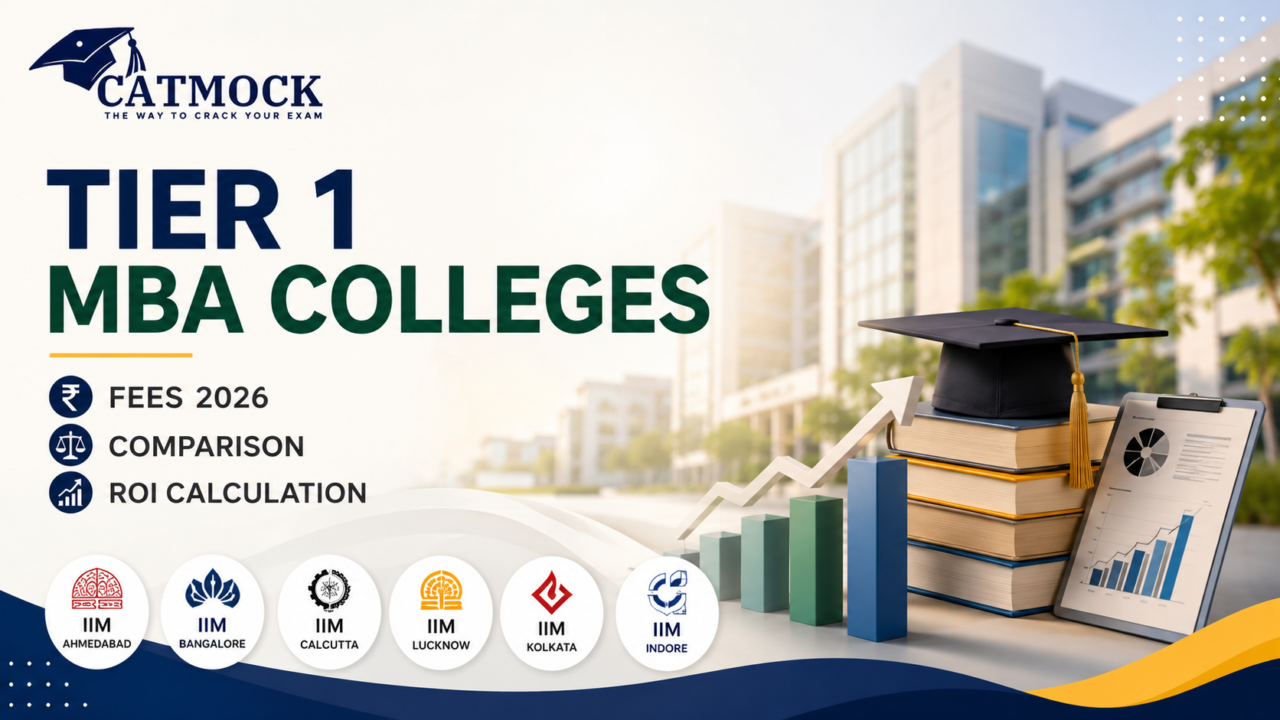
An MBA at a Tier 1 college in India can cost anywhere from ₹2 lakh to ₹31 lakh — and the college charging the least isn’t automatically the worst deal. That’s the part most fee-comparison guides get wrong. They’ll list numbers side by side and let you assume that lower fees mean lower quality or that a bigger price tag guarantees a bigger payday. Neither assumption survives contact with real placement data.
This guide does two things properly: it lays out verified Tier 1 MBA fees for 2026 admissions across IIMs and top non-IIM colleges, and it walks you through an actual ROI calculation—not a vague “good ROI” label, but a formula you can apply to any college on your shortlist. By the end, you’ll know exactly how to weigh a ₹27 lakh IIM Ahmedabad seat against a ₹2.4 lakh FMS Delhi seat using the same yardstick.
This matters more now than it did three or four years ago. Tier 1 MBA fees have climbed 4–8% annually across nearly every institute on this list, education loan interest rates have moved, and placement packages have grown unevenly across colleges. A comparison built on 2022 or 2023 numbers—which is what a lot of aspirants are still working off—no longer reflects the real trade-off you’re making today. Getting the fee-versus-package math right at the start saves you from a decision built on outdated assumptions.
What Makes a College “Tier 1” in India?
Tier 1 status isn’t an official ranking category—it’s a working classification based on four consistent factors: placement track record, faculty and academic rigor, brand recognition among recruiters, and admission competitiveness (typically requiring a 95+ CAT percentile or equivalent). Out of thousands of MBA colleges in India, only around 20–30 institutions consistently meet this bar year after year.
The Tier 1 bracket includes the older IIMs (Ahmedabad, Bangalore, Calcutta, Lucknow, Kozhikode, Indore), a set of non-IIM heavyweights (XLRI Jamshedpur, ISB Hyderabad, FMS Delhi, JBIMS Mumbai, MDI Gurgaon, SPJIMR Mumbai), and a few specialized government institutes (TISS Mumbai for HR). What separates them from Tier 2 isn’t just prestige—it’s the consistency of ₹25 LPA+ average placement outcomes across multiple consecutive batches.
Tier 1 MBA Colleges’ Fees 2026: Full Comparison Table
Here’s where the real fee spread becomes obvious. Government-subsidized institutes sit at one extreme, and premium private/international-format programs sit at the other—with genuine Tier 1 brand value on both ends.
| College | Total MBA Fees (2026, 2-yr programme) | Establishment Year |
|---|---|---|
| FMS Delhi | ₹2.43 Lakhs | 1954 |
| TISS Mumbai | ₹2.03 Lakhs | 1936 |
| IIM Lucknow | ₹20.75 Lakh | 1984 |
| IIM Kozhikode | ₹23.50 Lakhs | 1996 |
| IIM Indore | ₹25.15 Lakh | 1996 |
| IIM Bangalore | ₹26.5 Lakh | 1973 |
| IIM Calcutta | ₹27.00 Lakh | 1961 |
| IIM Ahmedabad | ₹27.50 Lakh | 1961 |
Placement Packages at Tier 1 MBA Colleges (2026 Batch)
| College | Average Package | Median Package | Highest Package |
|---|---|---|---|
| FMS Delhi | ₹30 LPA | ₹28 LPA | ₹65 LPA+ |
| TISS Mumbai | ₹25–28 LPA | ₹24 LPA | ₹50 LPA+ |
| IIM Lucknow | ₹32.23 LPA | ₹30 LPA | ₹1.00 Cr (domestic) |
| IIM Kozhikode | ₹28–31 LPA | ₹27 LPA | ₹72.02 LPA |
| IIM Indore | ₹29.57 LPA | ₹27–28 LPA | ₹70 LPA |
| IIM Bangalore | ₹34.88 LPA | ₹32 LPA | ₹1 Cr+ |
| IIM Calcutta | ₹35.07–35.50 LPA | ₹33 LPA | ₹1.15 Cr |
| IIM Ahmedabad | ₹35.50 LPA | ₹33 LPA | ₹1.10 Cr |
The pattern that jumps out: FMS Delhi’s ₹30 LPA average sits almost level with IIM Lucknow’s ₹32.23 LPA—at roughly a tenth of the fee. That single comparison is the reason FMS shows up in every serious ROI conversation about Indian MBA programs.
How to Calculate MBA ROI: The Actual Formula
Most fee-comparison articles stop at listing numbers. Here’s the calculation method you actually need, broken into three steps.
Step 1 — Calculate your net investment.
Net Investment = Total Course Fees + Estimated Living Costs − Scholarships/Waivers − Opportunity cost adjustment (if relevant)
Step 2 — Calculate your payback period.
Payback Period (in years) = Net Investment ÷ Average Annual Package (post-MBA)
Step 3 — Calculate your ROI ratio.
ROI Ratio = (Average Package × Expected Working Years, typically 5) ÷ Net Investment
An ROI ratio above 5x over five years is generally considered strong for an Indian MBA; anything above 10x (like FMS or TISS) is exceptional. A ratio under 3x means a longer financial recovery window, which isn’t necessarily “bad”—it just means the college’s value proposition is leaning more on brand and long-term career compounding than immediate financial payback.
ROI Calculation: Tier 1 MBA Colleges Compared
Applying that formula directly to our fee and package data gives a genuinely useful side-by-side view—the piece most competing articles skip entirely.
| College | Total Fees | Avg. Package | Payback Period | 5-Year ROI Ratio |
|---|---|---|---|---|
| FMS Delhi | ₹2.40 Lakh | ₹30 LPA | ~1 month | ~62x |
| TISS Mumbai | ₹2.03 Lakh | ₹26 LPA | ~1 month | ~64x |
| IIM Lucknow | ₹20.75 Lakh | ₹32.23 LPA | ~7.7 months | ~7.8x |
| IIM Kozhikode | ₹23.50 Lakh | ₹31.02 LPA | ~9.1 months | ~6.6x |
| IIM Indore | ₹25.15 Lakh | ₹29.57 LPA | ~10.2 months | ~5.9x |
| IIM Ahmedabad | ₹27.50 Lakh | ₹35.50 LPA | ~9.3 months | ~6.5x |
| IIM Calcutta | ₹27.50 Lakh | ₹35.50 LPA | ~9.2 months | ~6.5x |
| IIM Bangalore | ₹26.50 Lakh | ₹34.88 LPA | ~9.1 months | ~6.6x |
Fees vs. Brand Value: Why the Cheapest Option Isn’t Always Right
The ROI table makes a strong case for FMS and TISS, but pure financial payback isn’t the only variable worth weighing before you choose.
- International exposure and exchange programs. Older IIMs and ISB offer structured exchange semesters and global immersion modules that FMS and TISS don’t provide at the same scale—which are valuable if your career goal involves an international transition.
- Consulting and PE/VC recruiter depth. Firms like McKinsey, BCG, and top-tier PE funds recruit far more consistently from IIM-A/B/C and ISB than from FMS or JBIMS, simply due to historical relationship depth.
- Alumni network breadth. A 60+ year-old IIM alumni base spans more industries and geographies than a newer or smaller batch program, which compounds in value over a 15–20-year career.
- Specialization strength. TISS’s HR specialization and JBIMS’s finance-heavy placement record make them the stronger pick within their specific domain, even against a “higher-ranked” general MBA.
- Batch size and personal access. Smaller programs (JBIMS, TISS) often mean closer faculty access and tighter cohort relationships than large IIM batches.
Factors That Actually Move MBA Fees Year on Year
If you’re planning for CAT 2026 or beyond, it helps to understand why Tier 1 MBA fees keep climbing roughly 4–8% annually:
- Infrastructure and campus upgrades at older IIMs, particularly new hostel blocks and academic buildings, get folded directly into tuition.
- International immersion components—a growing standard feature at top IIMs and ISB—add a fixed cost per student that shows up as a fee structure line item.
- Faculty compensation and research investment, which affect both fees and long-term placement quality through better academic rigor.
- Inflation-linked annual revisions, which most Tier 1 institutes apply as a standard policy rather than a one-off jump.
Financing Your Tier 1 MBA: Loans, EMIs & What ROI Actually Means With Interest
The ROI table above uses gross package figures, but most students fund a Tier 1 MBA partly or fully through an education loan—and interest cost changes the real payback math meaningfully.
- Collateral-free loans up to ₹40 lakh are available from most major banks for admits at IIMs, XLRI, ISB, and other listed Tier 1 institutes, given their placement track record.
- Interest rates typically range from 8.5% to 11%, depending on the lender and whether you have a co-applicant with strong credit history.
- A ₹27 lakh loan at 9% interest, repaid over five years post-MBA, adds roughly ₹6–7 lakh in total interest—worth factoring into your net investment figure if you’re loan-funding the degree.
- Moratorium periods (interest-only or no-payment during the course) are standard at most lenders, meaning your EMI clock effectively starts only after placement, which softens the immediate cash-flow pressure.
- Government-subsidized colleges reduce this variable significantly. A ₹2–7 lakh loan for FMS, TISS, or JBIMS carries a fraction of the interest burden of a ₹27–30 lakh IIM or ISB loan, reinforcing their ROI advantage even further once financing costs are included.
If you’re building your own ROI calculation using the formula above, swap “Total Course Fees” for “Total Course Fees + Estimated Loan Interest” to get a more realistic net investment figure — especially if you’re not funding the degree through savings or a scholarship.
FAQs: Tier 1 MBA Colleges’ Fees in 2026 & ROI
Q1. Which Tier 1 MBA college has the lowest fees in 2026?
TISS Mumbai has the lowest total fees among Tier 1 MBA colleges at approximately ₹2.03 lakh for the full program, closely followed by FMS Delhi at ₹2.40 lakh.
Q2. Which Tier 1 MBA college offers the best ROI?
FMS Delhi and TISS Mumbai offer the strongest ROI among Tier 1 colleges, recovering their entire course fee within the first month of a post-MBA salary due to their government-subsidized fee structure combined with strong placement outcomes.
Q3. How do I calculate MBA ROI myself?
Subtract scholarships from your total fees to get net investment, divide that by your expected average package to find your payback period, and then multiply your average package by five years and divide by net investment to get your 5-year ROI ratio.
Q4. Is IIM Ahmedabad worth the higher fees compared to FMS Delhi?
Financially, FMS Delhi recovers its cost faster, but IIM Ahmedabad offers a stronger global brand, deeper consulting and international recruiter access, and a larger long-term alumni network—the right choice depends on whether you’re optimizing for fast payback or long-term career compounding.
Q5. What is the average fee range for Tier 1 MBA colleges in 2026?
Government-subsidized Tier 1 colleges range between ₹2-7 lakh, while IIMs and premier private institutes range between ₹20.75 lakh and ₹30.6 lakh for the full program.
Q6. Do Tier 1 MBA colleges offer scholarships that affect ROI?
Yes, most Tier 1 colleges, including IIMs, offer need-based and merit-based scholarships or fee waivers, which directly lower your net investment and improve your ROI calculation.
Q7. Does education loan interest change my MBA ROI calculation?
Yes, if you’re funding your degree through a loan, add the estimated total interest cost to your net investment figure—a ₹27 lakh loan at 9% interest over five years can add roughly ₹6–7 lakh, which meaningfully extends your payback period compared to a savings-funded MBA.
Conclusion
Comparing Tier 1 MBA colleges purely on sticker price misses the point entirely. Once you run the actual ROI numbers—net investment, payback period, and 5-year return—nearly every Tier 1 option in India clears the bar for a financially sound decision. The real question isn’t “Which college costs less?” It’s “Which combination of cost, payback speed, and long-term brand value matches my career goals?” Use the tables above as your working reference and run your own numbers through the formula, and you’ll walk into your MBA decision with far more clarity than a simple fee list can offer.