

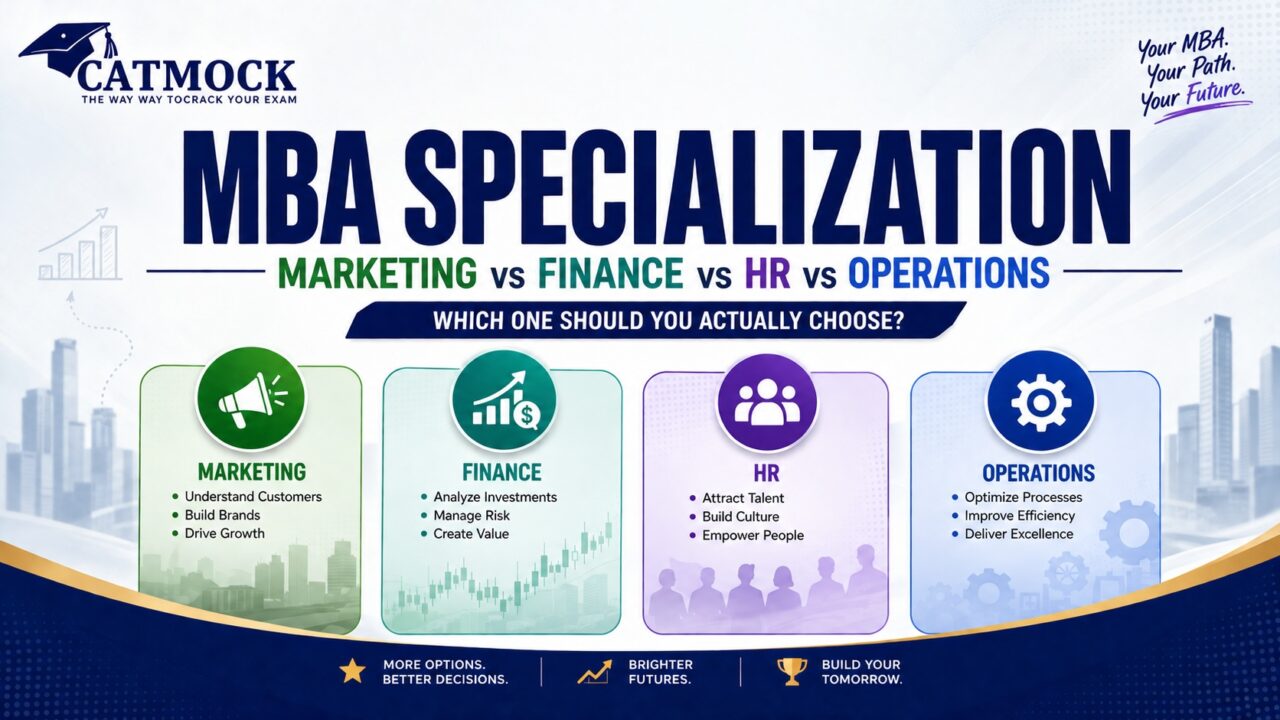
Somewhere in the middle of the first year, almost every MBA student hits the same fork in the road: which specialization to pick. It’s a decision that quietly shapes the electives you sit through, the summer internship you chase, the recruiters who show up for you on placement day, and often the first five to ten years of your career.
And yet, it’s frequently made for the wrong reasons—a senior’s offhand opinion, a placement brochure’s loudest number, or whichever subject felt easiest in term one.
This guide compares the four most-picked MBA specializations in India—Marketing vs. Finance vs. HR vs. Operations—on what actually matters: the day-to-day work, the pay at different career stages, the kind of person who tends to thrive in it, and how much your specific college changes the outcome.
Why this matters: The salary story tied to any MBA specialization is driven far more by your college tier, the exact role within that specialization, and your batch ranking than by the specialization label alone. Choose based on genuine fit and long-term trajectory — not the single highest number in a placement report.
Quick Overview: The Four MBA Specializations at a Glance
Before the detailed breakdown, here’s how Marketing vs Finance vs HR vs Operations stack up on the essentials.
| Specialization | Typical Fresher Salary Range | Core Strength Needed |
|---|---|---|
| Finance | ₹6–11 LPA (higher in investment banking at top colleges) | Analytical thinking, comfort with numbers and risk |
| Marketing | ₹6–12 LPA (often starts in sales/GTM roles) | Communication, consumer insight, creativity |
| HR | ₹7–10 LPA (significantly higher from premium HR-focused institutes) | People skills, empathy, organisational judgement |
| Operations | ₹6–9 LPA (strong at supply-chain-heavy recruiters) | Systems thinking, process discipline, problem-solving |
Table 1: Indicative fresher salary ranges across MBA specializations. Actual figures vary by college tier and recruiter.
MBA in Finance: Career Path, Salary and Who It Suits
Finance has been the default “safe” MBA choice for decades, and it remains the specialization with the highest ceiling at senior levels. It suits candidates who are analytically inclined, comfortable working with numbers daily, and genuinely curious about how capital, risk, and corporate decision-making connect.
| Aspect | Detail |
|---|---|
| Typical Career Paths | Investment Banker, Financial Analyst, Risk Manager, Credit Officer, Portfolio Manager, CFO (long-term) |
| Best Suited For | Commerce, Economics, and Engineering graduates comfortable with quantitative work |
| Fresher Salary Range | ₹6–11 LPA on average; investment banking roles at top colleges can start well above this |
| Senior-Level Ceiling | Among the highest of all specializations—CFO and portfolio management roles command premium pay |
| Key Skills to Build | Financial modelling, valuation, corporate finance fundamentals, risk assessment |
Table 2: MBA in Finance — career snapshot.
Is finance right for you?
If spreadsheets don’t intimidate you, if you like the idea of assessing risk before others do, and if a high-pressure, high-reward environment sounds energizing rather than draining, Finance rewards that temperament more consistently than any other specialization on this list.
Read full blog top MBA colleges known for their finance programs
MBA in Marketing: Career Path, Salary and Who It Suits
Marketing is often chosen for its creative appeal, but the reality of the first few years is less “campaign brainstorming” and more sales and go-to-market execution. Even at large FMCG recruiters, most marketing graduates start in a sales-facing role before moving into brand or category management.
| Aspect | Detail |
|---|---|
| Typical Career Paths | Sales/GTM roles (early career), Brand Manager, Category Manager, Digital Marketing Manager, and CMO (long-term) |
| Best Suited For | Strong communicators who enjoy consumer psychology, storytelling, and market-facing work |
| Fresher Salary Range | ₹6–12 LPA on average; the gap between top-recruiter and average-recruiter offers is unusually wide |
| Senior-Level Ceiling | Brand managers and CMOs at large companies can reach ₹30–50 LPA and above |
| Key Skills to Build | Consumer behaviour, digital marketing analytics, brand strategy, negotiation |
Table 3: MBA in Marketing — career snapshot.
Key insight: Marketing salary outcomes swing more by company than by specialization itself. The gap between a strong FMCG or consulting-adjacent marketing offer and an average one is wider than in Finance or operations—so the specific recruiter you land matters more here than almost anywhere else.
MBA in Human Resources (HR): Career Path, Salary and Who It Suits
HR has moved well past its old “paperwork and policies” reputation. Modern HR roles increasingly blend people strategy with data-driven workforce planning. That said, HR remains the specialization where your specific institute has the most outsized effect on starting compensation.
| Aspect | Detail |
|---|---|
| Typical Career Paths | HR Business Partner, Talent Acquisition Manager, L&D Lead, Compensation & Benefits Specialist, CHRO (long-term) |
| Best Suited For | Candidates with strong interpersonal skills, empathy, and organisational judgement |
| Fresher Salary Range | ₹7–10 LPA on average; significantly higher from premium HR-focused institutes |
| Senior-Level Ceiling | CHRO and VP-HR roles are well-compensated, though the path is typically slower than finance. |
| Key Skills to Build | Organisational behaviour, HR analytics, labour law fundamentals, conflict resolution |
Table 4: MBA in HR — career snapshot.
Key insight: HR shows the widest gap between premium-institute and general-institute outcomes of any specialization here. From a top-tier, HR-focused program, it’s a genuinely high-paying, high-prestige path. From most other institutes, fresher salaries tend to sit in a more modest—though still respectable—₹7–10 LPA band.
MBA in Operations: Career Path, Salary and Who It Suits
Operations is the specialization working quietly behind the scenes of everything from a 10-minute grocery delivery to a factory production line. It tends to be undervalued in popular perception relative to Finance and Marketing, despite steady, strong demand from manufacturing, e-commerce, and logistics-heavy recruiters.
| Aspect | Detail |
|---|---|
| Typical Career Paths | Supply Chain Manager, Plant Operations Manager, Logistics Manager, Process Excellence Lead, Operations Director (long-term) |
| Best Suited For | Systems thinkers who enjoy process optimisation and problem-solving; popular with engineering-background candidates |
| Fresher Salary Range | ₹6–9 LPA on average, competitive at manufacturing, e-commerce, and consulting-adjacent recruiters |
| Senior-Level Ceiling | Strong, steady growth trajectory; Operations Directors at large firms are well compensated |
| Key Skills to Build | Supply chain management, process design, lean/six sigma methodology, project management |
Table 5: MBA in Operations — career snapshot.
Why Operations deserves more credit than it gets
Operations doesn’t have the glamour of a brand campaign or the swagger of an investment banking offer, but it offers one of the steadiest growth curves of any specialization—and in a country where e-commerce and manufacturing are both scaling fast, demand for operations talent is only going up.
Side-by-Side Comparison: All Four Specializations
Placing all four next to each other on the factors that matter most for decision-making:
| Factor | Finance | Marketing | HR | Operations |
|---|---|---|---|---|
| Entry Salary Range | ₹6–11 LPA | ₹6–12 LPA | ₹7–10 LPA | ₹6–9 LPA |
| Salary Growth Ceiling | Very High | High (recruiter-dependent) | Moderate–High (institute-dependent) | High |
| Effect of College Tier | High | Moderate–High | Very High | Moderate |
| Core Personality Fit | Analytical, risk-aware | Communicative, creative | Empathetic, people-first | Structured, process-driven |
| Common Entry Background | BCom / Economics / Engineering | Any background, strong communicators | Any background, people-oriented | Engineering background common |
Table 6: Side-by-side comparison across key decision factors.
A Practical Decision Framework for Choosing Your MBA Specialization
Instead of choosing based on which specialization pays the most on paper, work through these four questions:
- What kind of work do you actually enjoy day to day?
Analyzing numbers and risk points toward finance. Understanding people and consumer behavior points toward Marketing. Enabling and developing people points toward HR. Optimizing processes and systems points toward Operations. - What is your academic background?
Commerce, Economics, and quantitative Engineering backgrounds transition most naturally into Finance. Engineering backgrounds are common and well-regarded in Operations. Marketing and HR are genuinely open to any background, provided the required soft skills are strong. - What is your target company profile?
Set on investment banking or corporate finance? Finance is close to mandatory. Targeting FMCG, e-commerce, or brand-led companies? Marketing fits. Aiming at manufacturing, logistics, or e-commerce operations? Choose Operations. Excited by people strategy and organizational design? HR fits—provided you can get into a premium HR-focused institute. - How does your specific college perform in this specialization?
A strong operations placement record at a college known for it can outperform a mediocre Finance placement record at the very same college. Check specialization-wise placement data at your target institute rather than assuming a generic industry ranking applies. If you’re still building your target list, our [Internal Link: IIM comparison guide — slug to be confirmed] is a useful next read.
Key insight: Institute reputation compounds over a career more than most first-year students expect. A top-tier MBA in HR will often outperform a lower-tier MBA in Finance over a ten-year horizon—brand and network effects matter as much as the specialization label itself.
Common Myths About MBA Specializations
Myth 1: “Finance and Marketing always pay more than HR and Operations.” Not necessarily. HR from a premium institute can out-earn general-institute Finance or Marketing graduates, and Operations offers strong, steady growth that’s often underestimated.
Myth 2: “Marketing means creative brand work from day one.” Most marketing graduates, even at top FMCG recruiters, begin in sales or go-to-market execution roles before moving into brand management.
Myth 3: “Operations is a fallback for those who don’t get Finance or Marketing.” It’s a legitimate, in-demand specialization in its own right—particularly for candidates who enjoy systems thinking, with several institutes carrying real recruiter strength here.
Myth 4: “HR is a low-paying, non-strategic function.” Modern HR blends people strategy with data-driven workforce planning, and from premium institutes it commands genuinely competitive pay.
Myth 5: “You can’t change your mind after choosing.” Most Indian MBA programs run a common first-year curriculum, with specialization chosen going into year two—giving you a full year of exposure and recruiter interaction before you commit. If you’re still at the exam-prep stage, building strong fundamentals through consistent [Internal Link: CAT preparation strategy article — slug to be confirmed] practice keeps every specialization door open for longer.
Which Specialization Fits Your Situation? Three Common Scenarios
Scenario A—An engineering graduate unsure between Finance and operations:
Engineering graduates often do well in both. The deciding factor should be whether you’re drawn to analyzing financial risk and capital allocation (finance) or designing and optimizing physical and logistical systems (operations). Let genuine interest decide, not which one “sounds” more prestigious.
Scenario B — A candidate targeting a specific dream company:
If your target company—a specific FMCG major, an investment bank, or a large e-commerce operations team—is already clear, work backward from that recruiter’s typical hiring specialization rather than choosing a specialization first and hoping the company follows.
Scenario C — Uncertain about long-term interest, prioritizing flexibility:
Marketing and HR tend to be the most open to candidates from varied academic backgrounds, offering relatively transferable skills—communication, people management—if you later pivot roles or industries, compared to the more specialized technical grounding Finance requires.
Conclusion
There is no universally “best” MBA specialization among Marketing, Finance, HR, and Operations—each serves a different kind of thinker, a different set of target companies, and a different career shape.
Finance rewards analytical, risk-comfortable minds with the highest long-term ceiling. Marketing rewards strong communicators willing to start in sales-facing roles. HR rewards people-first thinkers, provided the institute carries the right brand weight. And operations rewards systems-oriented problem-solvers with steady, often underrated, growth.
The single most useful exercise before choosing is to look past the headline salary number: check your specific institute’s specialization-wise placement data, talk to seniors who’ve taken each path, and be honest about which day-to-day work genuinely interests you. Two years of study followed by decades of a career is a long time to spend in a function that doesn’t fit.
If you’re still working toward your MBA seat, getting your [CAT 2026 study plan] in place now gives you the widest possible choice of institute—and specialization—later.
Frequently Asked Questions
Q1. Which MBA specialization has the highest salary in India?
Finance and Business Analytics generally lead on both starting salary and long-term ceiling, particularly in investment banking, fintech, and analytics-heavy roles, though outcomes vary sharply by college tier.
Q2. Is an MBA in Marketing a good career option?
Yes—marketing offers strong long-term growth, especially in FMCG, e-commerce, and digital-first companies, though most graduates start in sales-facing roles before moving into brand or category management.
Q3. Which MBA specialization is best for non-commerce students?
Operations, HR, and Marketing are generally more accessible for engineering or science-background students without a commerce foundation, since they rely less on prior financial-accounting knowledge than Finance does.
Q4. Is HR a good MBA specialization?
Yes, particularly from premium, HR-focused institutes, where HR salaries and prestige are genuinely competitive with Finance and Marketing. From other institutes, HR salaries tend to be more modest, typically in the ₹7–10 LPA range at the fresher stage.
Q5. Can I switch specializations or industries later in my MBA career?
Yes. While a specialization builds focused expertise, many MBA graduates successfully move across industries and even functions later in their careers, using the transferable leadership and management skills built during the program.
Q6. Does the college matter more than the specialization?
In many cases, yes. A top-tier MBA in a lower-demand specialization like HR can outperform a lower-tier MBA in a high-demand specialization like Finance over a ten-year career due to brand and recruiter-network effects.
Q7. How do I decide between Operations and Finance as an engineering graduate?
Choose based on which underlying work excites you more—analyzing financial risk and capital allocation or designing and optimizing physical and logistical systems. Both offer strong outcomes at the right institute, so let genuine interest, not perceived prestige, guide the decision.
Q8. Does specialization choice affect long-term career flexibility?
Yes, to some extent. Marketing and HR tend to be more portable across industries thanks to transferable communication and people-management skills, while Finance offers deep technical specialization that pays off strongly if you stay within the field.
You May Also Like: CAT MOCK, CAT MOCK PYQ
Follow Us On: Facebook, Instagram