
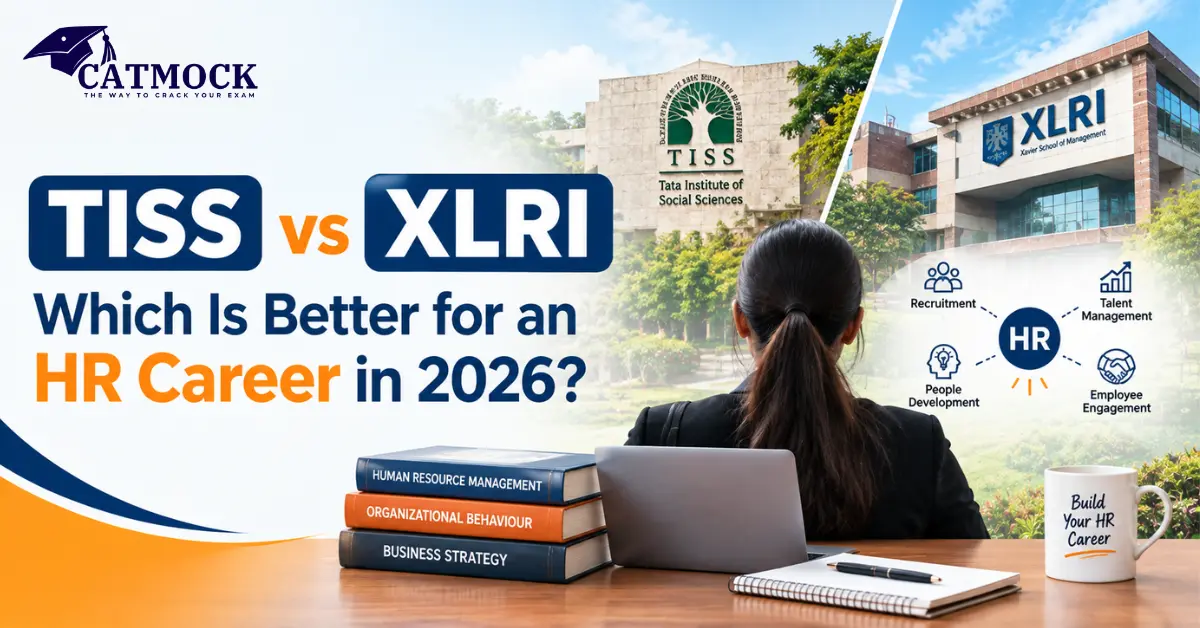
Ask ten HR aspirants “TISS or XLRI?” and you’ll get ten confident, contradictory answers. That’s because both institutes rank among India’s top HR education destinations, yet they come from completely different backgrounds — one focuses on corporate management, while the other draws on its social sciences foundation to run one of India’s most respected HR programs.
This guide settles the TISS vs XLRI comparison properly — full forms, admission routes, fees, curriculum, and the actual 2026 placement numbers — so you can decide based on facts, not campus folklore.
TISS and XLRI — Full Forms and Quick Overview
Before comparing anything else, it helps to know exactly what these acronyms stand for, since a surprising number of aspirants get this wrong.
- TISS stands for the Tata Institute of Social Sciences, a public deemed university established in 1936 in Mumbai. Its flagship management program is the MA in Human Resource Management & Labour Relations (MA HRM & LR).
- XLRI stands for Xavier School of Management (formerly known as the Xavier Labour Relations Institute), a private Jesuit-run business school established in 1949 in Jamshedpur. It offers a Post Graduate Diploma in Management (PGDM) across several specialisations, including HRM and Business Management.
Here’s the fastest way to see how the two compare at a glance.
Table 1: TISS vs XLRI — Quick Comparison
| Parameter | TISS Mumbai | XLRI Jamshedpur |
|---|---|---|
| Full Form | Tata Institute of Social Sciences | Xavier School of Management (formerly Xavier Labour Relations Institute) |
| Established | 1936 | 1949 |
| Institute Type | Public, deemed-to-be university | Private, Jesuit-run business school |
| Location | Mumbai, Maharashtra | Jamshedpur, Jharkhand |
| Flagship HR Program | MA in HRM & LR | PGDM in HRM |
| Admission Route | CUET PG / CAT score, depending on program | XAT score |
| Approx. Total Fees | ₹1.85–2 lakh (2-year program) | ₹28–30 lakh (2-year program) |
| NIRF Management Ranking | Ranked in Management category, generally outside top 15 | Ranked among the top 10 |
| Core Identity | Social sciences institute with an HR-focused pedagogy | Dedicated business school with strong corporate placements |
TISS Mumbai vs XLRI Jamshedpur: Programs Offered
XLRI’s PGDM Programs (BM, HRM, GM, IEV, LSCM)
XLRI, by contrast, runs a full portfolio of two-year, AICTE-approved PGDM programs: PGDM in Business Management (BM), PGDM in Human Resource Management (HRM), along with specialised tracks in General Management (GM), International Business (IEV), and Logistics & Supply Chain Management (LSCM). Its HRM program is the one most directly comparable to TISS, but XLRI’s broader PGDM portfolio gives students exposure to core business functions — finance, marketing, operations, strategy — that a dedicated HR program typically doesn’t cover in the same depth.
TISS Mumbai’s MA in HRM & LR
TISS Mumbai’s flagship management offering is the MA in Human Resource Management & Labour Relations, run through its School of Management and Labour Studies. The program blends conventional HR subjects — recruitment, compensation, organisational behaviour — with labour law, industrial relations, and social-sciences research methods, since TISS’s academic roots sit in social work and public policy rather than general business management. TISS also runs related programs such as MA in Human Resource Management (general) and MA in Organisation Development, Change and Leadership (ODCL), though HRM & LR remains the most sought-after by placement-focused aspirants.
Admission Process: TISS vs XLRI
How to Get Into TISS Mumbai
TISS has significantly changed its admission process in recent years, making many older comparison articles online outdated. The institute discontinued TISSNET, its standalone entrance exam. From the 2024–25 admission cycle onward, TISS routes most of its postgraduate programs through CUET PG (Common University Entrance Test – Postgraduate), conducted by the NTA. However, its three flagship management programs — HRM & LR, ODCL, and MHA — instead use the candidate’s CAT score, with a small diversity weightage added. Shortlisted candidates then go through a Pre-Interview Test (PIT) and Personal Interview (PI) round before final selection.
Read Full Blog: TISS Mumbai MBA 2026: Fees, Placements, Cutoff, Admission & Average Package
How to Get Into XLRI
XLRI’s admission process runs entirely on the Xavier Aptitude Test (XAT), a national-level exam conducted by XLRI itself every January. The XAT tests Verbal & Logical Ability, Decision Making, Quantitative Ability & Data Interpretation, and General Knowledge — the Decision Making section is unique to XAT and doesn’t appear in CAT. After clearing the qualifying cutoff (typically in the mid-to-high 90s percentile for the HRM and BM programs), shortlisted candidates go through Group Discussion (GD) and Personal Interview (PI) rounds.
Rad Full Blog: XLRI Selection Process 2027: Complete Guide to MBA Admissions
Table 2: TISS vs XLRI — Admission Process Compared
| Parameter | TISS Mumbai (HRM & LR) | XLRI Jamshedpur |
|---|---|---|
| Entrance Exam | CAT score (HRM & LR / ODCL / MHA) | Xavier Aptitude Test (XAT) |
| Exam Conducted By | IIMs (CAT) | XLRI, Jamshedpur (XAT) |
| Approx. Qualifying Cutoff | ~70 percentile (general category, recent cycles) | ~94–96 percentile (varies by category and gender) |
| Next Round | Pre-Interview Test (PIT) + Personal Interview | Group Discussion (GD) + Personal Interview (PI) |
| Minimum Eligibility | Bachelor’s degree from a recognised university | Bachelor’s degree from a recognised university |
| Note | TISSNET, the older standalone entrance test, has been discontinued | XAT remains XLRI’s own, self-conducted exam |
TISS vs XLRI: Fees and ROI
This is one of the starkest differences between the two institutes, and it materially affects the return-on-investment conversation.
Table 3: TISS vs XLRI — Fee Comparison (2-Year Program)
| Parameter | TISS Mumbai (MA HRM & LR) | XLRI Jamshedpur (PGDM HRM/BM) |
|---|---|---|
| Total Program Fee (approx.) | ₹1.85–2 lakh | ₹28–30 lakh |
| Fee Category | Public university fee structure | Private B-school fee structure |
| Hostel/Other Charges | Comparatively minimal | ₹1.1–1.4 lakh per year additional |
| Scholarship Availability | Government and institute-level scholarships for eligible categories | Merit- and need-based scholarships (up to 50% of fees for eligible candidates) |
Given TISS’s fee structure sits at a small fraction of XLRI’s, TISS consistently posts one of the strongest fee-to-salary ratios of any HR program in India — a factor that matters a great deal for candidates weighing cost against long-term career value.
TISS vs XLRI: Placements and Salary Package 2026
Numbers settle more arguments than opinions do, so here’s how the two institutes’ most recently concluded placement cycles compare.
For its 2024–26 HRM & LR batch (placements concluded February 2026), TISS Mumbai recorded a highest package of ₹66 LPA, an average CTC of ₹28.69 LPA, and a median of ₹28 LPA, with 34 recruiters participating and roughly 78% of the batch securing offers above ₹20 LPA. Around 31% of the batch had already secured Pre-Placement Offers (PPOs) before the main process began.
XLRI’s 2024–26 PGDM batch recorded a considerably higher ceiling: a highest domestic package of ₹59 LPA and a highest international offer of ₹1.1 crore, with an average package of ₹31.4 LPA and a median of ₹29 LPA, across 576 domestic and 2 international offers.
Table 4: TISS vs XLRI — Placement Snapshot (2026 Batch)
| Parameter | TISS Mumbai (HRM & LR) | XLRI Jamshedpur (PGDM) |
|---|---|---|
| Batch Size (flagship program) | 65 students | ~578 offers across PGDM programs |
| Highest Domestic Package | ₹66 LPA | ₹59 LPA |
| Highest International Package | Not separately disclosed | ₹1.1 crore |
| Average Package | ₹28.69 LPA | ₹31.4 LPA |
| Median Package | ₹28 LPA | ₹29 LPA |
| Recruiters Participated | 34 | 170+ |
| PPO Conversion | ~31% of batch | Included within total offers |
The takeaway: XLRI’s average and highest domestic figures edge out TISS, driven largely by its much broader recruiter base and multiple PGDM specialisations feeding into the placement pool. But TISS’s per-student outcome relative to its near-negligible fee remains difficult for almost any B-school in India — XLRI included — to match on pure ROI terms.
Also Read: Lateral vs Final Placement in MBA: What’s the Real Difference?
Curriculum and Learning Approach: Social Sciences vs Business School
The deepest difference between TISS and XLRI isn’t fees or placements — it’s pedagogy. TISS’s curriculum is rooted in social sciences: labour law, industrial sociology, fieldwork placements with NGOs and community organisations, and a research-driven approach to HR that produces graduates comfortable with policy, labour relations, and the human side of organisations. XLRI’s PGDM, by contrast, follows a conventional business-school structure — case studies, quantitative rigour, cross-functional exposure to finance and strategy alongside HR — producing graduates who are equally at home in a broader general-management or consulting-adjacent role, not just a pure HR function.
Neither approach is objectively superior; they simply produce differently shaped HR professionals. A candidate aiming for labour relations, policy, or a development-sector HR career tends to find TISS’s grounding more directly useful, while a candidate targeting corporate HR business-partner roles or a broader general-management track often finds XLRI’s business-school rigour a better fit.
Which One Should You Choose — TISS or XLRI?
If cost efficiency and a specialised, research-grounded HR education matter most to you, TISS Mumbai is very hard to beat — a fee of roughly ₹2 lakh against a median outcome of ₹28 LPA is an ROI very few institutes in the country can replicate. If you want the widest possible recruiter base, the highest salary ceiling, and the flexibility of a full business-school PGDM that keeps options open beyond pure HR, XLRI is the stronger pick, provided you’re comfortable with its significantly higher fee structure. Candidates who are still undecided about how experience level and program format should factor into a B-school choice may also find it useful to read a broader comparison of executive versus regular MBA formats before finalising a shortlist.
Common Myths About TISS and XLRI
- “TISS is easier to get into than XLRI.” Not necessarily true in effective terms — while TISS’s CAT cutoff for HRM & LR looks lower on paper (~70 percentile) than XLRI’s XAT cutoff (~94+ percentile), TISS’s flagship HRM & LR batch size is a fraction of XLRI’s, making the actual seat-to-applicant ratio extremely competitive.
- “XLRI only produces generalist managers, not real HR specialists.” Inaccurate — XLRI’s dedicated PGDM (HRM) track is one of the most respected HR-specific programs in the country, distinct from its general management (BM) program.
- “TISS students can’t compete for corporate HR roles.” False — TISS’s 2026 placement data shows strong participation from consulting, FMCG, and BFSI recruiters, not just NGO or development-sector roles.
- “TISSNET is still TISS’s entrance exam.” Outdated — TISSNET has been discontinued; TISS now uses CUET PG for most programs and CAT scores specifically for its HRM & LR, ODCL, and MHA programs.
Also Read: Best MBA Colleges for HR in India (2026): Rankings, Fees, Eligibility & Entrance Exams
Summary
- TISS = Tata Institute of Social Sciences (1936, Mumbai, public university); XLRI = Xavier School of Management, formerly Xavier Labour Relations Institute (1949, Jamshedpur, private B-school).
- TISS’s flagship HRM & LR program now admits via CAT score + PIT + PI, not the discontinued TISSNET; XLRI admits via XAT + GD + PI.
- TISS’s total program fee (~₹2 lakh) is a small fraction of XLRI’s (~₹28–30 lakh), giving it a standout fee-to-salary ratio.
- For the 2026 cycle, XLRI’s highest (₹59 LPA domestic / ₹1.1 crore international) and average (₹31.4 LPA) packages edge out TISS (₹66 LPA highest, ₹28.69 LPA average), though TISS’s per-rupee-spent ROI remains exceptional.
- The right choice depends on your goal: TISS for specialised, research-grounded HR at minimal cost; XLRI for the widest recruiter base and a broader business-school foundation.
Frequently Asked Questions
Q1. What is the full form of TISS and XLRI?
TISS stands for Tata Institute of Social Sciences, and XLRI stands for Xavier School of Management, formerly known as the Xavier Labour Relations Institute.
Q2. Which is better for HR — TISS or XLRI?
Both are considered top-tier HR institutes in India. TISS offers a more specialised, research-grounded HR education at a fraction of the cost, while XLRI offers a broader business-school PGDM with a wider recruiter base and a higher salary ceiling. The “better” choice depends on your budget, career goals, and preference for a specialised versus generalist program.
Q3. What exam is required for TISS and XLRI admission?
TISS’s flagship HRM & LR program uses the candidate’s CAT score for shortlisting (its earlier standalone exam, TISSNET, has been discontinued), followed by a Pre-Interview Test and Personal Interview. XLRI requires the Xavier Aptitude Test (XAT), followed by Group Discussion and Personal Interview rounds.
Q4. What is the fee difference between TISS and XLRI?
TISS’s two-year MA in HRM & LR costs approximately ₹1.85–2 lakh in total, while XLRI’s two-year PGDM programs cost approximately ₹28–30 lakh — making TISS one of the most cost-efficient top-tier HR programs in India.
Q5. What is the highest package offered at TISS and XLRI?
For the most recently concluded placement cycle, TISS Mumbai’s HRM & LR batch recorded a highest domestic package of ₹66 LPA, while XLRI recorded a highest domestic package of ₹59 LPA and a highest international package of ₹1.1 crore.
Q6. Is TISSNET still the entrance exam for TISS?
No. TISSNET has been discontinued. From the 2024–25 admission cycle onward, TISS uses CUET PG for most postgraduate programs, and the candidate’s CAT score specifically for its HRM & LR, ODCL, and MHA management programs.
Q7. Does XLRI offer courses other than HR?
Yes. Beyond its PGDM in Human Resource Management, XLRI offers PGDM in Business Management, General Management, International Business, and Logistics & Supply Chain Management, making it a full-portfolio business school rather than an HR-only institute.
Conclusion
TISS vs XLRI isn’t a contest with a single winner — it’s a choice between two fundamentally different paths to the same destination: a serious career in Human Resources. TISS Mumbai delivers a specialised, socially grounded HR education at a cost that makes its return on investment almost unmatched in Indian management education. XLRI Jamshedpur delivers the scale, recruiter diversity, and broader business-school rigour of a dedicated PGDM, at a correspondingly higher cost. Instead of asking which institute is “better” in general, aspirants should identify the learning style, cost structure, and career trajectory that align with their goals and choose the institute accordingly.
Sources
Placement, fee, and admission figures referenced in this guide are drawn from official and institute-reported data, including TISS Mumbai’s 2026 HRM & LR placement disclosure and XLRI Jamshedpur’s 2026 PGDM placement report. For the most current figures, verify directly on the official websites: TISS Mumbai and XLRI Jamshedpur.
You May Also Like : CAT MOCK, CAT MOCK PYQ
Follow Us On : Facebook, Instagram, Youtube