
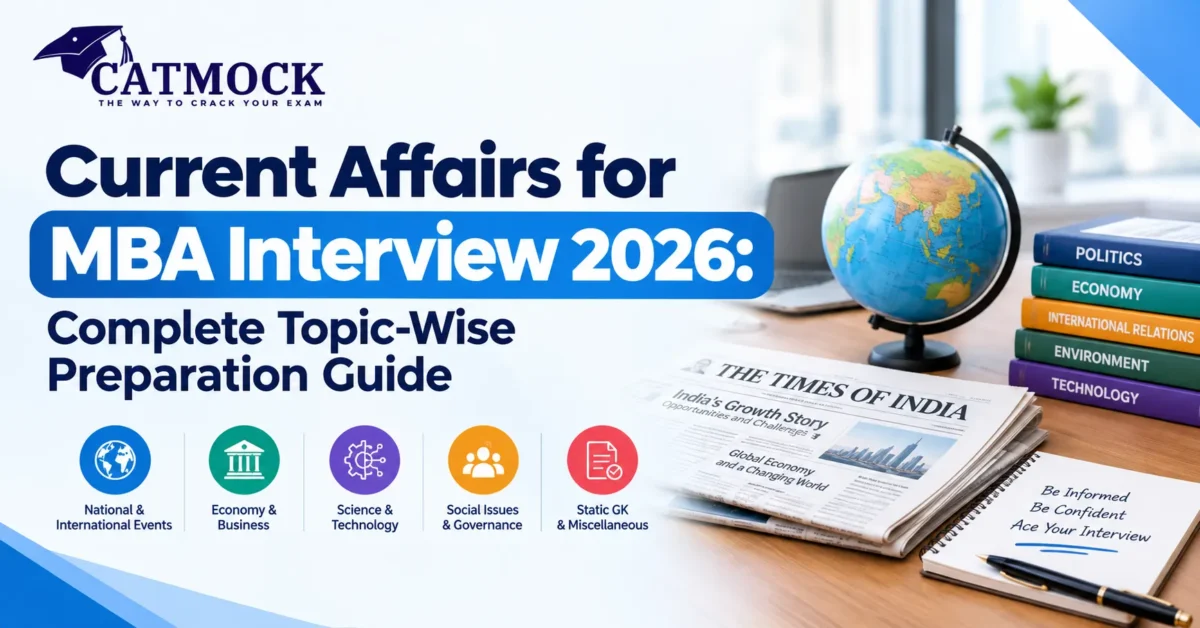
If your CAT, XAT, SNAP or CMAT WAT-PI call is round the corner, one question is probably keeping you up at night: “Am I reading enough news?” Current affairs for MBA interview 2026 isn’t about memorising 300 headlines — panels at IIMs and top B-schools use it to check whether you can think like a manager, not a newspaper. In most GD-PI-WAT rounds, close to 40-50% of questions connect directly or indirectly to what’s happening in the economy, business and the world around you.
This guide breaks down exactly what to prepare — the Indian economy, RBI policy, Union Budget 2026-27, GST reforms, business news, government schemes, and global affairs — along with a simple framework to answer any current affairs question with confidence, even one you’ve never seen before.
Why Current Affairs Matter in MBA GD-PI-WAT Rounds
Business schools aren’t testing you like a quiz show. An MBA interview panel wants to know if you can connect a headline to its business impact. Ask yourself: if the RBI changes the repo rate, what happens to your father’s home loan EMI, a bank’s profitability, and a startup’s funding round — all at once? That’s the kind of second-order thinking current affairs for MBA interview 2026 preparation is really testing.
Panels use current affairs to judge three things:
- Awareness — do you read beyond your syllabus and your feed?
- Analytical thinking — can you connect a policy change to its ripple effects on industry, consumers, and jobs?
- Communication — can you explain a complex event simply, without rambling or sounding rehearsed?
If you’re still finalising your target schools, our guide to Top government MBA colleges accepting CAT can help you shortlist the right institutes before planning your GD-PI-WAT preparation.
Practice smarter with these handpicked current affairs questions before your interview.
How MBA Panels Actually Test Current Affairs
Current affairs questions in an MBA interview rarely sound like “What is GST 2.0?” Instead, they sound like: “You mentioned you follow the stock market — how has the rupee’s fall this year affected import-heavy businesses?” The panel is less interested in the fact and more interested in your reasoning. A candidate who says “GDP growth is projected at 6.7% for FY27, largely because of stronger private consumption and government capital expenditure, though rural demand still needs support from a good monsoon” sounds far more prepared than one who just states the number.
Indian Economy and RBI Policy: What to Know for 2026
The economy section is the single most asked current affairs area in MBA interviews, because almost every business question eventually traces back to growth, inflation, or interest rates. Here’s where things stood heading into the second half of 2026, based on the Reserve Bank of India’s Monetary Policy Committee updates.
| Indicator | Latest Reading (2026) | Why It Matters for MBA Interviews |
|---|---|---|
| Repo Rate | Held at 5.25% (neutral stance, fourth consecutive pause) | Signals RBI’s balancing act between supporting growth and containing inflation |
| CPI Inflation | Around 4.3-4.4%, still inside the RBI’s 2-6% tolerance band | Link this to consumer spending power and input costs for businesses |
| GDP Growth (FY 2026-27 projection) | Revised to roughly 6.6-6.7% | Explains hiring trends, capex cycles and campus placement sentiment |
| Rupee & FII Flows | Rupee under pressure; notable foreign equity outflows earlier in 2026 | Connects to import costs, RBI’s forex measures and stock market volatility |
| Crude Oil Prices | Elevated due to Middle East tensions during parts of 2026 | Impacts inflation, logistics costs and India’s import bill |
A useful way to frame this in an interview: “Growth is holding up, but the RBI is watching inflation closely because of global supply shocks — so a rate cut looks unlikely in the near term.” That single sentence shows awareness, analysis and a clear opinion — exactly what current affairs for MBA interview 2026 prep should train you to produce on the spot. You can track the latest figures directly on the Reserve Bank of India’s official website.
Union Budget 2026-27: Key Highlights for GD-PI-WAT
The Union Budget is almost guaranteed to come up in some form — either directly (“What did you like about this year’s Budget?”) or indirectly through a sector-specific question. Finance Minister Nirmala Sitharaman presented her ninth consecutive Budget on 1 February 2026, built around the idea of “Yuva Shakti” — converting India’s young population into productive capacity through skilling and enterprise creation.
| Focus Area | Key Highlight | MBA Interview Angle |
|---|---|---|
| Manufacturing & Semiconductors | India Semiconductor Mission 2.0 and a ~₹40,000 crore Electronics Components Manufacturing Scheme | Ties into Atmanirbhar Bharat, import substitution and supply chain strategy |
| Capital Expenditure | Continued shift toward capex-led spending over revenue expenditure | Good example of the government-spending multiplier effect on GDP |
| Taxation | New Income-tax Act, 2025 came into force from 1 April 2026 | Useful for finance-focused candidates discussing compliance simplification |
| Trade | India-EU Free Trade Agreement marked as a major milestone | Strong talking point for exports, market access and FDI questions |
| Labour Reforms | Implementation push for the New Labour Codes | Connects to formalisation of jobs and ease of doing business |
| Healthcare & Services | Push to position India as a global medical tourism and services hub | Relevant for healthcare management and services-sector aspirants |
You can read the full Budget documents on the official Union Budget portal, and cross-check sector reactions through the Press Information Bureau for accurate, government-verified statements.
GST 2.0: The Reform Everyone’s Talking About
GST 2.0 has become one of the most popular GD and WAT topics of 2026, and for good reason — it directly affects consumers, small businesses and large manufacturers at once. The reform rationalised the tax slab structure with the aim of easing compliance for small businesses and boosting overall consumption. For an interview answer, don’t just describe the reform — mention one likely winner (consumer durables and FMCG, due to lower effective rates) and one open question (short-term revenue impact for states), because panels reward balanced answers over one-sided ones.
Business, Startups and Corporate Current Affairs 2026
Beyond macroeconomics, panels also expect you to know what’s happening in the business world — funding trends, major mergers, IPOs and sectoral shifts. A few themes that have stayed relevant through 2026:
- AI adoption across industries — from customer service automation to AI-assisted hiring and product development, with growing debate around job displacement versus productivity gains.
- EV and green mobility push — continued policy support for electric vehicles, charging infrastructure, and battery manufacturing under India’s clean-energy transition goals.
- Startup funding cycles — a more disciplined, profitability-first funding environment compared to the growth-at-all-costs years, with investors favouring sustainable unit economics.
- Digital finance and UPI’s global expansion — India’s digital payments infrastructure being adopted or studied by other countries, a frequently cited example of Indian innovation.
If you’re weighing which specialisation to build your current affairs reading around — finance, analytics, HR or general management — it’s worth first reading our comparison of MBA vs MSc career ROI, and if HR interests you, our TISS vs XLRI comparison covers how current affairs preparation differs slightly by specialisation focus.
Government Schemes and Policies MBA Aspirants Should Know
Interviewers often use government schemes to test whether you understand policy intent, not just scheme names. Keep your knowledge one level deeper than the name — know the objective and one criticism or challenge for each.
| Scheme / Policy | Core Objective | Good Interview Angle |
|---|---|---|
| Make in India / PLI Schemes | Boost domestic manufacturing and reduce import dependence | Discuss sectors like electronics, pharma and semiconductors |
| Digital India | Expand digital infrastructure and e-governance access | Link to UPI, DigiLocker and financial inclusion outcomes |
| Startup India | Ease compliance and funding access for new-age businesses | Connect to the shift toward profitability-focused funding |
| Skill India / Samarth Initiative | Improve employability through vocational and sector-specific skilling | Relevant for HR and operations-focused answers |
| Atmanirbhar Bharat | Strengthen domestic supply chains and self-reliance | Ties well with semiconductor and defence manufacturing news |
Global Affairs and Geopolitics for MBA Interviews
You don’t need to be a foreign policy expert, but you do need working knowledge of the events shaping global trade and markets in 2026:
- Russia-Ukraine conflict — the war has stretched into a prolonged phase, with periodic signals of possible negotiation, but continued global implications for energy prices and supply chains.
- Middle East tensions — periods of elevated crude oil prices in 2026 have been linked to instability in the region, directly affecting India’s import bill and inflation outlook.
- US-China trade tensions — ongoing tariff and trade-policy friction continues to influence global supply chain “friend-shoring” and gives India an opening to attract manufacturing investment.
- India-EU Free Trade Agreement — a significant 2026 milestone, expected to widen market access for Indian exporters, particularly in textiles, pharma and engineering goods.
The trick with global affairs questions is to always land the answer back in India: “Here’s the event, here’s the direct India connection, here’s a one-line implication.” That structure alone makes you sound far more prepared than someone reciting facts.
Technology, AI and the Digital Economy
Technology-linked current affairs for MBA interview 2026 preparation deserve special attention, because panels increasingly ask candidates to take a position — not just describe a technology. Expect questions around generative AI’s role in white-collar hiring, data privacy regulation, semiconductor self-reliance, and the balance between automation and employment. A safe, credible structure: acknowledge the productivity benefit, flag one genuine risk (job displacement, data privacy, algorithmic bias), and suggest a policy or business response. This shows nuanced thinking rather than a one-sided “AI is great” or “AI is scary” answer.
How to Answer Current Affairs Questions: The IOA Framework
Most candidates fumble current affairs answers not because they lack knowledge, but because they lack structure. Use this simple three-part framework — Issue, Opinion, Application — for almost any current affairs question:
- Issue: State the fact or event in one clear sentence, with a number or date if you know it.
- Opinion: Give a balanced, reasoned view — mention both a positive and a limitation where possible.
- Application: Connect it back to business, economy or your own field of interest — this is what makes an MBA-level answer instead of a general knowledge answer.
Practising with a timer under real pressure makes a bigger difference than passive reading. Our Daily Capsule and Daily Practice tools on CATMOCK are built exactly for this kind of short, focused current affairs and aptitude revision.
Sample MBA Interview Questions on Current Affairs (With Model Answer Approach)
| Sample Question | What the Panel Is Really Testing | Model Answer Approach (IOA) |
|---|---|---|
| Why did the RBI keep the repo rate unchanged in 2026? | Understanding of monetary policy trade-offs | State the rate and stance → explain the inflation-growth balancing act → link to loan EMIs or business borrowing costs |
| What is your view on GST 2.0? | Ability to form a balanced opinion on policy | Describe the rationalisation → mention consumer/business benefit → flag a short-term revenue trade-off for states |
| How does the Russia-Ukraine conflict affect the Indian economy? | Ability to connect global events to domestic impact | State the conflict’s current phase → link to crude oil and fertiliser prices → connect to India’s inflation and import bill |
| Should AI replace entry-level jobs in your field of interest? | Nuanced, non-extreme thinking | Acknowledge productivity gains → flag displacement risk for routine roles → suggest reskilling as the business response |
| What is one Budget 2026-27 announcement you found impactful, and why? | Genuine reading, not rote memorisation | Pick one specific measure (e.g., ISM 2.0) → explain its intent → connect to a sector or company you can discuss confidently |
30-Day Current Affairs Preparation Strategy for MBA Interviews
You don’t need to read five newspapers a day. A focused, consistent routine beats last-minute cramming every time.
- Week 1: Build a base — read a business daily for 20-30 minutes a day, focusing only on economy, budget and policy news. Maintain a simple notebook with the IOA structure for each story.
- Week 2: Add sector-specific reading based on your target specialisation (finance, marketing, operations, HR) and start following 2-3 credible business news sources consistently.
- Week 3: Practice mock GD-PI-WAT sessions with peers or mentors, forcing yourself to speak current affairs answers out loud within 60-90 seconds.
- Week 4: Revise your notes, focus on the 15-20 topics most likely to come up (economy, Budget, GST, one global conflict, AI, and your specialisation’s sector news), and do timed recall drills.
Think you’re ready? Try these current affairs questions before your MBA interview:
Quick Summary: Current Affairs for MBA Interview 2026
| Category | Must-Know Points |
|---|---|
| Economy | Repo rate at 5.25%, inflation near 4.3-4.4%, FY27 GDP growth projected around 6.6-6.7% |
| Budget | Union Budget 2026-27’s “Yuva Shakti” theme, ISM 2.0, capex push, new Income-tax Act |
| Tax Reform | GST 2.0 rate rationalisation and its consumer/business impact |
| Global | Russia-Ukraine conflict, Middle East tensions, US-China trade friction, India-EU FTA |
| Technology | AI adoption, semiconductor push, data privacy debate |
| Approach | Use the Issue-Opinion-Application framework for every answer |
Frequently Asked Questions (FAQs)
1. How much current affairs is really needed for MBA interviews in 2026?
You don’t need encyclopaedic knowledge. Focus on 15-20 well-understood topics — economy, Budget, GST, one global conflict, AI, and your specialisation’s sector — rather than skimming 100 headlines superficially.
2. Is current affairs more important than academic or work-experience questions?
No, it’s one part of a broader interview that also covers your academics, work experience and goals. But current affairs is often used as a tiebreaker to judge awareness and articulation, so it’s worth dedicated preparation.
3. Which sources should I follow for current affairs for MBA interview 2026?
Stick to one or two credible business dailies, the RBI and PIB websites for official data, and a consistent daily revision habit rather than jumping between many sources.
4. How do I answer a current affairs question I know nothing about?
Be honest about the gap, but attempt a reasoned guess based on related knowledge. Panels often value structured thinking over a lucky factual answer.
5. Are GD topics and interview current affairs topics the same?
They overlap heavily, but GD topics are usually broader and debate-style, while interview questions are more personalised and dig deeper into your specific opinion and reasoning.
6. How close to the interview date should I revise current affairs?
Do your deep reading at least 3-4 weeks before the interview, then spend the final week purely on revision and mock practice rather than learning new topics.
Conclusion
Current affairs for MBA interview 2026 isn’t a memory test — it’s a rehearsal for how you’ll think as a manager. The economy, Budget, GST reform, global conflicts and AI’s business impact will almost certainly come up in some form across your GD-PI-WAT rounds this year. Build your reading around the topics in this guide, practice the Issue-Opinion-Application framework until it feels natural, and focus on depth over breadth in your final weeks of preparation.
For more interview and admissions preparation, explore our detailed guides on ISB Hyderabad admissions, GMAT vs GRE 2026, and browse the complete CATMOCK blog for the latest CAT, XAT, SNAP and CMAT preparation resources.
You May Also Like : CAT MOCK, CAT MOCK PYQ
Follow Us On : Facebook, Instagram, Youtube